Comparing Chinese Operas to Western Ones

January 29, 2020

San Francisco Opera.com reports that Western Opera was born in Italy more than 400 years ago during the Renaissance. Western Opera is a combination of vocal and orchestral music, drama, visual arts and dance. An opera, like a play, is a dramatic form of theatre that includes scenery, props, and costumes. However, in opera, the actors are trained singers who sing their lines instead of speaking them.

How about China’s opera?

“Since the time of the Tang Dynasty’s Emperor Xuonzong from 712 to 755—who created the first national opera troupe called the ‘Pear Garden’—Chinese opera has been one of the most popular forms of entertainment in the country, but it actually started nearly a millennium before in the Yellow River Valley during the Qin Dynasty (221 to 206 BC).

“Now, more than a millennium after Xuanzong’s death, it is enjoyed by political leaders and commoners alike in many fascinating and innovative ways, and Chinese opera performers are still referred to as ‘Disciples of the Pear Garden,’ continuing to perform an astonishing 368 different forms of Chinese opera.” ꟷ Thought Co.

Not only is Chinese opera almost 1,900 years older than Western Opera, it is also culturally different.

For instance, China Highlights.com lists 7 differences: The first being “Western operas focus on powerful singing and emotional expression during the performances. The acting is self-explanatory, fluid, and life-like.

“In Beijing opera, as well as the more stylized singing, each performer’s actions are important ways to tell the story.

“The performance style is more of a rigid, symbolic visual show. For example, a performer will tie a horsewhip on their wrist and when they wave the horsewhip it means they are riding a horse.”


If you live in the United States, you do not have to travel to China to see a Chinese Opera.

“Chinese Opera, a product of Chinese tradition and innovation spanning many centuries, is at the core of traditional Chinese art. The Confucius Institute of Rutgers University (CIRU), since its establishment in 2007, has been committed to the preservation and promotion of this traditional Chinese art. For over a decade, CIRU has been hosting events and providing platforms to showcase the exquisiteness of Chinese opera. This documentary features several renowned Chinese Opera performers and their stories.” ꟷ Rutgers University

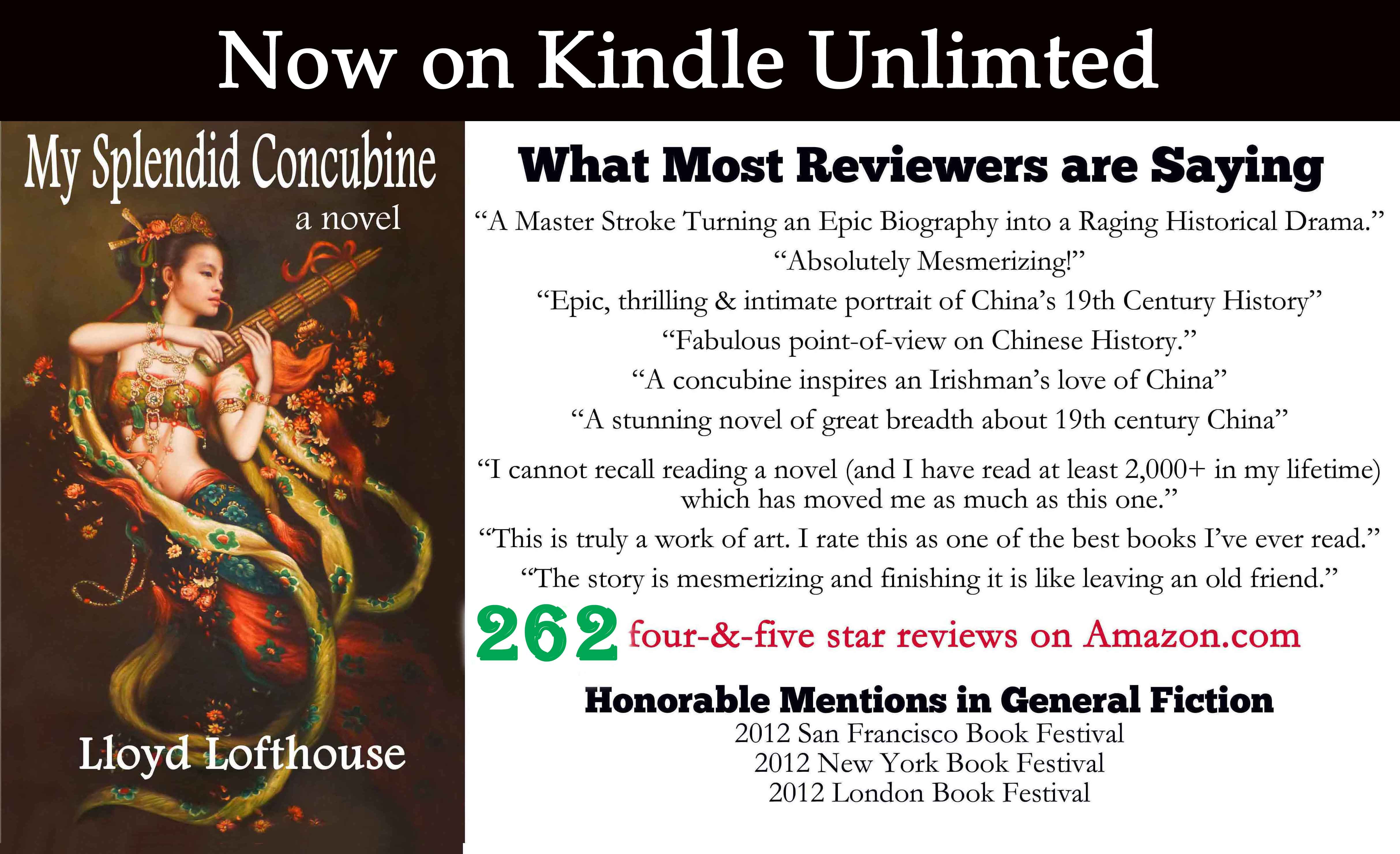
Lloyd Lofthouse is the award-winning author of My Splendid Concubine, Crazy is Normal, Running with the Enemy, and The Redemption of Don Juan Casanova.
Where to Buy

About iLook China


What is happening in Hong Kong is a collision of cultures and Christianity may be the catalyst

January 22, 2020

World Population on Review reports, “93.6% of Hong Kong’s population consists of ethnic Chinese. Most are Taishanese, Chiu Chow, other Cantonese people, and Hakka. Most Han people in Hong Kong are from the Taishan and Guangzhou regions. Of the non-ethnic Chinese in Hong Kong, many are South Asians — including Indians, Nepalese, and Pakistanis — as well as Vietnamese refugees. There are also many Canadians, Britons, Americans, Koreans, and Japanese working in the city.”

With almost 7.5 million people in Hong Kong, Christians account for 11-percent of the city’s population and most of them are Protestant. The primary language of Hong Kong is not Mandarin. It is Cantonese, a minority language in China. The city’s culture is broadly Cantonese and not Han. With 1.4 billion people in China, Cantonese is spoken by around 60-million (0.04 percent of China’s population).

World Population on Review continues: “When the British forces formally took over Hong Kong in 1841, the population was 7,541. A century later, the figure officially stood at 1,600,000. This figure fell to 500,000 in 1945, following the Battle of Hong Kong. However, ever since then, the population has steadily increased culminating in its current figure.”

What World Population on Review doesn’t reveal is how the British took over Hong Kong. The British along with the French and other colonial European Empires invaded China and started two Opium Wars to force the Chinese Emperor to allow the British to sell opium to the Chinese people. The British Empire needed money to survive and the sale of opium was an important revenue stream. The British also forced China’s Emperor to give them Hong Kong.

The British Empire ruled Hong Kong for 156 years (1841 – 1997) but not as a republic or democracy. See The History of Democracy in Hong Kong is so Short it Never Happened.

[youube=https://www.youtube.com/watch?v=aCCku0_tVD4]

As for Macau, only 7.2 percent of its population is Christian, and the Portuguese who ruled the city for 400 years made little effort to convert the Chinese population to their way of thinking and to adopt Christianity as their religion.

ABC.net.au, explains, “Why Macau hasn’t been swept up by Hong Kong’s pro-democracy protests? … As Hong Kong grapples with its 12th consecutive week of protests, we take a look at why Macau has often been seen as a success story for the ‘one country, two systems’ framework and what it means for the future of the world’s largest gambling hub. … Macau has generally been seen as the better-behaved special administrative region (SAR) under Chinese rule because of its largely conservative society, and as such, has remained at an arm’s length from the protests in Hong Kong.”

“Macau people,” also, “often turn to mainland China for identification, interpretations, and solutions to their own problems. And while Hong Kong in 2003 expressed strong opposition to a national security law known as Article 23 — which prohibited “treason, secession, sedition” against the Central Government — the same law was passed in Macau.”

NPR.org also reveals, “A Surprising Tie That Binds Hong Kong’s Protest Leaders: Faith … Many of the leaders are Christian, and some cite faith as an inspiration.”

“National surveys conducted in the early 21st century estimated that some 80% of the population of China, which is more than a billion people, practice some kind of Chinese folk religion; 10–16% are Buddhists; 10% are Taoist; 2.53% are Christians; and 0.4% are Muslims.”

China: 2.53-percent are Christians

Macau: 7.2-percent are Christians

Hong Kong: 11-percent are Christians (about 825,000)

Mark Juergensmeyer argues that “despite its central tenets of love and peace, Christianity—like most traditions—has always had a violent side. The bloody history of the tradition has provided disturbing images and violent conflict is vividly portrayed in the Bible. This history and these biblical images have provided the raw material for theologically justifying the violence of contemporary Christian groups.” ꟷ Christianity and violence

To help understand China’s culture, read Looking at China through a Single Lens

Lloyd Lofthouse is the award-winning author of My Splendid Concubine, Crazy is Normal, Running with the Enemy, and The Redemption of Don Juan Casanova.

Where to Buy

 > also offered on Kindle Unlimited <

About iLook China


Looking at China through a Cultural Lens – Part 2 of 2

January 15, 2020

What do Confucianism, Taoism, and Zen Buddhism have in common?

Buddhism and Taoism are peaceful religions that use meditation for peace of mind and enlightenment. Taoism originated in China in the sixth century B.C. It is also believed that Buddhism originated in the sixth century B.C. but in India. Both Taoism and Buddhism believe in reincarnation, life after death, and both have similar end goals. The goal of Taoism is to have a balanced life while Confucianism focuses on creating and maintaining harmony in society and avoiding conflict.

For instance, if an individual or group threatens harmony for everyone else, China’s leaders throughout history have often imprisoned or executed those individuals or groups threatening the tranquility of the majority of people.

A Cup of Tea (Zen poem)
Nan-in, a Japanese master during the Meiji era (1868-1912), received a university professor who came to inquire about Zen.
Nan-in served tea. He poured his visitor’s cup full, and then kept on pouring.
The professor watched the overflow until he no longer could restrain himself. “It is overfull. No more will go in!”
“Like this cup,” Nan-in said, “you are full of your own opinions and speculations. How can I show you Zen unless you first empty your cup?”
101 Zen Stories

Zen-like Taoism focuses on staying in the present without judging anything or anyone.

However, it isn’t easy for Christians, Jews, or Muslims to do the same thing. Instead, the members of these religions often judge just about everything and everyone leading to many wars and lost lives.

Wars in China have seldom if ever been started by people that practice the philosophies of Zen Buddhism, Taoism, or Confucianism.

Return to or start with Part 1

Lloyd Lofthouse is the award-winning author of My Splendid Concubine, Crazy is Normal, Running with the Enemy, and The Redemption of Don Juan Casanova.

Where to Buy

About iLook China


Looking at China through a Cultural Lens – Part 1 of 2

January 8, 2020

“Taoism (also known as Daoism) is a Chinese philosophy attributed to Lao Tzu (c. 500 BCE) that contributed to the folk religion of the people primarily in the rural areas of China and became the official religion of the country under the Tang Dynasty. Taoism is therefore both a philosophy and a religion.”  ꟷ Ancient History Encyclopedia

“Unlike Buddhism (that originated in India and reached China to become popular), Taoism arose from the observations and beliefs of the Chinese people. The principles of Taoism impacted Chinese culture greatly because it came from the people and was a natural expression of the way the Chinese (working class) understood the universe.”


Buddhist Parable on the True Nature of Human Existence

Buddha Weekly says, “The Daoist tradition was already present in China when Buddhism first entered the country over the border from neighboring India around the 3rd Century BCE. The two religions (Taoism and Buddhism) came to heavily influence each other in China, and this Daoist influence on Buddhism — after the two started to interact with one another — helped shape history and philosophical belief in the region for centuries.”

“Taoism has been one of the most influential philosophies and religions during the past 2,500 years in China, and it affects every aspect of Chinese life, including leisure.” ꟷ World Leisure Journal

The BBC reports, “Zen Buddhism is a mixture of Indian Mahayana Buddhism and Taoism. It began in China, spread to Korea and Japan, and became very popular in the West from the mid 20th century. The essence of Zen is attempting to understand the meaning of life directly, without being misled by logical thought or language. … If you’re a westerner you may find it hard to shake off the intellectual and dualist ways of thinking that dominate western culture: this can make it difficult for westerners to come to Zen.”

Part 2 will be posted on January 15, 2020

Lloyd Lofthouse is the award-winning author of My Splendid Concubine, Crazy is Normal, Running with the Enemy, and The Redemption of Don Juan Casanova.

Where to Buy

About iLook China


Frozen in China but the sky is Blue

January 1, 2020

Tourism is an important industry in China and if you prefer colder weather, like me, the place to go for winter fun is Harbin.

CNN Travel reports, “China has invested heavily in bringing commercial and tourist traffic to more remote regions of the country. ……… The city of Harbin hosts the annual Harbin International Ice and Snow Sculpture Festival, the biggest of its kind in the world. Every winter, visitors come from across China and the world to see the mammoth creations, which this year included a Buddha statue made from 4,500 square cubic meters of snow, and a 3-D light show reflected against the ice for dramatic effect.”

The festival originated in 1963. … In 2001, the Harbin Ice Festival was merged with Heilongjiang’s International Ski Festival and got a new formal name, the Harbin International Ice and Snow Sculpture Festival.


Sneak Preview of Harbin Snow and Ice World 2020

“More than 100 activities and events will be held in Harbin … The activities and events fall into several categories, namely ice and snow tourism, ice and snow culture, ice and snow fashion culture, ice and snow trade, and ice & snow sports.” ꟷ Ice Festival Harbin.com

The Atlantic reports that more than a million tourists visit Harbin to see the massive ice and snow sculptures.

China Daily.com reports, “The festival officially starts in January 5th every year, but the locals begin to celebrate the festival in the third week of December of the previous year because most of the ice lanterns, ice and snow sculptures are completed by this time. Depending on the weather conditions and activities, the festival usually last until the end of February.”

As of 2015, China is the fourth most visited country in the world, after France, the United States, and Spain, with almost 57 million international tourists per year. In 2017, tourism resulted in revenue of about USD 1.35 trillion, 11.04% of the GDP, and contributed to direct and indirect employment for more than 28-million Chinese.

The Chinese also like to travel outside of China. According to The Telegraph, in 2018, almost 150 million Chinese visited other countries. But domestic tourism adds up to almost 5.5 billion trips annually.

Lloyd Lofthouse is the award-winning author of My Splendid Concubine, Crazy is Normal, Running with the Enemy, and The Redemption of Don Juan Casanova.

Where to Buy

About iLook China