Remote Southwest China

March 4, 2020

Far from the Great Wall and the Grand Canal are the remote villages and towns of Southwest China.

Post Magazine reports, “Historically, this area, which spans the provinces of Guangxi, Guizhou, and Yunnan, was a hotbed of ethnic insurrection and separatist movements. The region proved so difficult to pacify that the Chinese have long dubbed it ‘the land of a hundred barbarians’ and even today, ethnic minorities, as well as local Han, eke out lives as removed from mainstream affairs as one can be in today’s China.”

While I have never visited Southwest China, a few years ago when my daughter was a student at Stanford University, she volunteered to travel to this area with a nonprofit that provided heart-related health care for poor children. The closest I came was when we flew to Southeast China and visited the Dragon’s Back and cruised along the Li River.

Southwest China is also where Pu’erh tea originated, and the beginning of the Tea Horse Road to Tibet.

In 225 A.D., when China was divided into the three kingdoms of Wei, Shu, and Wu, the prime minister of Shu led a military expedition to Yunnan. Historical records say that many of the Shu troops came down with eye diseases.  After they drank boiled Pu’erh tea, the troops recovered.

Wild China reports, “Deep in the heart of Southern Yunnan there exist tea trees unlike any other on Earth. The jungles of Xishuangbanna Dai Autonomous Prefecture and the districts of Simao and Lincang are home to the oldest tea trees in the world. In these regions grow tea trees that range in age from several centuries to over a millennium, and the tea that is made from their leaves is called Pu’er.

“Over the past 30 to 50 years, however, the number of these ancient trees has steadily decreased. Since China’s reform and opening-up policies were implemented in 1978, the Chinese tea industry has grown rapidly.” …

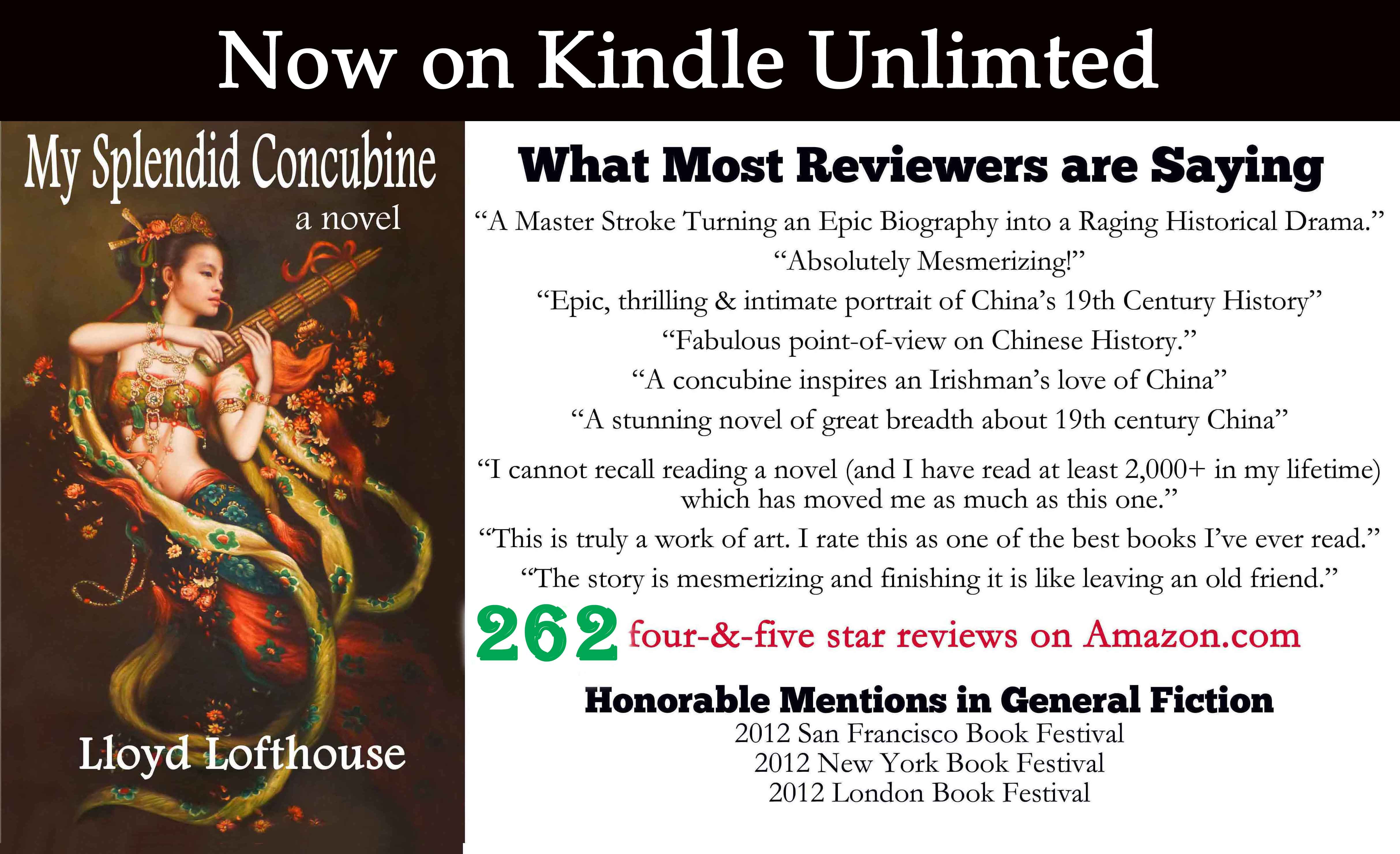
Lloyd Lofthouse is the award-winning author of My Splendid Concubine, Crazy is Normal, Running with the Enemy, and The Redemption of Don Juan Casanova.
Where to Buy

About iLook China


What are Trees Good for

February 26, 2020

Trees are vital. As the biggest plants on the planet, they give us oxygen, store carbon, stabilize the soil and give life to the world’s wildlife. They also provide us with the materials for tools and shelter.

The UN’s 2006 Billion Tree Campaign was inspired by Nobel Peace Prize Laureate Wangari Maathai, founder of the Green Belt Movement. When an executive in the United States told Professor Maathai their corporation was planning to plant a million trees, her response was: “That’s great, but what we really need is to plant a billion trees.” The campaign was carried out under the patronage of Prince Albert II of Monaco.

As of November 2019, 13 years since the campaign’s launch, its website The Trillion Tree Campaign registered over 13.6 billion trees planted across 193 countries.

China planted 2.8 billion of those trees, after already planting 63.2 billion before 2006. India was in 2nd place with 2.5 billion trees and Ethiopia was third with 1.7 billion. The United States, a distant 12th place, only planted 315 million.

While China has been planting trees for “the past 40 years, the Earth has lost a third of its arable land to erosion and degradation.” – National Geographic

You might ask, “What is arable land?” Arable land is any land capable of being plowed and used to grow crops. That means in the last 40 years, our planet has lost thirty-three percent of the land capable of growing the food we need to keep from starving and dying off.

National Geographic reports, “in 1978, the Chinese government implemented the Three-North Shelterbelt Project, a national ecological engineering effort that called for the planting of millions of trees along the 2,800-mile border of northern China’s encroaching desert, while increasing the world’s forest by 10 percent. Also known as the ‘Great Green Wall,’ the project’s end date isn’t until 2050; so far, more than 66 billion trees have been planted.” …

“Beyond the Great Green Wall, China has taken other measures against encroaching deserts. A series of laws starting in the early 2000s also targeted the problem, including efforts to return some farm and grazing lands to a more natural state of forests or grasslands.”

Since China’s Great Green Wall is being planted in an arid desert without enough water, Chinese engineers are planning to build a 1,000km tunnel, the longest in the world, to carry 10 – 15 billion tonnes of water each year from the Yarlung Tsangpo River to the Taklimakan Desert in the north.

“The proposed tunnel, which would drop down from the world’s highest plateau in multiple sections connected by waterfalls, would ‘turn Xinjiang into California”, one geotechnical engineer said.” – South China Morning Post

China currently leads the world in planting trees, photovoltaic solar power use, the most wind energy produced, the most hydroelectric power, and Lithium-Ion battery production. Ancient China also built The Great Wall (13,170 miles long) and the longest canal in the world.

Lloyd Lofthouse is the award-winning author of My Splendid Concubine, Crazy is Normal, Running with the Enemy, and The Redemption of Don Juan Casanova.

Where to Buy

About iLook China


China’s fifty-six Recognized Ethnic Groups

February 19, 2020

By 1979, the People’s Republic of China (PRC) had recognized 56 ethnic groups. The largest is the Han Chinese with 91.51-percent of the population. China’s population was 1.435 billion in November 2019. The largest, the Han numbered 1.313 billion. That left 122 million for the other 55 recognized ethnic groups.

The two minority groups in China the world hears about the most are the Tibetans (almost 6.3 million) and the Uyghurs with a bit more than 10 million. But what about the others 53? For instance, the largest minority group is the Zhuang people and most of them live in China’s Guangxi Zhuang Autonomous Region.

Since most of the minorities do not have large populations, not all of the 55 minority groups have their own autonomous zone. There are five autonomous zones in China: in Guangxi (population 46 million), Inner Mongolia (24.7 million), Tibet (3 million), Xinjiang (almost 22 million), and Ningxia (almost 6.2 million).

The PRC also has programs to improve the quality of life in each autonomous zone. For instance, in 1950, the average lifespan of Tibetans was age 35.5. Today, life expectancy in Tibet is 68.2 years and still improving. That’s almost twice what it was when China’s long civil war finally came to an end.

China.org.cn reports, “In China regional autonomy for ethnic minorities is a basic policy adopted by the Chinese government in line with the actual conditions of China, and also an important part of the political system of China. Regional autonomy for ethnic minorities means that under the unified leadership of the state regional autonomy is practiced in areas where people of ethnic minorities live in concentrated communities; in these areas organs of self-government are established for the exercise of autonomy and for people of ethnic minorities to become masters of their own areas and manage the internal affairs of their own regions. …”

The United Nations Human Rights Office of the High Commissioner reports, “The economy in five autonomous regions (Inner Mongolia, Guangxi, Tibet, Ningxia and Xinjiang) and three multi-ethnic provinces (Guizhou, Yunnan and Qinghai) had made significant progress and people’s living standards continued to rise: the population living in poverty went down from 31 million in 2012 to 10 million, and the poverty rate dropped from 34 per cent to six per cent.” …

However, “NICOLÁS MARUGÁN, Committee Rapporteur for China, asked China to provide written information on the allegations of torture and on the intentions concerning the establishment of an independent mechanism for the investigation of allegations of torture and deaths in custody in Tibet and in Xinjiang Uyghur Autonomous Region.” …

Meanwhile, the 30,875 reindeer herders of China’s small Ewenki ethnic minority in Northern China is struggling to keep their centuries-old traditions alive.

Lloyd Lofthouse is the award-winning author of My Splendid Concubine, Crazy is Normal, Running with the Enemy, and The Redemption of Don Juan Casanova.

ADD IMAGE

Where to Buy

About iLook China


It takes Faith to believe in something Science cannot explain

February 12, 2020

It takes faith to believe in God because there is no hard evidence that He exists. Belief in astrology also takes faith. Berkeley.Edu’s Understanding Science reports, “Although astrologers seek to explain the natural world, they don’t usually attempt to critically evaluate whether those explanations are valid — and this is a key part of science.”

Astrology: East vs West

In the East, the Chinese Zodiac, known as Sheng Xiao, is based on a twelve-year cycle, each year in that cycle relates to an animal sign. These signs are the rat, ox, tiger, rabbit, dragon, snake, horse, sheep, monkey, rooster, dog and pig, and first appeared in the Zhan Guo period [5th century B.C.].

The Chinese zodiac was officially identified during the Han Dynasty [206 B.C.–9 A.D.]. “The zodiac was based on Chinese astrology and was used as a way to count years, months, days, and hours in the calendar. It was formed from two components: the Celestial Stem and the Terrestrial Branch. Each of the 12 animals stands for a year in a 12-year cycle, a day in a 12-day cycle, and for every two hours in a 24-hour day. These were used to name each year along with the animal signs, but now they mainly just use the dates.” – The Chinese Zodiac Washington.edu

My Chinese Zodiac Sign is the Rooster.

As a Rooster, it is alleged that I am “foresighted, ambitious, meticulous, and independent. The Rooster is the representative of confidence and intelligence. People who are born in the Years of the Rooster usually share lots of common personality traits such as being responsive, distinctive, smart, and earnest.”

In the West, the twelve astrological signs are Aries, Taurus, Gemini, Cancer, Leo, Virgo, Libra, Scorpio, Sagittarius, Capricorn, Aquarius and Pisces. These signs are based on the twelve 30° sectors of the ecliptic, starting at the vernal equinox (one of the intersections of the ecliptic with the celestial equator), also known as the First Point of Aries.

Alexander the Great [356 BC – 323 BC] is attributed with the spread of astrology to Egypt and India. He is known to have consulted astrologers and to have them counted among his entourage during his campaigns. Alexander is responsible for the cross-fertilization of Greek, Persian, Mesopotamian and Indian astrologies. He founded the city of Alexandria to become the ancient world’s center of learning and housed, among many things, the astrological knowledge of antiquity.

Popular astrology could be said to have had its beginnings in ancient Rome. The early Roman astrologers were commonly referred to as Chaldeans, as it was the Chaldeans coming into the Empire that promoted and practiced the art. Astrology immediately appealed to the general public and the priests and intellectuals alike. – Astrology House.com

Western astrology says I am a LEO.

It is alleged that “those born under the Western Zodiac sign of Leo have much to say about everything. Leos are strong, confident, and majestic. They are highly social individuals who are often heavily involved in pursuits that interest them.”

Lloyd Lofthouse is the award-winning author of My Splendid Concubine, Crazy is Normal, Running with the Enemy, and The Redemption of Don Juan Casanova.

Where to Buy

About iLook China


2020 is the Year of the Rat

February 5, 2020

China’s Lunar New Year officially started several days ago on January 24th and ended yesterday on February 4, 2020.

Webexhibs.org reports, “The beginnings of the Chinese calendar can be traced back to the 14th century B.C.E. Legend has it that the Emperor Huangdi invented the calendar in 2637 B.C.E. The Chinese calendar is based on exact astronomical observations of the longitude of the sun and the phases of the moon.”

But centuries passed before the Han Dynasty (206 BC – 220 AD) modernized the calendar and made it official. The first lunar calendar used 10 months with 36 days each, as calculated through observation of the night sky. “It didn’t take long, however, for them to make the switch to a lunisolar 12-month calendar – a system they stuck to ever since.” – Military Time Chart.com

The Han Dynasty was one of the longest of China’s major dynasties. In terms of power and prestige, the Han Dynasty in the East rivaled its almost contemporary Roman Empire in the West.

SupChina.com says, “One of the greatest joys of celebrating the new lunar year is the feast on the eve of the holiday. In Chinese culture specifically, superstitions intertwine with food to bring about special dishes intended to bring good luck. Auspicious meanings are represented by a food’s appearance or pronunciation, and common homophones include words for prosperity, success, and family togetherness. …

“A whole fish is a staple for New Year celebrations in China and is intended to welcome prosperity for the entire year. …

“Dumplings represent wealth because of their close appearance to Chinese gold ingots, which are oval, boat-shaped hunks of gold used as currency in imperial China. …

“A whole chicken is usually served to represent family togetherness. …

“Spring rolls … are also a traditional food of the Lunar New Year. … Like dumplings, spring roll filling can be made based on personal preference. …

“Exceptionally long noodles … represent a long, long life. It’s customary to slurp down the noodle without chewing so that the strands aren’t severed. …

“The star dessert is glutinous rice cake … the word for cake sounds like the word for ‘tall,’ or ‘to grow,’ so eating glutinous rice on Lunar New Year symbolizes growth, whether it be in career, income, health, or even height. …

“Following the circular concept, certain round fruits are eaten during Lunar New Year to encourage family unity. Oranges and tangerines are especially popular because their golden color is believed to attract wealth … ”


But this year, the BBC reports that Beijing has canceled Chinese New Year celebrations in some provinces to control the spread of the dangerous new coronavirus.

Lloyd Lofthouse is the award-winning author of My Splendid Concubine, Crazy is Normal, Running with the Enemy, and The Redemption of Don Juan Casanova.

ADD IMAGE

Where to Buy

About iLook China