China’s Transition Years – Discovering History through Film

July 18, 2017

Farewell, My Concubine covers more than 50-years of Chinese history from 1924 – 1977.

In 1924, prostitute Yanhong sees no other alternative than leaving her son Douzi at a training school for Chinese opera where the boys are beaten, and tortured for forgetting their lines. The only escape is suicide. China’s decades long Civil War between the Communists and Nationalist rages on and then Japan invades China in 1937 and the challenges to survive become worse. After World War II, the Chinese Civil War continues and doesn’t end until 1949.

Two of the boys at the training school, Douzi and Shitou, become friends destined to be great actors, and they impress audiences by performing together. Through the years, with the political situation in China ever changing and not always for the good, Shitou and Douzi remain close.

Chen Kaige, self-trained as a filmmaker, was the director for this award-winning 1993 film. Prior to “Farewell, My Concubine”, Chen received modest acclaim for the “Yellow Earth” and “The Big Parade”. With “Farewell, My Concubine,” he won the Palme d-or in Cannes.

Although the film is in Mandarin with English subtitles, the story captured me from the beginning. If you are interested in Chinese history, this film spans several decades beginning soon after the end of the Qing Dynasty. On the surface, it is a story of two boys that happen to become famous, but they have difficulties and challenges like most of us do. However, the film takes us from the Qing Dynasty to a warlord dominated, struggling republic, the Japanese invasion of World War II, and through Mao’s Cultural Revolution.

I saw this movie more than a decade ago and I remember this powerful, dramatic story of one man’s life from the day his mother took a knife and chopped off an extra finger on each hand so he would have five instead of the six he was born with.

Discover Anna May Wong, the American actress who died a thousand times.

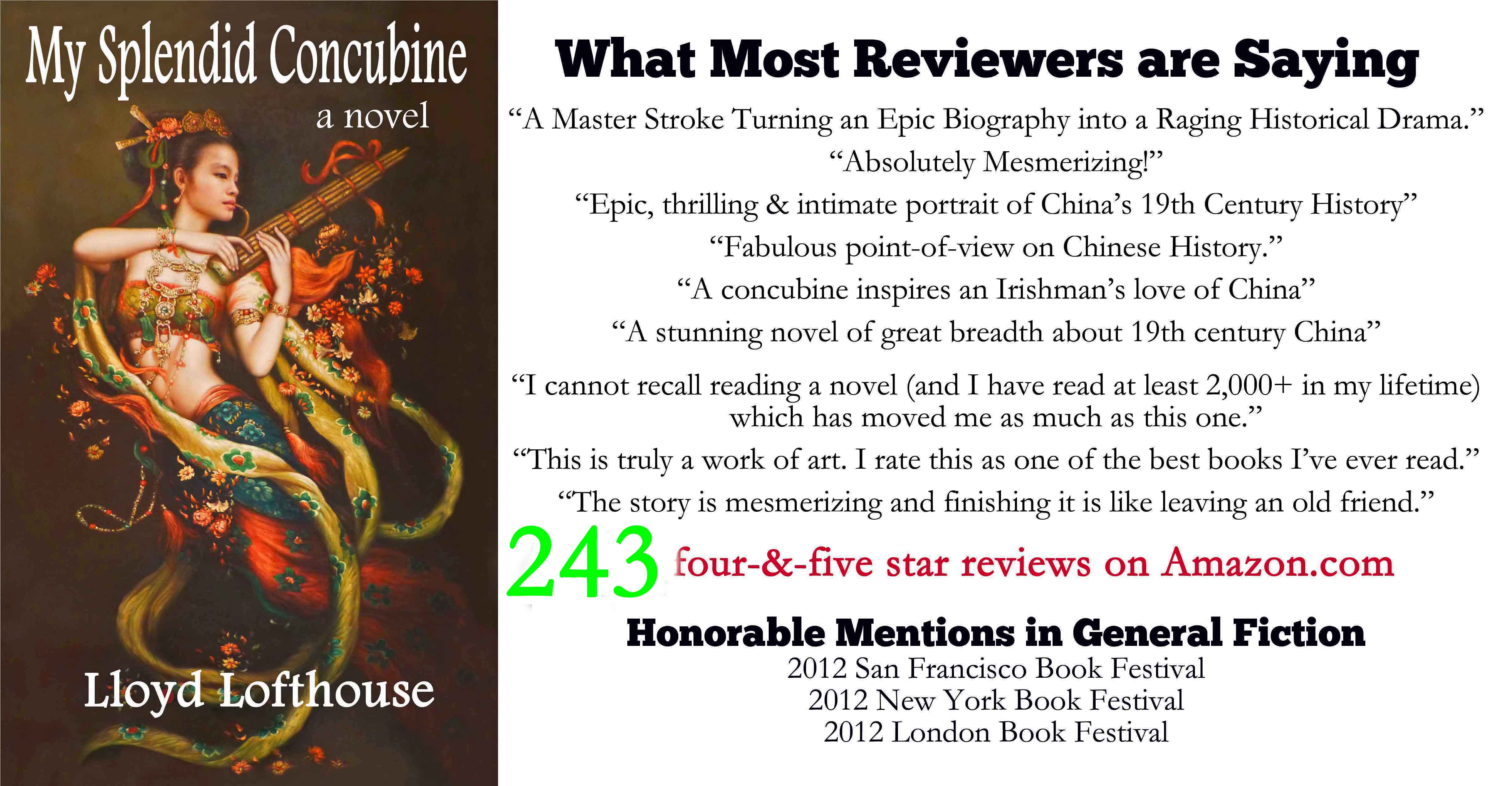
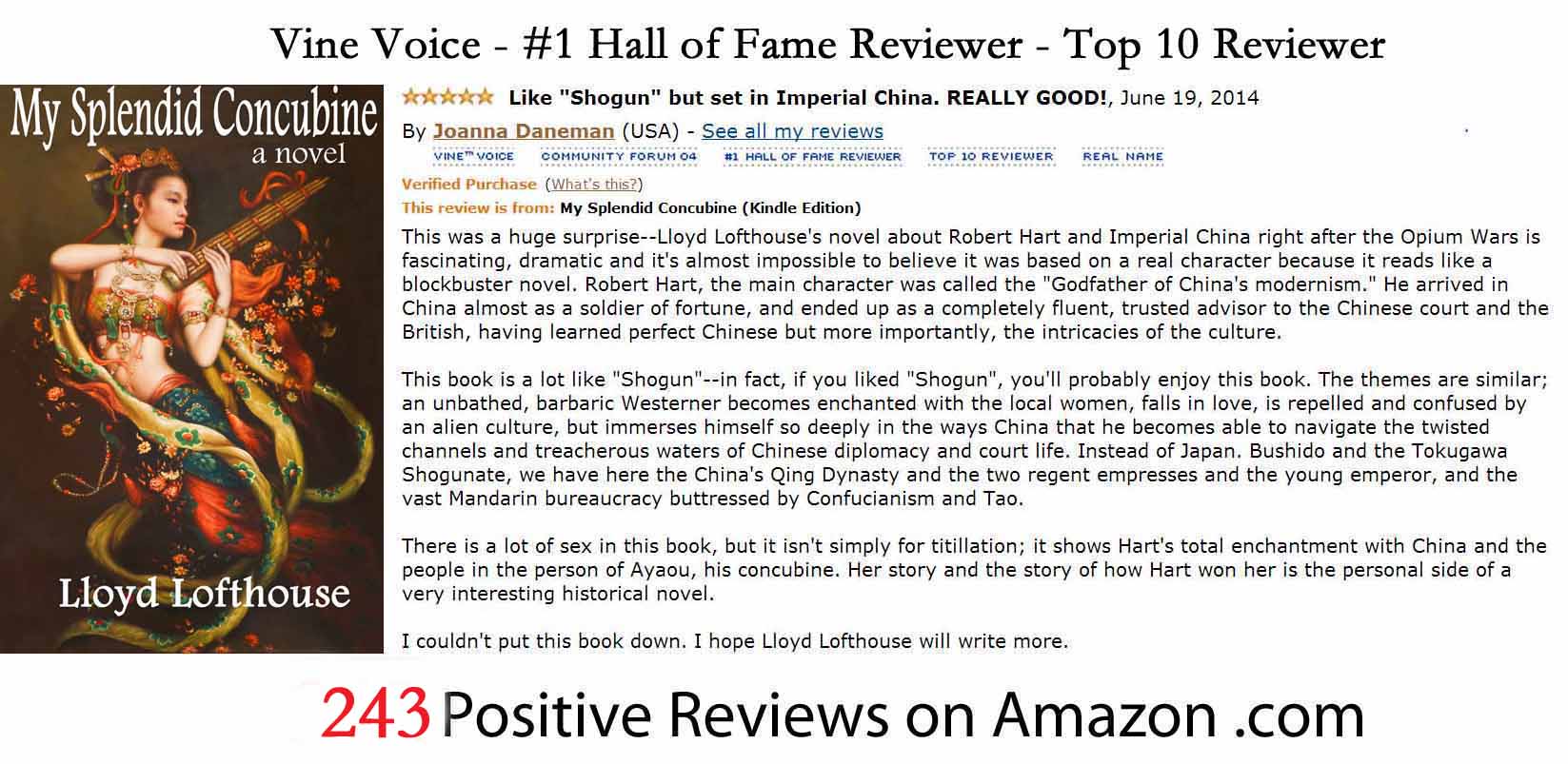
Lloyd Lofthouse is the award-winning author of My Splendid Concubine, Crazy is Normal, Running with the Enemy, and The Redemption of Don Juan Casanova.
Where to Buy

Subscribe to my newsletter to hear about new releases and get a free copy of my award-winning, historical fiction short story “A Night at the Well of Purity”.

About iLook China

China’s Holistic Historical Timeline


Discovering Mao’s Cultural Revolution through Books and Film

July 12, 2017

I read Balzac and the Little Chinese Seamstress by Dai Sijie soon after its English translation came out in 2002.  A few years later in 2005, we drove about sixty miles to see the Mandarin language film with English subtitles. Checking Amazon recently, I saw 344 customer reviews with an average of 4.2 out of 5 stars for the novel. The film had a 4.5 average.

This short novel spent twenty-three weeks on the New York Times best-seller list. The author, born in China, moved to France where he learned to read, speak, and write French. The book was originally written in French and translated into English by Ina Rilke.

The story is about two likable, teenage boys and their struggle after being banished to a peasant village for “re-education” during Mao’s Cultural Revolution. Sons of doctors and dentists, the boys work at muscling buckets of excrement up the mountainside and mining coal. Then there is the little seamstress of the title, whom Luo, one of the boys, falls in love with. He dreams of transforming the seamstress from a simple country girl into a sophisticated lover. He succeeds beyond his expectations, but the result is not what he expected.

Discover more about Mao’s Cultural Revolution in China through Joan Chen’s film Xiu Xiu: The Sent Down Girl and Anchee Min’s memoir Red Azalea. Joan Chen’s film earned high marks on Rotten Tomatoes from both critics and the audience.  Min’s Red Azalea was a national bestseller. The Vogue Review said, “”The book sings. It is a small masterpiece. . . [No one] has written more honestly and poignantly than Anchee Min about the desert of solitude and human alienation at the center of the Chinese Communist revolution.”  The New York Times called it “[An] extraordinary story. . . . This memoir of sexual freedom is [both] a powerful political as well as literary statement.” And the Miami Herald said Min’s memoir was “Brave and heartbreaking.”

The best way to learn about the Mao era in Chinese history is to read it from those who were there and lived through it; not from some foreigner that wasn’t there and/or has never been to China.

Discover Wu Zetian, China’s only female emperor

Lloyd Lofthouse is the award-winning author of My Splendid Concubine, Crazy is Normal, Running with the Enemy, and The Redemption of Don Juan Casanova.

Where to Buy

Subscribe to my newsletter to hear about new releases and get a free copy of my award-winning, historical fiction short story “A Night at the Well of Purity”.

About iLook China

China’s Holistic Historical Timeline


With High Stakes Tests Comes Cheating

July 4, 2017

I guess I’m naïve, stupid, or something else. During the nine years I attended colleges and universities to earn my BA in journalism and MFA in writing, I did my own work. It didn’t occur to me that I could pay someone else to do it for me. It wouldn’t have mattered anyway. I didn’t have the money to pay to cheat.

And when I read, “Rampant cheating hurts China’s research ambitions” (from Yahoo news), I was disappointed at the lack of balance. There was no mention that cheating is a global problem. But cheating on exams didn’t start in Communist China. For instance, the South China Morning Post reported about a tiny book that was used for centuries by Chinese students to cheat on civil service exams.

I taught journalism and was an adviser for an award winning high-school newspaper for several years, and the student reporters learned to write balanced pieces, even for the opinion page. I said that both sides of an issue should be heard even if the balance isn’t perfect and one side is not politically correct.

Since Yahoo is or was an American company (I read recently that Yahoo was sold to another company), I’m going to start with cheating in America to correct this imbalance. It’s worth noting that since student test results are being used and abused in America’s k-12 public schools to rank teachers and schools and then fire or close them, the odds are that someone who was once honest will cheat to survive. Imagine punishing a child’s teacher for the results of a test the child took. This is insanity, and it is a crime. No other country in the world, even China, uses student tests to rank-and-fire teachers and close public schools.

Lawyers.com reports, “In a 2005 research study, 75 percent of (U.S.) students admitted to cheating in school; 90 percent admitted to copying another student’s test paper or homework. A 2009 study of 2,000 middle and high school students showed 35 percent of them used cell phones to cheat and 52 percent used the internet to cheat.”

But Chinese and U.S. students aren’t the only ones that cheat. The Conversation.com says, “Students at a medical college in Thailand have been caught using spy cameras linked to smartwatches to cheat during exams. They used wireless spycams in eyeglasses to capture exam questions, transmit them to associates elsewhere and receive responses through linked smartwatches.”

CBS News reported that Indian parents scale school walls to help students cheat on exams.

In addition, there was this about cheating in the UK. The Telegraph says, “Invisible ink revealed as the latest university exam scam.”

News24 reports “Cheating students on the rise … Johannesburg (South Africa) – A survey has found that universities are battling a rising tide of cheating by students who brazenly take the easy route to a qualification, reports the Sunday Times.”

And just to make a point, I decided to include South America. Peru This Week.com says,”Imposters arrested for cheating on teachers’ exams in Peru.”  All I did was Google the same question, “Cheating on school exams (name of country)” and changed the name of the country each time.

Discover The Return of Confucious

Lloyd Lofthouse is the award-winning author of My Splendid Concubine, Crazy is Normal, Running with the Enemy, and The Redemption of Don Juan Casanova.

Where to Buy

Subscribe to my newsletter to hear about new releases and get a free copy of my award-winning, historical fiction short story “A Night at the Well of Purity”.

About iLook China

China’s Holistic Historical Timeline


Marco Polo wrote, “It is without a doubt the finest and most splendid city in the world.”

June 21, 2017

Huangzhou is considered one of the most beautiful cities in China. In 1127, the Song Dynasty made the city their capital after losing northern China to the Jin Dynasty.

“Spring Day on West Lake” by Ouyang Xiu (1007 – 1072 AD)

“The lovely Spring breeze has come
Back to the Lake of the West
The Spring waters are so clear and
Green they might be freshly painted.
The clouds of perfume are sweeter
Than can be imagined. In the
Gentle East wind the petals
Fall like grains of rice.”

Translated by Kenneth Rexroth, One Hundred Poems from the Chinese

The city of Huangzhou (developed in the 4th and 5th centuries CE) is about a hundred miles or 161 kilometers from Shanghai. I’ve visited this city several times. My last trip was in 2008.

The city has one of the largest bike sharing projects in the world and one of the most successful. Launched in 2008, the city of Huangzhou provides 50,000 free bicycles at 2,000 bike stops across the city, and in July 2012 a paper was published on the Clean Air Action Planning in Chinese Cities: Hangzhou and Jinan Cases.

Li Zhi Hong of Hangzhou Public Transport says the city wanted to encourage citizens to leave their cars and use more public transportation. The bicycles allowed people to take that final kilometer from the bus station to their destination.

The bikes are also great for tourism.

Hangzhou’s architecture and gardens are renowned, and it is situated among hills and valleys in which some of the most famous monasteries in China are located.

Huangzhou, also known as the Westlake, has been one of the more environmentally conscious cities in China. For instance, the city’s government made space to build parks alongside the rapid development and modernization. That’s why Huangzhou has remained picturesque unlike many other cities in China where concrete has taken over.

Lloyd Lofthouse is the award-winning author of My Splendid Concubine, Crazy is Normal, Running with the Enemy, and The Redemption of Don Juan Casanova.

Where to Buy

Subscribe to my newsletter to hear about new releases and get a free copy of my award-winning, historical fiction short story “A Night at the Well of Purity”.

About iLook China

China’s Holistic Historical Timeline


Meet the Last Empress-Regent of China

June 20, 2017

The Last Emperor of China was Pu-Yi, but he never had the power of an emperor. Pu-Yi was born in 1906 and became emperor in 1908 when he was two-years old. His Empress was Wanrong and she was also born in 1906.  Pu-Yi married Wanrong in 1922 when they were both 16, ten years after the end of the Qing Dynasty. Wanrong might have technically been the last empress of China but she never had the power of one.

The real Last Empress of China was the Empress Dowager Tzu Hsi (Cixi). She ruled the Qing Dynasty as a coregent after her husband, the Xianfeng Emperor died in 1861, because her son, The Tongzhi Emperor (1856 – 1875), was too young to rule.

Tzu Hsi was the last empress to rule China as a regent. Pu-Yi was in a branch of the Manchu Aisin Gioro clan with close ties to Empress Dowager Cixi, who was from the Manchu Yehenara clan.

Sterling Seagrave, the author of Dragon Lady, wrote, “Absurdly little was known about her (Cixi) life. The New York Times printed a long, error-filled obituary calling her Tzu An, the title of her coregent, who had died twenty-seven years earlier.”

Many current history texts have slandered the Dowager Empress Tzu Hsi (1835 – 1908) without much evidence as one of history’s most monstrous women, a ruthless Manchu concubine who seduced and allegedly murdered her way to the throne in 1861 to rule China through perversion, corruption, and intrigue.

She was even accused of murdering her son and then years later her nephew, who died the day before she did.

Instead, the evidence suggests her son died of syphilis because it was alleged he preferred prostitutes to the hundreds of concubines that were his property, young virgins that were selected for their beauty.

The allegations that Tzu Hsi was a monster was started by Edmund Backhouse, a reporter working in China for The London Times. His lies and deceit wouldn’t be discovered until Sterling Seagrave was doing research for his book about Tzu Hsi.

Backhouse’s journalistic fraud is still used as the foundation of most history textbooks that continue to slander Tzu Hsi.

To do Tzu Hsi justice and to discover the truth, read Seagrave’s Dragon Lady, The Life and Legend of the Last Empress of China.

Also, read what Robert Hart wrote about her in his letters and journals.  Robert Hart arrived in China from Ireland in 1854 to work as an interpreter for the British consulate in Ningpo. Five years later Hart quit that job and went to work for the Emperor of China. He didn’t retire and return to England until 1908.

Hart was Inspector General of Chinese Maritime Customs and worked closely with the Imperial ministers and Manchu princes. Before returning to England, he met with the Dowager Empress in a private audience where witnesses said she cried.

Hart referred to Tzu Hsi as “the Buddha” and later “the old Buddha,” because she was a devout Buddhist.

Hart, who is considered the Godfather of China’s modernization, at no time indicated in anything he wrote that Tzu Hsi was conspiratorial, sinister, or manipulative. However, he did indicate that she was strong-willed and hot-tempered, clever, and had ability. In fact, it’s obvious from what he wrote about her that he thought of her with affection and admiration.

Tzu Hsi died in 1908 a few weeks after Robert Hart left China. China’s last Imperial Dynasty, the Qing Dynasty, collapsed in 1911.

Discover Wu Zetian, China’s only female emperor

Lloyd Lofthouse is the award-winning author of My Splendid Concubine, Crazy is Normal, Running with the Enemy, and The Redemption of Don Juan Casanova.

Where to Buy

Subscribe to my newsletter to hear about new releases and get a free copy of my award-winning, historical fiction short story “A Night at the Well of Purity”.

About iLook China

China’s Holistic Historical Timeline