Tibet Inside China (Viewed as Single Page)

January 28, 2010

In 2008, I wrote a post about Tibet on another forum. Someone with a Tibetan sounding name left a comment in crude English calling me a “Communist rabbit”.

Name-calling seems to be popular these days. In America, people like Glenn Beck (FOX network), Rush Limbaugh (600 radio stations), Ann Coulter and the Tea Baggers have developed name-calling into an art form—not much substance but disguised racism, colorful and angry.

The Tibetan government in exile’s Prime Minister Samdhong Rinpoche was quoted in “Good” magazine’s May/June 2008 Issue that six-million Tibetan Buddhists still lived in Tibet. He also said that Tibet has never historically been part of China. That isn’t true. Tibet was ruled by three of China’s Imperial Dynasties.
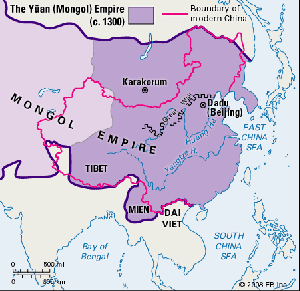
Yuan (Mongol) Dynasty 1277 – 1367

Tibet was first ruled by China during the Yuan Dynasty (1277-1367). Then, when the Ming Dynasty (1368-1643) reclaimed China, a Ming Imperial army was sent to Tibet to drive out the last of the Mongols–holdovers from the Yuan Dynasty. The Ming emperor ordered his army to stay.

When the Ch’ing (Manchu) Dynasty (1644-1911) came to power, the Chinese empire expanded further and Tibet remained in China. Later, I’ll provide evidence from a 1912 National Geographic magazine as proof.

I previously quoted the Tibetan government in exile’s Prime Minister Samdhong Rinpoche claiming that six million Tibetan Buddhists still lived in Tibet.

China, on the other hand, reports that Tibet’s population was 2.84 million at the end of last year, 31,500 more than at the end of 2006. Among its permanent residents, more than 2.5 million, or 95.3 percent, were Tibetans. (Tibet’s population was 1.14 million in 1951.)
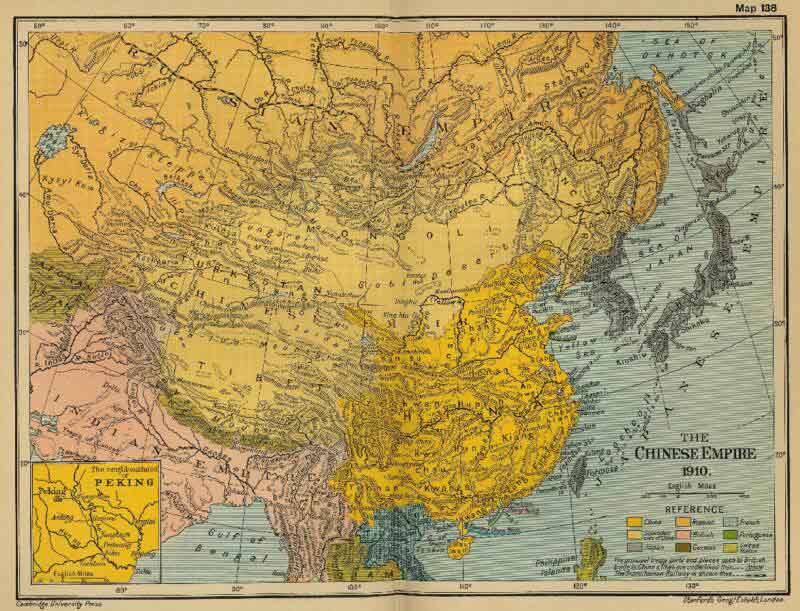
1910 Map of Qing (Manchu) Dynasty – China

More evidence that is interesting comes from the CIA World Factbook. It seems that there are about 80,000 Tibetan refugees living outside Tibet/China. Wikipedia estimates about 5,000 to 9,000 live in the United States. The rest live closer to the Tibetan government in exile.

There were no Tibetans in America prior to the 1950s. Chinese first immigrated to America in the 18th century, and Chinese Americans make up the largest Asian population in America today—more than three million.

The most damaging evidence against Rinpoche’s claims come from the October 1912 issue of The National Geographic Magazine (I have a copy—it cost me $20 on e-bay). Since the earliest evidence of Communists in China was about 1920, and it wasn’t until 1949 that the Communists came to power under Mao, there is no way the Chinese doctor who wrote that 1912 piece could have lied for the Communists.
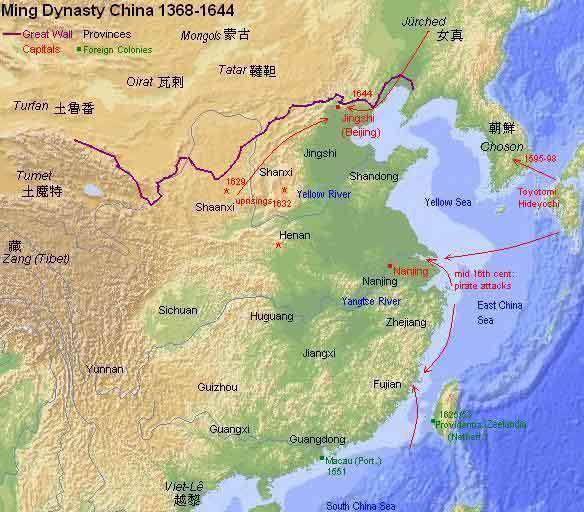
Ming Dynasty (1368 – 1643 AD)

In the 1912 issue of The National Geographic Magazine on page 979, Dr. Shaoching H. Chuan wrote, “Tibet is governed by the Dalai Lama as politco-religous head and two “Ambans” as the political dictators. The Ambans are appointed by the Chinese Emperor every four years. All governmental affairs have to undergo examination by the two Ambans, and all government policy must be sanctioned by them before it can be put into operation. Literally, the Dalai Lama is under the authority of the two Ambans…” (Page 979)

From recent news, it appears that rough times may be ahead for the People’s Republic of China (PRC). In China sees US as hedge for Taiwan, Tibet (Asia Times) by Peter Lee, the author says, “After the Dalai Lama is gone, there is a strong possibility that motivated and organized pro-independence activists (militants) will be able to win power in the Tibetan government in exile.”
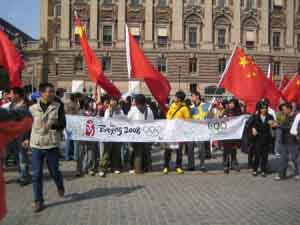
Chinese Protesting Against Tibetan Separatists

Militant Tibetan separatist groups have not been happy with the Dalai Lama’s call for autonomy talks with China instead of calling for a fight to gain independence. Tibetan militant groups want Tibet to break from China even if it means taking a violent path—one the Dalai Lama does not advocate.

What would Tibet be like if the separatists had their way and broke free from China?

Would they return to the system of landowners and serfs (slaves)?

Would the Tibetan Buddhists require that every family send at least one son to become a Buddhist monk as before?

Would mandatory schooling (as we have in the United States) be shut down so the literacy rate would plummet from the high 90% back to a single digit like it was prior to 1950?

Would the wealth and the land be returned to the one percent that had it all before Mao’s troops occupied Tibet?

Regardless of the evidence that proves the Tibetan government in exile is not telling the truth about Tibet being part of China for centuries before declaring independence in 1913 (when the Ch’ing Dynasty was collapsing and the British Empire urged Tibet to break free for political reasons), the Dalai Lama and his Prime Minister represents less than 100,000 Tibetans outside China.


Robert Hart’s (1835 – 1911) letters supports one side of this argument.

If Rinpoche’s figure of six million is correct, that means the Tibetan government in exile represents about 1% of the Tibetan population. If China’s 2.5 million is correct, the percentage goes up to 3.2%. Not much of a base to wage a violent rebellion. There are more troops in the PRC’s army than the entire Tibetan population inside and outside of China.

I also wonder if that 1% in exile were the Tibetan landowners. Did they leave most of the serfs/slaves behind when they fled?

Maybe the Tibetan separatists/rebels (whatever term you like), with help from the CIA, should join the American Tea Bagger movement and gain the support from the likes of Ann Coulter, Glenn Beck and Rush Limbaugh.

They could sit around the campfire during protests and sing hymns about marching into battle to take back the wealth and return to the good-old-days, which would be the opposite of Robin Hood. In this case, the landowners that fled old Tibet (1% of Tibet’s population) would take back what they owned when they left and restore Tibet to the way it was.

In fact, The steady improvement of health care and living standards has raised the average life expectancy of Tibetans from 36 years in the old Tibet to the present 65 years.… It is recorded that during the 150 years before Tibet was (returned to China) there were four pandemic outbreaks of smallpox, one of which, in 1925, killed 7,000 people in the Lhasa area alone. Outbreaks of typhoid fever in 1934 and 1937 carried off some 5,000 people in Lhasa. Source: China-un.ch, which is supported by the facts in the 1912 piece published in the National Geographic Magazine.

Here is a suggested slogan for the Tibetan separatists (former landowners) living in India. “Freedom for landowners, illiteracy for serfs and life expectancy of 36 again!”

Originally posted as a five-part series starting on April 11, 2010 at Tibet Inside China – Part 1

_______________

Lloyd Lofthouse is the award-winning author of My Splendid Concubine [3rd edition]. When you love a Chinese woman, you marry her family and culture too. This is the love story Sir Robert Hart did not want the world to discover.

Subscribe to “iLook China”!
Sign up for an E-mail Subscription at the top of this page, or click on the “Following” tab in the WordPress toolbar at the top of the screen.

About iLook China


Xi’an (Chang’ an) – China’s Ancient Capital [Viewed as Single Page]

January 28, 2010

Most people outside China only know of Beijing (once known as Peking) as the capital of China. However, another city was China’s capital for more than a thousand years.

In fact, Chang’ an (Xi’an) served as the capital for twelve dynasties, including the Western Zhou, Qin, Western Han, Sui and Tang dynasties, spanning more than eleven hundred years. It was also the cultural center of the Silk Road.

In 2008, the last time we visited Xi’an, subway construction was running behind schedule due to a law that does not allow the destruction of historical sites such as the tombs of emperors. There are so many of these tombs below ground that the subway tunnels must be diverted to avoid them resulting in delays.

With such a long history, the Discovery Channel produced a documentary of Xi’an (Chang’ an) called China’s Most Honourable City.

To discover Xi’an’s long history also teaches us much about China’s civilization. Discovery Channel’s Neville Gishford will take us on this historical journey leading to the present.

Gishford says, “It (Han Chang’ an) was more powerful than Rome. If any Roman army had actually gone there, they would have been absolutely annihilated.”

Han Chang’ an (Xi’an) was larger than Constantinople and richer than Egypt’s Alexandria. It was a fortress so powerful that even 20th century artillery could not knock its walls down.

Today, Xi’an is home to millions of people and thousands of men made of clay, the Terra Cotta Warriors guarding China’s first emperor.

In addition, the massive city wall is more than six hundred years old and longer than 12 kilometers. Cracks are appearing and an engineering team keeps close watch and makes repairs

However, the Xi’an of today was first build over two thousand years ago and has been three cities—not one. The Han Dynasty built the first city (Chang’ an), which is close to the modern city of Xi’an and the old eroding walls are still visible.

At 36 square kilometers, Han Chang’ an was more than one and a half times the size of Rome.

Earlier, I mentioned the subway system that was under construction in modern Xi’an.

For an update, Travel China Guide.com says, “The Xi’an subway system is scheduled to have 6 lines, with a total length of 251.8 kilometers… While the first phase of subway Line 2 has been in use since Sep 16, 2011, the other five lines are designed to be finished in 2018 in sequence.”

When the second phase is completed, the full length of Line 2 will be 26.64 kilometers (about 16.5 miles).

The population of Xi’an has also increased since Neville Gishford hosted the documentary for China’s Most Honourable City. Today, there are more than 8 million people living there.

This segment of Gishford’s documentary starts with Archaeologist Charles Higham, a world famous authority on ancient Asian cities.

Higham says, “A delegation of jugglers from Roman Emperor Marcus Aurelius (161-180 AD, who is regarded as one of the greatest emperors in Roman history) traveled and performed in the Han Court of Chang’ an.”

More than two thousand years ago, the walls of Chang’ an (Xi’an) were made of rammed (compressed) earth and much of the city from kiln fired clay bricks, which was a revolutionary building material at the time that changed the history of architecture.

The builders of Han Chang’ an (Xi’an) used this new technology in revolutionary ways such as building an underground sewer system connected to the moat that surrounded the city.

From the Qin to the Tang Dynasty, 62 emperors ruled China from Chang’ an (Xi’an). The China Daily says in and around Xi’an, there are about 500 burial mounds where the remains of emperors and aristocrats rest.

The largest tombs mark the passing of Emperors Qin Shi Huangdi (259 – 210 BC), Tang Gaozong (628 – 683 AD), and his wife Empress Tang Wu Zetian (624 – 705 AD).

When we left Neville Gishford‘s documentary, China’s Most Honourable City, in Part 2, Chang’ an was the capital of the Tang Dynasty (618 – 907 AD) with a population of over a million — six times the size of ancient Rome.

The Daming Palace, where the Tang Emperors ruled China, was 800 years older and nearly five times larger than Beijing’s Forbidden City. This huge palace was built in one year.

However, it wasn’t the Daming Palace that made Chang’ an (Xi’an) powerful. Long before Manhattan, Hong Kong, Paris and Dubai, Chang’ an was where the world came to shop.

Over a thousand years ago, the wealth of the West poured into China (and it is happening again) and arrived at Chang’ an over the Silk Road.

But wealth wasn’t the only thing China gained. Major religions also arrived in China at this time.

Islam was barely a century old, when Silk Road traders brought this religion to Chang’ an. In another post, A Road to the Hajj from China, I wrote, “The ancient city of Xi’an in Shaanxi province is home to about 60,000 ethnic Chinese Muslims.”

Xi’an claims it has a Muslim history going back thirteen hundred years when Islam was first introduced to China in 650 AD.

In fact, the oldest mosque in China was built in 685-762 AD in Chang’ an during the reign of Emperor Xuanzong of the Tang Dynasty.

Although Christianity and Islam were both introduced to China during the Tang Dynasty, Buddhism had deeper roots in the culture since it first arrived in China from India about 200 BC.

Christianity arrived in China in 635 AD (more than eight centuries after Buddhism and only a decade before Islam), when a Nestorian monk named Aluoben entered the ancient capital city of Tang Chang’ an.

Then in 629 AD, the Buddhist monk Xuanzang left Chang’ an against the emperor’s orders to travel the world in search of enlightenment. He went west toward India along the Silk Road with a goal to find original Buddhist scriptures. He traveled 10,000 miles over three of the highest mountain ranges in Asia and was gone 16 years.

When Xuanzang returned in 645 AD, he had 1,300 scrolls of Buddhist Sutras, and requested the building of a pagoda, which became the Giant Wild Goose Pagoda—nearly 65 meters tall (more than 213 feet). It was made of rammed earth, and the pagoda would collapse more than once and be rebuilt. No one knows exactly how the Tang Dynasty engineers managed to build a structure that tall of rammed earth.

Neville Gishford‘s Discovery Channel documentary, China’s Most Honourable City, reveals the answer to a mystery when a hidden crypt beneath the Giant Wild Goose Pagoda is discovered using ground based radar. When The Tang Dynasty collapsed due to rebellion, the city was destroyed, but the Giant Wild Goose Pagoda was left untouched.

Gishford reveals that even though Tang Chang’ an was destroyed, the city was copied throughout Asia and one city in Japan, Kyoto (formally the imperial capital of Japan – 794 to 1869 AD), was a scaled replica of Tang Chang’ an.

In fact, in 1974, the modern city of Xi’an and Kyoto formally established a sister-city relationship.

However, this was not the end of Chang’ an (Xi’an). It would be rebuilt a third time. In 1368, nearly five hundred years after the fall of the Tang Dynasty, the Ming Dynasty (1368 – 1643 AD) would rebuild the Great Wall in addition to Xi’an as a defense against the Mongols that had conquered and ruled China during the Yuan Dynasty (1277 – 1367 AD).

During the Ming Dynasty (1368 – 1643 AD), China mostly isolated itself from the world by rebuilding the Great Wall and a string of impregnable fortresses to protect China’s heartland from Mongol invasion.

One of those fortresses was a new military city built on the ruins of Tang Chang’ an, and the Ming named this city “Western Peace”—which in Chinese/Mandarin is “Xi’an”.

Xi’an was one-sixth the size of Tang Chang’ an, but nearly six hundred years later, its walls are still standing.

Charles Higham says these walls are the most extraordinary, largest, best-preserved set of defensive walls in the world.

The last segment of Neville Gishford‘s Discovery Channel documentary, China’s Most Honourable City, introduces Zheng Canyang, the engineer responsible for preserving Xi’an’s walls, and Zheng explains how the walls would have been defended.

History records that when the walls of this third city faced its first attack, they stood firm, but the attack did not come during the Ming or Qing Dynasties. It came five hundred years later from April to November 1926.

As China bled from the Civil War between warlords, the CCP and the KMT, a powerful Chinese general by the name of Liu Zhenhua attacked Xi’an with a large army and modern artillery.

However, the 20th century artillery rounds only dented the walls, and after months, Xi’an’s walls still stood and Liu Zhenhua’s army retreated.

The siege was part of an anti-Guominjun campaign lasting from late 1925 to early 1927, which raged across North China and had nothing to do with the civil war between CCP and KMT, explaining why this military campaign received no coverage in the popular media or academic circles. Source: A Study of the Siege of Xi’an and its Historical Significance by Kingsley Tsang

The newest enemy to Xi’an’s ancient walls comes from modernization and the millions of inhabitants of the city. As the water table below the city is sucked dry from so many people, this has caused the earth to sink, which is pulling down the walls, and engineers and scientists work to discover ways to save them.

______________

Lloyd Lofthouse is the award-winning author of The Concubine Saga. When you love a Chinese woman, you marry her family and culture too. This is the love story Sir Robert Hart did not want the world to discover.

Subscribe to “iLook China”
Sign up for an E-mail Subscription at the top of this page.

About iLook China


Note: This post first appeared as part of a five-part series on October 21, 2011 as Xi’an (Chang’ an) – China’s Ancient Capital – Part 1


The History of Organized Crime in China (Viewed as a Single Page)

January 28, 2010

For two thousand years, secret societies have been part of Chinese culture.

Most of these secret societies were harmless but a few were highly organized criminal organizations. Under emperors and Communists, in war and peace, Chinese crime lords have acted as shadow governments with their own laws and severe forms of punishment.

In recent decades, Chinese gangs have moved into major American cities competing with Russian gangs, Italians, Sicilians, Ukrainians, Japanese, Latinos, etc. Today, these gangs deal in more than gambling and drugs. They deal in human trafficking too.


Was she the Godfather of Chinese organized crime or a Robin Hood?

Over the last few decades, the business of smuggling people into the US by Chinese organized crime has boomed.

Many poor Chinese want to start a new life in the United States, which is known as Gold Mountain.

However, the risks are big and costly.  Each person may have to pay as much as 40 thousand dollars to the smugglers often ending in a form of slavery in America until the debt is paid.

Kingman Wong of the FBI says these smugglers are like the flu because they are always mutating their methods and alliances to find new ways to smuggle illegal aliens in to the US. There are hundreds of independent groups operating like this around the globe.

However, the beginnings of all this illegal activity may be traced to one group from the past — the Triads. The first such group was known as the “Heaven and Earth Association” and may have started in 1761 AD.

A myth says that China’s Triads started with a group of Buddhist monks that were martial arts experts who went to the assistance of a Qing Emperor to defeat an enemy.

Later, after defeating this enemy, the emperor decided to get rid of these monks since he saw them as a future threat.

After the assassination of hundreds of monks, a handful survived and started the secret societies known as the “Heaven and Earth Association”.

However, the myth of the Buddhist monks is only a legend. The truth is that the Triads (organized crime in China) didn’t start from such a noble cause.

FBI Unit Chief Kingman Wong says that Chinese organized crime members identify themselves with these ancient heroes in order to glamorize their criminal activities.

According to scholars, the true story of the Triads starts during the 1700s in Fujian province along China’s southeast coast facing Taiwan.

Dian Murray, a historian at the University of Notre Dame, says that Fujian province was China’s Wild West. For protection, young men banded together in mutual aid societies. Soon, these societies turned to crime.

The “Heaven and Earth Association” took for its emblem an equilateral triangle, which explains why these gangs are called the Triads in the West.

There was no central figure or mob boss that controlled the Triad gangs, which were similar to America’s street gangs of today.

Then in 1787, the Qing Emperor discovered the existence of these gangs and declared war.

However, to survive, the Triads in Fujian province spread to every corner of the Qing Empire, to Southeast Asia and America’s China towns where they sold drugs and dealt in prostitution and gambling.

In time, one gang, known as the Green Gang, controlled the opium trade and Shanghai in the early 1900s. The Green Gang was involved in every criminal activity.

At the center of the Green Gang’s metamorphosis was one man. His name was Du Yue-sheng. Du grew up an orphan and illiterate near Shanghai.

When Du was fourteen, he arrived in Shanghai and spent the money he earned on opium and women. In 1910, Du was sworn into the Green Gang.

Du lived and worked out of the French Concession in Shanghai where the police were the criminals.

In 1924, Du had an opportunity to become the leader of the Green Gang when the current leader, Wong, had the son of a powerful warlord beaten. The warlord then had Wong arrested and tossed in prison.

Du paid the warlord to free Wong, who then owed Du a debt of gratitude. From that day on, Du controlled the Green Gang.


Du Yue-sheng, godfather of the underworld—45 minute documentary

In 1927, General Chiang Kai-shek made a deal with the Triad Du controlled to destroy the Communists in Shanghai who were organizing labor unions.

Frederick Wakeman, a historian at the University of California-Berkeley says that Du was threatened with the possibility of a Communist victory.

Thousands of Green Gang members went after the Communists to shoot and behead as many as possible. Within hours, at least five thousand Communists had been executed.

As a reward, Chiang Kai-shek made Du a general in the Nationalist Army. Du’s public image became one of respectability while he maintained an iron control over Shanghai and the Green Gang.

For Chiang Kai-shek, the alliance with Du and the Green Gang became a useful way to raise money from Shanghai’s wealthy families.

Du was also in charge of the agency to stop the opium trade in Shanghai and he controlled the drugs seized by the Nationalists, which he would sell making a huge profit.

In 1937, Japan invaded China. On August 14, the Japanese launched a fierce assault on Shanghai. Chinese refugees fled to the foreign concessions hoping to be safe.

Du Yue-sheng had his Green Gang fight alongside Nationalist troops against the Japanese.

Three months later, Shanghai fell and Du fled to Hong Kong, and the Triads would never be the same.

A month after the end of World War II, in 1945, Du returned to Shanghai.

Any respect and fear he’d earned before the war had been lost. The Shanghainese saw him as a coward for running away from the Japanese and booed him when he was seen on the streets.

When the Communists won in 1949, broken and unhealthy, Du fled to Hong Kong and died there in 1951 at 66. The Communist Revolution ended the Green Gang in Shanghai.


  Asian Crime Gangs in the US: 43:47 min.

The Chinese Communists didn’t destroy China’s criminal underworld. With hundreds of gangs operating in other countries, the leadership of the gangs left mainland China.

In time, New York’s Chinatown would become the center of the Chinese Triads in the US.

In 1977, on Mott St. in the heart of New York’s Chinatown, a war raged between the Chinese gangs. One Chinatown gang boss, Nicky Louie, became the most feared gangster in New York’s Chinatown.

Nicky arrived in New York’s Chinatown in the 1960s along with tens of thousands of other Chinese soon after Congress changed the Chinese Exclusion Act allowing more Chinese into the US.

Work was hard to come by, so young Chinese men organized street gangs modeled after the same gangs from China that the Communists had destroyed.

Nicky, ruthless and smart, quickly became the leader of a Triad gang called the Ghost Shadows.

Under Nicky’s leadership, the Ghost Shadows became more powerful and ruthless. However, Nicky wanted to control all of Chinatown. Success then made Nicky a target and he was shot many times but survived.

During one assassination attempt from one of his gangsters, Nicky Louie was shot in the head but managed to run to the police station to save himself.

He agreed to work with the police and the federal prosecutors.

However, to gain the government’s protection, he had to admit to his own crimes and was sentenced to fifteen years in prison.

This led to the end of the era of New York’s Chinatown Triads.

Today in the U.S., the Chinese Triads consist of an elusive array of constantly changing alliances among many small gangs scattered across the country.

The only bond between the gangs is the desire for making money. These Triads are involved in everything from human trafficking and gambling, to heroin smuggling.

For the first time, the Chinese American Triads are moving beyond the Chinese community and are willing to work with anyone as long as they make money.

FBI Unit Chief Kingman Wong says this makes the Triads in the U.S. a more significant threat to the safety of American citizens.

It’s not easy to define Chinese organized crime today. The Triads are difficult to penetrate.

The History Channel produced a documentary on Organized Crime in China.
click the link to see the entire video—about an hour

_______________

Lloyd Lofthouse is the award-winning author of My Splendid Concubine [3rd edition]. When you love a Chinese woman, you marry her family and culture too. This is the love story Sir Robert Hart did not want the world to discover.

His latest novel is the multiple-award winning Running with the Enemy.

Subscribe to “iLook China”!
Sign up for an E-mail Subscription at the top of this page, or click on the “Following” tab in the WordPress toolbar at the top of the screen.

About iLook China

China’s Holistic Historical Timeline


What Honor Means to Many Chinese—View as Single Page

January 28, 2010

We visited General Yue Fei’s tomb in Hangzhou, and hundreds of Chinese tourists were there. It was early October 2008. This was our third trip to the city in a decade, and I was watching people spitting on the kneeling, life sized metal statues of men dead for more than eight centuries. Those metal effigies with their hands tied behind their backs had been traitors.

It may be difficult to understand what honor means to most of the Chinese if one isn’t Chinese. One way to possibly understand the importance of this concept is to examine two of China’s historical heroes.

General Yue Fei died on January 27, 1142. He was a famous Chinese patriot and military general who fought for the Southern Song Dynasty against the Jurchen armies of the Jin Dynasty.

Several jealous Song ministers lied to the emperor saying that Yue Fei was planning to kill him and take over. The emperor believed these lies and had General Yue Fei executed. When the truth came out, Yue Fei became a model for loyalty in Chinese culture. By spitting on those statues of those ministers who lied, the Chinese honor Yue Fei’s memory.

Although the Communist Chinese government has made it illegal to spit on those statues for public health reasons, hundreds defy the law on a daily basis, and continue to insult those traitors while honoring Yue Fei.

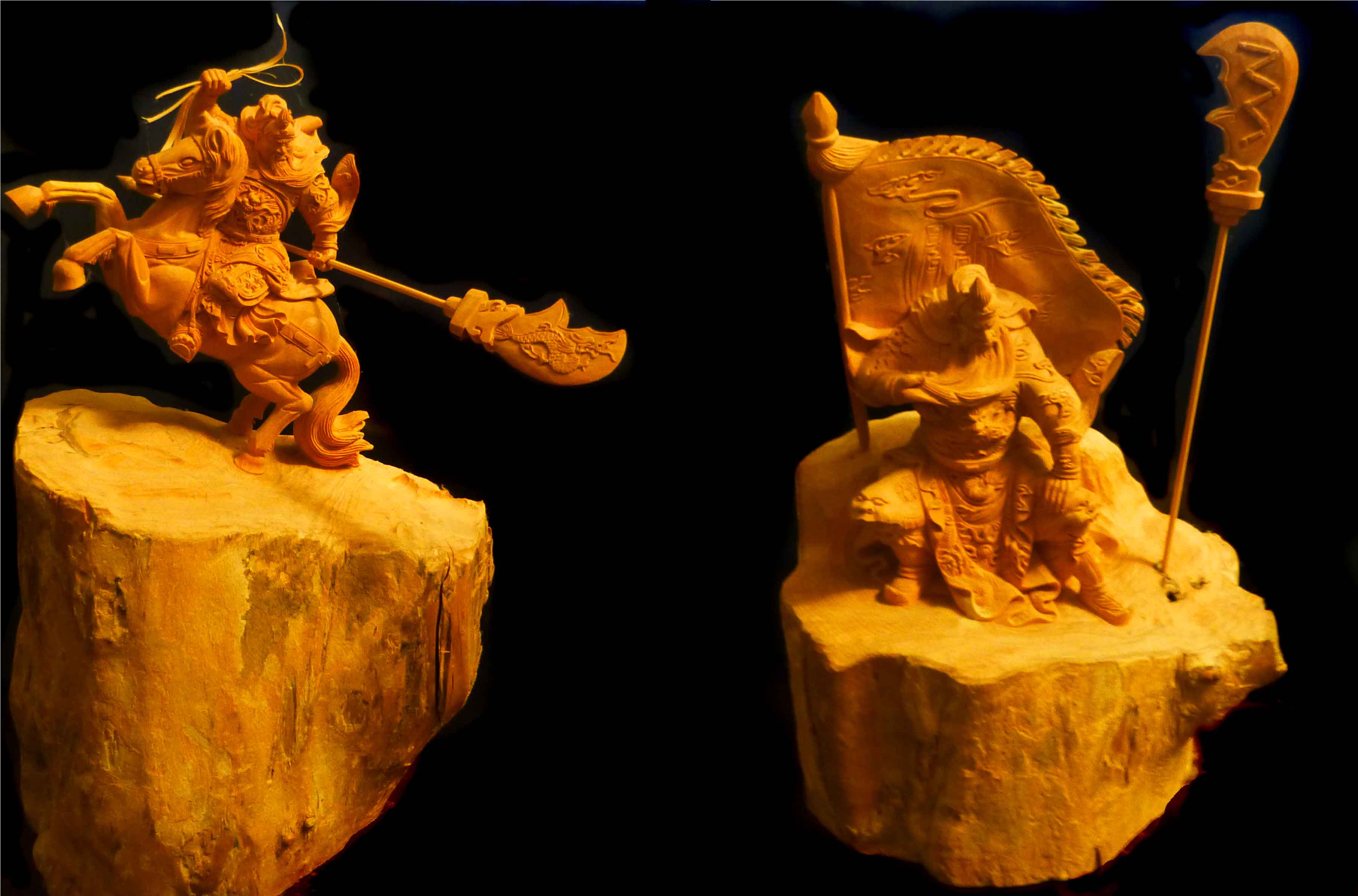
There is another moral hero from China’s history. During the Three Kingdoms era (220-265 A.D.) after the fall of the Han Dynasty, there was a period of civil war. Out of this era came the story of Guan Yu, who was another moral model of loyalty and righteousness.

Guan Yu lived almost eighteen hundred years ago, but it is easy to find carvings and statues of him in China. In fact, I have several hand carved in wood. Here are two of them.

Photo of Guan Yu wood carvings

It doesn’t matter if one is a member of the Communist Party, because role models like Yue Fei and Guan Yu still play an important part in how many Chinese behave and what they think. Anyone in China holding a position of power is measured against men like Yue Fei and Guan Yu.

To help gain a better understanding of what honor means to the Chinese, here’s a link to a piece published in the Los Angeles Times.

In 1935, Lin Yutang said, “Face cannot be translated or defined. It is like honor and is not honor. It cannot be purchased with money, and gives a man or a woman a material pride. It is hollow and is what men fight for and what many women die for.

“It is invisible and yet by definition exists by being shown to the public. It exists in the ether and yet can be heard, and sounds eminently respectable and solid. It is amenable, not to reason but to social convention.

“It protracts lawsuits, breaks up family fortunes, causes murders and suicides, and yet it often makes man out of a renegade who has been insulted by his fellow townsmen, and it is prized above all earthy possession.”

“It is more powerful than fate and favor,” Lin Yutang said, “and more respected than the constitution. It often decides a military victory or defeat, and can demolish a whole government ministry. It is that hollow thing which men in China live by.” (Lin Yutang, My Country and My People, Halcyon House, New York, NY, 1938, page 200)

Chinese like Yue Fei and Guan Yu were honorable men and gained much face/respect because of their beliefs and behavior.

When anyone in China reacts to anything, politically or personally, honor plays a large role. It doesn’t matter if one is a member of the Communist Party, a farmer or a factory worker or one of the wealthiest members of the new capitalist elite.

Most Chinese measure what is important in life by a different standard than the rest of the world.

_______________

Lloyd Lofthouse is the award-winning author of My Splendid Concubine [3rd edition]. When you love a Chinese woman, you marry her family and culture too. This is the lusty love story Sir Robert Hart did not want the world to discover.

Finalist in Fiction & Literature – Historical Fiction
The National “Best Books 2010” Awards

Low-Res_E-book_cover_MSC_July_24_2013

Honorable Mentions in General Fiction
2012 San Francisco Book Festival
2012 New York Book Festival
2012 London Book Festival
2009 Los Angeles Book Festival
2009 Hollywood Book Festival

Subscribe to “iLook China”!
Sign up for an E-mail Subscription at the top of this page, or click on the “Following” tab in the WordPress toolbar at the top of the screen.

About iLook China

China’s Holistic Historical Timeline


China’s Holistic Historical Timeline: Part 4 of 5

January 28, 2010

Timeline Viewed as Single Page

1912 – 1976

Dr. Sun Yat-Sen, the father of China’s Republics

Sun Yat-sen’s Last Days

Yuan Shikai, the general who became China’s president for life

Chiang Kai-shek, brutal dictator and America’s friend

America’s Angel Island

Massacre in Taiwan and America says nothing

Mao’s Long March

China’s Communist Revolution or Civil War

Mao and Snow

World War II and The Rape of Nanking

Japan’s war of lies about atrocities in China

The Rape of Nanking with Iris Chang

China’s Health Care During Mao’s Time

Mao Zedong, the Poet

Xiu Xiu: The Sent Down Girl

From Mao to the Met

Mao’s Last Dancer

The Founding of a Republic

Ah Bing and “Reflection of the Moon”

Balzac and the Little Chinese Seamstress

Tibet Inside China

China’s Sensitivity over Tibet

Tibet as a Province of China – the unresolved issue

No Way is Tibet a Democracy in Exile!

Chinese Gold from Dead Tibetan Caterpillars

China in Korea Protecting the Teeth

China’s Great Leap Forward

China’s Great Famine (1959 – 1961)

Mao’s ‘alleged’ Guilt in the Land of Famines

Mao and Complex Post Traumatic Stress Disorder

China and India at War – 1962

The KMT-CIA Heroin, Cocaine Pipeline to the US

Pearl S. Bucks’ China Predictions – 1966

Nixon in China

Continued with China’s Holistic Historical Timeline: Part 5 or return to Part 3

Timeline Viewed as Single Page

_______________

Lloyd Lofthouse is the award-winning author of My Splendid Concubine [3rd edition]. When you love a Chinese woman, you marry her family and culture too. This is the love story Sir Robert Hart did not want the world to discover.

His latest novel is the multiple-award winning Running with the Enemy.

Subscribe to “iLook China”!
Sign up for an E-mail Subscription at the top of this page, or click on the “Following” tab in the WordPress toolbar at the top of the screen.

About iLook China