Jesus Christ’s Younger Chinese Brother

June 13, 2018

After China lost both of the Opium Wars started by the British and French, Christian missionaries flooded China along with a tsunami of opium.

Hong Xiuquan (1814 – 1865), a failed student of Confucian doctrine, converted to Christianity and woke up one morning claiming he was the younger brother of Jesus Christ. From there, he built a following and started the Taiping Rebellion (1850 – 1864) that lasted for more than a decade.

History of War says, “Conservative estimates of the dead in the 14-year Taiping Rebellion in southern China start at between 20 and 30 million. In contrast, around 17 million soldiers and civilians were killed fifty years later during the First World War. The devastating death toll between 1850 to 1864 certainly makes the uprising one of the bloodiest events in history, with more than 100,000 people killed in three days during the Third Battle of Nanking in 1864.”

Hong’s goals were to replace the Qing Dynasty and rid China of Opium. After achieving that goal, he was going to turn China into a Christian nation. He planned to be China’s first Christian emperor.

Since the English, United States, and French did not want the opium trade to end, these Christian nations helped the Ch’ing Dynasty defeat the Taipings even though the rebellion was a Christian uprising.

If the British and their western allies had sided with Hong Xiuquan, China would probably be a Christian nation today, but think of all the lost profits.

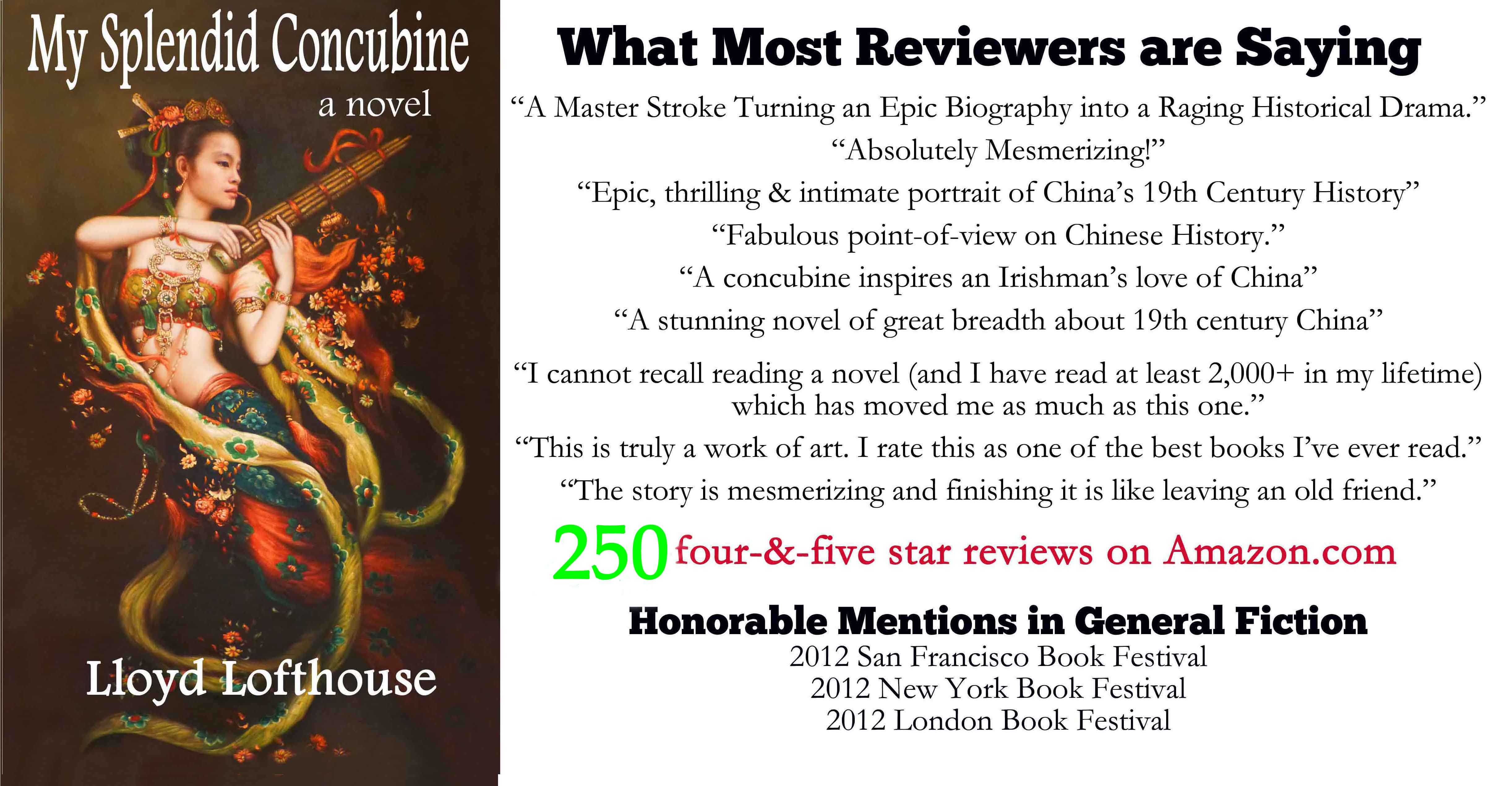
Lloyd Lofthouse is the award-winning author of My Splendid Concubine, Crazy is Normal, Running with the Enemy, and The Redemption of Don Juan Casanova.
Where to Buy

Subscribe to my newsletter to hear about new releases and get a free copy of my award-winning, historical fiction short story “A Night at the Well of Purity”.

About iLook China


The Most Popular Drink in the World originated in China and was stolen by the British

June 12, 2018

Tea is the most popular drink in the world second only to water. Its consumption equals all other manufactured drinks combined including coffee, chocolate, soft drinks, and alcohol, and China is still the leading tea producer in the world.

If you are interested in a real-life collision between the West and China early in the 19th century, I highly recommend reading Sarah Rose’s heavily researched nonfiction book For All the Tea in China: How England Stole the World’s Favorite Drink and Changed History.

In this book, you will discover that the British Empire and its merchants were successful, because they were more ruthless and devious than anyone else on Earth. When China’s last Dynasty collided with the British Empire, the Qing Emperors probably had no idea who they were dealing with.

The British Empire was the largest in history, and it covered more than thirteen-million square miles (20,921,472 square kilometers), which is about a quarter of the Earth’s total land area, and it controlled more than 500 million people, a quarter of the world’s population at the time.

What financed the brutal expansion of this empire?  In the 19th century the British Empire was not only a thief, but the largest drug cartel in human history. After all, it was the British that forced Opium on China and fought two Opium Wars to make that happen. How do you think the British paid for the expansion of their empire?

The real-life main character in Sara Rose’s fascinating, true, fact-based story is Robert Fortune (1812 – 1880) who successfully pulled off one of, if not the largest, act of corporate espionage and theft in history. This nonfiction book is about how the British stole tea plants and the method of producing tea from China and successfully transplanted this industry in India where the British were also growing the opium they were selling to the Chinese.

If you drink Darjeeling Tea from India, you are drinking a product that was stolen from China by Robert Fortune in the early half of the 19th century.

But there is much more to this story than the theft of tea from the country that has the earliest records of tea drinking dating back to the first millennium BCE, because this nonfiction book reads like a spy thriller. If caught, Fortune would have been executed by the Chinese. To pull off the biggest heist of all time, he disguised himself as Chinese and traveled to areas of China that no foreigner had ever visited before, and his only companions were Chinese that he had bribed to work for him.

Lloyd Lofthouse is the award-winning author of My Splendid Concubine, Crazy is Normal, Running with the Enemy, and The Redemption of Don Juan Casanova.

Where to Buy

Subscribe to my newsletter to hear about new releases and get a free copy of my award-winning, historical fiction short story “A Night at the Well of Purity”.

About iLook China


China’s Last Imperial Dynasty was not ruled by the Han Chinese: Part 3 of 3

June 8, 2018

During the 19th century, the two Opium Wars started by Britain and France weakened the Qing Dynasty.

Besides the Opium Wars, there was also the Taiping Rebellion, which lasted more than a decade.

In 1900, the so-called Boxer Rebellion (known as “I-ho Chuan” or the “Righteous and Harmonious Fists”) was originally started to bring down the Manchu Qing Dynasty but the Qing government managed to redirect the rebellion against the foreigner invaders that had defeated China during the Opium Wars.

This ended in a worse defeat after the foreign powers formed an alliance and marched on Beijing slaughtering the rebels.

Back to the Qing Dynasty

How does a country innovate and prosper when it is fighting endless rebellions and wars. For a brief example, Business Insider estimates 25-million died during the Qing conquest of the Ming dynasty, a period of extreme political turmoil in China that lasted for sixty-five years. It is estimated that during the Taiping Rebellion 1850-1864, another 20-million died (some estimates allege the number was closer to 100-million). During the Dungan Revolt 1862-1877, another 10-million were killed.  If you click this link, you will discover a list of thirty wars and revolts that the Qing Dynasty was involved in. Do you see any comparison to the United States since the end of World War II?

The driving force behind the revolution of 1911 that ended the Qing Dynasty was Dr. Sun Yat-sen, who had been educated in Hawaii when it was an American territory. This exposure to the U.S. Republic motivated Sun Yat-sen to build a Republic to China but one that would fit the Chinese culture.

Return to Part 2 or start with Part 1

Lloyd Lofthouse is the award-winning author of My Splendid Concubine, Crazy is Normal, Running with the Enemy, and The Redemption of Don Juan Casanova.

Where to Buy

Subscribe to my newsletter to hear about new releases and get a free copy of my award-winning, historical fiction short story “A Night at the Well of Purity”.

About iLook China


China’s Last Imperial Dynasty was not ruled by the Han Chinese: Part 2 of 3

June 7, 2018

The next Qing Emperor Yongzheng ruled from 1722 to 1735, and he was frugal like his father.

Yongzheng created an effective government and used military force to preserve the dynasty’s position as his father had. Under his leadership, he continued the era of peace and prosperity by cracking down on corruption and waste while reforming the financial administration of the empire.

The next one was the Qianlong Emperor, also known as the warrior emperor, and he ruled China for much of the 18th century (1735 – 1796). During his leadership, he subdued several rebellions known as the “ten successful campaigns”, which drained the Qing Dynasty’s treasury. These rebellions went on for forty-five years from 1747 to 1792.

However, when the Qianlong Emperor died, China was unified, at peace, and still strong. He was a brilliant military leader and expanded the empire further into Mongolia and Tibet.

During Qianlong’s rule, Manchu and Chinese armies spread Qing sovereignty over Burma and Nepal.

In addition, Chinese settlers in Yunnan, Guizhou, Sichuan, and Taiwan dealt with rebellions of the aboriginal tribes that could only be subdued by military force. Muslim people also resisted the Qing regime in Gansu and Xinjiang.

Part 3 will be posted on June 8, 2018 or return to Part 1

Lloyd Lofthouse is the award-winning author of My Splendid Concubine, Crazy is Normal, Running with the Enemy, and The Redemption of Don Juan Casanova.

Where to Buy

Subscribe to my newsletter to hear about new releases and get a free copy of my award-winning, historical fiction short story “A Night at the Well of Purity”.

About iLook China


China’s Last Imperial Dynasty was not ruled by the Han Chinese: Part 1 of 3

June 6, 2018

The Qing Dynasty can be traced back to the 1580s when a Manchurian chieftain Nurhachi (1558–1626) unified the Jurchen tribes in an area north of the Great Wall of China. In time, Nurachi controlled most of Manchuria. In 1616, Nurhachi declared himself khan, and founded the Later Jin Dynasty, that his successors renamed in 1636, the Qing Dynasty.

He launched his war against China in 1618. In February 1626, he was defeated for the first time by the Chinese and died of his wounds by the end of September.

In 1644, his son Dorgon conquered China. However, the Chinese fought hard to drive the Manchurians from China and continued resistance in Southern China until crushed.

The second emperor of the Qing Dynasty was Kangxi (1654 – 1722) who ruled for sixty-two years and is considered by many historians one of the ablest emperors to govern the vast Chinese empire. He laid the foundation of a long period of political stability and economic prosperity for China.

The rebellions Kangxi put down was called the Rebellion of the Three Feudatories, which lasted from 1673 to 1681.

Then there was the pirate-merchant Zheng Chenggong, who set up an independent kingdom on the island of Taiwan. Eventually, that kingdom was defeated and brought back into the Qing empire.

The Kangxi emperor also fought wars with Russia from 1685 until 1689 when the Treaty of Nerchinsk was signed.

Next were the campaigns against the Mongols until they were defeated. In 1720, the Qing Dynasty occupied Tibet adding that region to the empire.

However, even in times of war, the Kangxi emperor provided tax relief for the people, and he was known as a frugal and wise leader. When he died, he left China strong and in good financial shape

It is also well known that the Qing Dynasty did not trust the Han Chinese and went out of its way to hire foreigners to fill government positions held by Han Chinese for centuries.

Part 2 will be posted on June 7, 2018

Lloyd Lofthouse is the award-winning author of My Splendid Concubine, Crazy is Normal, Running with the Enemy, and The Redemption of Don Juan Casanova.

Where to Buy

Subscribe to my newsletter to hear about new releases and get a free copy of my award-winning, historical fiction short story “A Night at the Well of Purity”.

About iLook China