The Myth of Hsi Wang Mu

July 4, 2010

To the Chinese, Hsi Wang Mu is the Queen Mother of the  West (Western China), an important figure of Chinese mythology.

It is believed that the myth of the Queen Mother goes back almost three thousand years, but the earliest recorded history was found from the Chou Dynasty (1122 – 222 BC) and was written in the second century BC.  It appears she may have been a real queen of a Western Chinese state and stories of her life become legend over hundreds of years turning into magical myths.
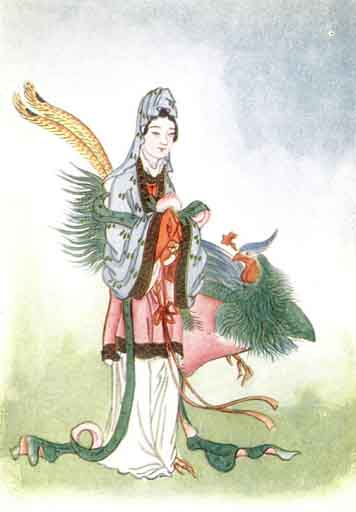
One of the older stories is about Hsi Wang Mu and the celestial archer, where she asks him to build her a palace of jade in the western sky. His reward was a pill made from the peaches of immortality, which ends in tragedy and heartbreak.

It is said that Hsi Wang Mu had nine sons and twenty-four daughters with her mate, Tung Wang Kung.

See The First Emperor – The Man Who Made China

_________________________

Lloyd Lofthouse is the award-winning author of the concubine saga, My Splendid Concubine & Our Hart. When you love a Chinese woman, you marry her family and culture too. 

Sign up for an RSS Feed for iLook China


China’s Capitalist Revolution (Part 6 of 9)

July 4, 2010

For those Red Hat capitalists who survived harassment from the hardliners, the rewards were huge—fortunes were made. Some Chinese were following Deng Xiaoping’s advice “To Get Rich Gloriously.”

However, there was an area of China’s industry that Deng couldn’t change—factory owned industries, which were outdated and inefficient. The state industries still placed politics over profit. In the average state-owned factory, 15 to 20% of the workers did nothing but read and shout slogans.

Deng decided to take state-owned industries from government management.  He said we are going to bring in experts to run our factories like they do in the West. In fact, Beijing was spending a quarter of its revenues supporting state-owned enterprises. The Chinese constitution guaranteed jobs and no one could be fired.

In 1986, Deng decided to allow unprofitable state-owned enterprises to close. Millions lost jobs. With people out of work, crime soared.  In 1989, Deng did away with price controls. There was a panic while workers in private industries were earning much more than people in state-owned industries.

Then bribery became a problem as those in charge at the local level started to accept bribes from foreign investors.

Return to China’s Capitalist Revolution Part 5 or go to Part 7

_________________________

Lloyd Lofthouse is the award-winning author of The Concubine Saga. When you love a Chinese woman, you marry her family and culture too. This is the love story Sir Robert Hart did not want the world to discover.

To subscribe to “iLook China”, look for the “Subscribe” button at the top of the screen in the menu bar, click on it then follow directions.


China’s Capitalist Revolution (Part 5 of 9)

July 3, 2010

Deng had the support of the reformers he had appointed to key positions. A struggle between the hardliners and the reformers begins.  The hardliners are afraid the reforms will threaten communism.

While Deng’s supporters debate the hardliners, Deng visits the nations and leaders of the world.  In the US, while on 60 Minutes, he says, “To get rich is glorious…Wealth in a socialist society belongs to the people. That’s why our policy won’t lead to a situation where the rich get richer and the poor get poorer.”

During the Cultural Revolution, Deng Xiaoping was a victim. Mao sent the Red Guard to punish him for capitalist tendencies forcing Deng to work in a tractor factory on the production line. The Red Guard broke his son’s back, and he was permanently paralyzed. This caused Deng to realize that what Mao was doing was wrong.

Eight years into his leadership, Deng begins the next stage of his economic revolution by allowing Chinese entrepreneurs to start businesses. Red Hat capitalism was born. At first, only villagers were allowed to start enterprises. The hardliners were not happy. They wanted to end this, so the new Chinese capitalists were threatened.

Return to China’s Capitalist Revolution Part 4 or go to Part 6

_________________________

Lloyd Lofthouse is the award-winning author of The Concubine Saga. When you love a Chinese woman, you marry her family and culture too. This is the love story Sir Robert Hart did not want the world to discover.

To subscribe to “iLook China”, look for the “Subscribe” button at the top of the screen in the menu bar, click on it then follow directions.


China’s Capitalist Revolution (Part 4 of 9)

July 2, 2010

When the first US businessmen arrive in China, they complained. It took years to gain approval to open manufacturing plants in China. Then the trickle of investors turned into a flood as foreigners scrambled to cash in on a cheap and willing workforce.

The new industrial zones were sealed behind fences from the rest of China. The economies in the industrial zones doubled every three years. Wages were higher than the rest of China and people came looking for work. Investments poured in.

Deng’s popularity was at an all time high. He says, “We have given the highest priority to modernization. Our economy has grown more vigorously than ever.”

However, high ranking Maoists fear a capitalist country with a Communist flag. In 1983, the hardliners start a campaign against spiritual pollution—code for Western ideas.

The hardliners attack journalists who write for the People’s Daily. Top editors are fired for being corrupted by Western values.  The hardliners now control the media.  If you don’t follow the party line, your future becomes grim.

Next, the hardliners pressured the banks to stop lending money to the industrial zones.  Deng has to force the banks to loan the money.

Return to China’s Capitalist Revolution Part 3 or go to Part 5

_________________________

Lloyd Lofthouse is theaward-winning author of The Concubine Saga. When you love a Chinese woman, you marry her family and culture too.This is the love story Sir Robert Hart did not want the world to discover.

To subscribe to “iLook China”, look for the “Subscribe” button at the top of the screen in the menu bar, click on it then follow directions.


China’s Capitalist Revolution (Part 3 of 9)

July 2, 2010

In May 1978, Deng invited President Carter’s National Security Advisor to Beijing. Deng needed a deal with the US but he wanted something in return. The US had to end its friendship with the breakaway republic of Taiwan—an island China considered theirs. America agreed and closed its embassy in Taiwan to open full diplomatic relations in China. A few weeks later, Deng became the first Chinese leader to visit the US.

Deng Xiaoping meets President Carter in the White House and signs the new alliance.  Deng says, “Mr. President, we share the sense of being on a historic mission.  Sino-US relations have reached a new beginning.”

Later in the White House, Carter mentions human rights and says that people in China should have the right to leave if they wanted to. Deng says, “Sure, how many Chinese would you want—forty or fifty million?”  Deng tours the US.

After US diplomats arrive in China, a new cultural revolution starts.  With the Chinese and Americans now the best of friends, Deng opened China to American companies, who would get cheap labor while China would get money to grow an economy.

Return to China’s Capitalist Revolution Part 2 or go to Part 4

_________________________

 Lloyd Lofthouse is the award-winning author of The Concubine Saga. When you love a Chinese woman, you marry her family and culture too. This is the love story Sir Robert Hart did not want the world to discover.

To subscribe to “iLook China”, look for the “Subscribe” button at the top of the screen in the menu bar, click on it then follow directions.