The Han Dynasty (1/3)

August 3, 2010

In this three-part series you will take a tour of Xuzhou, which was the capital of the Han Dynasty (206 BC – 219 AD) and is situated between modern day Shanghai and Beijing. In the third century BC, The Roman Empire was at its peak. At the same time, China’s Han Dynasty was more powerful than Rome.

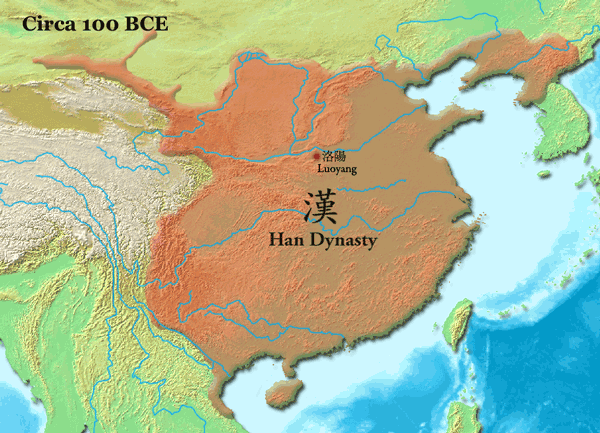
Xuzhou in northern Jiangsu province is one of China’s best showcases of the art and historical relics of the Han Dynasty. At its height, the Han Dynasty stretched from the Pacific Ocean to Central Asia and as far south as Vietnam. Its culture had a great influence on Central and Southeast Asia. 

In the center of Xuzhou on top of a mountain stands the famous horse-training terrace where the first Han emperor trained his troops. At age 23, Emperor Gaozu (202 – 195 BC), then known by his common name Liu Bang, fought the Qin and defeated China’s first dynasty.

To honor the first emperor of the Han dynasty, China rebuilt his palace in Xuzhou with many ancient Han stone sculptures displayed.

See The First Emperor: The Man Who Made China

______________

Lloyd Lofthouse is the award-winning author of the concubine saga, My Splendid Concubine & Our Hart. When you love a Chinese woman, you marry her family and culture too. 

If you want to subscribe to iLook China, there is a “Subscribe” button at the top of the screen in the menu bar.


Piety’s Flaw

August 3, 2010

I’ve heard that it was Confucianism that caused China to fall victim to Western Imperialism in the 19th century, and the reason Mao started the Cultural Revolution his last decade was to correct this imperfection.

However, I believe that the collective culture created in China by Emperor Han Wudi (156-87 BCE), considered one of the most influential emperors in Chinese history, is the reason that China’s civilization survived for thousands of years without suffering the fate of Europe after the Roman Empire collapsed.

Han Dynasty 100 BC

The problem is not from Confucianism but a flaw in the way an element of Confucianism has been interpreted over the centuries.  In fact, this flaw is buried so deep in the Chinese psyche that Mao’s disastrous Great Leap Forward and the tragic Cultural Revolution were not stopped because of it. 

There were powerful individuals in the Communist Party who did not agree with what Mao was doing but did not speak out when they could have. Some of those individuals even suffered during the Cultural Revolution but still kept silent due to the power of piety.

It wasn’t until after Mao’s death that those same people acted and Deng Xiaoping came to power stopping the madness of the Cultural Revolution.

To criticize an elder in China, even when that individual is power hungry, senile or maybe a bit crazy, is considered similar to Christian heresy during the Spanish Inquisition. Piety means elders must be treated with respect as if they can do no wrong. There must be a way to find a balance.

See China’s Capitalist Revolution

_______________

Lloyd Lofthouse is the award-winning author of the concubine saga, My Splendid Concubine & Our Hart. When you love a Chinese woman, you marry her family and culture too. 

Sign up for an RSS Feed for iLook China


Chinese Crossbow and other Inventions (4/4)

August 1, 2010

The Chinese invented rockets long before anyone in the West did. By the 15th century, the Chinese had mass rocket launchers that fired hundreds of rockets in battle. In one battle during the Ming Dynasty, more than one-hundred rocket launchers were used capable of launching 32,000 rockets in an instant.

The Chinese also invented one of the most dangerous weapons on earth—the landmine. The first landmines were invented in 13th century China.  The triggering mechanism for these weapons was kept a secret until the 16th century. Then this concept was used to create the first musket.

During world war I, armies used colored flares to send messages. The Chinese invented this signal method in the 13th century.

The most important contribution to warfare took place during in the 6th century BC— The Art of War by Sun Tzu. Today, American generals study this Chinese book for fighting wars.

Some might ask, if the Chinese were so advanced in waging war, why not conquer the world?  The answer—they had no desire because they were satisfied with what they had in China.

Ironically, the Mongols (Yuan Dynasty 1277 – 1367) conquered China using the weapons that the Chinese had invented.

Return to the Chinese Crossbow and other Inventions Part 3 or start with Part 1

______________

Lloyd Lofthouse is the award-winning author of The Concubine Saga. When you love a Chinese woman, you marry her family and culture too. This is the love story Sir Robert Hart did not want the world to discover.

To subscribe to “iLook China”, look for the “Subscribe” button at the top of the screen in the menu bar, click on it then follow directions.


Chinese Crossbow and other Inventions (3/4)

August 1, 2010

The first firearm was invented in China about one thousand years ago. It was made of bamboo, fired pebbles and had a range of about thirty yards.

Bamboo is strong, flexible and hollow in the center. It was perfect for the first crude gunpowder weapons.  Over time, bamboo was replaced with bronze, and the pebbles became cast-iron chips or pellets. In fact, the first bronze handgun dates to 12th century AD. It was about a foot long and weighed eight pounds.

From these early weapons came cannons.  Long before the rest of the world knew anything about heavy artillery, the Chinese were making strong, mobile cannons from bronze. Since the Chinese already had repeating crossbows, the next step was repeating cannons along with exploding artillery shells.

During the Ming Dynasty, in the 14th century, the Great Wall was equipped with more than 3,000 cannons. In Europe, the first cannons were still being developed. The Chinese also invented the hand grenade about a thousand years ago along with grenade launchers—the bow powered grenade.

A computer analysis demonstrated that China’s largest cannons could fire more than a third of a mile.  It would take centuries before Europeans could match the weaponry of China.

Go to  hinese Crossbow and Other Inventions – Part 4 or return to the Chinese Crossbow and other Inventions Part 2

______________

Lloyd Lofthouse is the award-winning author of The Concubine Saga. When you ove a Chinese woman, you marry her family and culture too. This is the love tory Sir Robert Hart did not want the world to discover.

To subscribe to “iLook China”, look for the “Subscribe” button at the top of the screen in the menu bar, click on it then follow directions.


Chinese Crossbow and other Inventions (2/4)

July 31, 2010

The invention of gunpowder did not come from weapons makers but from alchemists. Chinese alchemy has a long tradition that is interwoven with other areas of learning.

There was no clear line between alchemy and politics.  In Chinese, the word for politics and finding a cure meant the same thing.

All Chinese alchemists had sulfur, charcoal and saltpeter. They just hadn’t combined them. Since saltpeter is white and many other powders used by China’s alchemist were white, there was a simple test to make sure.  If a small amount of the saltpeter were heated in a charcoal fire, there would be a purple flame.

The first account of the discovery of gunpowder comes from about 850 AD.  Soon after, they envisioned new kinds of weaponry.  By the 11th century AD, there were gunpowder weapons—crude rifles, cannons, etc.

The first gun or “fire lance” was produced in 905 AD. The next innovation was to add bullets to the fire lance.

Go to Chinese Crossbow and other Inventions – Part 3 or return to the Chinese Crossbow and other Inventions Part 1

______________

Lloyd Lofthouse is the award-winning author of The Concubine Saga. When you love a Chinese woman, you marry her family and culture too. This is the love story Sir Robert Hart did not want the world to discover.

To subscribe to “iLook China”, look for the “Subscribe” button at the top of the screen in the menu bar, click on it then follow directions.