I’m sure that most people outside of China don’t think of love poems when they think of China. However, there has to be a reason for more than 1.3 billion people, other than the Great Wall of China, the Pacific Ocean and the biggest mountain range on the planet, the Himalayas, which helped shelter China from some of the violence that rocked the rest of the world for centuries—at least until the Opium Wars.
For poetry lovers, Chinese Love Poetry imparts a sense of the private passion that beats in the Chinese heart. The three arts of poetry, calligraphy and painting, the Triple Excellence, are represented on the pages.
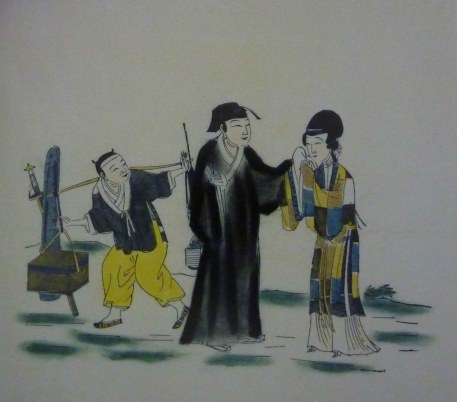
The following painting, lady weeping at parting from husband, 17th century, comes from the Qing Dynasty and the book says it is a color woodblock print on paper.
Chinese poetry is frequently personal and often linked to a particular occasion (page 9).
Deeply in love, but tonight
we seem to be passionless;
I just feel, before our last cup of wine
a smile will not come.
The wax candle has sympathy –
weeps at our separation:
Its tears for us keep rolling down
till day breaks.
by Du Mu (803-852 AD)
As you can see, the Chinese are a passionate people—they just don’t dramatize these passions publicly as many Westerners do—at least until the West invaded China to force—if possible—a different set of values on China’s collective culture.
_______________
Lloyd Lofthouse is the award-winning author of My Splendid Concubine [3rd edition]. When you love a Chinese woman, you marry her family and culture too. This is the love story Sir Robert Hart did not want the world to discover.
Subscribe to “iLook China”!
Sign up for an E-mail Subscription at the top of this page, or click on the “Following” tab in the WordPress toolbar at the top of the screen.
The closest celebration in China to Halloween in the United States is The Hungry Ghost Festival, which is celebrated the 14th or 15th night of the 7th lunar month in July or August.
The Ghost Festival, also known as The Hungry Ghost Festival, is a traditional Chinese festival and holiday celebrated by Chinese in many countries, in which ghosts and/or spirits of deceased ancestors come from the lower realm and/or hell to visit the living.
Buddhists from China and Taoists claim that the Ghost Festival originated with the canonical scriptures of Buddhism, but many of the visible aspects of the ceremonies originate from Chinese folk religion, and other local folk traditions (see Stephen Teiser’s 1988 book, The Ghost Festival in Medieval China).
In America, most children wear costumes and go door to door collecting free candy. In China, food is offered to dead ancestors, joss paper is burned and scriptures are chanted.
Chinese Culture.net says the Hungry Ghost Festival is “Celebrated mostly in South China, Hong Kong, Taiwan and especially in Singapore and Malaysia… It is believed by many Chinese that during this month, the gates of hell are opened to let out the hungry ghosts who then want food.
By comparison, History.com says, “Halloween’s origins date back to the ancient Celtic festival of Samhain (pronounced sow-in). The Celts, who lived 2,000 years ago in the area that is now Ireland, the United Kingdom and northern France, celebrated their new year on November 1. This day marked the end of summer and the harvest and the beginning of the dark, cold winter, a time of year that was often associated with human death. Celts believed that on the night before the New Year, the boundary between the worlds of the living and the dead became blurred.”
I found it interesting that the dead linked both America’s Halloween and The Chinese Hungry Ghost Festival—at least historically.
As a child, I loved wearing a costume on Halloween and going out “trick-or-treating” at night to return home with a heavy bag (usually a pillowcase) filled with candy.
I still remember how much my stomach hurt and how terrible I felt after gorging myself on all that free candy.
Today, due to the epidemic of diabetes and overweight or obese children in the United States, I do not celebrate Halloween and do not give candy to children. The last time I gave treats to children on Halloween, I handed out small boxes of raisins (sweet dried grapes) instead of candy, and one mother called me cheap.
But Science Daily.com comes to my defense with: “Teenagers who consume a lot of added sugars in soft drinks and foods may have poor cholesterol profiles—which may possibly lead to heart disease in adulthood, according to first-of-its-kind research reported in Circulation: Journal of the American Heart Association.”
In addition, the Centers for Disease Control and Prevention reported, “Teenagers and young adults consume more sugar drinks than other age groups and have been linked to poor diet quality, weight gain, obesity, and, in adults and children, type 2 diabetes.”
Then the Mayo Clinic said, “Type 2 diabetes used to be called adult-onset diabetes. But type 2 diabetes in children is on the rise, fueled largely by the obesity epidemic,” and the American Diabetes Association says, “25.8 million children and adults in the US have diabetes while 79 million have prediabetes.
“Due to excessive sugar consumption, the risk of diabetes may lead to heart disease, stroke, high blood pressure, blindness, kidney disease, nervous system disease, and/or amputation of feet and legs.”
Americans are Addicted to Sugars
To be fair, I can’t leave out the for-profit candy and costume industry in the U.S. that salivates when Halloween arrives. For instance, Forbes reported that consumers spent $1.96 billion on decorations, $360 million on greeting cards, $2.08 billion on candy and $2.6 billion on costumes. Consider that next time you go out shopping for Halloween candy, you’re helping make the rich wealthier at the cost of your child’s health.
In fact, Americans should learn something from the Chinese Hungry Ghost Festival. Do not feed sugary candy to children. Instead, give the sugar to the dead and eat an apple—because there’s a lot of truth to the old saying that if you eat an apple a day, it will help keep the doctor away. And if you doubt that, then I suggest you read this post on Science Daily.
Lloyd Lofthouse is the award-winning author of My Splendid Concubine [3rd edition]. When you love a Chinese woman, you marry her family and culture too. This is the love story Sir Robert Hart did not want the world to discover.
Subscribe to “iLook China”!
Sign up for an E-mail Subscription at the top of this page, or click on the “Following” tab in the WordPress toolbar at the top of the screen.
After I wrote Superior versus Civilized, which mentions that for millennia the Chinese considered everyone outside of the Middle Kingdom a barbarian, the subject stuck in my head.
Why?
As I researched the “Superior versus Civilized” post, I ran into Blogs where Westerners were calling the Chinese barbarians for a variety of reasons.
In this post, I will focus on the opinion I discovered in one Blog.
Warning, the images in this video are graphic and bloody.
The Blog, Animal Abuse in China, attempts building a case that the Chinese are barbarians in these words, “The greatness of a nation and its moral progress can be determined by the way it treats its animal. China tortures animals while little children laugh and cheer. Help the animals who cannot help themselves from this horrific life of torture. Thousands die daily from torture! WE MUST PUT THE SPOTLIGHT ON CHINA!!”
However, if that opinion were true and China was guilty, then most nations are also guilty.
Watch the three YouTube videos to see what I mean.
Warning, the images in this video are graphic and bloody.
Many people in most countries are animal lovers but still eat meat, and there is a lot of pain and suffering that takes place from feed lot to a sanitary package in a super market.
I don’t eat meat, but I’m not an animal lover. I don’t hate animals either. I’ve been a vegan since 1981. Imagine all the animals that didn’t suffer, because I stopped eating meat for health reasons.
Warning, the images in this video are graphic and bloody.
Let’s refer back to that opinion where it says, “The greatness of a nation and its moral progress can be determined by the way it treats its animals.”
If true, America and all Western nations are filled with barbarians. Passing laws won’t change the behavior of people you might consider to be barbarians—wherever they live. New laws just means more people who get caught go to prison, and the United States already has more people locked up than any nation on the planet.
If you don’t believe that, study what happened in America during Prohibition(1920 – 1933). Just click on the link and look at what the charts reveal.
I’m going to borrow an “edited” quote attributed to Jesus Christ—who never wrote anything down—that says, Let the nation that has no guilt cast the first stone.
_______________
Lloyd Lofthouse is the award-winning author of My Splendid Concubine [3rd edition]. When you love a Chinese woman, you marry her family and culture too. This is the love story Sir Robert Hart did not want the world to discover.
Subscribe to “iLook China”!
Sign up for an E-mail Subscription at the top of this page, or click on the “Following” tab in the WordPress toolbar at the top of the screen.
In the West, Pliny’s Natural History encyclopedia (77 – 79 A.D.) was a massive compilation of practical information on medicine and on the natural world. The first institutions in Europe that were considered universities were established in Italy, France, Spain and England in the late 11th and 12th centuries A.D., and public education has been a development of the last 150 to 200 years.
In contrast, many Chinese scholars believe the history of education in China can be traced back as far as the 16th century B.C. during the late Xia Dynasty (1523-1027 B.C.). Throughout this period, education was the privilege of the elites. China Education Center.com
It was during the Han Dynasty (206 BC – 220 AD), that China’s first public education system was established, so it should not come as a surprise that the origins of China’s first encyclopedias can be traced to the late Han Dynasty. The biggest Chinese historiographic work of antiquity was written during this period, and Chinese calligraphy developed into an art.
Then, in 986 A.D., a Sung Dynasty emperor ordered that an encyclopedia be written.
This ancient encyclopedia is known as the Four Great Books of Song (宋四大书), which was compiled by Li Fang (925 – 996 A.D.) and other scholars during the Sung Dynasty (960–1279 A.D.).
The last book (Cefu Yuangui) was finished during the 11th century. The four encyclopedias were published with the intent to collect all known knowledge of the time. Source: History Cultural China
There were one thousand scrolls with 2,200 biographical entries.
This ancient example of the literary world printed about a thousand years ago was commissioned by Vice Primer Zhou Bida (Sung Dynasty), who had a group of scholars proof read the original copy of the encyclopedia before block printing it.
_______________
Lloyd Lofthouse is the award-winning author of My Splendid Concubine [3rd edition]. When you love a Chinese woman, you marry her family and culture too. This is the love story Sir Robert Hart did not want the world to discover.
Subscribe to “iLook China”!
Sign up for an E-mail Subscription at the top of this page, or click on the “Following” tab in the WordPress toolbar at the top of the screen.
The first time I read about China’s singing crickets was in “Empress Orchid” by Anchee Min. Retired concubines spent time carving gourds where these crickets lived to entertain empresses, emperors and princes.
Then I learned about China’s fighting critics from a comment left on this Blog, and there was a link included.
While writing this post, I Googled the subject. In Gardening4us.com, Catherine Dougherty tells us, “cricket culture in China dates back to the Tang Dynasty (618 – 906 AD).”
She says, “It was during this time the crickets first became respected for their powerful ability to ‘sing’ and a cult formed to capture and cage them. And in the Sung Dynasty (960 – 1276 AD)… cricket fighting became popular.”
In TrueUp.net, Kim says, “The Chinese consider the cricket to be a metaphor for summer and courage…”
In addition, Pacific Pest Inc. says, “Crickets are popular pets and are considered good luck in some countries; in China, crickets are sometimes kept in cages, and various species of crickets are a part of people’s diets … and are considered delicacies of high cuisine in places like Mexico and China.” Soon, the United States may be added to this list—Exo, a U.S. company, is producing protein bars from cricket flower. Exo says, “After cleaning the crickets, we dry them to remove the moisture and mill them into fine flour. The result is slightly nutty tasting flour that is high in protein and micronutrients.”
Then from Home Made in China, we learn from Gogovivi, who is based in Qingdao, North China that, “Summer used to mean picking berries in the yard and making jam, canning green beans, going to the farmer’s market, BBQs, lawn mowing, hiking, swimming. Now my whole family looks forward to the arrival of singing crickets.”
_______________
Lloyd Lofthouse is the award-winning author of My Splendid Concubine [3rd edition]. When you love a Chinese woman, you marry her family and culture too. This is the love story Sir Robert Hart did not want the world to discover.
Subscribe to “iLook China”!
Sign up for an E-mail Subscription at the top of this page, or click on the “Following” tab in the WordPress toolbar at the top of the screen.


 Posted by Lloyd Lofthouse
