Learning the power of the Talmud in China and South Korea

September 1, 2015

According to Jewish tradition, the Torah was revealed to Moses about the time of China’s Shang Dynasty (1766 – 1122 B.C.), more than three thousand years ago.

In fact, the Talmud is an organic interpretation through discussion and debate of what the Torah means and teaches.

In most of Asia, the perception of Jews as expert moneymakers does not have the religion-based antagonism that often accompanies the same stereotype elsewhere in the world. While both Christians and Muslims have persecuted Jews for religious reasons, China hasn’t done this.

Instead, South Korea and China respect what may be learned from the wisdom of Judaism.

The Muqata says, “Close to 50 million people live in South Korea, and everyone learns Gemara (Talmud) in school. ‘We tried to understand why the Jews are geniuses, and we came to the conclusion that it is because they study Talmud,’ said the Korean ambassador to Israel.”

“In my country we also focus on family values,” The South Korean Ambassador said. “The (Jewish) respect for adults, respect and appreciation for the elderly parallels the high esteem in my country for the elderly.”

Another significant issue is the respect for education. In the Jewish tradition, parents have a duty to teach their children and devote a lot of energy and attention to it.

For South Korean parents, their children’s education is also a top priority. For contrast, in the United States too many ignorant and lazy parents blame teachers when their children are not learning, but not in Asia.

How valuable is education to Jewish tradition? “Maimonides (1135 – 1204 C.E.) in his great code of Jewish law has an entire section devoted to teaching, teachers, students and the concept of knowledge and education. The basic value is that teachers are to be respected and given honor.

“One should rise before one’s teacher, speak respectfully to one’s teacher, and treat one’s teacher with greater probity than even one’s parent.” The Talmud teaches, “parents bring a child into this world but a teacher can bring a child into the World to Come” into a world of spirit, creativity, ideas and self-worth and ultimate immortality.

In fact, “the Talmud itself attributes to God, so to speak, the attribute of being a teacher. “He Who teaches Torah to His people Israel.” Even mortal teachers are viewed in Judaism as being engaged in holy work.

These ancient Jewish values have also found a home in China.

Newsweek reported, “The apparent affection for Jewishness has led to a surprising trend in publishing over the last few years: books purporting to reveal the business secrets of the Talmud that capitalize on the widespread impression among Chinese that attributes of Judaism lead to success in the financial arts.”

Newsweek said, “Titles such as Crack the Talmud: 101 Jewish Business Rules, The Illustrated Jewish Wisdom Book, and Know All of the Money-Making Stories of the Talmud share the shelves with stories of Warren Buffet and Bill Gates.”

“The admiration for Judaism stems from a history that goes beyond business,” Newsweek continues. “About half of the dozen or so Westerners active in Mao Zedong’s China were Jewish, and that also led to increased interest in Jewish culture among Chinese intellectuals,” says Xu Xin, professor of Jewish studies at Nanjing University.

______________________________

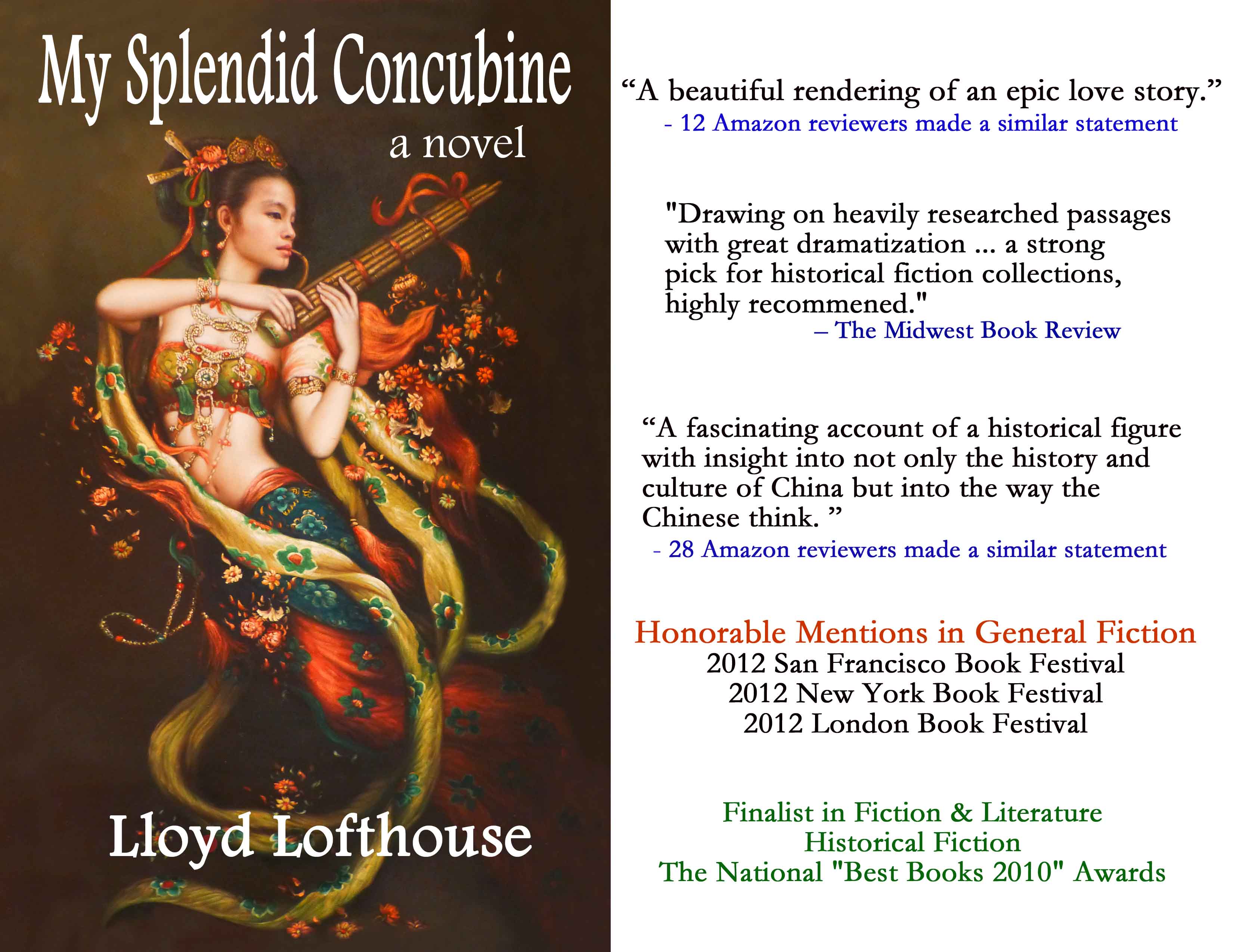
Lloyd Lofthouse is the award-winning author of My Splendid Concubine [3rd edition]. When you love a Chinese woman, you marry her family and culture too. This is the lusty love story Sir Robert Hart did not want the world to discover.

IMAGE with Blurbs and Awards to use on Twitter

Where to Buy

Subscribe to “iLook China”!
Sign up for an E-mail Subscription at the top of this page, or click on the “Following” tab in the WordPress toolbar at the top of the screen.

About iLook China

China’s Holistic Historical Timeline


The Cultural Glue that Holds China together

August 26, 2015

Under Qin Shi Huangdi, China’s first emperor, who united China in 221 BC, a standardized written language was mandated for an empire that once resembled Europe with many countries and written languages, and this created a unique cultural identity from the rest of the world.

To understand this, I’m turning to a conversation thread from the Yuan-Xiao Festival. Alessandro, a European with a degree in East Asian studies, who lives in China with his Chinese wife, wrote a comment that helped me understand something I’d read years ago written by Lin Yutang.

Writing of the Chinese Mind on page 81 of the 1938 Holcyon House Edition of My Country and My People, Lin Yutang wrote, “The Chinese language and grammar … in its form, syntax and vocabulary, reveals an extreme simplicity of thinking, concreteness of imagery and economy of syntactical relationships.”

I didn’t clearly understand what Lin Yutan meant until Alessandro’s comment. “The Latin alphabet is a phonetic one,” Alessandro said, “and as such, it simply reproduces the sounds of the spoken language, making it more susceptible of changes whenever the spoken language changes. Chinese Hanzi, on the other hand, conveys almost no ‘phonetic’ information by itself … (and doesn’t change much in its meaning as time passes).”

 
Cultural Competence: Managing Your Prejudices

Alessandro went on to say, “Both Europe and China have had political upheavals and long periods in which they were divided, but (China) having a stable writing system that doesn’t change as much as an alphabetic one helped them not to lose an important element of cultural unity, therefore of ‘national’ identity…

“The Chinese concept of ‘nation’ has nothing to do with the ‘nation state’ concept common in Europe (and North America).

“European nation states are more or less based on ethnicity, while in China it was – and it still somewhat is – based on cultural elements.

“You were Chinese because you shared a common culture, because you acted as a Chinese and assumed Chinese customs.

“Europe never regained the unity that existed during the Roman Empire, while China always strove to regain unity after each period of division. The traditional saying 合久必分,分久必合 — means more or less ‘after unity comes division, after division comes unity’.”

While the West—North America and Europe—has many written languages, China has had one for more than two millennia and this has been the glue that creates a sense of unity and what it means to be Chinese. Westerns don’t have that sense or cultural identity or unity.

______________________________

Lloyd Lofthouse is the award-winning author of My Splendid Concubine [3rd edition]. When you love a Chinese woman, you marry her family and culture too. This is the lusty love story Sir Robert Hart did not want the world to discover.

IMAGE with Blurbs and Awards to use on Twitter

Where to Buy

Subscribe to “iLook China”!
Sign up for an E-mail Subscription at the top of this page, or click on the “Following” tab in the WordPress toolbar at the top of the screen.

About iLook China

China’s Holistic Historical Timeline


Long before Romeo and Juliet there was China’s Butterfly Lovers

August 25, 2015

The legend of The Butterfly Lovers first appeared in 618 AD during the Tang Dynasty, and it’s a tragic Chinese love story similar to Romeo and Juliet.

The basic premise is of a young woman in China wanting to go to school. Since boys were the only ones allowed to attend school, this young woman, like Barbara Streisand in the movie Yentl (1983), disguised herself as a boy.

Yentl was based on Isaac Bashevis Singer’s (1902 – 1991) short story Yentl the Yeshiva Boy.

When I talked to my wife about this, she found her copy of a popular theme song from The Butterfly Lovers played as a violin solo by Yu Lina. As the house filled with the music, which may also be found on the next embedded YouTube video, my wife started to dance.

She said, “This is one of my favorites. I cannot resist dancing when I hear it.”

In fact, Yentl the Yeshiva Boy and Shakespeare’s (1564 – 1616) Romeo and Juliet must be combined to become The Butterfly Lovers. What starts as a charade becomes a love story ending in the suicide of the two young lovers.

The love story of Liang Shanbo and Zhu Yingtai is one of four Chinese folk legends and one of the most influential and best known in China.

China has traded with the West since the Han Dynasty (206 BC – 219 AD). There was an overland route in the north and a sea route in the south, which the Roman Empire used around the time of Christ.

Since China traded with the West for more than two thousand years, it is conceivable that The Butterfly Lovers reached the West and was adapted by Shakespeare and then Singer after being exposed to the plot.

______________________________

Lloyd Lofthouse is the award-winning author of My Splendid Concubine [3rd edition]. When you love a Chinese woman, you marry her family and culture too. This is the lusty love story Sir Robert Hart did not want the world to discover.

2015 Promotion Image for My Splendid Concubine

Subscribe to “iLook China”!
Sign up for an E-mail Subscription at the top of this page, or click on the “Following” tab in the WordPress toolbar at the top of the screen.

About iLook China

China’s Holistic Historical Timeline


Cupid in China

August 12, 2015

For millennia, Chinese parents and/or matchmakers played cupid and arranged marriages sometimes as early as birth.

However, that is changing. China Daily reports that “Nearly 30 percent of those born after the 1990s admitted that their first ‘puppy love’ happened in primary or junior high school, according to Baihe, a major dating website that recently conducted an Internet survey of more than 50,000 people across the country. Only 3 percent of those born before the 1970s gave the same answer.”

And Sufie, of Sexy Beijing, takes us on a journey to discover what’s happening to matchmaking Cupids in China.

One man Sufie interviews on the street says he was born in the late 70’s, and he has no problem with traditional matchmaking but those born in the 80s and afterwards may not like it.

In this embedded episode of Sexy Beijing, Sufie wants to discover if arranged marriages are still popular in China. To discover what she learned, watch the video


Sexy Beijing: Matchmaker, Matchmaker

Cupid is no stranger to China and may have traveled here on the southern Silk Road when the Roman Empire was trading with the Han Dynasty (206 BC to 219 AD).

Top News, China Through a Lens reports that archaeologists working at the Quren Ruins of Yunyang County, Chongqing Municipality discovered what easily passes as a little bronze cupid.

“The discovery of the naked “cupid” naturally associates the Han Dynasty and ancient Greece and Roman Empire”.

But sometimes Cupid’s arrow misses. Watch the next video to discover a modern Chinse girl who proposed to a guy in public and gets rejected.

______________________________

Lloyd Lofthouse is the award-winning author of My Splendid Concubine [3rd edition]. When you love a Chinese woman, you marry her family and culture too. This is the lusty love story Sir Robert Hart did not want the world to discover.

IMAGE with Blurbs and Awards to use on Twitter

Subscribe to “iLook China”!
Sign up for an E-mail Subscription at the top of this page, or click on the “Following” tab in the WordPress toolbar at the top of the screen.

About iLook China

China’s Holistic Historical Timeline


Searching for Shakespeare’s Romeo and Juliet in China

August 4, 2015

Shakespeare’s drama Romeo and Juliet is often taught to ninth graders in US high schools. Other Shakespeare plays are studied at other grade levels and in college.

However, you may be surprised to discover Shakespeare is probably more popular in China since his work is taught in most Chinese universities, both in English and in Chinese, and Shakespearean texts are easily available in China in both languages.

When Mao ruled China (1949 to 1976), Shakespeare was banned as was Aristotle and other Western philosophers.  Mao died in 1976, and that ban was lifted in 1978.

In fact, according to Cheng Zhaoxiang, the author of Teaching Shakespeare in China, “It is no exaggeration to say that every educated Chinese knows something about Shakespeare.”

However, when produced in China on stage, the plot may not stay true to the original Shakespeare.

Writing for the The People’s Republic of Shakespeare, Adventures in Chinese Research, Meammi says, “My interest in this topic started when I noticed that many of the Romeo and Juliets performed in China are either parodies or rewrites where one of the lovers survives in the end.

“China has their own pair of star-crossed lovers (The Peony Pavilion – 1598 AD), who tragically die for love and their plight is described in a much more mournful tone than Shakespeare’s version.

“Some Chinese theater companies state in interviews that their audiences have too much sadness in their lives so Romeo just can’t die in the end of their performance.”

______________________________

Lloyd Lofthouse is the award-winning author of My Splendid Concubine [3rd edition]. When you love a Chinese woman, you marry her family and culture too. This is the lusty love story Sir Robert Hart did not want the world to discover.

IMAGE with Blurbs and Awards to use on Twitter

Subscribe to “iLook China”!
Sign up for an E-mail Subscription at the top of this page, or click on the “Following” tab in the WordPress toolbar at the top of the screen.

About iLook China

China’s Holistic Historical Timeline