Caressing Nature with Chinese Calligraphy

July 3, 2010

It would be difficult to talk about Chinese art without understanding Chinese calligraphy and its artistic inspiration. A painting has to convey an object, but a well-written character conveys only its beauty through line and structure.

In Shanghai, or Beijing, I’ve watched men with longed handled brushes, as seen in the first video, using water for ink and concrete for paper. With grace, they exhibit the skills of a Rembrandt breathing life to the characters.

Lin Yutang writes in My Country and My People that Western art is more sensual, more passionate, fuller of the artist’s ego, while the Chinese artist and art-lover contemplates a dragonfly, a frog, a grasshopper or a piece of jagged rock—more in harmony with nature.

Owing to the use of writing calligraphy with a brush, which is more subtle and more responsive than the pen, calligraphy as art is equal to Chinese painting. Through calligraphy, the scholar is trained to appreciate, as regards line, qualities like force, suppleness, reserved strength, exquisite tenderness, swiftness, neatness, massivness, ruggedness, and restraint or freedom.

Maybe this helps explain why the Chinese are not as warlike as Christian and Islamic cultures.

See Chinese Yu Opera with Mao Wei-tao

______________

Lloyd Lofthouse is the award-winning author of the concubine saga, My Splendid Concubine & Our Hart. When you love a Chinese woman, you marry her family and culture too.

If you want to subscribe to iLook China, there is a “Subscribe” button at the top of the screen in the menu bar.


Sinophobia and the Nation With the Soul of a Church

July 1, 2010

An old friend of mine once wrote in an e-mail that Communism was evil and if China didn’t do what America wanted, the US would spank them. That and his endless born-again preaching bruised about five decades of friendship. Now, we don’t communicate much.

The definition for Sinophobia is one who fears or dislikes China, its people or its culture—in other words, an ignorant, brainwashed bigot (my opinion).

This morning, I finished reading  An Exceptional Obsession by John Lee, which was published in The American Interest. On page 42, Lee wrote, “Above all, Chinese leaders are anxious about having to deal with a society so different from their own, and by different we don’t mean a superficial contrast between communism and capitalism.  China’s is a communal culture; America’s is individualist. China is rooted in its land longer and more deeply than any society on earth. America is an immigrant society and an unprecedentedly mobile one at that. China has never institutionalized the rule of law; America is fundamentally based on it. China has never experienced deistic religions; America, as Chesterton once said is “a nation with the soul of a church.”

Lee’s comparison reminded me of the few shallow Communist haters and Sinophobic people I’ve run into on the Internet, who live in this nation with the soul of a church. Occasionally, one crawls out of the woodpile on a thousand legs.

Discover Power Corrupts

______________

Lloyd Lofthouse is the award-winning author of The Concubine Saga. When you love a Chinese woman, you marry her family and culture too. This is the love story Sir Robert Hart did not want the world to discover.

To subscribe to “iLook China”, look for the “Subscribe” button at the top of the screen in the menu bar, click on it then follow directions.


Chinese Pavilion, Shanghai World Expo

June 28, 2010

Dan Redford writes in The Huffington Post that at the Shanghai World Expo, the Chinese Pavilion is a 220 million dollar advertisement for the Chinese people and the world to see.

Redford’s post is worth reading, but he misses a few points when he says, “China’s economic growth is happening exclusively in cities.”  That’s old news.

Evidently, he hasn’t heard that last year China’s ruling body launched a five-year plan to extend the electric grid into rural China and subsidize modern electric appliances for peasants, explore ways to modernize rural villages, build about 40,000 additional kilometers of railroads while crisscrossing the country with a grid of high-speed rail.

China was the most powerful nation on the planet between 206 BC and 1800 AD. The Han Dynasty was more powerful and more technologically advanced than the Roman Empire at its height.  Prior to British opium flooding China from India early in the 19th century, China had the largest economy in the world.

Starting with the first Opium War, that power was robbed by the West.  It wasn’t until Deng Xiaoping said, “Getting rich (and powerful) is glorious”, that the Chinese started to get back on their feet. He also said, “Some areas must get rich before others.”

China was a global power for more than two millennia.  America has only been one since the end of World War II in 1945. Although Redford doesn’t say so, it was obvious that the Chinese are sending a strong message—”We are back”.

To discover more about Shanghai visit:
Shanghai
Shanghai’s History & Culture
Eating Gourmet in Shanghai
Shanghai Huangpu River Tour
Shanghai Huxinting Teahouse

_________________________

Lloyd Lofthouse is the award-winning author of the concubine saga, My Splendid Concubine & Our Hart. When you love a Chinese woman, you marry her family and culture too. 

If you want to subscribe to iLook China, there is a “Subscribe” button at the top of the screen in the menu bar.


Conversation—Sung Dynasty Philosophy

June 28, 2010

China may be the only ancient culture that survived the spread of Islam and Christianity and managed to hold onto its identity.

________________________________

“Guan-jiah,” Robert said, “before I came to China I read The Travels of Marco Polo. Do you know who he was?”

“No, Master,” Guan-jiah replied.

“He came to China from Europe more than six hundred years ago and served under Kublai Khan during the Yuan Dynasty. Polo wrote that Hangzhou was the finest and noblest city in the world.”

“Hangzhou was the capital of the Southern Sung Dynasty, Master,” Guan-jiah said. “I’ve heard it is beautiful. Sung philosophy says that we have the power in our minds to overcome our emotions.”

“Marco Polo believed it was God’s will that he came back from China so others in the West might know what he’d seen.” Robert turned to his servant, who was the last in line. “Do you believe in this Sung philosophy, Guan-jiah?”

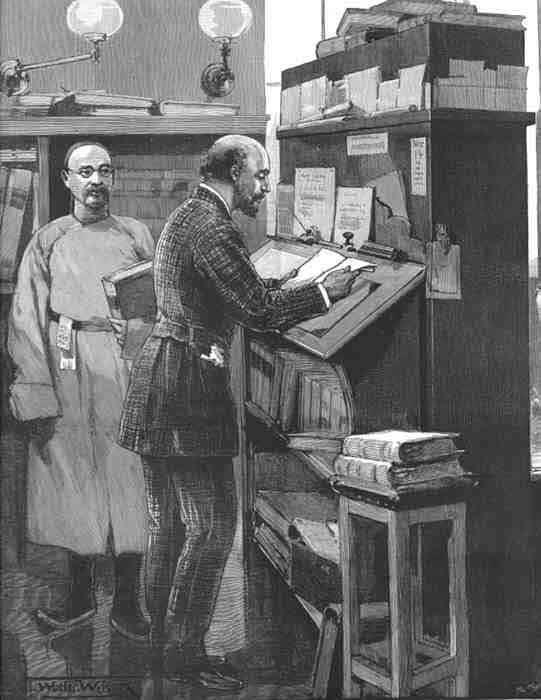
Guan-jiah and Robert Hart - 19th century China

“The Sung said that if you know yourself and others, you would be able to adjust to the most unfavorable circumstances and prevail over them.”

“That’s admirable, Guan-jiah. You never mentioned you were a scholar. If the Sung Dynasty was that wise, I want to see Hangzhou one day.”

“I am no scholar, Master, but I must believe in the Sung philosophy to survive. I have read and contemplated much literature. However, I am like a peasant and have never mastered calligraphy. It is a skill that has eluded me.”

“How old were you when you studied this philosophy?”

“I was eleven, Master, two years after I was sent to Peking.”

Source: From Chapter 4, My Splendid Concubine
See The Influence of Confucius

_________________________

Lloyd Lofthouse,
Award winning author of Hart’s concubine saga, My Splendid Concubine & Our Hart. When you love a Chinese woman, you marry her family and culture too. 

Sign up for an RSS Feed for iLook China


The Eighteen Levels of Chinese Hell

June 27, 2010

Many Chinese believe heaven/paradise is out of reach of ordinary mortals. However, hell is a harsh reality and the souls of the dead must go.

Buddhists brought this concept of hell to China from India, and over time, this belief grew wings and picked up baggage as it spread. Taoism, Buddhism and traditional Chinese folk religions believe that the souls of the dead must experience several tests before reaching the gates of hell, where demons demand money to enter, which might explain why many Chinese burn paper money at funerals to make sure beloved family members have some for the journey.

one of the eighteen levels to hell

There are eighteen levels on this journey—each one a test. For criminals, the souls are heavy and the trip long and painful. Chinese almanacs graphically illustrated the punishments. Good souls were light and made the journey quickly.

Today, these beliefs are probably more alive in rural China than urban areas where Mao’s Cultural Revolution had more of an impact driving out old beliefs.  Most Taiwanese and many in Hong Kong still hold to these beliefs.

If given a choice, which hell would you select—Chinese, Islamic or Christian?

Discover The Failure of Multiculturalism in the United States

_______________

Lloyd Lofthouse is the award-winning author of My Splendid Concubine [3rd edition]. When you love a Chinese woman, you marry her family and culture too. This is the love story Sir Robert Hart did not want the world to discover.

Subscribe to “iLook China”!
Sign up for an E-mail Subscription at the top of this page, or click on the “Following” tab in the WordPress toolbar at the top of the screen.

About iLook China