China’s Ancient Chimes

September 9, 2010

In 1977, a discovery was made in China—a complete set of chime bells were unearthed from the tomb of Marquis Yi, who lived during the Warring States Period (475 to 221 BC). These chimes were older than the Qin Dynasty’s famous Terra Cotta warriors (221 to 206 B.C.) were.

When the chimes were discovered in Hubei Province, a plot of land was being leveled to build a factory.  The Red Army officer in charge of the work had an interest in archeology.

The officer discovered that the workers were selling the ancient bronze and iron artifacts they were digging up. He convinced local authorities there might be an ancient tomb buried below the site.

When the tomb was unearthed, a set of chime bells was found.  These musical instruments were an important part of ritual and court music going back to ancient times. An American professor in New York City even called these chimes the eighth wonder of the ancient world.

The sixty-five chime bells weighed about 5 tons.

No other set of chimes like this had been discovered in China before and this set was in excellent condition.

A project was launched in 1979 to duplicate four sets of these chimes. More than a 100 scientists and technicians were recruited.  In 1998, twenty years after the discovery, the project was completed. One of the sets was sent to Taiwan as a gift.

See The Sheng, one of China’s Oldest Musical Instruments

_______________

Lloyd Lofthouse is the award-winning author of the concubine saga, My Splendid Concubine & Our Hart. When you love a Chinese woman, you marry her family and culture too. 

Sign up for an RSS Feed for iLook China


Emperor Wu of Zhou Dynasty – Part 4/4

September 7, 2010

The Temple of Heaven in Beijing is a tribute to the Rituals from the Zhou Dynasty.

What the Zhou Dynasty established is still embedded in everyday aspects of Chinese social life. Showing respect for family ancestors originated with the Zhou Dynasty and is practiced today all over China.

The Book of Songs was the first poetry collection in Chinese history. Among the poems is the Eulogy for the Zhou Dynasty.


Video: Chinese with English subtitles.

The Book of Changes, which also discusses military thought, came from the Zhou Dynasty.

The civilization established by the Zhou Dynasty influenced the cultures of Korea, Japan and Southeast Asia.

Duke Zhou, Emperor Wu’s younger brother, was regent for seven years when King Cheng was mature enough to assume the power of king.  Duke Zhou stepped aside.

The Zhou Dynasty is also known for its bronze castings with history unscripted on them. Jade became important at this time too.

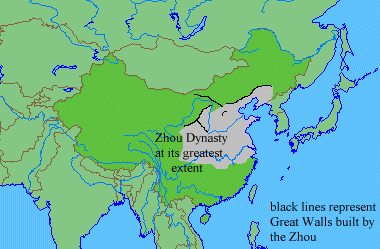
Zhou Dynasty at its greatest

The Zhou Dynasty attached great importance to agriculture and a large number of bronze farming tools were extensively used.

The Zhou Dynasty continued to expand as other states were slowly absorbed.  The Zhou also fought the nomads to the north and northwest.

Return to Emperor Wu of Zhou Dynasty – Part 3 or start with Part 1

______________

Lloyd Lofthouse is the award-winning author of The Concubine Saga. When you love a Chinese woman, you marry her family and culture too. This is the love story Sir Robert Hart did not want the world to discover.

To subscribe to “iLook China”, sign up for an E-mail Subscription at the top right-hand side of this page and then follow directions.


Emperor Wu of Zhou Dynasty – Part 3/4

September 7, 2010

Historical records shows that the Zhou people introduced what would become Chinese social codes—some followed to this day.

Duke Zhou, a younger brother to Emperor Wu, became an important figure after his older brother’s death.

According to tradition, the oldest son would succeed to his father’s position. Due to this, King Wu’s son, Jisong, became emperor after his father’s death.

Jisong became King Cheng but was too young to rule, so his uncle, the Duke of Zhou, became regent.

Some of the vassal states didn’t like this and revolted. Duke Zhou led a military expedition to suppress the revolt.


Video: Chinese with English subtitles

Duke Zhou then wrote China’s first laws known as the Ritual of Zhou—more than 3,000 rules that covered behavior and manners.

The rules also formulated wedding rituals and required ancestral temples in each vassal state, which encouraged loyalty to the king. The Zhou Dynasty attached great important to ritual and music.

The Kings of Zhou proclaimed that they were “the sons of Heaven.”  There were rituals for burials.

Worship for ancestors and Heaven were of prime importance and were practiced into the 20th century, which explains the Temple of Heaven in Beijing.

The Zhou tomb of the Marquis of Jin was discovered in 1992 in Shanxi province. Many jade articles were found.

Return to Emperor Wu of Zhou Dynasty – Part 2 or continue to Part 4

______________

Lloyd Lofthouse is the award-winning author of The Concubine Saga. When you love a Chinese woman, you marry her family and culture too. This is the love story Sir Robert Hart did not want the world to discover.

To subscribe to “iLook China”, sign up for an E-mail Subscription at the top right-hand side of this page and then follow directions.


Emperor Wu of Zhou Dynasty – Part 2/4

September 7, 2010

To defeat the Shang Dynasty, King Wu crossed the Yellow River and immediately marched his army toward the capital.

At the Battle of Muye, the Zhou army was outnumbered more than three to one with less than fifty thousand troops against one hundred and seventy thousand.

However, during the battle, many slaves and conscripted prisoners of war from other tribes in the Shang army changed sides to fight with the Zhou army.


Video: Chinese with English subtitles

The remaining Shang army offered little resistance after that.  The Shang king fled to his capital leaving what was left of his army behind. Once he arrived at his capital, he set himself on fire.

To honor his father, King Wu named him the founder of the Zhou Dynasty (1126 – 222 B.C.). Now an Emperor, Wu established a feudal kingdom built on a patriarchal clan system.

The agricultural system of the time required peasants to not only farm the land they owned but also a plot of state land—this was called the “jing-fields” system.

Return to Emperor Wu of Zhou Dynasty – Part 1 or continue with Part 3

______________

Lloyd Lofthouse is the award-winning author of The Concubine Saga. When you love a Chinese woman, you marry her family and culture too. This is the love story Sir Robert Hart did not want the world to discover.

To subscribe to “iLook China”, sign up for an E-mail Subscription at the top right-hand side of this page and then follow directions.


Emperor Wu of Zhou Dynasty – Part 1/4

September 6, 2010

Wu of the Western Zhou Dynasty was named Jifa. He was the second son of King Wen, and the founder of the Western Zhou Dynasty.

The Zhou Dynasty would last almost 900 years. Source: Cultural China

The Zhou people lived along the western part of the Yellow River and were one of the first nations to develop agriculture. To the Northwest of Zhou were barbarian tribes.


Video: Chinese with English subtitles

The Zhou capital was near today’s modern city of Xian in Shanxi Province, and the Zhou, a vassal state, were given the job of protecting the Shang Dynasty’s western frontier.

However, while the brutal last king of the Shang Dynasty waged endless wars with surrounding tribes, the Zhou ruler placed more importance on developing agriculture and his small kingdom grew wealthy.

Zhou’s prosperity bothered the Shang king so he threw King Wen in prison.  After his release, Wen recruited a talented general to lead his army to wage war on the Shang Dynasty.

The Zhou king died during the war and his son Wu became king and defeated the Shang. To achieve this victory King Wu forged an alliance with other Shang vassal states.

According to historical records, the Shang Dynasty fell in the first month of 1027 B.C.

Continued with Emperor Wu of Zhou Dynasty – Part 2

______________

Lloyd Lofthouse is the award-winning author of The Concubine Saga. When you love a Chinese woman, you marry her family and culture too. This is the love story Sir Robert Hart did not want the world to discover.

To subscribe to “iLook China”, sign up for an E-mail Subscription at the top right-hand side of this page and then follow directions.