China’s Queen of the Golden Voice

December 7, 2016

Jingyun Dagu is a form of Chinese opera where stories are often sung in a Beijing dialect accompanied by a drum along with one or two other musical instruments.

The focus is on the singing that depicts stories in short episodes.

Dagu was first popular near the end of the Qing Dynasty (1644-1911).

One super star of Dagu was Luo Yusheng, who was born in 1914, and died at 89 in 2002. Her stage name was Xiao Caiwu. She studied under Su Huanting at the age of nine in order to play Laosheng (old man) roles in Peking Opera. At 14, she gave performances in singing without musical accompaniment in Nanjing, before she formally switched to Jingyun Dagu at the age of 17.

In 1934, Luo Yusheng studied at the Liu School of Jingyun Dagu (storytelling in Beijing dialect while beating a drum, accompanied by two or three persons who play three-stringed instruments).

At one time she was well known by most of China, and her fans called her the Queen of the Golden Voice.

After the PRC was founded in 1949, Dagu singers were regarded as people’s artists or actors, who sang traditional stories and new operas with themes reflecting contemporary life. For instance, patriotic Communist stories like Glorious Journey, Red Flag Over Mount Everest, and Patriotism and Roaring Waves.

The singer/drummer is often accompanied by the Sihu, a four-stringed instrument similar to an Erhu, and Pipa (lute) in addition to three-stringed lutes and wooden clappers.

Discover Wu Zetian, China’s only female emperor

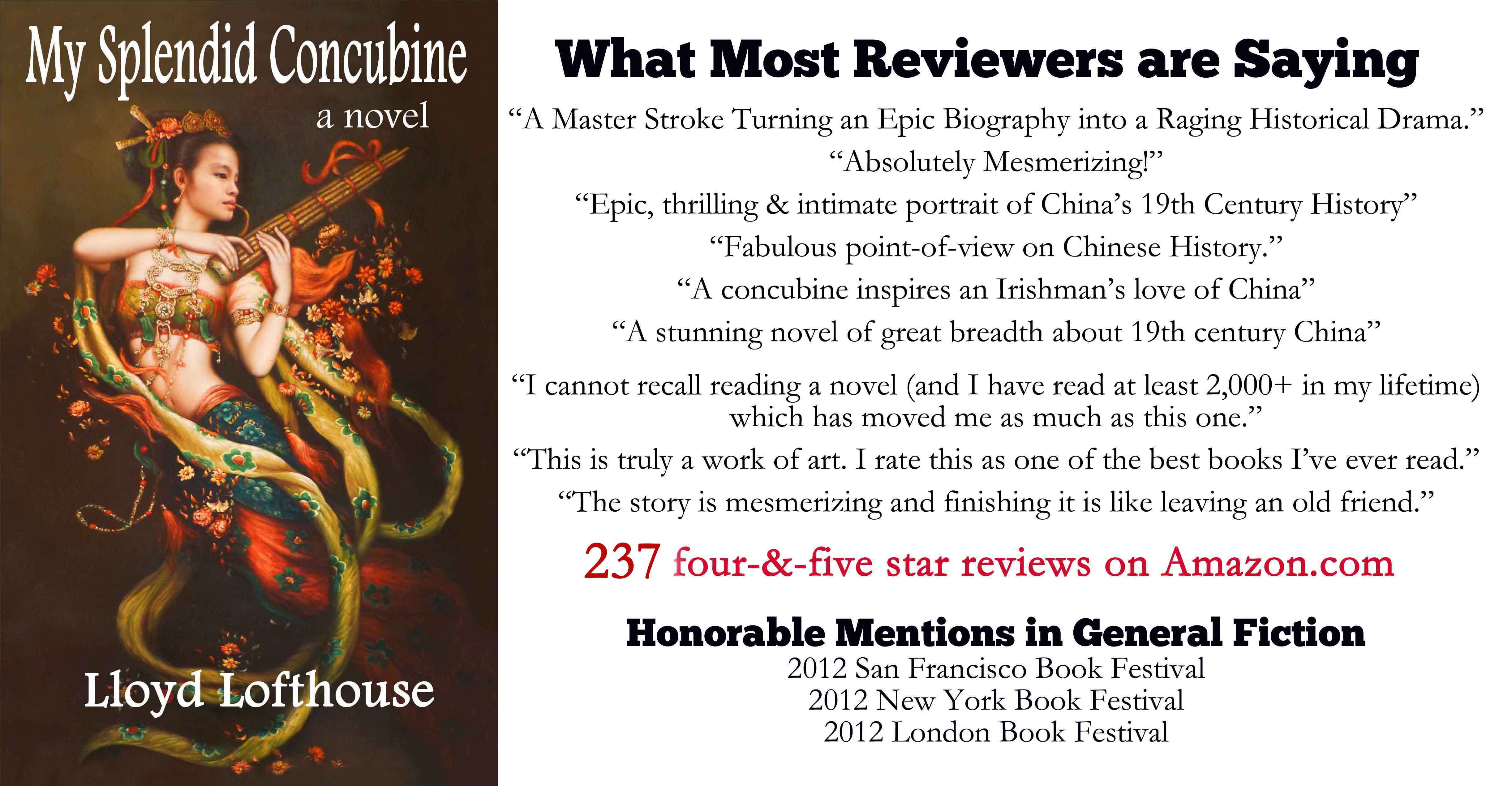
Lloyd Lofthouse is the award-winning author of My Splendid Concubine [3rd edition]. When you love a Chinese woman, you marry her family and culture too. This is the unique love story Sir Robert Hart did not want the world to discover.
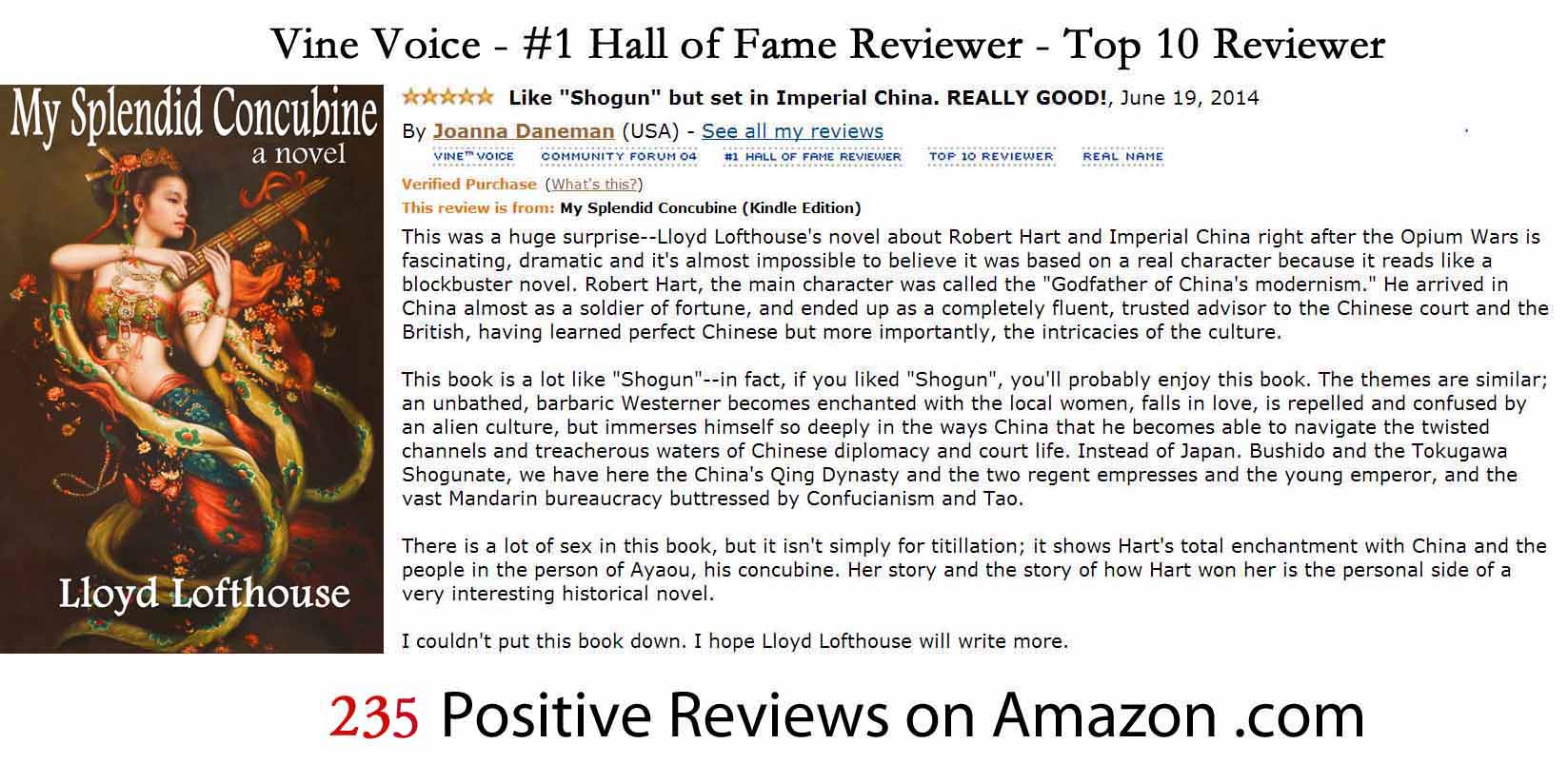
1-joanna-daneman-review-updated-sept-21-2016_edited-3

Where to Buy

Subscribe to “iLook China”!
Sign up for an E-mail Subscription at the top of this page, or click on the “Following” tab in the WordPress toolbar at the top of the screen.

About iLook China

China’s Holistic Historical Timeline


Kung Fu Cricket Mania

November 30, 2016

The first time I read about China’s singing crickets was in “Empress Orchid” by Anchee Min.  Retired concubines spent time carving gourds where these crickets lived. The crickets entertained empresses, emperors, and princes.

Then I learned about China’s fighting critics from a comment left on this Blog, and there was a link included.

While writing this post, I Googled the subject. In Gardening4us.com, Catherine Dougherty says, “Cricket culture in China dates back to the Tang Dynasty (618 – 906 AD).

“It was during this time the crickets first became respected for their powerful ability to ‘sing’ and a cult formed to capture and cage them. And in the Sung Dynasty (960 – 1276 AD)… cricket fighting became popular.”

The Chinese consider the cricket to be a metaphor for summer and courage. Pacific Pest Inc. says, “Crickets are popular pets and are considered good luck in some countries; in China, crickets are sometimes kept in cages, and various species of crickets are a part of people’s diets … and are considered delicacies of high cuisine in places like Mexico and China.”

Soon, the United States may be added to this list, because Exo, a U.S. company, is producing protein bars from cricket flower. “After cleaning the crickets, we dry them to remove the moisture and mill them into fine flour. The result is slightly nutty tasting flour that is high in protein and micronutrients.”

From Home Made in China, we learn “Summer used to mean picking berries in the yard and making jam, canning green beans, going to the farmer’s market, BBQs, lawn mowing, hiking, swimming. Now my whole family looks forward to the arrival of singing crickets.”

Discover Wu Zetian, China’s only female emperor

Lloyd Lofthouse is the award-winning author of My Splendid Concubine [3rd edition]. When you love a Chinese woman, you marry her family and culture too. This is the unique love story Sir Robert Hart did not want the world to discover.

a1-237-promo-cover-on-october-8-2016_edited-1

Where to Buy

Subscribe to “iLook China”!
Sign up for an E-mail Subscription at the top of this page, or click on the “Following” tab in the WordPress toolbar at the top of the screen.

About iLook China

China’s Holistic Historical Timeline


An Art Form that started in China more than 6,000 years ago

November 22, 2016

Chinese brush painting developed over a period of more than six thousand years; landscape painting was established by the 4th century, and figure painting developed beyond religious themes during the Song Dynasty (960 – 1127 AD) starting in the 10th century.

Another style is flower-and-bird painting, which became independent of other Chinese brush art around the 9th century. This gradually developed into two different styles. Asia Art.net

One famous 20th century Chinese brush-painting artist was Chen Zhifo (1896 – 1962), who was born to an educated family.  At 23, he went to Japan to learn patterns that later influenced his painting style.

Chen would become a renowned painter in the early 20th century. His artistic career started in design, patterns and other arts. When he started Gongbi style flower-and-bird painting, he was almost 40, and he revived the declining tradition of Gongbi. To discover how successful Chen has been, Christies.com sold one of his paintings for USD$242,400.

When Chen started painting, he usually sketched his subjects then went through many drafts modifying them before applying colors as he focused on the design of branches, leaves and birds to portray his subjects.

Discover Anna May Wong, the woman that died a thousand times.

Lloyd Lofthouse is the award-winning author of My Splendid Concubine [3rd edition]. When you love a Chinese woman, you marry her family and culture too. This is the unique love story Sir Robert Hart did not want the world to discover.

a1-237-promo-cover-on-october-8-2016_edited-1

Where to Buy

Subscribe to “iLook China”!
Sign up for an E-mail Subscription at the top of this page, or click on the “Following” tab in the WordPress toolbar at the top of the screen.

About iLook China

China’s Holistic Historical Timeline


Music with Two Strings

October 18, 2016

If you Google the name for this two stringed instrument, you may find the same name is used for girls names and a railroad that runs between Beijing and Shanghai. Jing is for the capital and Hu for Shanghai.

Since Chinese is a tonal language, each word is pronounced in a different tone.  The word is also written differently in Chinese when used for a girl’s name or the railroad.

京胡
for the musical instrument


Beijing-Shanghai

The Jing-Hu I’m writing about is a two-stringed instrument often used with Beijing Opera. The Jing-Hu first appeared during the Qing Dynasty (1644 – 1912).  In the 17th century the strings were made of silk. Today, they are often made of steel or nylon.  The Jing-Hu is the smallest of the Chinese fiddles and is related to the larger Erhu.

Discover China’s First Emperor Qin Shi Huangdi, the man that unified China more than 2,000 years ago.

Lloyd Lofthouse is the award-winning author of My Splendid Concubine [3rd edition]. When you love a Chinese woman, you marry her family and culture too. This is the unique love story Sir Robert Hart did not want the world to discover.

on-sale-october-november-2016

Where to Buy

Subscribe to “iLook China”!
Sign up for an E-mail Subscription at the top of this page, or click on the “Following” tab in the WordPress toolbar at the top of the screen.

About iLook China

China’s Holistic Historical Timeline


Discover the history of China’s drums

August 31, 2016

The earliest evidence of the use of drums in China was found in Oracle inscriptions from the Shang Dynasty (1783-1123 BC).

Drums were used to motivate troops, set a marching pace and for sending orders or announcements.

The drum had a purpose in almost all elements of Chinese life. Copper drums come from southern China and date to almost a thousand years before Christ.  The copper drum was also called the war drum.

The Han Dynasty used copper drums for war too.

The Fengyang Drum Dance originated in Anhui Province and was used by traveling musicians and dancers in the streets of villages and towns. In time, it would represent poverty.

Tibetan drums, and Tibet is part of China, are part of the Sholdon (Yogurt) Festival, which occurs in late August.

Drums are also used for the traditional Chinese New Year’s Lion Dance.

Discover China’s First Emperor Qin Shi Huangdi, the man that unified China more than 2,000 years ago.

Lloyd Lofthouse is the award-winning author of My Splendid Concubine [3rd edition]. When you love a Chinese woman, you marry her family and culture too. This is the unique love story Sir Robert Hart did not want the world to discover.

#1 - Joanna Daneman review posted June 19 2014

Where to Buy

Subscribe to “iLook China”!
Sign up for an E-mail Subscription at the top of this page, or click on the “Following” tab in the WordPress toolbar at the top of the screen.

About iLook China

China’s Holistic Historical Timeline