Hung Huang, one of China’s four Opras, and the CEO of China Interactive Media Group, the host of China’s TV talk show Crossing Over and one of the top-five most popular Bloggers in China wrote a post for the New York Times Economix Blog about why the Chinese save so much.
She thinks the Chinese save out of fear.
I don’t agree, because China is not unique when it comes to Asians saving money. Galbi Think.org says, “Savings rates for East Asian economies averaged about 35% of GDP.
For a comparison, the long term saving rate in the US has dropped to 5.4% for the last three years. – YCHARTS.Inc.
Another study reported by All Business.com says, “The fact that the saving rate of rural households (in China) is considerably higher than that of urban households—even though their income levels are so much lower—is surprising.”
That isn’t so surprising to me. I married into a Chinese family, and I’ve come to believe the Chinese can out frugal anyone. The less earned, the more the Chinese save. All it takes is saying no to buying frivolous junk and eating out when the money isn’t there.
In fact, I found the comments to Huang’s New York Times Economix Blog post to be more convincing than what she thinks.
Melvin Chin said in a comment, “Asians, including Chinese, Japanese, and Koreans, are predominantly brought up with the concepts of frugality and saving from very young. … Saving teaches them to be proud of what is accumulated, enjoy the fruits of abundance, and cherish the habit as a virtue.”
Ray said, “The strong family connection is the reason for Chinese to save. It is the same in Taiwan. Almost every elder person I know saves for their descendants.”
Fei said, “Simply look at the generations of Chinese who live in North America, you’ll find out that the majority of them still maintain a lifelong enthusiasm of saving … because saving is a habit that’s deeply rooted in the Chinese culture.”
If all Asian cultures are so good at saving money and are all collective cultures, what does that say about self-centered individualistic cultures like the U.S.?
中
Lloyd Lofthouse is the award-winning author of My Splendid Concubine [3rd edition]. When you love a Chinese woman, you marry her family and culture too. This is the unique love story Sir Robert Hart did not want the world to discover.
Subscribe to “iLook China”!
Sign up for an E-mail Subscription at the top of this page, or click on the “Following” tab in the WordPress toolbar at the top of the screen.
This is the real life story of Dina and Bernard Bennett driving in a road rally from Beijing to Paris in 2007.
The closest books I can compare this reading experience with is Paul Theroux’s “The Great Railway Bazaar: By Train Through Asia” and Tom Carter’s “China: Portrait of a People“.
The big difference is that Theroux rode the rails, and Carter walked for almost two years across China. In Peking to Paris, Dina and her husband drove a 1940 Cadillac-LaSalle Series 52 Coupe that Dina called Roxanne.
On page 79, Dina says, “China is full of surprises.” Then she dives into a description of a café that specializes in Mongolian hotpot, and said, “Behind me is a full wall of shelves and bins stuffed with vegetables, fish, poultry, pork, lamb and beef. I count four sections, each easily five feet wide, divided by eight shelves reaching the ceiling. Every shelf is crammed with ingredient bins …”
With this description, Bennett shows us that China is an eating culture, and that food is very important to the Chinese.
In another chapter, she discovers that the Chinese and Americans have more in common than she had thought when they stay a night at a rustic Chinese dude ranch where urban Chinese come to rough it on vacations spending time with Mongolian herders.
While driving across China, the roads were smooth, but once they crossed the border into Mongolia, a band of boys exercising their democratic freedom, threw rocks at Roxanne and shattered the driver’s side of the windshield helping to explain why China built the Great Wall.
In addition, a few hundred yards into Mongolia, the smooth, paved roads they had enjoyed in China ended and the rest of the trek across this landlocked country was mostly on dirt and sand taking a heavy toll on the mechanical health of Roxanne. And in Russia the biggest challenge was avoiding potholes capable of swallowing whole cars.
Because of their road trip from China to Paris, Dina and Bernard were bitten by the travel bug and they have now completed more than a dozen road trips all over the world. After reading this true life adventure, you might want to follow their road trips at Dina Bennett.net
The LaSalle in the above video is not the one that Dina and Bernard drove in the 2007 rally from Beijing to Paris, but the video gives you an idea of the car they drove 7,800 miles across China, Mongolia, Russia to Eastern Europe and eventually Paris, France — a journey that took thirty-five grueling days.
I think reading Peking to Paris was an adventure, and I highly recommend this book as a safer way to travel without the risk of flat tires and breakdowns.
中
Lloyd Lofthouse is the award-winning author of My Splendid Concubine [3rd edition]. When you love a Chinese woman, you marry her family and culture too. This is the unique love story Sir Robert Hart did not want the world to discover.
Subscribe to “iLook China”!
Sign up for an E-mail Subscription at the top of this page, or click on the “Following” tab in the WordPress toolbar at the top of the screen.
Chen Zhou’s said, “God of Heaven took my legs, but he gave me a beautiful wife and a pair of healthy children granting me a platform where I can make my life meaningful. Everyone gets knocked down in life. The winners get up no matter how many times they get knocked down. I’ll keep fighting as long as I breathe.”
Born in 1983, Chen Zhou, age 30, lost his legs in a train accident when he was age 13. He then started singing for money on the streets.
To survive, he also shined shoes, sold newspapers and repaired electronic appliances.
Chen Zhou is more than a traveling musician. He is a mountain climber, an inspirational speaker and an advocate for the handicapped.
In fact, he has climbed China’s Five Great Mountains including Mount Tai eleven times (more than 5,000 feet above sea level—the base starts at 490 feet—an elevation gain of more than 4,500 feet). Mount Tai has been a place of worship for at least 3,000 years and has served as one of China’s most important ceremonial centers—emperors often traveled to the summit of Mount Tai to pay homage to heaven. – Viral Nova.com
The stone stairway to the summit has 7,200 steps. To give you an idea of how high that is, the stairway in a two story house usually has 14 steps. If Mount Tai were a house, it would be about 514 stories high. For a comparison, the tallest building in the world, the Burj Khalifa in the United Arab Emirates, only has 163 floors.
To walk up those steps with his arms, Chen Zhou uses a pair of home-made wooden boxes that each weighs seven pounds (watch videos to see how he does it).
Yu Lei is Chen Zhou’s wife, originally from Henan Province. They first met when she heard him singing in the streets for donations in the town of Jiu-jiang in Jiangxi Province.
She was deeply touched by his story, introduced herself and they became friends.
Chen’s positive attitude toward life and powerful will impressed Yu so much that she fell in love with him, and they married. She felt that she had found her hero.
Chen Zhou promised to have a traditional wedding ceremony on the top of Mount Tai. It took him 19 hours to complete the hike to the summit. In the ceremony both Chen Zhou and Yu Lei wore bright red Chinese traditional costumes to celebrate their marriage and happiness.
The couple has a daughter and a son.
The CCP, China’s government, promotes Chen Zhou as a hero in the media. He has traveled to hundreds of towns and cities in China and has held thousands of street concerts.
中
Lloyd Lofthouse is the award-winning author of My Splendid Concubine [3rd edition]. When you love a Chinese woman, you marry her family and culture too. This is the unique love story Sir Robert Hart did not want the world to discover.
Subscribe to “iLook China”!
Sign up for an E-mail Subscription at the top of this page, or click on the “Following” tab in the WordPress toolbar at the top of the screen.
I arrived early at the local library to attend a lecture called the Wit and Wisdom of Abraham Lincoln, but first I stopped by the library’s used bookstore and found a three-dollar DVD of Hao Jiang Tian’s From Mao to the Met. My wife said she had been looking for that DVD, and she invited her sister and father to join us and watch it.
Funded by the Committee of 100, this one-man show features Metropolitan Opera basso Hao Jiang Tian weaving song and story into a compelling tale of growing up in China under Chairman Mao, based on his autobiography (with co-author Lois B. Morris) “Along the Roaring River: My Wild Ride from Mao to the Met“.
What I enjoyed most about the one-man show was that Tian never condemned Mao, the CCP or China for his bitter-sweet journey.
Instead, this fantastic opera singer says it was fate that led him from Mao to the Met. When you stop to think about it, fate is the river-of-life known later as history—the current that carries all of us through life often without much say in what is happening to us.
As a child, Tian hated his piano lessons. Then with the arrival of Mao’s Cultural Revolution, Tian said, “So one happiest day came when I heard an announcement from the loudspeakers: My piano teacher was arrested as a counterrevolutionary. And then I was so happy. And so immediately I ran to the courtyard, screaming and jumping with joy.”
Thirty years later, Tian returned to Beijing and visited his piano teacher, who said, “Well, that was a crazy period, and it was so hard to figure out who was right and who was wrong.”
In his one man show, Tian performs songs of the Cultural Revolution, American standards such as “Some Enchanted Evening”, Irish song “Danny Boy” and operatic arias from his favorite roles; Tian tells the story of the music – and the woman – that changed his life.
NPR reports, “For more than 20 years, the basso voice of Hao Jiang Tian has filled major American opera houses. As one of the few Chinese stars in opera, his life story is as remarkable as his work. … Tian is one of the few opera singers to emerge from China.” – NPR.org
中
Lloyd Lofthouse is the award-winning author of My Splendid Concubine [3rd edition]. When you love a Chinese woman, you marry her family and culture too. This is the unique love story Sir Robert Hart did not want the world to discover.
Subscribe to “iLook China”!
Sign up for an E-mail Subscription at the top of this page, or click on the “Following” tab in the WordPress toolbar at the top of the screen.
In late 2015, the South China Morning Post reported that the Chinese Communist Party (CCP) had almost 88 million members, a figure greater than the population of Germany and 217 other countries. In fact, out of 233 countries listed by worldometers, only 15 had populations greater then the CCP’s membership.
The South China Morning Post report said, “Membership is coveted and can bring benefits in terms of connections in business and academia as well as the prestige associated with being part of the country’s ruling class.”
For a comparison to the United States, there are four major political parties that rule America: 46.6-million are registered Democrats, 33.5-million are Republicans, and 65.5 million are independents, that do not belong to any political party (because they are so disgusted with extremists and corruption).
The Libertarian Party has 411,250 members with 143 members holding elected offices in the U.S. but this party has more political power than its size because of support from the Koch brothers and several other American billionaires (click the link to learn how devious they are). The Green Party, the smallest of the four with 134 elected Greens across the U.S., has 250,000 registered voters.
How does a Chinese citizen become a member of the CCP?
One source for CCP members may come from the Communist Youth League of China that has 89-million members. China’s Youth League, although overseen by the CCP, is a separate organization. The two are not necessarily one and the same, and not all Youth League members go on to join the CCP.
The China Daily says, “It (the Youth League) is a school where a large number of people learn about socialism with Chinese characteristics and about communism through practice. It is the Party’s assistant and reserve force.”
However, “Many of today’s party members are culled from the top ranks of high schools and colleges: top students are invited to join the party, and it is the sort of invitation that can’t be refused. Others can be nominated by friends who are party members, or apply on their own initiative if they have the support of other party members. During the past two decades, the ranks of the party have been expanded to include businessmen (who were previously not allowed to join) as well as more ethnic minorities, who currently account for 7 per cent of party members.” – Beyond Bricks
There are also factions within the CCP—just like the United States—that have different political opinions and agendas that balance each other. Political theorists have identified two groups within the Communist Party, a structure that has been called “one party, two factions”. The first is the “elitist coalition” or Shanghai clique which is composed mainly of officials who have risen from the more prosperous provinces. The second is the populist coalition, the core of which are the tuanpai, or the Youth League faction which consists mainly of officials who have risen from the rural interior, through the Communist Youth League.
Within his “one party, two factions” model, Li Cheng has noted that one should avoid labeling these two groupings with simplistic ideological labels, and that these two groupings do not act in a zero-sum, winner take all fashion. Neither group has the ability or will to dominate the other completely.
Then there is a study from the China Quarterly that explains why we find so many of China’s wealthy as members/supporters of the CCP.
“This article presents original survey data from 1999 and 2005 to evaluate the Communist Party’s strategy towards the private sector. The CCP is increasingly integrating itself with the private sector both by co-opting entrepreneurs into the Party and encouraging current Party members to go into business. It has opened the political system to private entrepreneurs, but still screens which ones are allowed to play political roles. Because of their close personal and professional ties, and because of their shared interests in promoting economic growth, China’s capitalist and communist officials share similar viewpoints on a range of political, economic and social issues. Rather than promote democratic governance, China’s capitalists have a stake in preserving the political system that has allowed them to prosper, and they are among the Party’s most important bases of support.” — The China Quarterly, 192, December 2007, pp.827-854
In addition, the President of China, who is limited to two, five-year terms, does not hold total dictatorial power and cannot be labeled a dictator. In fact, Bloomberg reports that China’s president has far less power than the President of the U.S. For a better understanding of who holds power in China and how that power works, I suggest clicking the Bloomberg link in this paragraph.
中
Lloyd Lofthouse is the award-winning author of My Splendid Concubine [3rd edition]. When you love a Chinese woman, you marry her family and culture too. This is the unique love story Sir Robert Hart did not want the world to discover.
Subscribe to “iLook China”!
Sign up for an E-mail Subscription at the top of this page, or click on the “Following” tab in the WordPress toolbar at the top of the screen.


 Posted by Lloyd Lofthouse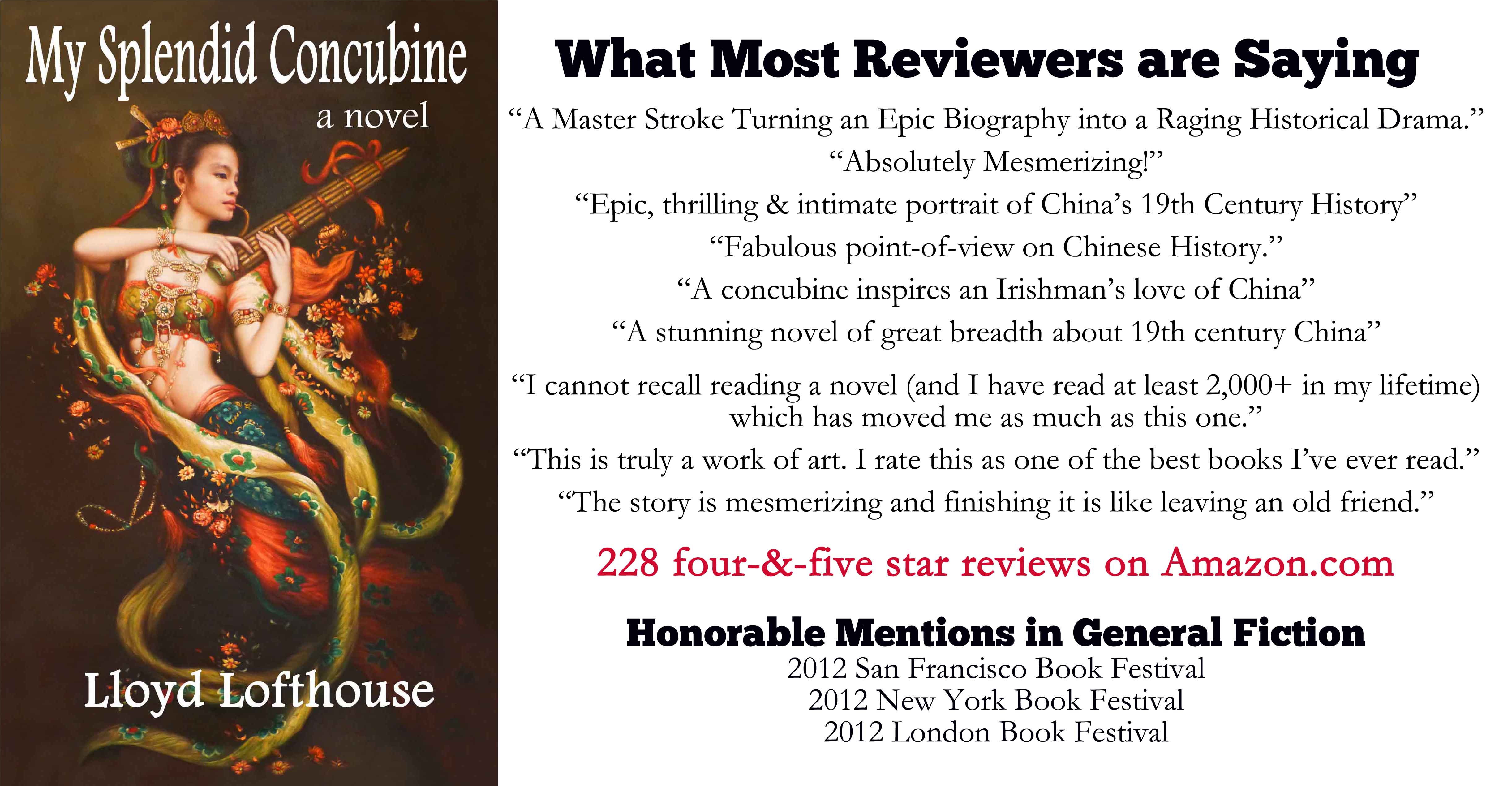
 iLook China