Pearl S. Buck (1892 – 1973; awarded the 1932 Pulitzer Prize and 1938 Nobel Prize in Literature) loved the peony and so did the Empress Dowager Tzu Hsi (1835 – 1908). The Chinese Peony is the Paeonia lactiflora. Along with the plum blossom, the peony is a traditional floral symbol of Mongolia and China. The peony comes as a shrub and a tree.
The peony is also known as the “flower of riches and honor” and is used symbolically in Chinese art. In 1903, the Qing Dynasty made the peony the national flower. Today, there is no national flower in the PRC, but the tree peony can be regarded as a national favorite. Taiwan—on the other hand—has named the plum blossom as the national flower for its island territory.
The World Health Organization reports that the dried root of the Radix Paeonia (red peony) is used to treat dementia, headache, vertigo, spasms of the calf muscles, liver disease, and allergies and as an anticoagulant. These uses have been described in pharmacopoeias and in traditional systems of medicine.
Traditional Chinese medicine claims that drinking Bai Mudan (white peony tea) helps dispel heat within the body and enhances immune function while protecting the heart and blood vessels.
Ode to Peonies
中
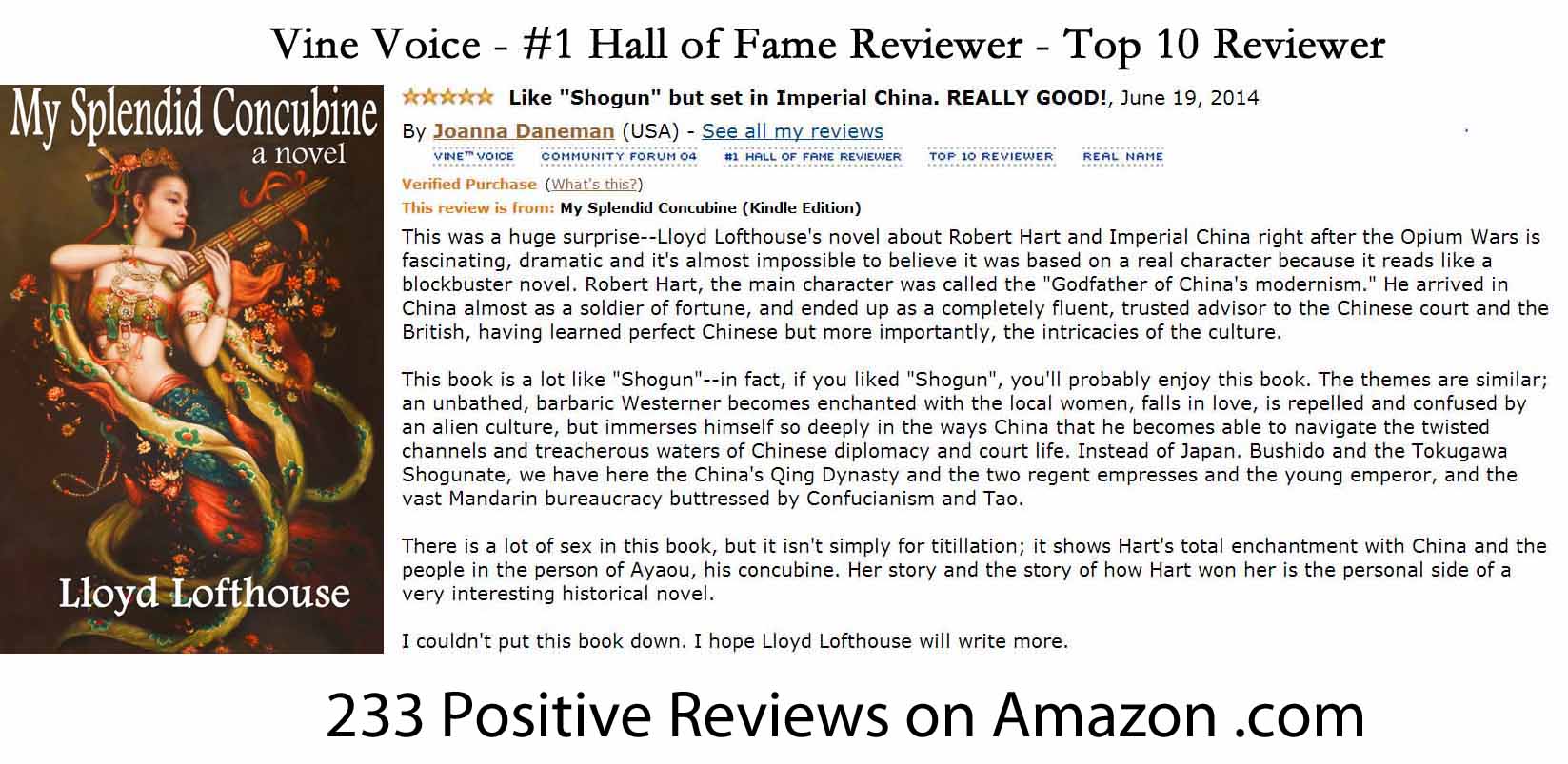
Lloyd Lofthouse is the award-winning author of My Splendid Concubine [3rd edition]. When you love a Chinese woman, you marry her family and culture too. This is the unique love story Sir Robert Hart did not want the world to discover.
Subscribe to “iLook China”!
Sign up for an E-mail Subscription at the top of this page, or click on the “Following” tab in the WordPress toolbar at the top of the screen.
A man or woman can survive for weeks without food but only a few days without water. Knowing that, it shouldn’t come as a surprise that Tibet will stay in China for some time and water is one of the most important reasons why.
The Yellow River and Yangtze start in Tibet serving more than a third of China’s population—more than 400 million people. It’s possible that Mao realized the importance of water from Tibet when he sent 40,000 PRC troops to reoccupy the former troublesome province/tributary that at the urging of the British Empire’s broke from China in 1913 and declared its independence as a theocracy ruled by a Dalai Lama known as a living god.
Tibet has an area of about 1.3 million square kilometers (about 5 million square miles) and it is estimated that there are less than 3 million people living in Tibet. China, on the other hand, serves more than 1.3 billion people, so who benefits the most from water that starts its journey in Tibet?
Rajendra K. Pachauri, chairman of the Intergovernmental Panel on Climate Change and winner of the 2007 Nobel Peace Prize, said, “At least 500 million people in Asia and 250 million people in China are at risk from declining glacial flows on the Tibetan Plateau.” – Circle of Blue Waternews
If Tibet’s water were in the hands of anyone else like a free Tibet that might favor other nations over China, China’s future would be dim at best and dire in a worst-case scenario. As it is, China is one of the earth’s driest areas and the challenge to supply more than 1.3 billion people with water is a daunting task. In fact, China is racing to beat a disaster, and the end of that race will be reached in a few decades.
Today, water and waste pollution is the single most serious issue facing China.
While replacing thousands of older, coal-burning power plants with cleaner technologies, building more hydroelectric dams, and constructing nuclear reactors, China is also adding desalinations plants to ease the growing water crises. In 2005, a desalination facility south of Shanghai started producing about 375,000 gallons of fresh water an hour, with a goal to build more plants and produce 250 million gallons of water per day by 2010. – Environmental News Network
In fact, to achieve this, China contracted with IDE Technologies in Kadima, Israel to build four new desalination units and the first went on line near Beijing in 2010. These plants are designed to provide desalinated seawater for a power plant’s steam boilers as well as drinking water for local residents.
Bloomberg reports, “Home to 20 percent of the world’s population but only 7 percent of its fresh water, China has embraced desalination. The central government’s Special Plan for Seawater Utilization calls for producing 3 million tons (807 million gallons) a day of purified seawater by 2020—roughly quadruple the country’s current capacity. Of China’s 668 largest cities, at least 400 already suffer from water scarcity.”
And this isn’t all that China is doing to deal with its water woes. China is building an aqueduct—some of it running underground and it is known as the South-North Water Transfer Project—that may rival China’s Great Wall as a construction project that will cost twice as much as the Three Gorges Dam. The completed aqueduct will be slightly over 716 miles long.
China also plans to build 100 dams in Tibet—not only to generate electricity but to store much needed water for its more than 1.3 billion people. Both projects are controversial, but can China afford to do nothing?
Meanwhile, the United States with the 3rd largest population in the world is facing its own challenges with water. Business Insider reports, “Americans tend to take it for granted that when we open a tap, water will come out. … (but) Many states — 40 out of 50 according to the U.S. Government Accountability Office — have at least one region that’s expected to face some kind of water shortage in the next 10 years.”
In addition, India, with the 2nd largest population in the world, has an even larger challenge than China or the U.S. when it comes to water. The Water Project reports, “India’s water crisis is often attributed to lack of government planning, increased corporate privatization, industrial and human waste and government corruption. In addition, water scarcity in India is expected to worsen as the overall population is expected to increase to 1.6 billion by year 2050. To that end, global water scarcity is expected to become a leading cause of national political conflict in the future, and the prognosis for India is no different.”
Lloyd Lofthouse is the award-winning author of My Splendid Concubine [3rd edition]. When you love a Chinese woman, you marry her family and culture too. This is the unique love story Sir Robert Hart did not want the world to discover.
Subscribe to “iLook China”!
Sign up for an E-mail Subscription at the top of this page, or click on the “Following” tab in the WordPress toolbar at the top of the screen.
On Tuesday, July 19, in Is 3,799 years old enough for you we learned about the discovery of China’s oldest known dynasty and the myth of the Yellow Emperor. In this post I link Moses with the Yellow Emperor.
“And Moses brought forth the people out of the camp to meet with God; and they stood at the nether part of the mount. And Mount Sinai was altogether on a smoke, because the Lord descended upon it in fire: and the smoke thereof ascended as the smoke of a furnace, and the whole mount quaked greatly.” Exodus 19:17, 18
What about China’s Yellow Emperor? Bellaonline.com reports, “Then one day, a yellow dragon descended from the sky to take the Yellow Emperor back to heaven …. Myth says, he ruled for a hundred years before leaving.”
In China no one knows for certain where the Yellow Emperor was from. … He was known as the Yellow Emperor in honor of his contributions to agriculture and the Chinese calendar. In addition to farming, his wife, Lei Zu, is credited with developing the idea of growing silkworms and creating silk. The Yellow Emperor is also noted as the creator of Chinese medicine, and the origins of Taoism and Confucianism trace their roots back to this mythical Emperor.
In addition, consider that the Biblical Moses (1393 – 1273 BC) and the Yellow Emperor were both on Earth about the same time.
Was the Old Testament’s description in Exodus a space ship landing on Mount Sinai, and is the Yellow Emperor returning to heaven on what sounds like another space ship a myth or reality?
Lloyd Lofthouse is the award-winning author of My Splendid Concubine [3rd edition]. When you love a Chinese woman, you marry her family and culture too. This is the unique love story Sir Robert Hart did not want the world to discover.
Subscribe to “iLook China”!
Sign up for an E-mail Subscription at the top of this page, or click on the “Following” tab in the WordPress toolbar at the top of the screen.
At one time, the Xia Dynasty was a myth as the Yellow Emperor still is. Then, according to US History.org, scientists excavated a city called Yin making some archaeologists think that Yin was the capital of the mythical Xia Dynasty.
US History.org reported, “From what has survived archaeologists and historians have learned much of the Shang culture. The Shang were skilled workers in bone, jade, ceramics, stone, wood, shells, and bronze, as proven by the discovery of shops found on the outskirts of excavated palaces. The people of the Shang dynasty lived off of the land, and as time passed, settled permanently on farms instead of wandering as nomads.”
Chinese archaeologists recently found a large-scale building foundation in Henan Province, which belongs to the later period of Xia Dynasty. The discovery, the first of its kind, causes great concern because it was founded at the key moment when the Xia Dynasty was replaced by the Shang Dynasty (1783 BC – 1123 BC),” said Dr. Xu Hong, head of the Erlitou Archaeological Team under the Chinese Academy of Social Sciences. “Was it built by people of the Xia or the Shang?
Chinese language with English subtitles
“The discovery of the Yin Ruins astounded the world in the 20th century,” Dr. Xu Hong said. “We believe the Erlitou Ruins will lead the study of Chinese ancient civilization to a new stage in the 21st century.”
Who knows? Maybe archaeologists will discover that the myth of the Yellow Emperor, who tradition says ruled China from 2697 – 2597 BC, is also true.
But who was the mythical Yellow Emperor? Britannica.com reports, “Huangdi is reputed to have been born about 2705 BC and to have begun his rule as emperor in 2697 BC. His legendary reign is credited with the introduction of wooden houses, carts, boats, the bow and arrow, and writing. … Upon his death he was said to have become an immortal.”
中
Lloyd Lofthouse is the award-winning author of My Splendid Concubine [3rd edition]. When you love a Chinese woman, you marry her family and culture too. This is the unique love story Sir Robert Hart did not want the world to discover.
Subscribe to “iLook China”!
Sign up for an E-mail Subscription at the top of this page, or click on the “Following” tab in the WordPress toolbar at the top of the screen.
Mao born in 1893 grew up during a period of madness in China’s history. To learn more, I suggest reading The Roots of Madness.
The Chinese Civil War lasted from 1926 to 1949 with a few years out to fight the horrors of the Japanese invasion of China during World War II.
The horrors of Mao’s Long March by itself was enough to cause PTSD in all 6,000 of its survivors from the more than 80,000 troops that started the year-long journey of retreat, battle, and severe suffering that was threatened by death on a daily basis.
After Mao was China’s leader, there was an assassination attempt by one of his most trusted generals, Lin Biao, a man Mao had named as his successor after he died. In addition, during China’s Civil War, Chiang Kai-shek ordered more than one failed assassination attempt on Mao.
However, the threats and violence that shaped Mao’s life began before The Long March and before he was a leader in the Chinese Communist Party.
As a child, he grew up among farmers and peasants with an average expected life span in China of 35 years. In the 1920s, as an idealist and a sensitive poet, he believed in helping the worker and led several labor movements that were brutally subdued by the Nationalist government led by Chiang Kai-shek.
Once, Mao barely escaped with his life.
In 1930, Yang Kaihu, his wife at the time — Mao was married four times — was arrested and executed. In addition, Mao had two younger brothers and an adopted sister executed by Chiang Kai-shek’s troops.
If you had several close calls with death; lost a wife, two younger brothers and an adopted sister in this way, how would that affect you?
To judge Mao by today’s Politically Correct Western values is wrong, because he grew up in a world ruled by a completely different set of values that shaped him to be tough enough to survive.
Anyone that survived and went on to rule China at that time would have been judged as brutal by today’s Politically Correct Western values. In fact, Chiang Kai-shek was a brutal dictator who ruled Taiwan — after he fled mainland China in 1949 — under military marshal law until his death in 1976. But Chiang didn’t have as many people to rule over so the death count he caused was smaller but no less significant.
The History of Humanitarianism shows us that this concept was born and nurtured in the West and developed slowly over centuries with the result that the individual was made more important than the whole.
However, in China, the whole is still more important than one person as it was during Mao’s time. If you were to click on the link to the History of Humanitarianism and read it, you would discover that China was not part of this movement while Mao lived. (Discover more about China’s Collective Culture)
PTSD as a war wound and a trauma was not recognized or treated until well after America’s Vietnam War. Prior to its discovery, it was known as shell shock. The diagnosis of PTSD first appeared in the 1980s, and Mao died in 1976.
In fact, if Mao were alive today he would not be alone. In the United States, it is estimated that 7.8% of all Americans suffer from PTSD, and among that segment of the population, more than 300,000 Iraq and Afghanistan military veterans have PTSD in addition to 1.7 million Vietnam veterans.
Lloyd Lofthouse, a former U.S. Marine and Vietnam combat vet, is the award-winning author of My Splendid Concubine [3rd edition]. When you love a Chinese woman, you marry her family and culture too. This is the unique love story Sir Robert Hart did not want the world to discover.
Subscribe to “iLook China”!
Sign up for an E-mail Subscription at the top of this page, or click on the “Following” tab in the WordPress toolbar at the top of the screen.


 Posted by Lloyd Lofthouse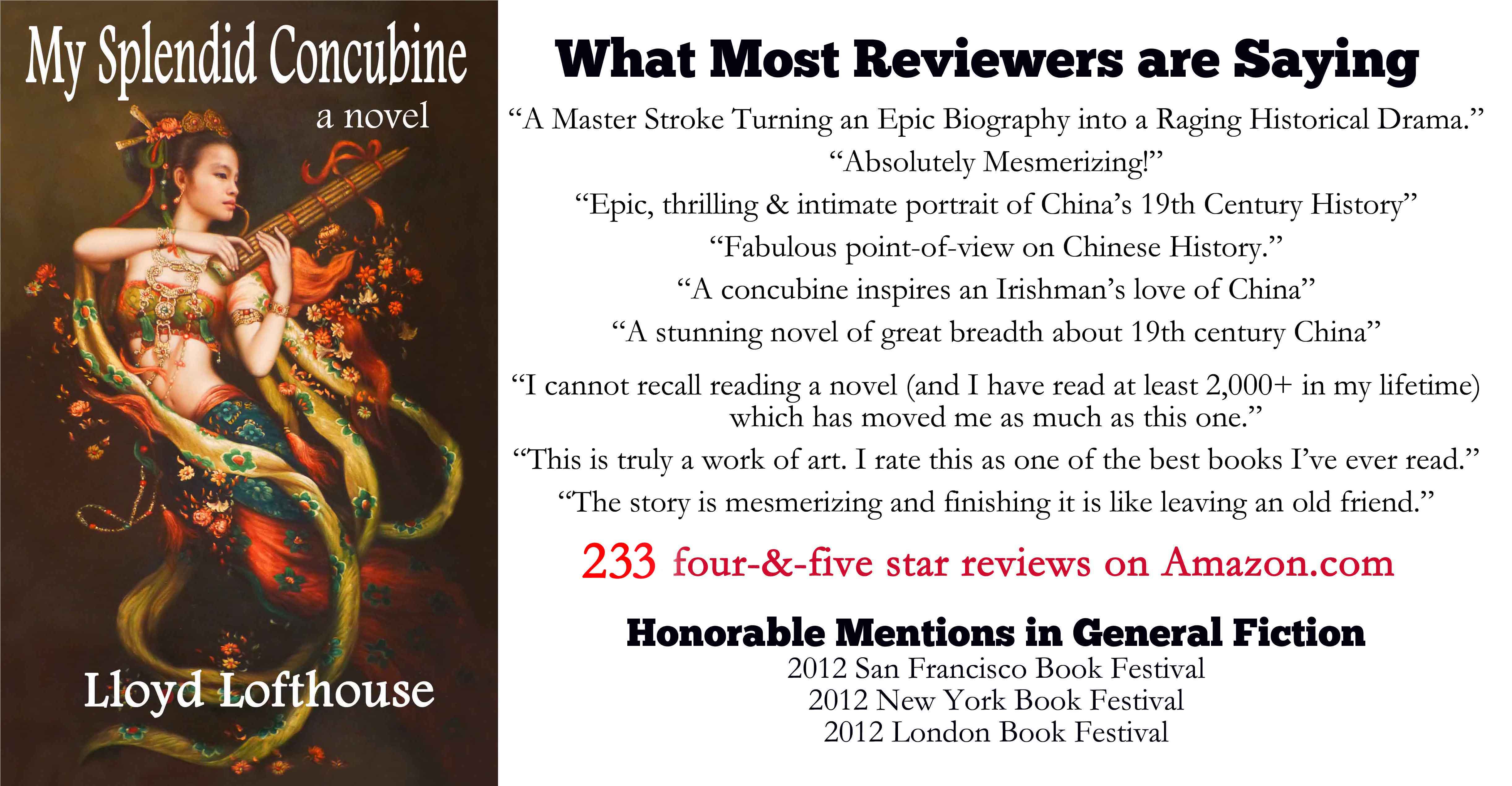

 iLook China