Most people outside of China don’t think of love poems when they think of China. However, there has to be a reason for more than 1.3 billion people, other than the Great Wall of China, the Pacific Ocean and the Himalayan Mountains that helped shelter China from global wars and invasions that rocked the rest of the world for centuries until the West invaded China during the 19th century Opium Wars to force, if possible, a different set of values on China’s collective culture.
For poetry lovers, China’s love poetry imparts a sense of the private passion that beats in the Chinese heart. The three arts of poetry, calligraphy and painting, the Triple Excellence, are represented on the pages of the book Jane Portal edited.
As you can see, the Chinese are a passionate people; they just don’t dramatize these passions publicly as many Westerners do.
The following poem by Du Mu (803 – 852 AD) is an English translation.
Deeply in love, but tonight
we seem to be passionless;
I just feel, before our last cup of wine
a smile will not come.
The wax candle has sympathy –
weeps at our separation:
Its tears for us keep rolling down
till day breaks.
Discover Wu Zetian, China’s only female emperor, who ruled during the Tang Dyansty.
中
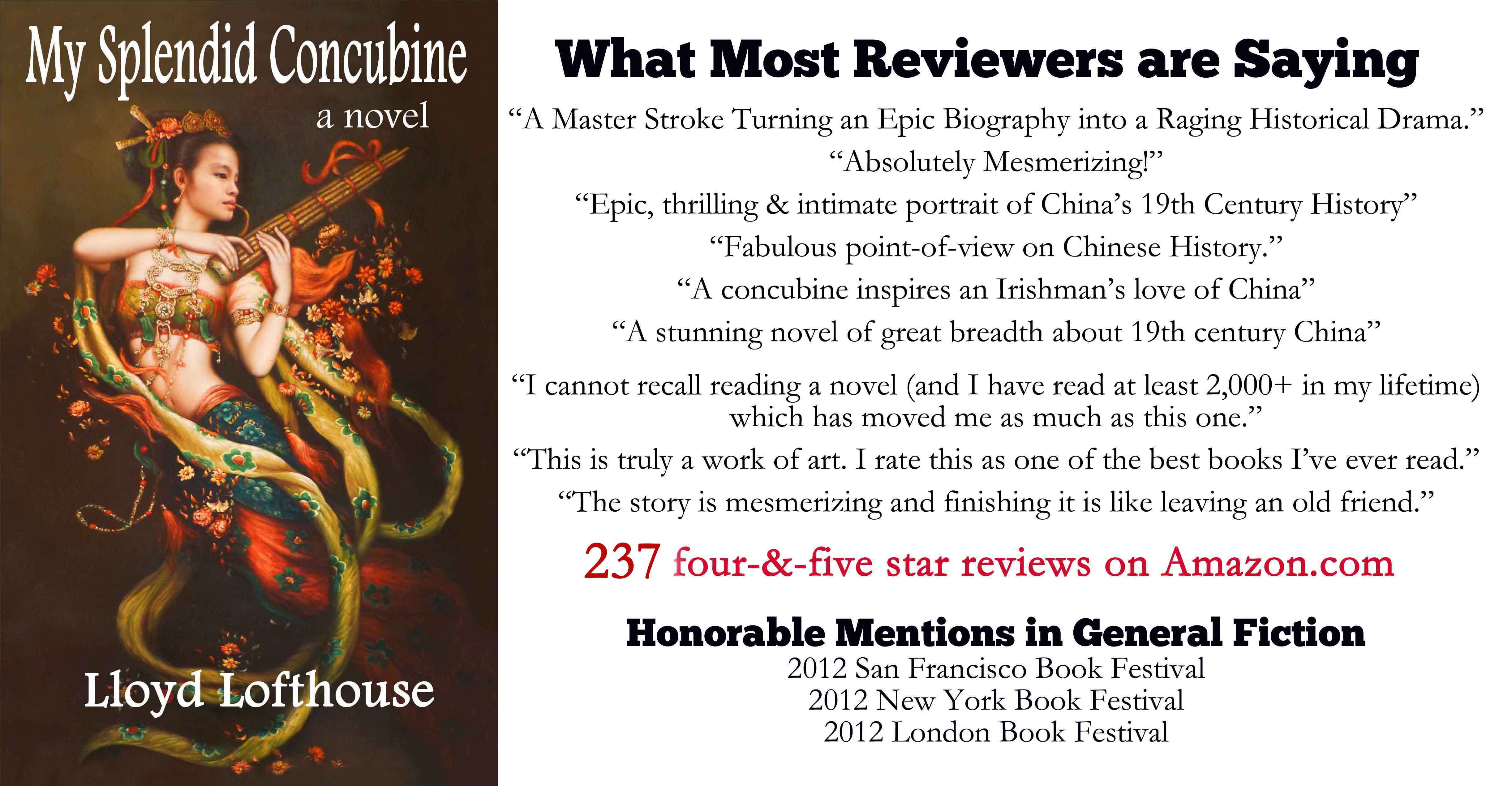
Lloyd Lofthouse is the award-winning author of My Splendid Concubine [3rd edition]. When you love a Chinese woman, you marry her family and culture too. This is the unique love story Sir Robert Hart did not want the world to discover.
Subscribe to “iLook China”!
Sign up for an E-mail Subscription at the top of this page, or click on the “Following” tab in the WordPress toolbar at the top of the screen.
Jingyun Dagu is a form of Chinese opera where stories are often sung in a Beijing dialect accompanied by a drum along with one or two other musical instruments.
The focus is on the singing that depicts stories in short episodes.
Dagu was first popular near the end of the Qing Dynasty (1644-1911).
One super star of Dagu was Luo Yusheng, who was born in 1914, and died at 89 in 2002. Her stage name was Xiao Caiwu. She studied under Su Huanting at the age of nine in order to play Laosheng (old man) roles in Peking Opera. At 14, she gave performances in singing without musical accompaniment in Nanjing, before she formally switched to Jingyun Dagu at the age of 17.
In 1934, Luo Yusheng studied at the Liu School of Jingyun Dagu (storytelling in Beijing dialect while beating a drum, accompanied by two or three persons who play three-stringed instruments).
At one time she was well known by most of China, and her fans called her the Queen of the Golden Voice.
After the PRC was founded in 1949, Dagu singers were regarded as people’s artists or actors, who sang traditional stories and new operas with themes reflecting contemporary life. For instance, patriotic Communist stories like Glorious Journey, Red Flag Over Mount Everest, and Patriotism and Roaring Waves.
The singer/drummer is often accompanied by the Sihu, a four-stringed instrument similar to an Erhu, and Pipa (lute) in addition to three-stringed lutes and wooden clappers.
Lloyd Lofthouse is the award-winning author of My Splendid Concubine [3rd edition]. When you love a Chinese woman, you marry her family and culture too. This is the unique love story Sir Robert Hart did not want the world to discover.
Subscribe to “iLook China”!
Sign up for an E-mail Subscription at the top of this page, or click on the “Following” tab in the WordPress toolbar at the top of the screen.
Poor relations with Japan started as far back as 1840, when Japan joined the British, French, and Americans during the Opium Wars to gain concessions to sell opium to the Chinese.
In 1843, under the agreement of the Nanjing Treaty, Shanghai became one of 5 treaty ports to be turned into a colonial city under the control of foreign countries: Great Britain, France, America, and Japan.
Imagine New York City divide and governed by Russia, China, Turkey, and Iran.
Until 1871, most Japanese had no contact with the Chinese. Then getting to know the Chinese caused many Japanese to think that the Chinese were ethnically inferior since they were different from the Japanese, and most Japanese haven’t changed their minds to this day.
In 1884, Japanese and Chinese troops faced off in Korea, which ended in a lopsided stalemate in Japan’s favor.
In 1894, Japan and China fought their first war over Korea. Like Tibet, Korea had been a tributary state of China for centuries.
China was defeated in 1895, lost Korea, and a large portion of Eastern Manchuria to Japan. Then in 1870, Japan annexed the islands of the Ryukyu Kingdom that had also been a tributary to China during the 17th century.
A Ryukyuan envoy begged England for help, but the British ruled that the islands belonged to Japan instead of China.
On July 7, 1937, Japan launched a war to conquer China. Over the next 8 years, Japan occupied a large portion of China. To this day Japan has never apologized for The Rape of Nanking and other atrocities in China during World War II that resulted in millions of Chinese deaths. The Chinese estimate that they lost about 15- 20 million people in World War II, and most of those deaths were civilians. An additional 2.2 million deaths were Chinese troops who fought to resist Japan’s invasion.
“The Chinese have resented the Japanese ever since Japan conquered and occupied China in the 1930s and 40s. The Japanese prime minister’s yearly visits to a Tokyo shrine for war veterans has always played in China as a reminder of Japan’s wartime brutality and continued lack of remorse.” U.S. News & World Report
Long memoires and hard feelings still smolder and sometimes ignite into flames.
Since China has risen from the ashes, Japan should walk softly around the mighty reborn dragon, and remember where its architecture, written language, and one of its major religions came from. Linguistics.byu.edu says, “Japanese writing is clearly taken from Chinese.”
Japan’s ancient architecture also came from China. The introduction of Buddhism in Japan (from China) during the sixth century was a catalyst for large-scale temple building using complicated techniques in wood. Influence from the Chinese Tang and Sui Dynasties led to the foundation of the first permanent capital in Nara. Its checkerboard street layout used the Chinese capital of Chang’an as a template for its design.
In The Spread of Chinese Civilization to Japan, Peter Stearns writes, “its full impact on global history has not been felt until the last century or so, the transmission of key elements in Chinese culture to the offshore islands that came to make up Japan clearly provides one of the most important examples of the spread of civilization from a central core area to neighboring or overseas peoples. In the 1st centuries A.D., the peoples of Japan imported a wide range of ideas, techniques of production, institutional models, and material objects from the Chinese mainland.”
Lloyd Lofthouse is the award-winning author of My Splendid Concubine [3rd edition]. When you love a Chinese woman, you marry her family and culture too. This is the unique love story Sir Robert Hart did not want the world to discover.
Subscribe to “iLook China”!
Sign up for an E-mail Subscription at the top of this page, or click on the “Following” tab in the WordPress toolbar at the top of the screen.
The first time I read about China’s singing crickets was in “Empress Orchid” by Anchee Min. Retired concubines spent time carving gourds where these crickets lived. The crickets entertained empresses, emperors, and princes.
Then I learned about China’s fighting critics from a comment left on this Blog, and there was a link included.
While writing this post, I Googled the subject. In Gardening4us.com, Catherine Dougherty says, “Cricket culture in China dates back to the Tang Dynasty (618 – 906 AD).
“It was during this time the crickets first became respected for their powerful ability to ‘sing’ and a cult formed to capture and cage them. And in the Sung Dynasty (960 – 1276 AD)… cricket fighting became popular.”
The Chinese consider the cricket to be a metaphor for summer and courage. Pacific Pest Inc. says, “Crickets are popular pets and are considered good luck in some countries; in China, crickets are sometimes kept in cages, and various species of crickets are a part of people’s diets … and are considered delicacies of high cuisine in places like Mexico and China.”
Soon, the United States may be added to this list, because Exo, a U.S. company, is producing protein bars from cricket flower. “After cleaning the crickets, we dry them to remove the moisture and mill them into fine flour. The result is slightly nutty tasting flour that is high in protein and micronutrients.”
From Home Made in China, we learn “Summer used to mean picking berries in the yard and making jam, canning green beans, going to the farmer’s market, BBQs, lawn mowing, hiking, swimming. Now my whole family looks forward to the arrival of singing crickets.”
Lloyd Lofthouse is the award-winning author of My Splendid Concubine [3rd edition]. When you love a Chinese woman, you marry her family and culture too. This is the unique love story Sir Robert Hart did not want the world to discover.
Subscribe to “iLook China”!
Sign up for an E-mail Subscription at the top of this page, or click on the “Following” tab in the WordPress toolbar at the top of the screen.
There is a poem on the Statue of Liberty that ends with “Give me your tired, your poor, Your huddled masses yearning to breathe free, The wretched refuse of your teeming shore. Send these, the homeless, tempest-tossed to me, I lift my lamp beside the golden door!”
Angel Island in San Francisco Bay was America’s west coast Ellis Island, but those famous last lines on the Statue of Liberty Poem did not apply to the Chinese and other Asians.
From 1919 to 1940, mostly Asian immigrants entered the US through Angel Island.
After 1940, the immigration station on Angel Island was forgotten until California Park Ranger Alexander Weiss discovered the stories carved in the walls.
He thought these stories were ghosts waiting to be heard.
Over half of the Angel Island immigrants came from China and Japan and most of the carvings on the walls were poems written in Chinese.
A former detainee, Dale Ching, went through the station in 1937 when he was sixteen. Even though Dale’s father was born in the United States, he still had to go through the immigration station.
While the East Coast’s Ellis Island welcomed immigrants, Angel Island’s story was one of sadness and suffering.
Most European immigrants who went through Ellis Island stayed a few hours, but immigrants on Angel Island were kept locked up under armed guard with barbed-wire fences surrounding the buildings and some people stayed for days, weeks, months and even years.
The park service wanted to tear the Angel Island buildings down but Weiss found supporters, and they struggled to preserve this history. They succeeded and the restoration project was challenging.
Alexander Weiss sums up the video saying we should know both the right and the wrong from U.S. history.
Lloyd Lofthouse is the award-winning author of My Splendid Concubine [3rd edition]. When you love a Chinese woman, you marry her family and culture too. This is the unique love story Sir Robert Hart did not want the world to discover.
Subscribe to “iLook China”!
Sign up for an E-mail Subscription at the top of this page, or click on the “Following” tab in the WordPress toolbar at the top of the screen.


 Posted by Lloyd Lofthouse
 iLook China