Does Putin want the Kremlin’s Candidate to start a war with China? Part 1 of 2

February 7, 2017

What are the odds that President Trump will start a war with China? Please wait and answer the question after reading this two part series.

President Donald Trump continuous to talk about Putin with praise while badmouthing and challenging China.

Trump has a history of racism, and the Chinese are not Caucasians but Putin is.

Beijing is seriously concerned about Trump’s comments on One China policy says Politico.com.

In an interview with Fox News, Trump had signaled that the U.S. commitment to the policy that undergirds its relationship with China should be up for negotiation: “I don’t know why we have to be bound by a One China policy unless we make a deal with China having to do with other things,” he said.

Then the New York Post reports, “China lashes out after Mattis backs Japan in islands dispute.”

Politifact reports, Trump warned of China military might. “We have rebuilt China, and yet they will go in the South China Sea and build a military fortress the likes of which perhaps the world has not seen …”

Trump was wrong when he said the U.S. rebuilt China. After World War II, the United States, under the Marshall Plan, rebuilt Europe, but blockaded China and fought wars in Korea (1959 – 1953 with an estimated 2.5 million civilians killed/wounded) and Vietnam (1955 – 1975 with an estimated 1.3 million to 4.2 million civilian dead) that were wars that China saw as a threat.

American Foreign Relations.com reports, “During the Cold War in Asia, the United States imposed embargoes on North Korea, China, and North Vietnam. These were severe embargoes established under the Trading with the Enemy Act. The embargo on China and North Korea began in 1950, during the Korean War.” The United States wouldn’t lift the embargo with China until 1969 during the Richard Nixon administration.

To discover if the Trump White House is planning to start a war with China, The Guardian.com reported that Steve Bannon said, “We’re going to war in the South China Sea in five to 10 years. There’s no doubt about that.”

The Guardian went on: “Bannon’s sentiments and his position in Trump’s inner circle add to fears of a military confrontation with China, after secretary of state Rex Tillerson said that the US would deny China access to the seven artificial islands. Experts warned any blockade would lead to war.”

Continued on February 22, 2017, in Part 2

Lloyd Lofthouse is the award-winning author of My Splendid Concubine, Crazy is Normal, Running with the Enemy, and The Redemption of Don Juan Casanova.
2a-242-positive-reviews-hall-of-fame-reviewer-jan-16-2017

Where to Buy

Subscribe to “iLook China”!
Sign up for an E-mail Subscription at the top of this page, or click on the “Following” tab in the WordPress toolbar at the top of the screen.

About iLook China


Chinglish

February 1, 2017

Chinglish is a play by David Henry Hwan that first premiered at the Goodman Theater in Chicago. The play premiered on Broadway at the Longacre Theater. I saw it at the Berkeley Rep Theater, and it was a laugh-out-loud evening.

This is not a review of Hwan’s play as much as it is about how different cultures find common behaviors hard wired in our DNA to make connections.

To summarize Chinglish, this laugh-out-loud play was about Daniel, a former employee of Enron, who almost went to prison with the rest of the Enron crooks. Daniel not only lost his high paying job with Enron, but he’s broke due to the legal battle that kept him out of jail.

In a last desperate attempt at success, he goes to China to find customers for his American company (a business that’s been in his family since 1925), but Daniel does not speak a word of Mandarin. At the beginning of the play, he says, “If you are an American, it is safe to assume that you do not speak a single f*****g foreign language.”

That one line reveals how clueless most Americans are when it comes to other cultures and languages.

Chinglish, through humor, teaches us a lesson about the minefield of misunderstanding and manipulation that happens when people of different cultures attempt to do business with each other.

“An American businessman arrives in a bustling Chinese province looking to score a lucrative contract for his family’s sign-making firm. He soon discovers that the complexities of such a venture far outstrip the expected differences in language, customs and manners.”

There is another implied theme in this play, and that’s about why sex is important, something all cultures and races have in common that often transcends cultural differences.

In the play, Daniel, an unhappily married man has an affair with an unhappily married mainland Chinese woman. Without spoiling the story, this affair provides the link that Daniel needs to succeed in China, and that link is known as Guanxi.

Early in the play, Daniel’s British interpreter, a man who has lived in China for years and speaks Mandarin fluently, tells him he must stay at least eight weeks to have a chance to develop Guanxi, a system of social networks and influential relationships that facilitate business and other dealings. The British interpreter says that for millennia China has survived without a Western legal system of laws, lawyers, courts and judges, and that Guanxi was crucial for China’s success as the longest surviving civilization and culture on the planet.

Without understand how Guanxi works, Daniel struggles to cross the cultural divide, but fails until he has the affair with the wife of a Chinese judge. The sexual attraction and lust that led to the affair opens the door to the Guanxi network of his lover, and her husband.

Discover Anna May Wong, the woman that died a thousand times.

1a-242-what-most-reviewers-are-saying-jan-16-2017

Where to Buy

Subscribe to “iLook China”!
Sign up for an E-mail Subscription at the top of this page, or click on the “Following” tab in the WordPress toolbar at the top of the screen.

About iLook China

China’s Holistic Historical Timeline


The Challenge of Health Care in China

January 31, 2017

In 1950, China’s population was almost 552 million, and the average lifespan was 35 as it had been for centuries. By the Time Mao died in 1976, even with the Great Famine (1958-1961) in a country known as the Land of Famines, the population increased to more than 930 million, and the average lifespan had climbed to almost 55. Today, there are almost 1-billion, 400-million Chinese, and the average lifespan has reached beyond 76 years, more than twice what it was in 1950 when Mao and the Chinese Communist Party (CCP) became the leader of China?

How did all that happen?

After the CCP won the Civil war in 1949, health care improved in China. By the time Mao died in 1976, average life expectancy had increased by twenty years, so the program must have worked, right?

The CCP was the first government in China’s history to set goals and plans to help the people who lived in extreme poverty improve the quality of their lifestyles, and soon after Mao Zedong’s healthcare speech in 1965, the concept of the barefoot doctor (with basic paramedical training) was developed.

By 1968, the barefoot doctors program was a national policy, and it was offered free to the working class. The barefoot doctor program ended in 1981 with the end the agricultural cooperatives. However, two-thirds of rural village doctors currently practicing in China were first trained as barefoot doctors.

This program was the foundation of rural-health care in China, but back then anyone could become a barefoot doctor.

Mao told the people that if you wanted to be a doctor, you didn’t need to go to medical school. All you had to do was have the motivation to provide medical care to needy people and the government would support you and provide limited training.

The second class of medical care went to teachers, clerks and secretaries, who were considered ‘friends’ of the working class, the proletariat. The only difference was that these ‘friends’ had to pay to get medical treatment, and it was possible to face financial ruin from one hospital stay.

A third group of people was considered enemies of the proletariat: former shop-owners, landlords and denounced intellectuals like liberal arts professors. These people were denied health care.

Mao died in 1976, and between 1981 and 2003, the health care system in China was privatized. People had to pay before treatment or receive no medical care. This changed again in 2003, when the CCP launched a new cooperative medical system operated and funded by the government with a copay of 10 Renminbi per year for each enrolled citizen.

In 2008, the SARS epidemic resulted in the beginning of more health-care reforms.

Health Affairs.org reports, “China is at a crossroads in transforming its health care system. Like the United States, China is faced with the double-edged sword of having both a large uninsured population and rapid health care cost inflation. … China’s solution for its rural areas is the New Cooperative Medical Scheme (NCMS), a government-run voluntary insurance program. … In an attempt to redirect urban patients’ reliance on hospital services toward primary care, the government announced in 2005 the establishment of community health centers (CHCs) to provide prevention, primary care, home care, and rehabilitative services.”

2a-242-positive-reviews-hall-of-fame-reviewer-jan-16-2017

Where to Buy

Subscribe to “iLook China”!
Sign up for an E-mail Subscription at the top of this page, or click on the “Following” tab in the WordPress toolbar at the top of the screen.

About iLook China

China’s Holistic Historical Timeline


China’s Mighty Ditch, the Grand Canal

January 25, 2017

I’ve heard China’s critics allege that China could never compete with a democracy when it comes to innovation. Yet for thousands of years China was ruled by autocratic all-powerful emperors, and China was the most advanced and wealthiest country in the world until about the time the Portuguese arrived. Encyclopedia Britannica reports, “Early in the 18th century the Portuguese found that they could import opium from India and sell it in China at a considerable profit.”

One Chinese innovation is the Grand Canal, and it wasn’t built overnight. It took centuries and more than one dynasty to complete. In fact, work on the first segment of the Grand Canal started in BC 486, and even after the canal was completed centuries later; it was renovated by the Ming Dynasty between 1411 and 1415 AD.  The Ming also renovated the Great Wall.

It could be said that China’s Grand Canal is the opposite of China’s Great Wall, because it’s a ditch and not a wall. Until my first trip to China in 1999, I’d never heard of the Grand Canal, and it is still in use today while the Great Wall is just a tourist attraction.

Is there anything in Europe and/or the United States that’s been around for more than 2,500 years that’s still in use today?

While building the Grand Canal, the pound lock was invented in the 10th century during the Song Dynasty.  Without the pound lock there’s be no Panama or Suez Canals.  According to Encyclopedia.com, “The ancestor of the modern lock is the flash lock. It originated in China and is believed to have been used as early as BC 50.”  The pound lock, an improvement of the flash lock, was also invented in China.

The first pound lock in Europe was built in the Netherlands in 1373 AD, and Leonardo de Vinci improved the pound lock in the 15th century. Did Marco Polo, who lived in China from about 1271 – 1295, bring back the concept of the pound lock? After all, while in China, Polo traveled extensively and probably used the Grand Canal to get around.

A report from Boston’s University of Massachusetts says, “The Grand Canal of China is not only the world’s oldest canal, it is far longer than either Suez or Panama. At 1,795 kilometers (or 1,114 miles) it has 24 locks and 60 bridges, and claim to the title of longest canal. Building began in 486 B.C. with an important extension decreed in the third century, BCE during the Qin Dynasty.”

To understand the significance, it helps to compare the Grand Canal to the Suez and Panama Canals. In the 19th century, the French built the Suez Canal, more than two millennia after the Chinese started to build the Grant Canal and about a thousand years after the pound lock was invented. When it opened, the Suez Canal was only 25 feet deep, 72 feet wide at the bottom and 200 to 300 feet wide at the surface and is 120.11 miles long. China’s Grand Canal is almost 10 times longer.

Construction on the Panama Canal was started in 1881 by the French but was a failure. The United States eventually stepped in and finished that canal between 1904 – 1914, and when finished, it was only 51 miles long.

A timeline of the Great Wall shows that the first segment was built between BC 685 – 645, and it was 398.5 miles in length, almost 8 times longer than the Panama Canal.

Discover Wu Zetian, China’s only female emperor

Lloyd Lofthouse is the award-winning author of My Splendid Concubine [3rd edition]. When you love a Chinese woman, you marry her family and culture too. This is the unique love story Sir Robert Hart did not want the world to discover.

a1-241-positive-reviews-jan-7-2017_edited-4

Where to Buy

Subscribe to “iLook China”!
Sign up for an E-mail Subscription at the top of this page, or click on the “Following” tab in the WordPress toolbar at the top of the screen.

About iLook China

China’s Holistic Historical Timeline


China’s Great Wall

January 24, 2017

Like so much about China, The Great Wall is also the victim of myths that are not always true. Did you know that the history of the Great Wall of China started with fortifications built by various states during the Spring and Autumn (771 – 476 BC) and Warring States (475 – 221 BC) periods? But the best-known and best-preserved sections of The Great Wall was built in the 14th through 17th centuries A.D., during the Ming Dynasty, more than two thousand years later.

If you want to know more about The Great Wall plan a trip to China, or read Peter Hessler’s Country Driving. The first part of this book is about the months he spent driving the length of The Great Wall all the way to Tibet.

In the first 122 pages Peter Hessler rented a Chinese made Jeep Cherokee. In this section, I learned that the Wall was successful most of the time and not the failure historians have claimed it was.

Over a period of several thousand years, the wall failed a couple of times, but served its purpose and offered protection for China’s heartland for centuries. Hessler says that there is no archaeologist in the world that has studied the history of the Great Wall, but he wrote that there are amateur experts, and you will meet a few in his book along with a unique view of rural China.


The Great Wall of China – Unbelievable Secrets & Unknown Facts

The Wall failed when first Genghis and then Kublai Khan unified the Mongol tribes and invaded China in the 13th century, but it didn’t happen overnight. It took sixty years for the Mongols to conquer all of China and then they ruled the country for almost a century before the Han Chinese rose up and drove them out.

The sections of the Great Wall I’ve visited are an hour out of Beijing. The most popular site is at Badaling.  The second choice, Mutianyu, is more dramatic, because this portion of the Great Wall runs along the ridge of a mountain range and you have to hike up a steep slope to reach it or ride a ski lift to the top. Badaling starts in a fortress in a mountain pass, and the wall climbs the slopes from there.

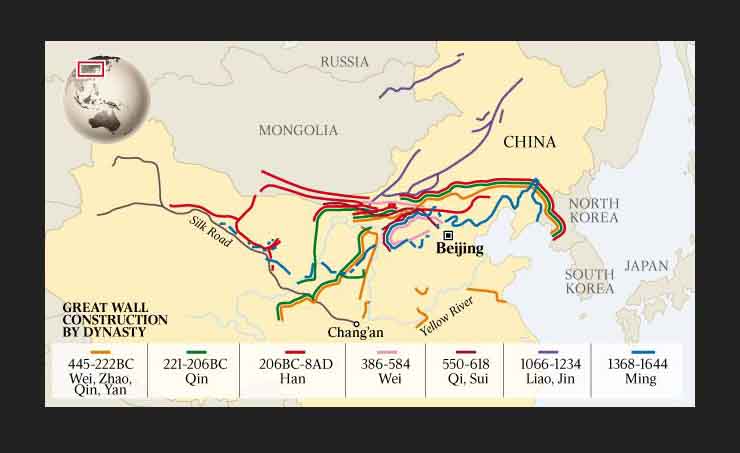
great-wall-consruction-by-dynasty

Smithsonian Magazine reported, “Few cultural landmarks symbolize the sweep of a nation’s history more powerfully than The Great Wall of China. Constructed by a succession of imperial dynasties over more than 2,000 years, the network of barriers, towers and fortifications expanded over the centuries, defining and defending the outer limits of Chinese civilization. At the height of its importance during the Ming Dynasty (1368-1644), The Great Wall is believed to have extended some 4,000 miles, the distance from New York to Milan.

China’s Great Wall was not built by one country, king, or emperor. The wall was built in sections by the kings of several nations over a period of centuries. Those walls were eventually linked together by China’s first Emperor Qin Shi Huangdi, who brutally unified China through bloody conquest into one country with one written language, Mandarin, and many spoken languages.

Then there is the recent Great Wall film starring Matt Damon, a film that explores a mystery centered on the construction of the Great Wall of China. Of course it obvious this story is based on a fantasy. In the film’s trailer, I was hooked by, “What were they trying to keep out?”

Lloyd Lofthouse is the award-winning author of My Splendid Concubine [3rd edition]. When you love a Chinese woman, you marry her family and culture too. This is the unique love story Sir Robert Hart did not want the world to discover.

a1-241-positive-reviews-jan-7-2017_edited-4

Where to Buy

Subscribe to “iLook China”!
Sign up for an E-mail Subscription at the top of this page, or click on the “Following” tab in the WordPress toolbar at the top of the screen.

About iLook China

China’s Holistic Historical Timeline