The Tao of Meditation: Part 2 of 3

October 18, 2017

I’ve been following an exercise routine for at least 18 years. Recently I added mind and body mediation to the physical exercise. When I mediate every day, I turn inward to link my mind and body.

What I think of when I think of Taoism is a story from Taoist tradition whose main image or metaphor is that of water that meets a rock in the river, and simply flows around it. Taoism suggests that a major source of our suffering is that we resist and try to control the natural movements of the world around us. The Tao literally means “The Way,” and it reminds us that the world is bigger than us, and we’ll enjoy it better if we humble ourselves to the natural flow of things.

You know. Go with the flow.

Taoism teaches that the physical body only contains the personality. There were rules for food, hygiene, breathing techniques and different forms of gymnastics, which were designed to suppress the causes of death and allow each follower to create an immortal body to replace the mortal one.

After the mortal body died, the immortal body went elsewhere to live.

About 200 AD, a Taoist scholar taught that virtue, avoidance of sin, confessions of sins and good works were the most important aspects and took precedence over diet and hygiene.

The difference from religions in the West was that Taoism did not have leaders on a national scale and was more like a federation of linked communities.

What I’ve discovered as I continue to meditation every morning after the physical exercise and before I start the day, is that I’m calmer throughout the day with little or no depression or doubts and with a lot less physical pain.

Continued in Part 3 on October 19, 2017, or return to Part 1

Discover The Return of Confucious

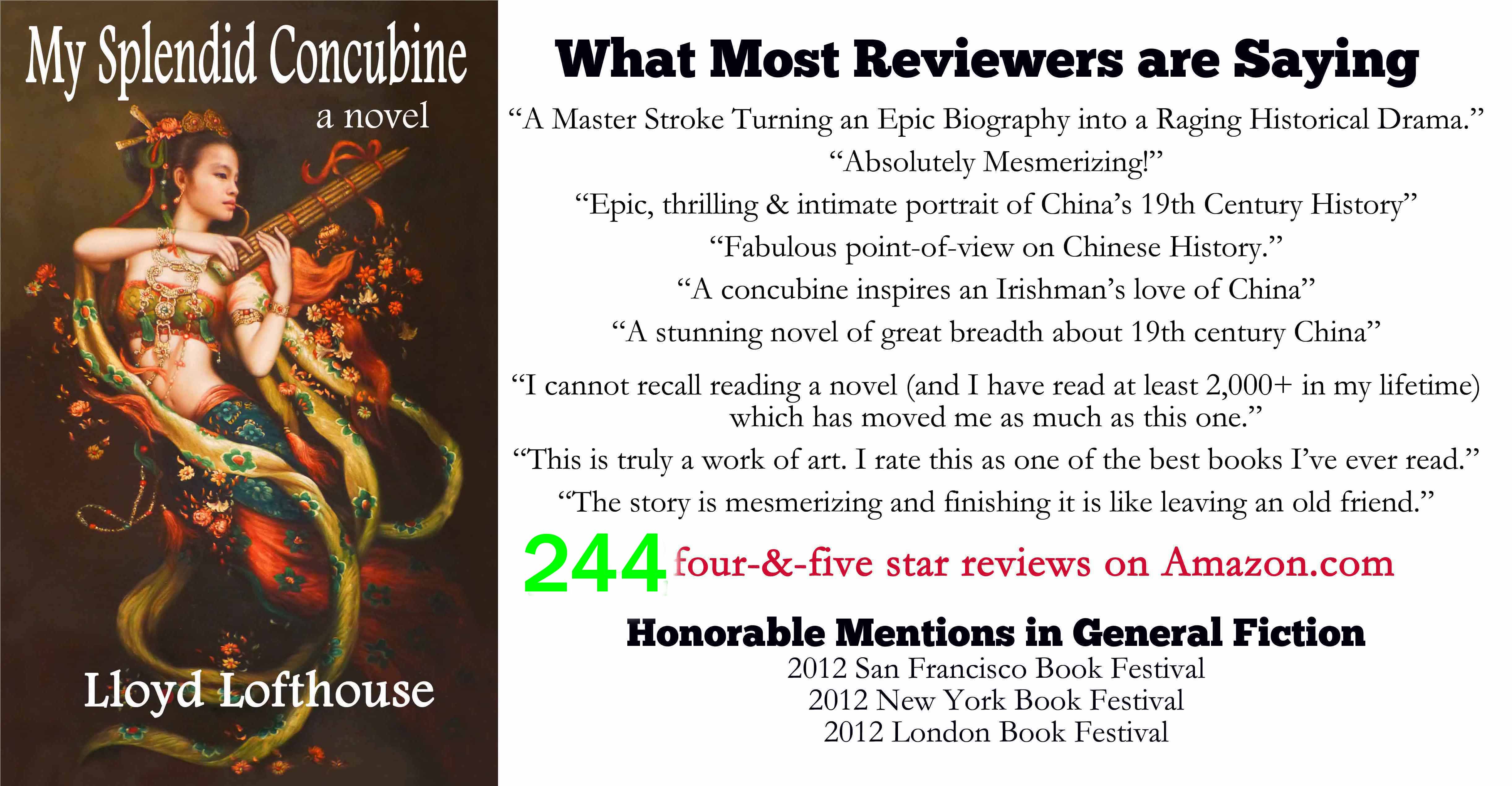
Lloyd Lofthouse is the award-winning author of My Splendid Concubine, Crazy is Normal, Running with the Enemy, and The Redemption of Don Juan Casanova.

Where to Buy

Subscribe to my newsletter to hear about new releases and get a free copy of my award-winning, historical fiction short story “A Night at the Well of Purity”.

About iLook China

China’s Holistic Historical Timeline


The Tao of Meditation: Part 1 of 3

October 17, 2017

Some of the earliest written records of meditation come from the Hindu traditions of Vedantism around 1500 BCE. Between the 6th to 5th centuries BCE, other forms of meditation developed in Taoist China and Buddhist India.

“Those who know do not say; those who say do not know.” -Lao-tzu, the father of Taoism (604 – 531 BC)

Lao-Tzu was an ancient Chinese philosopher and writer. He is known as the reputed author of the Tao Te Ching, the founder of philosophical Taoism, and a deity in religious Taoism and traditional Chinese religions.

I am no expert on Taoism.  I have a copy of Tao Te Ching and have read it in addition to a few pieces about it, but I was raised a Christian in a Christian culture. Even though I walked away from organized religion at 12, I still retain what I learned from studying the Bible.

I’ve also learned that by the time Buddhism arrived in China in the first century AD, Confucianism and Taoism had been well established for several centuries.

Taoism was popular in China while Confucianism was the official state religion of the Han Dynasty. In fact, I’ve read that the bureaucracy practiced Confucianism at work and turned to Taoist spiritual practices after work.

Even though Taoism and Buddhism have fundamental differences, Taoism helped spread Buddhism. While Taoism seeks the salvation of the individual, Buddhism seeks an escape from the cycle of personal existence.

Certain practices of Taoism and Buddhism are similar, and those are meditation, fasting, and breathing techniques.

The word “Tao” means both the order and totality of the universe and the pathway or road that allows the individual to enter into the rhythm of the world through a negation of self.

Two opposing but complementary forces of reality are fused in the Tao: Yin, which is passive, cold and feminine, and Yang, which is active, hot and masculine.

A contemporary of Confucius, Lao Tzu’s teachings were compiled in the fifth century BC into a collection called the Tao Te Ching or Dao De Jing, that has had a great influence on Chinese thought and medicine.

Continued in Part 2 on October 18, 2017

Discover The Return of Confucious

Lloyd Lofthouse is the award-winning author of My Splendid Concubine, Crazy is Normal, Running with the Enemy, and The Redemption of Don Juan Casanova.

Where to Buy

Subscribe to my newsletter to hear about new releases and get a free copy of my award-winning, historical fiction short story “A Night at the Well of Purity”.

About iLook China

China’s Holistic Historical Timeline


Earning Equality through Education

October 11, 2017

Prior to 1949, China faced a shocking literacy rate of 15 to 25 percent. But in the last 68 years, that has changed dramatically. In December 2014, The Globalist reported, “As of 2010, China’s literacy rate was just over 95 percent. … Among China’s youth, the literacy rate is 99.7 percent for young men and 99.6 percent for women.”

In addition, ICEF Monitor says, “Outside of the OECD countries, the trend toward more female students than males is also evident. In China and India, men still outnumber women in higher education, but not by much: women make up 48% of the university population in China and 42% in India.”

What’s driving these changes is explained by a teacher in China that tells her girl students, “You must matter. You must be independent.”

She said, “You don’t change overnight. It takes time. The ideas have to sink in.”

The students are schoolteachers from China’s rural areas. They have come to Beijing for workplace training and to learn more about themselves.

The rural teachers in this program study the Chinese Constitution to learn about their rights and responsibilities.

After all, men and women are considered equal under the law in China, but that doesn’t mean equality is automatic. It takes time to change the old ways of thinking and bring about real equality.

In fact, like women in the United States, women in China are often not paid the same as men for the same jobs.

One of the schoolteachers from rural China said, “You come to believe that you are not as good as men. But I hope when I return to my town that I will have the strength to stand up for myself.”

In October 2011, Chen Zhili, vice-chairperson of the National Congress Standing Committee and president of the All-China Women’s Federation, joined representatives from eleven other Asian and African countries and regions at a conference in Seoul, South Korea.  In her speech at the conference, she “emphasized the four concepts of education as a fundamental right; of education as a means to achieving gender equality and empowering women; of the health and social benefits to be gained from investing in women and girls’ education; and of the responsibility all state governments and international society bear in promoting gender equality.”

Lloyd Lofthouse is the award-winning author of My Splendid Concubine, Crazy is Normal, Running with the Enemy, and The Redemption of Don Juan Casanova.

Where to Buy

Subscribe to my newsletter to hear about new releases and get a free copy of my award-winning, historical fiction short story “A Night at the Well of Purity”.

About iLook China

China’s Holistic Historical Timeline


How are women doing in China compared to the United States?

October 10, 2017

In 1949, Mao announced that women hold up half the sky. In one day they went from being the property of men to being equal. Sixty-eight years later, how are women doing in China?

China’s women make up 48.1 percent of the population, but Catalyst.org reports, “In 2016, only 17.5 percent of firms in China have women as top managers. … Less than one-quarter (24.2%) of all positions in China’s single-house parliament are held by women.”

When we isolate China and report these facts, China looks bad, doesn’t it?

But how does China compare to the United States when it comes to women reaching the top?

In the United Staets women make up 50.8 of the population.  American Progress.org says, “They are only 14.6 percent of executive officers, 8.1 percent of top earners, and 4.6 percent of Fortune 500 CEOs.” In addition, Rutgers.edu reports, “21 women (21%) serve in the United States Senate, and 84 women (19.3%) serve in the United States House of Representatives.”

The Harvard Business Review says, “In the decades since Deng Xiaoping instituted market reform, millions of women have profitably followed Deng’s dictate that “to get rich is glorious.”

Quartz.com tells us “No country comes even close to China in self-made female billionaires.” China has 56 self-made female billionaires; The United States only has 15. China has almost four times as many self-make female billionaires.

Discover Wu Zetian, China’s only female emperor

Lloyd Lofthouse is the award-winning author of My Splendid Concubine, Crazy is Normal, Running with the Enemy, and The Redemption of Don Juan Casanova.

Where to Buy

Subscribe to my newsletter to hear about new releases and get a free copy of my award-winning, historical fiction short story “A Night at the Well of Purity”.

About iLook China

China’s Holistic Historical Timeline


Women’s Rights in China Today

October 4, 2017

Dramatic changes in women’s rights have been achieved in China where for millennia women were stereotyped as inferior to men, had no rights and served as slaves, concubines, and prostitutes. Marriages were arranged as early as infancy.

In 1949, foot binding was abolished, and the All-China Women’s Federation (ACWF) was formed and supported by China’s Communist Party (CCP).  After the CCP won the long Civil War, it took less than a year to liberate women and bring an end to everything mentioned in the first paragraph.

At the 10th National Women’s Congress in the Great Hall of the People in Beijing, in 2008, Deputy-Chairwoman HuangQingyi said, “Sex discrimination in employment should be eradicated and the income gap between men and women should be further narrowed.”

It has also been reported that domestic violence is a severe threat to women. Chinese authorities reported fifty-thousand complaints annually, according to figures released by the ACWF. The domestic violence fact sheet shows this is also a problem in the United States. And it doesn’t help that the Trump administration in the U.S. has backed away from supporting rape victims and is supporting alleged rapists instead.

Sexual discrimination was supposed to have been abolished in China back in 1949, when Chairman Mao Zedong famously announced, “women hold up half the sky”, but it wasn’t. It has only been a few years since China outlawed sexual harassment.


Imagine this happening in China before 1949.

Laws may be passed to bring about change but changing a culture happens much slower.

>Discover Anna May Wong, the American actress who died a thousand times.

Lloyd Lofthouse is the award-winning author of My Splendid Concubine, Crazy is Normal, Running with the Enemy, and The Redemption of Don Juan Casanova.

Where to Buy

Subscribe to my newsletter to hear about new releases and get a free copy of my award-winning, historical fiction short story “A Night at the Well of Purity”.

About iLook China

China’s Holistic Historical Timeline