 A Guest Post Movie Review by Hannah in China
The “banned” 2005 Chinese movie Summer Palace (颐和园, Yíhé Yuán) directed by Lou Ye, has become popular movie among Westerners.
Every expat website that discusses this movie says, “It’s the kind of movie that really shows and expresses the real China and its people.”
This flattering talk kept me wondering what movie was like.
Was it great?
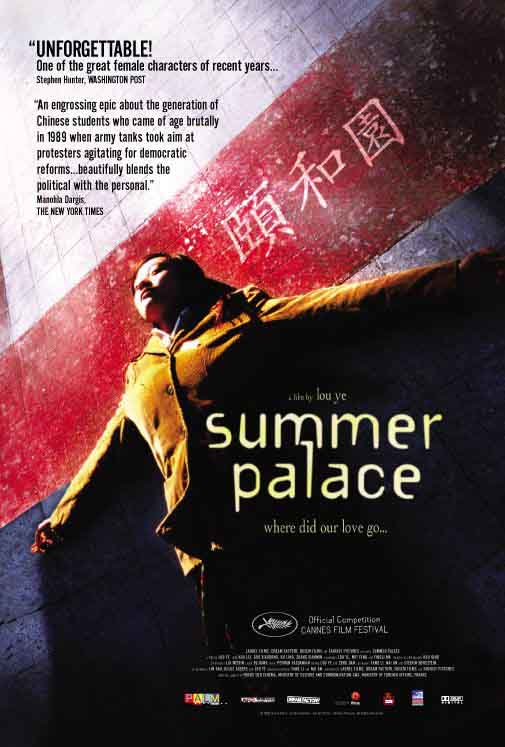
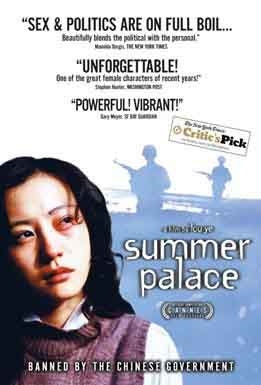
Does it tell some secret things about the Tiananmen Square incident of 1989 like the movie’s poster suggest?
I recently had an opportunity to finally watch Summer Palace, but after sitting for 140 minutes, the question was still there—what was movie good for?
The character Yu Hong says during the movie, “My college years were the most confused time in my life.”
However, for me, watching this movie was most confused time.
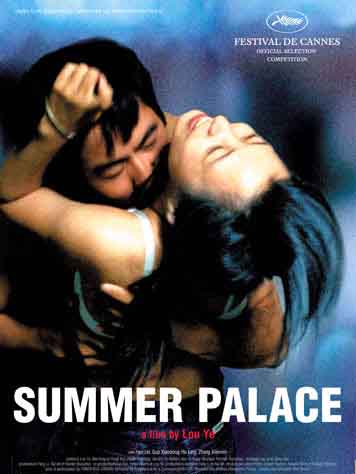
The story begins with the leading girl, Yu Hong (played by Hao Lei), having sex with her first lover at home in a North China village. Then she abruptly leaves for school at Beijing University.
We don’t know what she studies or if she is smart enough to get into “Beida,”, which is top university in China.
At school, a new girlfriend Li Ti takes her to bars and introduces her to boy named Zhou Wei, which turns into stormy relationship with constant love, sex and fighting.
In one scene, they are having naked sex and next scene are slapping and screaming then making love again.
Never does story tell why they act like this. Their love should be deeply hurt and touched inside.
However, all I saw was their cold, wild sex with different people. There was too much unnecessary nudity, like Yu Hong having a lesbian relationship in her dorm room, which cheapened movie.
In 1989, Tiananmen Square incident took place.
Movie poster for Summer Palace shows soldiers with guns and advertises that this story tells something about politics saying, it is “a powerful recreation of the Tiananmen events.”
However, they show few minutes of some students on campus singing songs, riding in the back of trucks and throwing bricks. That’s all.
This movie is definitely not about 1989 Tiananmen. I think director Lou Ye wanted to get commercial attention in the West by making story at the same time as 1989, an insincere marketing tactic.
Anyway, Yu Hong catches Zhou and Li in bed, so she leaves PKU without graduating.
Then she is working in some southern cities. Later, the movie say she is married, but we don’t see or know to whom.
Meanwhile, Zhou and Li travel to Berlin together. He has job there but movie doesn’t tell what job is.
Li Ti spends her time walking naked around her apartment. Then Zhou says he wants to go back to China, so Li Ti jumps off roof in front of him and dies.
Zhou then moves to Chongqing and seems successful but we don’t know why.
Then he is driving on highway and meets Yu Hong again at gas station.
Why is she in central China?
Why is she at gas station?
We don’t know. They go to hotel and have sex, which ends the movie.
Summer Palace is a little, blue sad story.
The director likes to show Yu Hong walking around with pouting, weepy face to get our pity or showing her having crazy sex to arouse us.
The director says it’s love story except there is no love. There’s no reason for anything that happens. There’s nothing to hold the story together.
There is only one scene after another without explanation as if director was confused and didn’t know what to do. With more than two and half-hours of this, imagine how boring that was.
Also, director made stupid, irresponsible mistakes. He shows students in 1980’s China wearing new designer clothes, high heels and sexy lingerie—even though none of these trends had arrived in PRC yet.
Then there are scenes at bars and nightclubs with PKU students drinking foreign liquor and listening to American pop music, which is also unreal.
None of these things came to China until the late 1990s, decade later.
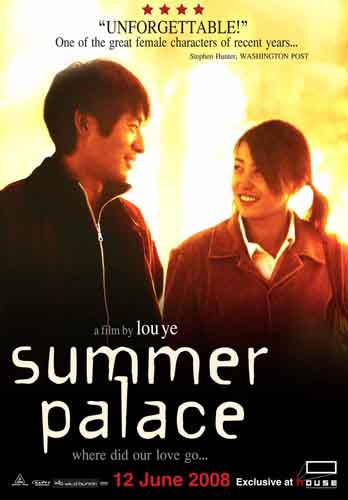
It is obvious that Lou Ye just wants to make his movie cool and stylish so people will watch it. He forgets that as filmmaker, he has certain responsibility to keep story historically accurate.
What bothers me most about Summer Palace is that so many Westerners will think this movie tells some real, true things about Chinese student culture, which is mostly unreal as depicted in movie.
The New York Times review says, “remarkable for its candor.”
The Shanghaiist, a popular website for foreigners in China, says, “This is the only honest piece of Chinese filmmaking we’ve seen in a long time”
Ha! Are they serious?
On the other hand, maybe they have never watched another Chinese movie except Crouching Tiger Hidden Dragon. I know of at least twenty, sixth-generation Chinese moves better than Summer Palace.
Even director’s first movie, Suzhou River, was better than this rubbish.
Maybe this movie is popular with foreigners because there’s so much sex and nudity and because it’s “banned by government”, which really seems to make Westerners excited.
Any movie banned by Communists is automatically “cool” to Westerners, even if movie sucks.
So why was Summer Palace banned and director Lou Ye censored for next 5 years?
Actually, it’s not because of politics because this movie tells nothing about Tiananmen Square incident. And it’s not because nudity since those scenes can easily be edited out.
It’s only because Lou Ye took the movie to Cannes Film Festival in France without permission from China’s State Administration of Radio, Film and Television, which is necessary for all Chinese filmmakers.
Lou Ye did this expecting he would be censored, so he could proudly say his movie was “banned in China” on his movie poster and get instant praise from Western audiences.
However, for me, I think this movie should be banned just because it sucks.
It’s big disappointment and waste of 2.5 hours.
Sixth-Generation Chinese filmmakers are trying hard to be shocking without telling good stories, and Western audience praises these filmmakers because they think Chinese who show nudity are “brave”.
How can anyone call this trash art as confusing as it is?
See Hannah’s review of Red Mansion, a Chinese TV series, or visit her Blogs at Hannah Travel Adventure (Chinese) or Hannah China Backpacker (English)
_________________________
Lloyd Lofthouse, the host of the Blog, is the award-winning author of the concubine saga, My Splendid Concubine & Our Hart. When you love a Chinese woman, you marry her family and culture too.
Sign up for an RSS Feed for iLook China


 Posted by Lloyd Lofthouse