The ‘Golden Age’ of the Song Dynasty: part 2 of 4

April 25, 2018

The Song Dynasty was responsible for innovations and prosperity that doubled the population from 50-million at the end of the Tang Dynasty to 100-million.

Here are a few examples of what happened. A new type of canal lock was invented in 1373 AD, four hundred years before someone in Europe invented a similar lock. This enabled China to finish building the Grand Canal, the longest canal in the world that is still in use.

The focus on astronomical observations helped improve agriculture and the Song Dynasty’s grain yield was ten to twenty times that of Europe at the time. In addition, methods to fertilize land that was not suitable for growing crops was also developed leading to two or three annual harvests that helped support the large population. For a comparison, the 3rd edition of Introduction to Medieval Europe reports, “Bold estimates for the whole of continental Europe (including Russia and the Balkans) place the number of inhabitants in the year 1000 at 30 and 40 million.”

Although China’s four greatest inventions came long before the Song Dynasty, it wasn’t until then that papermaking, the large-scale application of printing, the compass, and gunpowder made their mark about four hundred years before the German inventor Johannes Gutenberg invented his printing press in 1440 AD.

It was also during this dynasty that the compass was improved for navigation making it less likely for ships to get lost at sea and allowed ships to travel farther from China.

To preserve these innovations, Shen Kuo published his Dream Pool Essays in 1088 AD (still in print today), a huge encyclopedic book that covered a wide range of subjects, including literature, art, military strategy, mathematics, astronomy, meteorology, geology, geography, metallurgy, engineering, hydraulics, architecture, zoology, botany, agronomy, medicine, anthropology, archeology, etc.

Continued in Part 3 on April 26, 2018, or return to Part 1

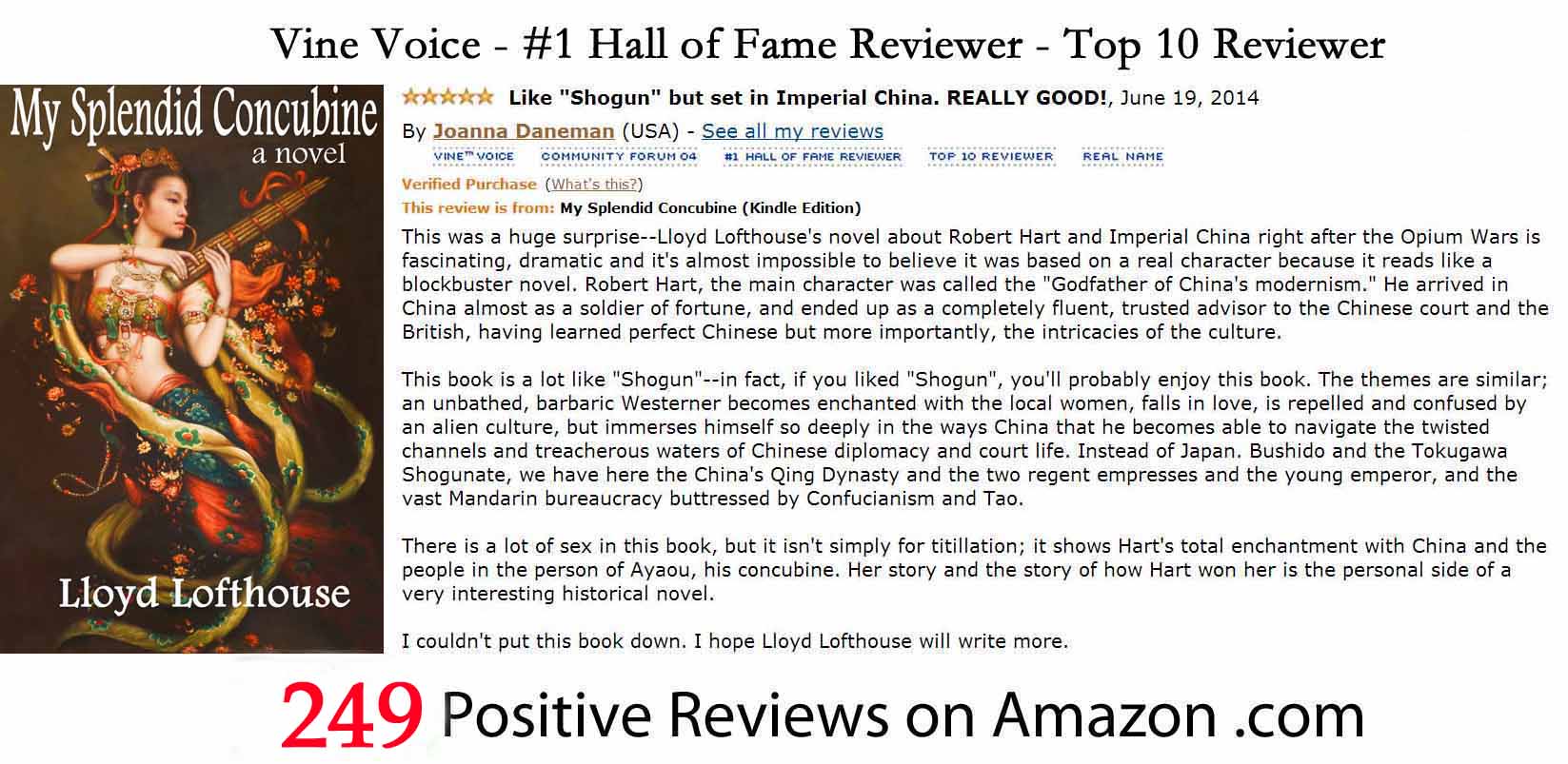
Lloyd Lofthouse is the award-winning author of My Splendid Concubine, Crazy is Normal, Running with the Enemy, and The Redemption of Don Juan Casanova.
Where to Buy

Subscribe to my newsletter to hear about new releases and get a free copy of my award-winning, historical fiction short story “A Night at the Well of Purity”.

About iLook China


The ‘Golden Age’ of the Song Dynasty: part 1 of 4

April 24, 2018

Fifty-three years after the Tang Dynasty collapsed (618 – 907AD), the Song Dynasty (960-1279 AD) was born and established its first capital in Kaifeng City, Henan Province.

The Song Dynasty survived for 319 years — thirty years longer than the Tang Dynasty.

Reference.com says, “While the Tang and Song dynasties shared much in common, there were a couple of major differences in the way they ruled over the populous territory of China. During both periods China experiences political, cultural and social blossoming. Some common traits include the development of trade, the flourishing of painting and poetry and the improvement of bureaucracy. Even though both Tang and Song were Chinese dynasties, they did not rule over the same territory. The Song power was centered on the southeastern part of the country, whereas the Tang power extended over much of modern China, as well as Manchuria, Tibet, and Mongolia.”

In addition, during the Song Dynasty, astronomy was one of the areas where advances were made. In July 1054, an unknown nova appeared in the sky. The sudden appearance of this nova alarmed the bureau of astronomy. A year later, the star vanished. The nova was important because Chinese astronomers discovered the Crab Nebula near Taurus and careful records were kept that still benefits science today.

In fact, the world’s largest and earliest star chart was carved on a stele in Suzhou, Jiangsu.

Continued with Part 2 on April 25, 2018

Lloyd Lofthouse is the award-winning author of My Splendid Concubine, Crazy is Normal, Running with the Enemy, and The Redemption of Don Juan Casanova.

Where to Buy

Subscribe to my newsletter to hear about new releases and get a free copy of my award-winning, historical fiction short story “A Night at the Well of Purity”.

About iLook China


Judaism in China

April 18, 2018

The Jews settled in Kaifeng, Henan Province in 960 AD after arriving along the Silk Road.  The Jews who first arrived in China were welcomed by the Imperial government, which encouraged them to retain their cultural identity by building a synagogue that was finished in 1163 AD.

The Kaifeng Synagogue had a Torah written on sheepskin. The architecture of the buildings reflects Jewish culture. Evidence indicates that the Kaifeng Jews were very traditional and obeyed Kosher dietary laws and practiced circumcision for males.

The Jewish community in China thrived for centuries before it was assimilated into Chinese culture through intermarriage. But by the middle of the 18th century, little survived of that Jewish community.

In 1849, the Yellow River flooded causing what was left of the Jewish community to break apart. Today there are about five hundred descendants of the Kaifeng Jewish community that want to reclaim their Jewish traditions.

Lloyd Lofthouse is the award-winning author of My Splendid Concubine, Crazy is Normal, Running with the Enemy, and The Redemption of Don Juan Casanova.

Where to Buy

Subscribe to my newsletter to hear about new releases and get a free copy of my award-winning, historical fiction short story “A Night at the Well of Purity”.

About iLook China


Religious Influence in China

April 17, 2018

The Financial Times reports, “Christianity first reached China in the 7th century AD, brought by Nestorian Eastern Syriac believers.” The Review of Religions.org says Islam arrived about the same time, but in the 17th century, The downturn for Muslims began with the rise of the Qing Dynasty in 1644. Qing Emperors made life very hard for Muslims. First they prohibited the Halal slaughter of animals, then they banned the construction of new Mosques and the pilgrimage for Hajj. Conditions grew bleak for Islam in the second half of the 19th Century when rebellion led to the slaughter of possibly millions of Chinese Muslims.”

This helps explain why China has never had an organized religion dominate the culture as religions have in Western and Middle Eastern countries.

In fact, when organized religions meddle too much, the Chinese eventually strike back. During the Tang Dynasty in 878 A.D., a rebel leader named Huang Chao burned and pillaged Guangzhou (better known in the West as Canton) killing tens of thousands of Muslims, Jews, and Christians.

Then there were two Opium Wars during the middle of the nineteenth century where France and England invaded to force opium and Christian missionaries on China.

That resulted in the Taiping Rebellion, which was led by a Christian convert, Hong Xiuquan, known as God’s Chinese son. Hong claimed to be Jesus Christ’s younger brother. Estimates say twenty to thirty million Chinese may have died during this religious war to rid China of opium and turn China into a Christian nation, far more than all the Crusades combined.

The culmination of a series of campaigns against organized religions starting in the late 19th century, including Mao’s Cultural Revolution, destroyed or forced Christians, Jews, and Muslims to hide their religious beliefs.

More than thirteen hundred years have passed since Christianity and Islam were introduced to China, but after all those centuries only 0.45-percent of the Chinese population follows Islam while about 2.5-percent are Christians. That means about 97-percent of the population does not belong to an organized religion like Christianity or Islam that often has an influence on politics.

Lloyd Lofthouse is the award-winning author of My Splendid Concubine, Crazy is Normal, Running with the Enemy, and The Redemption of Don Juan Casanova.

Where to Buy

Subscribe to my newsletter to hear about new releases and get a free copy of my award-winning, historical fiction short story “A Night at the Well of Purity”.

About iLook China


The repeating Chinese crossbow led to the modern machine gun

April 11, 2018

Vendian.org reports, “The crossbow was invented in Ancient China during the Zhou dynasty, around the year 700 BC. … They had a range of up to 650 feet. The crossbow had a firing mechanism, which was so complicated that it would have been nearly impossible for an enemy to understand how it worked, thus reducing the chance that the crossbow could be copied by hostile civilizations. …  And, in the eleventh century, rapid-firing crossbows were developed that could fire 20 arrows in only 15 seconds.”

The mechanism that made this Chinese eleventh-century repeating crossbow work was the forerunner to the modern machine gun.

The Chinese also invented the stirrup around the fourth century A.D. Before that invention, all of the people on earth rode horses without stirrups and staying on horseback while fighting was a challenge. Scientific American says the “Invention of the stirrup may rival that of the longbow and gunpowder.”

Thanks to stirrups, the horse became a more stable platform for war. Prior to the stirrup, it was common for a man to ride about seven miles a day. After the stirrup, that distance was extended to as much as seventy miles a day.

The invention of the stirrup along with the repeating crossbow created powerful weapons. The Chinese could also manufacture items in mass, quickly and efficiently. The Chinese used pottery molds to accomplish this—even to build the advanced trigger mechanism for the crossbow. When it came to cast iron, the Chinese were a thousand years ahead of the world.

However, by the time of the Sung Dynasty, the world was catching up because China’s enemies were stealing their technology.  It’s ironic that today, many in the West accuse the Chinese of stealing innovations. If so, China is only doing what was done to them centuries ago.

Lloyd Lofthouse is the award-winning author of My Splendid Concubine, Crazy is Normal, Running with the Enemy, and The Redemption of Don Juan Casanova.

Where to Buy

Subscribe to my newsletter to hear about new releases and get a free copy of my award-winning, historical fiction short story “A Night at the Well of Purity”.

About iLook China