China’s Last Imperial Dynasty was not ruled by the Han Chinese: Part 3 of 3

June 8, 2018

During the 19th century, the two Opium Wars started by Britain and France weakened the Qing Dynasty.

Besides the Opium Wars, there was also the Taiping Rebellion, which lasted more than a decade.

In 1900, the so-called Boxer Rebellion (known as “I-ho Chuan” or the “Righteous and Harmonious Fists”) was originally started to bring down the Manchu Qing Dynasty but the Qing government managed to redirect the rebellion against the foreigner invaders that had defeated China during the Opium Wars.

This ended in a worse defeat after the foreign powers formed an alliance and marched on Beijing slaughtering the rebels.

Back to the Qing Dynasty

How does a country innovate and prosper when it is fighting endless rebellions and wars. For a brief example, Business Insider estimates 25-million died during the Qing conquest of the Ming dynasty, a period of extreme political turmoil in China that lasted for sixty-five years. It is estimated that during the Taiping Rebellion 1850-1864, another 20-million died (some estimates allege the number was closer to 100-million). During the Dungan Revolt 1862-1877, another 10-million were killed.  If you click this link, you will discover a list of thirty wars and revolts that the Qing Dynasty was involved in. Do you see any comparison to the United States since the end of World War II?

The driving force behind the revolution of 1911 that ended the Qing Dynasty was Dr. Sun Yat-sen, who had been educated in Hawaii when it was an American territory. This exposure to the U.S. Republic motivated Sun Yat-sen to build a Republic to China but one that would fit the Chinese culture.

Return to Part 2 or start with Part 1

Lloyd Lofthouse is the award-winning author of My Splendid Concubine, Crazy is Normal, Running with the Enemy, and The Redemption of Don Juan Casanova.
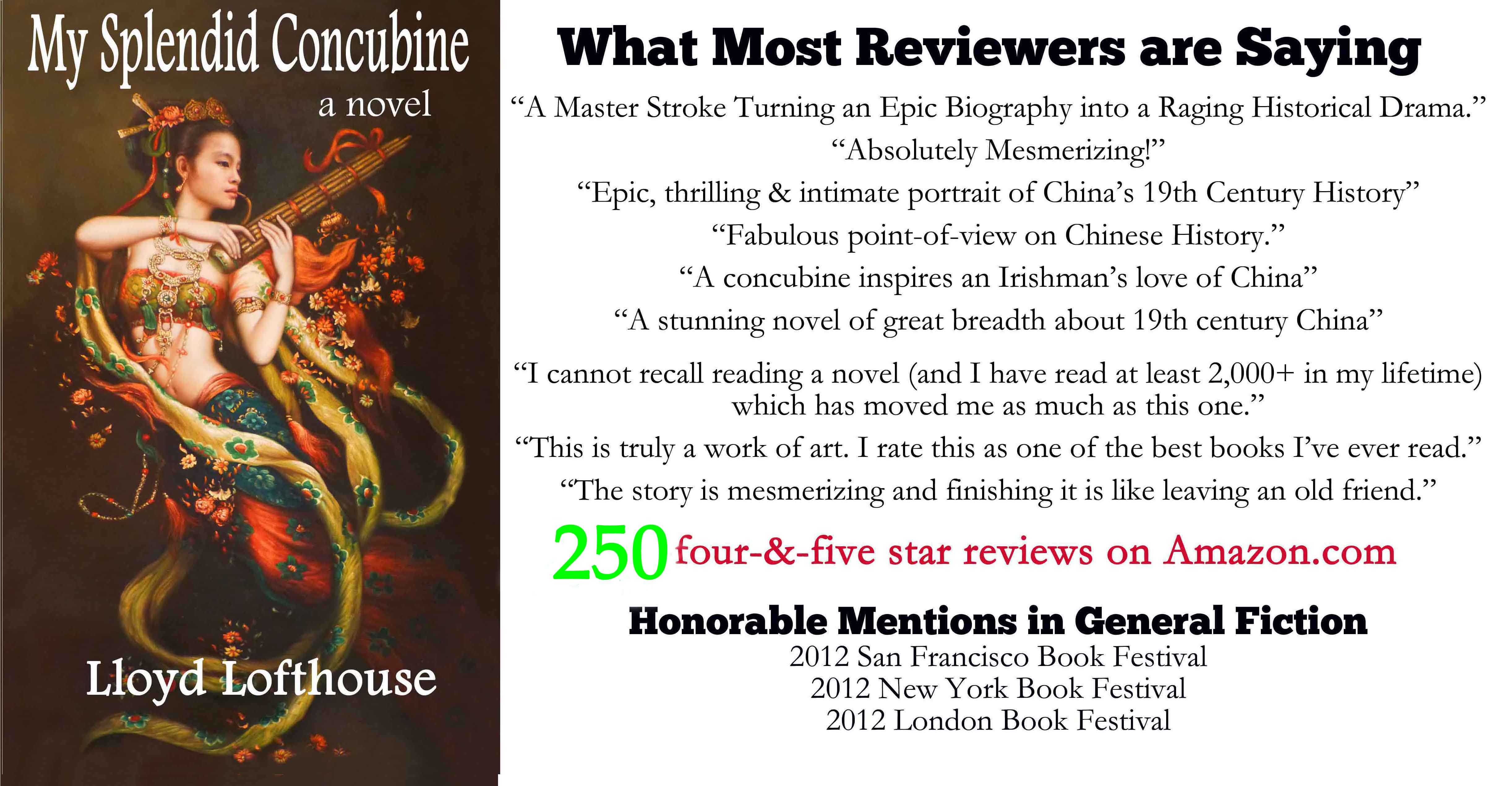
Where to Buy

Subscribe to my newsletter to hear about new releases and get a free copy of my award-winning, historical fiction short story “A Night at the Well of Purity”.

About iLook China


China’s Last Imperial Dynasty was not ruled by the Han Chinese: Part 2 of 3

June 7, 2018

The next Qing Emperor Yongzheng ruled from 1722 to 1735, and he was frugal like his father.

Yongzheng created an effective government and used military force to preserve the dynasty’s position as his father had. Under his leadership, he continued the era of peace and prosperity by cracking down on corruption and waste while reforming the financial administration of the empire.

The next one was the Qianlong Emperor, also known as the warrior emperor, and he ruled China for much of the 18th century (1735 – 1796). During his leadership, he subdued several rebellions known as the “ten successful campaigns”, which drained the Qing Dynasty’s treasury. These rebellions went on for forty-five years from 1747 to 1792.

However, when the Qianlong Emperor died, China was unified, at peace, and still strong. He was a brilliant military leader and expanded the empire further into Mongolia and Tibet.

During Qianlong’s rule, Manchu and Chinese armies spread Qing sovereignty over Burma and Nepal.

In addition, Chinese settlers in Yunnan, Guizhou, Sichuan, and Taiwan dealt with rebellions of the aboriginal tribes that could only be subdued by military force. Muslim people also resisted the Qing regime in Gansu and Xinjiang.

Part 3 will be posted on June 8, 2018 or return to Part 1

Lloyd Lofthouse is the award-winning author of My Splendid Concubine, Crazy is Normal, Running with the Enemy, and The Redemption of Don Juan Casanova.

Where to Buy

Subscribe to my newsletter to hear about new releases and get a free copy of my award-winning, historical fiction short story “A Night at the Well of Purity”.

About iLook China


China’s Last Imperial Dynasty was not ruled by the Han Chinese: Part 1 of 3

June 6, 2018

The Qing Dynasty can be traced back to the 1580s when a Manchurian chieftain Nurhachi (1558–1626) unified the Jurchen tribes in an area north of the Great Wall of China. In time, Nurachi controlled most of Manchuria. In 1616, Nurhachi declared himself khan, and founded the Later Jin Dynasty, that his successors renamed in 1636, the Qing Dynasty.

He launched his war against China in 1618. In February 1626, he was defeated for the first time by the Chinese and died of his wounds by the end of September.

In 1644, his son Dorgon conquered China. However, the Chinese fought hard to drive the Manchurians from China and continued resistance in Southern China until crushed.

The second emperor of the Qing Dynasty was Kangxi (1654 – 1722) who ruled for sixty-two years and is considered by many historians one of the ablest emperors to govern the vast Chinese empire. He laid the foundation of a long period of political stability and economic prosperity for China.

The rebellions Kangxi put down was called the Rebellion of the Three Feudatories, which lasted from 1673 to 1681.

Then there was the pirate-merchant Zheng Chenggong, who set up an independent kingdom on the island of Taiwan. Eventually, that kingdom was defeated and brought back into the Qing empire.

The Kangxi emperor also fought wars with Russia from 1685 until 1689 when the Treaty of Nerchinsk was signed.

Next were the campaigns against the Mongols until they were defeated. In 1720, the Qing Dynasty occupied Tibet adding that region to the empire.

However, even in times of war, the Kangxi emperor provided tax relief for the people, and he was known as a frugal and wise leader. When he died, he left China strong and in good financial shape

It is also well known that the Qing Dynasty did not trust the Han Chinese and went out of its way to hire foreigners to fill government positions held by Han Chinese for centuries.

Part 2 will be posted on June 7, 2018

Lloyd Lofthouse is the award-winning author of My Splendid Concubine, Crazy is Normal, Running with the Enemy, and The Redemption of Don Juan Casanova.

Where to Buy

Subscribe to my newsletter to hear about new releases and get a free copy of my award-winning, historical fiction short story “A Night at the Well of Purity”.

About iLook China


The Ming Dynasty’s Star-Crossed Lovers

June 5, 2018

China’s Romeo and Juliet, “The Peony Pavilion”, was a play written by Tang Xianzu and was first performed in 1598, forty-six years before the end of the Ming Dynasty.

Someone might assume that Xianzu borrowed from Shakespeare’s play, but that would be a wrong assumption because in the 16th century there was no internet, no television, no radio, no telephones, no TV, and it took months to sail from England to China. Communication and the sharing of ideas happened at a snail’s pace.

It was clearly a coincidence that Tang Xianzu came up with the idea of China’s Romeo and Juliet a few months after Shakespeare wrote his first version.

In fact, the Encyclopedia Britannica reports that “Romeo and Juliet” had a bumpy start.  “Romeo and Juliet, the play by William Shakespeare, was written about 1594–96 and first published in an unauthorized quarto in 1597. An authorized quarto appeared in 1599.” Two years after “The Peony Pavilion” (first) appeared on stage in China.

In addition, the star-crossed lovers that appear in the “The Peony Pavilion” also tragically die for love, but their plight is described in a much more mournful tone than Shakespeare’s version.

You might also be surprised to learn that Shakespeare is popular in China since his work is taught in most Chinese universities both in English and in Chinese.

Enid Tsui writes, “It’s had its ups and downs but, 400 years after William Shakespeare’s death, China’s affinity with The Bard is as strong as ever.”

However, The People’s Republic of Shakespeare, Adventures in Chinese Research says that many of the Romeo and Juliets performed in China are either parodies or rewrites where one of the lovers survives in the end because too many Chinese have experienced too much sadness in their lives thanks to Japan’s brutal invasion of China during World War II and China’s long bloody Civil War followed by the suffering caused by Mao’s Cultural Revolution.

Lloyd Lofthouse is the award-winning author of My Splendid Concubine, Crazy is Normal, Running with the Enemy, and The Redemption of Don Juan Casanova.

Where to Buy

Subscribe to my newsletter to hear about new releases and get a free copy of my award-winning, historical fiction short story “A Night at the Well of Purity”.

About iLook China


Although Established by a Nationalistic Religious Cult, the Ming Dynasty Was Not a Total Failure

May 30, 2018

During the Ming Dynasty (1368 – 1644), great achievements were recorded in architecture, shipbuilding, porcelain making, and textile weaving.

Eighty years before the British discovered what caused scurvy, Chinese sailors were not suffering from this disease because the Chinese had developed porcelain containers to grow bean sprouts in while the ships were crossing oceans.  Bean sprouts are a rich source of vitamin C.

During his voyages, Admiral Zheng He took more than 10,000 copies of books to give away in the hope of spreading Chinese civilization and traditional Confucian ideas. Instead of diseases and cannonballs that were ruthlessly used to spread colonialism out of Europe, the Chinese gave away books.

Of all the textile industries, silk weaving was number one and could be found in almost every large and small town in Southern China.

Shang Chuan, a Research Fellow at the Chinese Academy of Social Sciences says, “Textiles in China have a long history (back to the Warring States Period, BC 475-221). By the Ming Dynasty… large workshops had appeared, although work was still done by hand.

“However, compared with the old family production model, large worships were superior as the products were quality guaranteed, all looked the same and were the same standard.”

The silk industry in China was the beginning of modern manufacturing. As many think, modern manufacturing techniques did not start in England in the 18th century. It started in China centuries earlier.

The reputation of the Chinese products that Admiral Zheng He took with him on his voyages brought him considerable honor and made him welcome everywhere he visited. On his sixth voyage, he reached the African coast and twelve hundred envoys from sixteen African and Asian countries returned to China with Zheng He’s fleet.

In Beijing, the Ming Emperor presented these envoys with forty-thousand roles of silk and brocade.

Even before the Ming Dynasty, China had been sending diplomatic missions overland to the West for centuries and trade had extended as far as east Africa.

However, never before had a government-sponsored mission the size of Zheng He’s fleet been organized.  His voyages were a vivid demonstration of the economic and cultural prosperity of the Ming Dynasty.

The Great Wall, which the Ming Dynasty had continued to rebuild, modernize and strengthen, stretched from China’s eastern coast to the far northwest. This Great Wall is what tourists in China see today.

In 1637, the largest encyclopedia of ancient China was published. It was a comprehensive book covering science and handicraft technologies. Another encyclopedia was published on agriculture. A third described China’s geology in detail. A fourth was the most comprehensive medical book in Chinese history, the Compendium of Materia Medica.

Meanwhile, The Industrial Revolution in Europe would not start in Britain until about 1760, more than a century after the Ming Dynasty had been replaced in 1655 by the Manchu led Qing Dynasty.

However, after 1433, the Ming Dynasty turned inward and became isolated from the world, setting the stage for its collapse and the madness and horror that followed for more than a century up to 1949.

Lloyd Lofthouse is the award-winning author of My Splendid Concubine, Crazy is Normal, Running with the Enemy, and The Redemption of Don Juan Casanova.

Where to Buy

Subscribe to my newsletter to hear about new releases and get a free copy of my award-winning, historical fiction short story “A Night at the Well of Purity”.

About iLook China