Shanghai is considered the Paris of Asia. There’s a reason for this and I hope the photos and video will show that.
Notice the Chinese middle-class tourists on the boat. Study how they dress. See the cameras. And ask yourself this—if these people are so brainwashed and downtrodden, why are they out taking a cruise on the Huangpu River taking pictures as if they were visiting the Grand Canyon or New York?
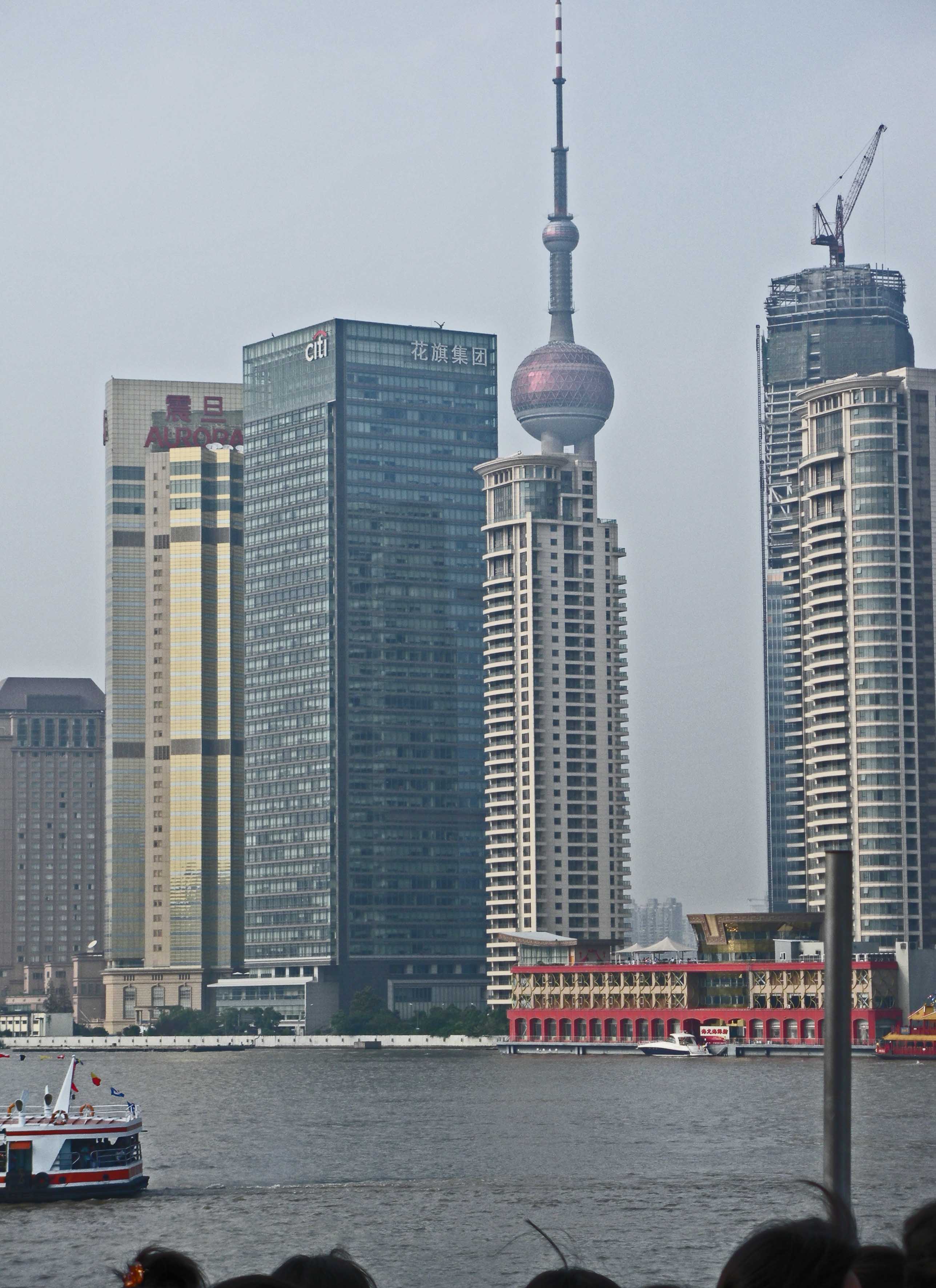
Pudong side of Huangpu River
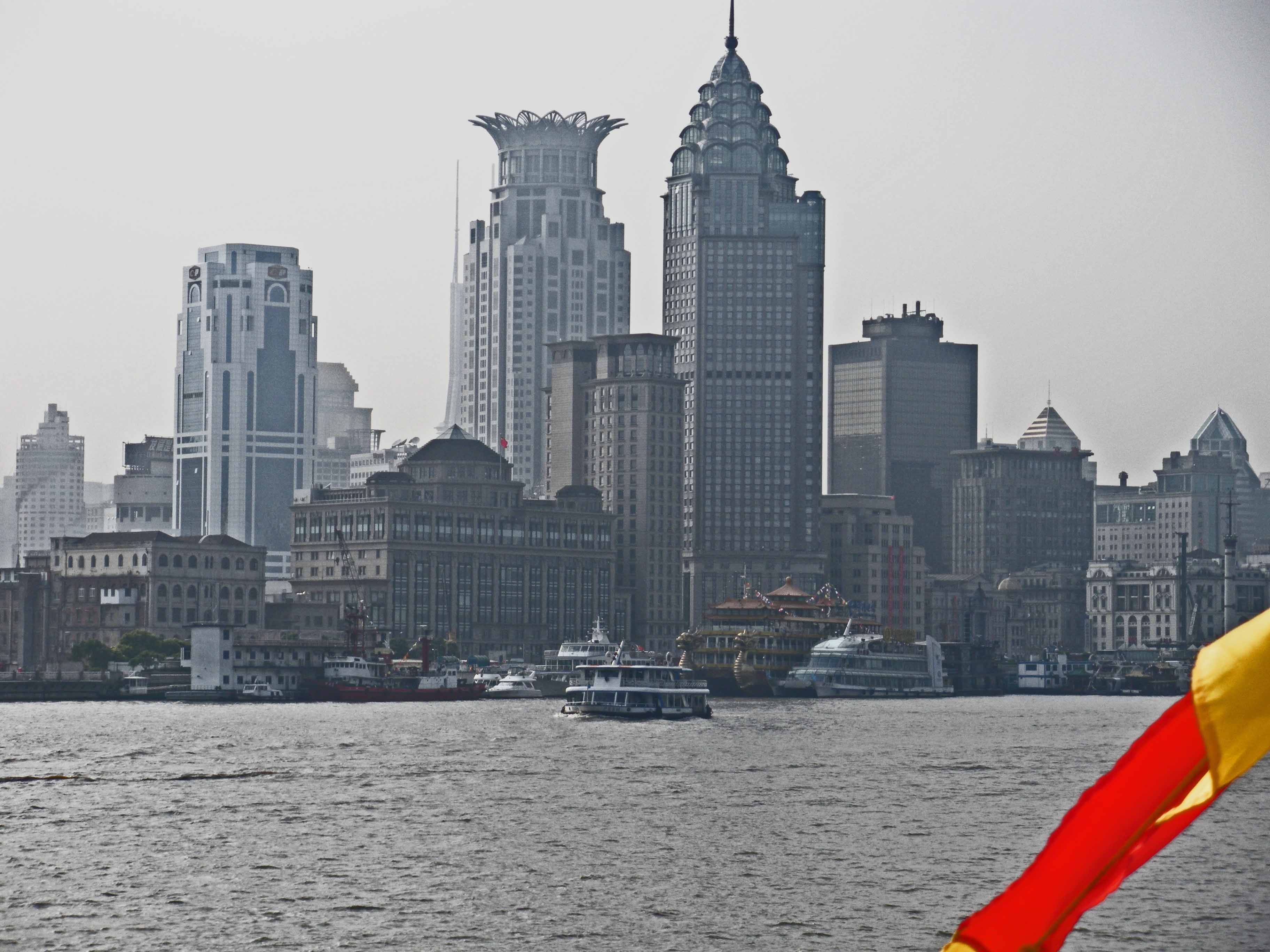
See the city skyline along the river.
This is only a small portion of Shanghai.
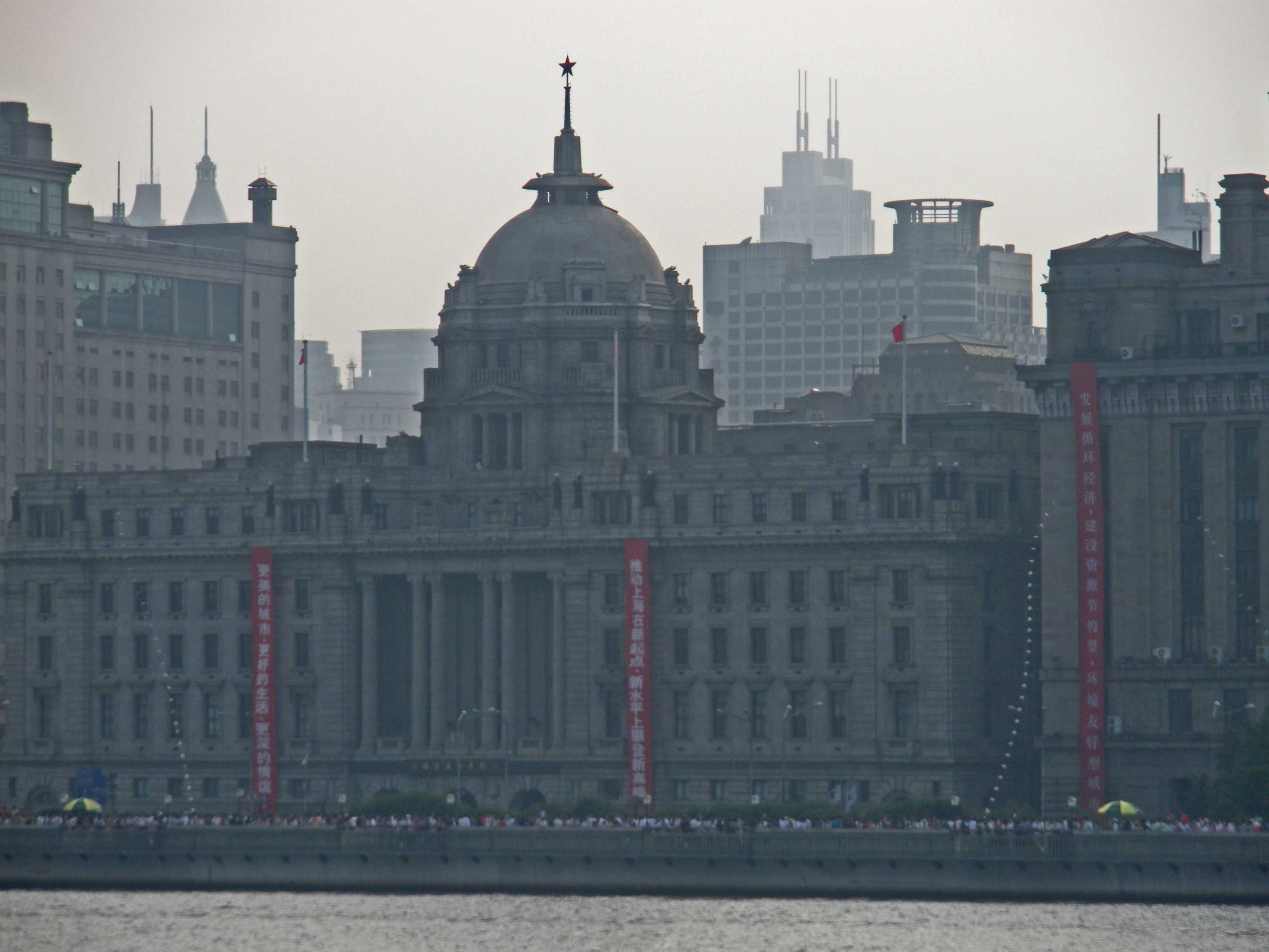
Shanghai side of Huangpu River – the croweded Bund
West of the Huangpu River is Shanghai. On the east bank is Pudong–fifty years ago, this land was farm land.
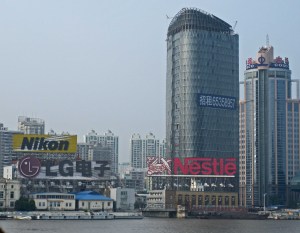
A close up of the crowded Bund on the Shanghai side of the river
Check out the number of Chinese tourists visiting the Bund in this photograph. I’ve waded through these crowds. These people are laughing, smiling, eating, taking pictures of each other, clowning around. They are having more fun than I see from most American tourists when I travel in America.
Look at the signs-Nikon, LG, Nestle
China has almost five hundred million people living in its cities. Another eight hundred million live in rural areas. There are now more Chinese surfing and Blogging on the Internet (513 million) than the entire population of the United States and there are ways to get around the censors. The average time spent on the Internet is almost three hours a day or more than 19 hours a week.
Fifteen to seventeen million people live in Shanghai.
Lloyd Lofthouse is the award-winning author of The Concubine Saga. When you love a Chinese woman, you marry her family and culture too. This is the love story Sir Robert Hart did not want the world to discover.
Subscribe to “iLook China”!
Sign up for an E-mail Subscription at the top of this page, or click on the “Following” tab in the WordPress toolbar at the top of the screen.
My wife, daughter and I saw “Chinglish“—a play by David Henry Hwan—on Sunday, September 16 at the Berkeley Rep Theater and we laughed-out-loud many times.
This is not a review of Hwan’s play as much as it is about how different cultures find common behaviors hard wired in our DNA to make connections.
Back to “Sex in NOT Important”, the title of this Post. Of course sex is important, but for thirty-two years, I kept telling myself it wasn’t. My reason for thinking this had nothing to do with sex but more to do with lust and how dangerous out-of-control lust might be. For example, lust has led many a man and women into relationships that do not turn out well. Lust has led to priests/pastors to molest children. Lust is linked to rape. Lust has motivated a few teachers to have sexual affairs with students ruining lives.
Now, thanks to Hawn’s Chinglish, I have changed my mind about the importance of sex.
After all, the Earth is still a big place and there is a lot going on 24/7.
To summarize Chinglish, this laugh-out-loud play was about Daniel, a former employee of Enron, who almost went to prison with the rest of the crooks. Daniel not only lost his high paying job with Enron but he’s broke due to the legal battle that kept him out of jail.
In a last desperate attempt at success, he goes to China to find customers for his American company (a business that’s been in his family since 1925), but Daniel does not speak a word of Mandarin. At the beginning of the play, he says, “If you are an American, it is safe to assume that you do not speak a single f*****g foreign language.”
That one line tells us how clueless most Americans are when it comes to other cultures.
Chinglish, through humor, teaches us a lesson about the minefield of misunderstanding and manipulation that happens when people of different cultures attempt to do business with each other.
Here’s the synopsis from the Website of the Broadway production of Chinglish: “An American businessman arrives in a bustling Chinese province looking to score a lucrative contract for his family’s sign-making firm. He soon discovers that the complexities of such a venture far outstrip the expected differences in language, customs and manners …”
However, there is another implied theme and that is why sex is important—something all cultures and races have in common that often transcends cultural differences. In the play, Daniel, an unhappily married man has an affair with an unhappily married mainland Chinese woman. Without spoiling the story, this affair provides the link that Daniel needs to succeed in China, and that link is Guanxi.
Early in the play, Daniel’s British interpreter, a man that has lived in China for years and speaks Mandarin fluently, tells him he must stay at least eight weeks to have a chance to develop Guanxi, a system of social networks and influential relationships that facilitate business and other dealings. The British interpreter says that for millennia China has survived without a Western legal system of laws, lawyers, courts and judges, and that Guanxi was crucial for China’s success as the longest surviving civilization and culture on the planet.
Hmm, is this a teachable moment? Do we learn something about the Western legal system compared to Guanxi?
Without understand how Guanxi works, Daniel struggles to cross the cultural divide but fails until he has the sexual affair with the wife of a Chinese judge. The sexual attraction and lust that led to the affair opens the door to the Guanxi network of his lover and her husband.
To discover what happens, you may want to see the play or wait for the movie, which I was told is in production and will stay faithful to the play. The last performance for Chinglish at the Berkeley Rep will be October 21, 2012. Then it will appear at the South Coast Repertory January 25 – February 24, 2013 in Orange County, California before moving to Hong Kong March 1 – 6, 2013.
______________
Lloyd Lofthouse is the award-winning author of The Concubine Saga. When you love a Chinese woman, you marry her family and culture too. This is the love story Sir Robert Hart did not want the world to discover.
Subscribe to “iLook China”!
Sign up for an E-mail Subscription at the top of this page, or click on the “Following” tab in the WordPress toolbar at the top of the screen.
China has a unique food culture. My wife loves noodles. I’ve followed her down narrow Shanghai streets to a famous won-ton and noodle shop on the corner of Chang-le and Shang-yang Road. The front is open and the ceiling low with each narrow table crowded with Chinese sitting on small chairs shoveling noodles in with chopsticks.
My wife orders a small bowl of noodles with peanut sauce for me and a bowl of blood soup and another bowl of noodles with spicy hot Sichuan peppercorn sauce for her. As she eats, sweat beads her face but there is not one word of complaint—not one sign that she suffers. Instead, this seriously satisfied look spreads across her face as if she has entered a Chinese noodle heaven.
When we are visiting Nanjing Road in Shanghai between People Square and the Bund, we always stop at the same food shop where my wife orders steaming hot noodles with the same peppercorn sauce, and I order deep fried, fresh chou dofu (stinky tofu) with the same sauce that makes me sweat.
At celebration feasts, a wider variety of food will be served from whole fish, crab, a variety of vegetable dishes and tofu.
Lloyd Lofthouse is the award-winning author of The Concubine Saga. When you love a Chinese woman, you marry her family and culture too. This is the love story Sir Robert Hart did not want the world to discover.
Subscribe to “iLook China”!
Sign up for an E-mail Subscription at the top of this page, or click on the “Following” tab in the WordPress toolbar at the top of the screen.
From Business Insider, comes 15 Facts (actually 17) About China that will Blow Your Mind. Here are five of them. Visit Business Insider to see the rest and the details.
1. By 2025, China will build TEN New York-sized cities.
Shanghai river waterfront
2. China already consumes twice as much steel as the US, Europe and Japan combined.
3. If the Chinese, one day, use as much oil per person as America, then the world will need seven more Saudi Arabias to meet the demand.
Note: Another reason why China NEEDS to go Green with their power. See my piece about this topic at China Going Green. The growing crises with industrial pollution linked to oil is another reason.
4. Chinese Internet users are five times as likely to have blogs as Americans.
5. Chinese GDP (Gross Domestic Product) could overtake the U.S. as soon as the early 2020s.
Bonus Fact: The Chinese plan to have a permanent space station before 2020, walk on the moon by 2025 and a manned mission to Mars by 2040-2060.
______________
Lloyd Lofthouse is the award-winning author of The Concubine Saga. When you love a Chinese woman, you marry her family and culture too. This is the love story Sir Robert Hart did not want the world to discover.
Subscribe to “iLook China”!
Sign up for an E-mail Subscription at the top of this page, or click on the “Following” tab in the WordPress toolbar at the top of the screen.
A recent comment for The Tiananmen Square Hoax was worth turning into a post. The comment was left by an anonymous person going by the name of Fred.
He or she mentioned the arrest of Shi Tao, a mainland Chinese journalist, and Fred claimed that Tao was tortured by Chinese police before being given a ten-year jail sentence for sending an e-mail.
My response was: “How many witnesses are there to this torture? Any photos? When the US was water boarding prisoners at GITMO (water boarding is considered torture by some but not by others), the G. W. Bush administration (2001 – 2009) did not consider it torture but the Obama administration did (2009 – ).
As for the jail sentence, the laws of each country are different. We cannot judge China using the US legal system or someone’s opinion that it was unjust. For example: Do you approve of a country having a death penalty for a drug related crime?
Some of the countries that allow the death penalty for drug crimes: Bahrain, China, Cuba, Egypt, Gaza (occupied Palestinian Territories), India, Indonesia, Iran, Iraq, Kuwait, North Korea, Pakistan, Saudi Arabia, Singapore, Taiwan, Thailand, Viet Nam and the United States of America.
Article 28 of China’s Constitution says, “The state maintains public order and suppresses treasonable and other counter-revolutionary activities; it penalizes actions that endanger public security and disrupt the socialist economy and other criminal activities, and punishes and reforms criminals.”
“When the Chinese government found out (about the leak—Fred calls it sending an e-mail, but what was in that e-mail turns out to be sensitive CCP information.), the CCP demanded the sender’s personal information from Yahoo!’s Hong Kong office. Yahoo! turned the information over without asking what it was for (the United States does the same thing for treason and any suspicion of a potential act of Terrorism).
“Shortly thereafter, Shi Tao was detained on November 24, 2004. The Chinese authorities confiscated his computer and documents without showing any proper permit or document, and warned his family members not to talk about it with others. He was formally arrested on December 14.”
Here’s the law for treason in the United States: “Whoever, owing allegiance to the United States, levies war against them or adheres to their enemies, giving them aid and comfort within the United States or elsewhere, is guilty of treason and shall suffer death, or shall be imprisoned not less than five years and fined under this title but not less than $10,000; and shall be incapable of holding any office under the United States.”
In addition, in the US, “If the police have probable cause to believe a person has committed a crime but the prosecutor has not yet brought formal charges, the police may detain the suspect in custody for a short period of time (generally twenty-four to forty-eight hours). Probable cause is defined as facts sufficient to support a reasonable belief that criminal activity is probably taking place or knowledge of circumstances indicating a fair probability that evidence of crime will be found. It requires more than a mere hunch, but less than proof beyond a reasonable doubt. After this short period of detention, the police must release the person, or bring formal charges and take the suspect before a judge. If released, the person may be rearrested at a later date if the police obtain sufficient evidence.”
Is there any language in China’s laws that says how long the police in China may hold an alleged criminal without charging them? Does anyone know?
Shi Tao was sentenced to ten years in prison for releasing a document of the CCP to an overseas Chinese democracy site. This was the alleged accusation that led to his conviction and prison sentence.
How is that different from the US wanting to arrest Julian Assange for doing the same thing to America? I’ve read that the US is working to extradite Assange for crimes against America so the US may throw the citizen of another country (Assange is an Australian) in a US prison.
Then there is this about the legal system in China from The Diplomat.com: “Since 2006, new political campaigns have proliferated in courts and government institutions. These reemphasize the supremacy of the Communist Party and warn against the infiltration of ‘Western’ rule-of-law concepts. Indeed, even the content of the national bar exam has been altered to reflect these changes.
“Personnel changes have also swept through the Chinese judiciary. In 2008, Party authorities replaced the outgoing head of the Supreme People’s Court (strongly identified with many of the 1990s-era legal reforms) with a Party political-legal cadre whose main prior career experience had been his time serving as a provincial public security chief.
“The work of the courts has changed as well. Since 2003, Chinese authorities have moved away from court trials according to law, which were heavily emphasized in the 1990’s as the preferred means for resolving disputes. In their place they have revived Maoist-style mediation practices. And they have revived and expanded programs that train ex-military officers to serve as judges in rural courts, a practice which had fallen out of favor during the 1990’s.”
I recommend reading the rest of this post at The Diplomat. It’s worth reading to understand how the Chinese legal system is changing and why the CCP is doing things the way it does. We don’t have to like what goes on in China, but there is nothing we can do to change it because China is governed by the CCP as the US is governed by the Democratic and Republican Parties.
Should we swap governments to see what happens to the legal system of each country?
Before you answer that last question, consider that the United States has the largest prison population (2.29 million) on the Earth and China (1.65 million) is in second place but with more than four times the population. In fact, when we factor in the ratio of prison population to total population, the US has 743 people locked up for every 100,000, while China has 122 per 100,000 of the national population. Russia has the second highest ratio at 598 per 100,000.
______________
Lloyd Lofthouse is the award-winning author of The Concubine Saga. When you love a Chinese woman, you marry her family and culture too. This is the love story Sir Robert Hart did not want the world to discover.
Subscribe to “iLook China”!
Sign up for an E-mail Subscription at the top of this page, or click on the “Following” tab in the WordPress toolbar at the top of the screen.






 Posted by Lloyd Lofthouse
 iLook China