The Questionable Private Life of Chairman Mao: Part 4 of 5

September 22, 2017

In addition, Li cannot be credited with the English edition of his flawed memoir since the original manuscript written by Li was translated from his native Chinese into English by Professor Tai Hung-chao, before being edited by Thurston that Dr. Li later accused of cutting substantial parts of his original manuscript without his knowledge.

I was also told by a friend that read the Chinese language edition of the memoir that it reads as if it were an accountant’s ledger.

In addition, Professor Tai, the translator, alleged that the English-language publisher Random House wanted more sensationalist elements to the book than that which Li had provided them, in particular requesting more information about Mao’s sexual relationships.

Despite Li’s own protests, Professor Tai said Random House overruled him, and put fictional sexual claims in Dr. Li’s memoir anyway.

Then there is an Open Letter published in April 1995, a statement that said many of the claims made in Li’s memoir were false. One-hundred-and-fifty people that had personally known or worked with Mao signed that letter.

Then there is Professor Frederick Teiwes, a western academic specializing in the study of Maoist China, who was also critical of Li’s memoir. Professor Teiwes argued in his book The Tragedy of Lin Biao: Riding the Tiger during the Cultural Revolution 1966-1971 (1996) that despite Li’s extensive claims regarding the politics behind the Cultural Revolution, Dr. Li was actually “on the fringe” of the events taking place in the Chinese government.

Does that mean Dr. Li was a fraud, a liar, and that Random House helped make that fraud worse?

Continued in Part 5 on September 23, 2017 or return to Part 3

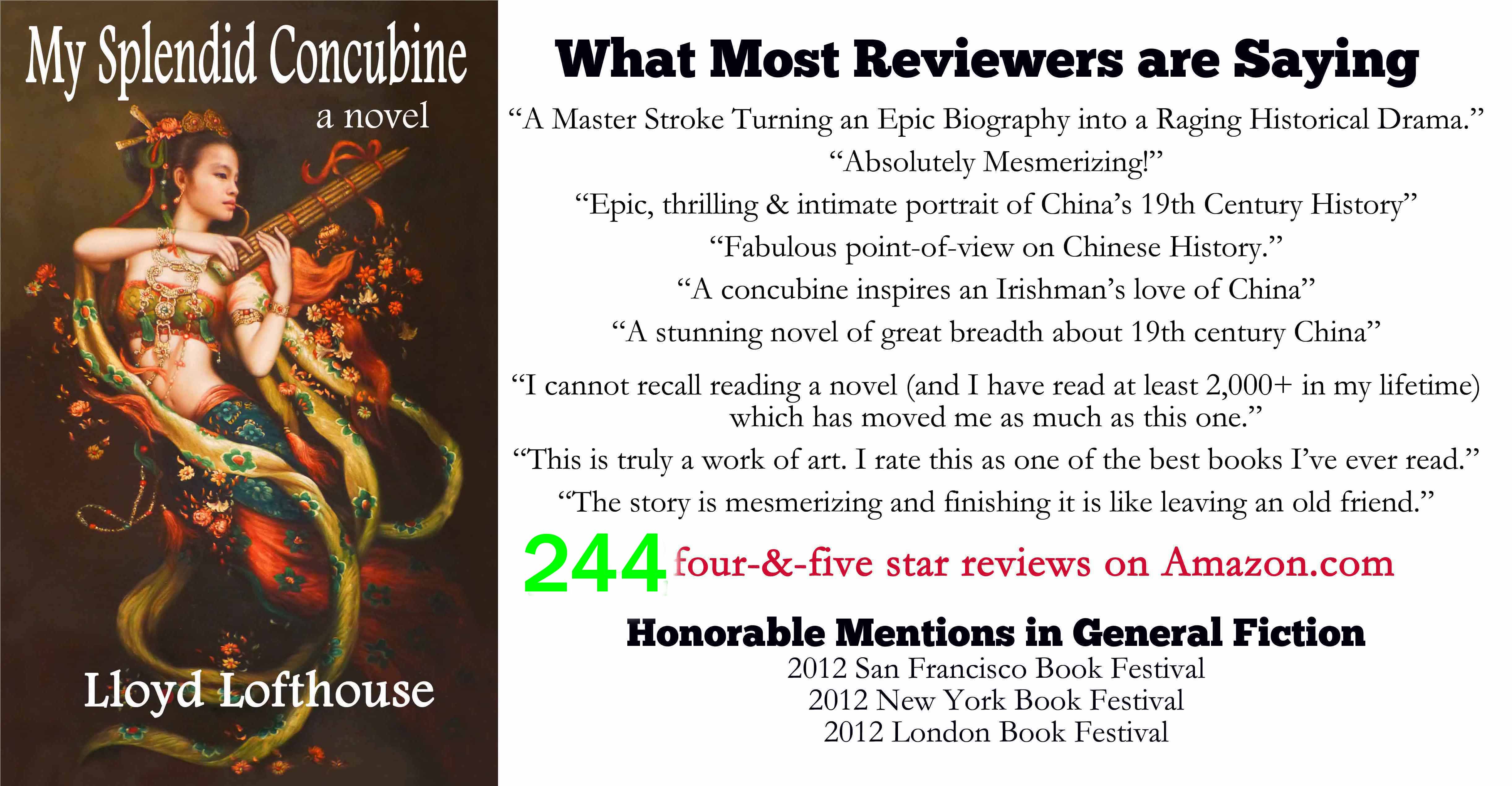
Lloyd Lofthouse is the award-winning author of My Splendid Concubine, Crazy is Normal, Running with the Enemy, and The Redemption of Don Juan Casanova.

Where to Buy

Subscribe to my newsletter to hear about new releases and get a free copy of my award-winning, historical fiction short story “A Night at the Well of Purity”.

About iLook China

China’s Holistic Historical Timeline


The Questionable Private Life of Chairman Mao: Part 3 of 5

September 21, 2017

In 1994, a year before he died, Dr. Li Zhisui published his memoir of Mao, The Private Life of Chairman Mao.

Li based the book’s contents upon his own memories of Mao several decades after the actual events because he burned all of his personal diaries during the Cultural Revolution in case something he wrote about Mao might get him in trouble with the teenage Red Guard.

In 1988, Dr. Li left China for good with Lillian (his wife), who was suffering from kidney trouble and joined their sons, Chong and Erchong, and daughter-in-law Mei, near Chicago.

His decision to set down his account of Mao’s private life was not easy since he had destroyed the forty notebooks of his private diary during the Cultural Revolution almost thirty years earlier.

It wouldn’t be until after Dr. Li’s wife died of kidney failure in 1989, that he started writing his memoir. “In her last days in the hospital, before she slipped into a coma,” says Li, “she urged me to write this book …”

One of Li’s collaborators involved in editing and revisions of the memoir, the western historian Anne F. Thurston, noted that because of this, Dr. Li’s claims were “fallible” and might “be wrong”.

One of the many critics of Li’s memoir was Qi Benyu, a former member of the Central Committee of the Communist Party of China that was connected with the left wing of the Cultural Revolution Group and the red-guard power seizures of 1967.

Qi had no reason to love Mao since he was arrested and imprisoned by Mao’s in 1968 and stayed in prison until 1986, a decade before Li wrote and published his memoir. Before prison, Qi spent several years near Mao and says he never heard any rumors of Mao having extra-marital affairs despite the fact that other senior Party members were known to have done this. Qi also said that most of the Cultural Revolution part of Li’s memoir consisted of information gleaned from newspapers, journals, and other people’s writings.

Continued on September 22, 2017, in Part 4 or return to Part 2

Lloyd Lofthouse is the award-winning author of My Splendid Concubine, Crazy is Normal, Running with the Enemy, and The Redemption of Don Juan Casanova.

Where to Buy

Subscribe to my newsletter to hear about new releases and get a free copy of my award-winning, historical fiction short story “A Night at the Well of Purity”.

About iLook China

China’s Holistic Historical Timeline


The Questionable Private Life of Chairman Mao: Part 2 of 5

September 20, 2017

Eighty-nine percent of the Amazon reviews of Dr. Li’s memoir of Mao earned 4 and 5-star reviews giving the book a 4.5 out of 5-star average. Before reviewing the book, it would have helped if the readers knew more about Dr. Li’s life.

Dr. Li Zhisui (1919 – 1995), attended West China Union University in Chengdu now known as Sichuan University that’s one of the oldest in China.

Soon after graduating from the university as a Western trained medical doctor in his mid-twenties, Li fled China in the 1940s to escape the ravages and dangers of the war and he ended up working as a ship’s surgeon out of Sydney, Australia.

In 1949, The Lecturn reports, “Madly enthusiastic about the Communist victory in 1949, he gives up a promising young career in Australia to take part in the efforts to rebuild China after a century of warfare and internal struggle…”

Since Mao officially declared an end to the Cultural Revolution in 1969 [its active phase lasted until the death of the military leader Lin Bao in 1971], we may assume that Dr. Li returned to Beijing from the destitute village in Zhejiang Province and/or rural Jiangxi Province mentioned in Part 1 of this five part series, where the doctor was sent in 1965 as part of the Socialist Education Program.

By this time, Dr. Li may have become a bitter man as we discover when we read his opinions in Around the Bend With Mao Zedong.

“As Dr Li presented it, the Socialist Education Program amounted to an elaborate waste of time … given the disparity between the living standards of the city people and the poor-beyond-all-imagination villagers.”

Mao held power in China for twenty-seven years but Dr. Li spent only eight of those years with Mao (less than 34-percent). That does not sound like someone that was with Mao every day he was in power.

How do we know that Li did not become Mao’s doctor until 1957?

In 1995, two years before the British gave Hong Kong back to China, a Chinese language book was published in Hong Kong. It was called Lishi de Zhenshi: Mao Zedong Shenbian Gongzuo Renyuan de Zhengyan. Translated that means The Truth of History: Testimony of the personnel who had worked with Mao Zedong.

Three people who had known Mao personally wrote that book. One was his personal secretary Lin Ke. The second person was his personal doctor from 1953 to 1957, Xu Tao, and the third person was his chief nurse from 1953 to 1974, Wu Xujun.

The three authors argued in this Chinese language book that Dr. Li didn’t know Mao that well, and Li presented an inaccurate picture of Mao in his obviously flawed memoir. The trio attacked Li’s claim that he had been Mao’s personal physician in 1954 and presented copies of a document from Mao’s medical record showing that Li only took on the responsibility of caring for Mao on June 3, 1957.

Continued on September 21, 2017 in Part 3 or return to Part 1

Lloyd Lofthouse is the award-winning author of My Splendid Concubine, Crazy is Normal, Running with the Enemy, and The Redemption of Don Juan Casanova.

Where to Buy

Subscribe to my newsletter to hear about new releases and get a free copy of my award-winning, historical fiction short story “A Night at the Well of Purity”.

About iLook China

China’s Holistic Historical Timeline


The Questionable Private Life of Chairman Mao: Part 1 of 5

September 19, 2017

On the Amazon page of The Private Life of Chairman Mao, it says, “From 1954 until Mao Zedong’s death 22 years later. Dr. Li Zhisui was the Chinese ruler’s personal physician. For most of these years, Mao was in excellent health; thus he and the doctor had time to discuss political and personal matters. Dr. Li recorded many of these conversations in his diaries, as well as in his memory.”

The previous paragraph as you will discover if you finish reading this five-part series is not correct.

But first, let’s examine how accurate a memory is. According to Elizabeth Loftus, “Memory is imperfect. This is because we often do not see things accurately in the first place. But even if we take in a reasonably accurate picture of some experience, it does not necessarily stay perfectly intact in memory.”

Loftus is an American cognitive psychologist and expert on human memory. She has conducted extensive research on the malleability of human memory. Loftus is best known for her ground-breaking work on the misinformation effect and eyewitness memory, and the creation and nature of false memories, including recovered memories of childhood sexual abuse.

Loftus says, “Another force is at work. The memory traces can actually undergo distortion. With the passage of time, with proper motivation, with the introduction of special kinds of interfering facts, the memory traces seem sometimes to change or become transformed.

“These distortions can be quite frightening, for they can cause us to have memories of things that never happened. Even in the most intelligent among us is memory thus malleable.”

For an example of what professor Loftus is talking about, we learn about faulty memories from Amy Chua when she discussed the writing of her memoir Battle Hymn of the Tiger Mother.

The Stamford Advocate reports, “The book was in many ways a family project. Rubenfeld, Chua’s husband, and their daughters read every draft and tried to reconcile their different memories. The final version reflects “four different sets of memories,” Chua said. “It was like family therapy.”

After reading about Dr. Li on his Amazon book’s page, it may come as a surprise to those that read Dr. Li’s memoir of Mao that Li was only one of Mao’s doctors. In addition, he wasn’t with Mao every day he was in power.

In fact, Dr. Li did not become Mao’s doctor until June 3, 1957, and Mao became the leader of China in 1949.

Then in 1965, according to  Around the Bend With Mao Zedong, eight years later, at the start of the Cultural Revolution, Dr Li was recruited into what was called the Socialist Education Program, and he was sent to a destitute village in Zhejiang Province.

In addition, in “Mao’s Last Revolution” by Roderick MacFarquhar and Michael Schoenhals, we discover that Dr Li was also living in rural Jiangxi Province, so maybe he spent time in both provinces during the ten year long Cultural Revolution that didn’t end until Mao died in 1976.

Continued on September 20, 2017 in Part 2

Lloyd Lofthouse is the award-winning author of My Splendid Concubine, Crazy is Normal, Running with the Enemy, and The Redemption of Don Juan Casanova.

Where to Buy

Subscribe to my newsletter to hear about new releases and get a free copy of my award-winning, historical fiction short story “A Night at the Well of Purity”.

About iLook China

China’s Holistic Historical Timeline