Deng had the support of the reformers he had appointed to key positions. A struggle between the hardliners and the reformers begins. The hardliners are afraid the reforms will threaten communism.
While Deng’s supporters debate the hardliners, Deng visits the nations and leaders of the world. In the US, while on 60 Minutes, he says, “To get rich is glorious…Wealth in a socialist society belongs to the people. That’s why our policy won’t lead to a situation where the rich get richer and the poor get poorer.”
During the Cultural Revolution, Deng Xiaoping was a victim. Mao sent the Red Guard to punish him for capitalist tendencies forcing Deng to work in a tractor factory on the production line. The Red Guard broke his son’s back, and he was permanently paralyzed. This caused Deng to realize that what Mao was doing was wrong.
Eight years into his leadership, Deng begins the next stage of his economic revolution by allowing Chinese entrepreneurs to start businesses. Red Hat capitalism was born. At first, only villagers were allowed to start enterprises. The hardliners were not happy. They wanted to end this, so the new Chinese capitalists were threatened.
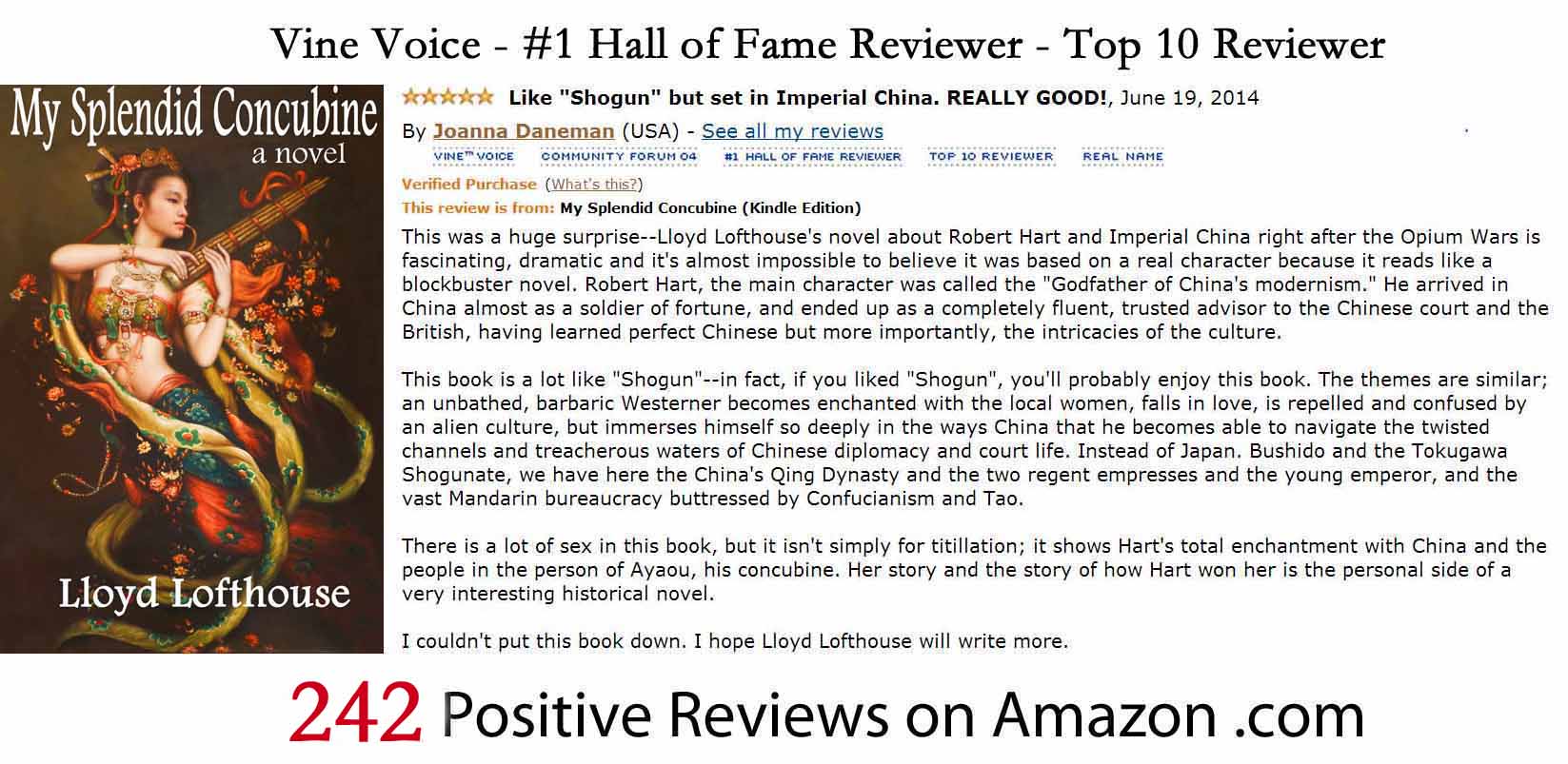
Lloyd Lofthouse is the award-winning author of The Concubine Saga. When you love a Chinese woman, you marry her family and culture too. This is the love story Sir Robert Hart did not want the world to discover.
To subscribe to “iLook China”, look for the “Subscribe” button at the top of the screen in the menu bar, click on it then follow directions.
US businessmen and politicians could learn from China, who learned from Japan. Instead of debt-ridden countries giving money away as the US does, America could be earning profits.
I read a fascinating piece in the Global Post by Stephanie Hanson that shows us China has elevated the art of barter to Ferengi levels. If you don’t know what I’m talking about, that’s okay. I’ve been watching Star Trek, Deep Space 9, and the Ferengi are an alien race who has turned the art of business into a science with a rule book.
While the US gives hundreds of billions of dollars to poor countries as aid, China trades or barters loans with African nations and in return China builds that country’s infrastructure. To understand, Hanson recommends reading “The Dragon’s Gift: The Real Story of China in Africa“.
Hanson writes, “In the 1970s, Japan extended aid to China that helped the country build transportation and energy infrastructure. This aid was repaid in barrels of Chinese oil. Now, across the African continent, China is extending concessional loans to African governments for roads, power plants, factories and hydro projects, in many cases using the same kind of financing arrangements it learned about from Japan.”
Lloyd Lofthouse is the award winning author of the concubine saga, My Splendid Concubine & Our Hart. When you love a Chinese woman, you marry her family and culture too.
An old friend of mine once wrote in an e-mail that Communism was evil and if China didn’t do what America wanted, the US would spank them. That and his endless born-again preaching bruised about five decades of friendship. Now, we don’t communicate much.
The definition for Sinophobia is one who fears or dislikes China, its people or its culture—in other words, an ignorant, brainwashed bigot (my opinion).
This morning, I finished reading An Exceptional Obsession by John Lee, which was published in The American Interest. On page 42, Lee wrote, “Above all, Chinese leaders are anxious about having to deal with a society so different from their own, and by different we don’t mean a superficial contrast between communism and capitalism. China’s is a communal culture; America’s is individualist. China is rooted in its land longer and more deeply than any society on earth. America is an immigrant society and an unprecedentedly mobile one at that. China has never institutionalized the rule of law; America is fundamentally based on it. China has never experienced deistic religions; America, as Chesterton once said is “a nation with the soul of a church.”
Lee’s comparison reminded me of the few shallow Communist haters and Sinophobic people I’ve run into on the Internet, who live in this nation with the soul of a church. Occasionally, one crawls out of the woodpile on a thousand legs.
Lloyd Lofthouse is the award-winning author of The Concubine Saga. When you love a Chinese woman, you marry her family and culture too. This is the love story Sir Robert Hart did not want the world to discover.
To subscribe to “iLook China”, look for the “Subscribe” button at the top of the screen in the menu bar, click on it then follow directions.
Cigarettes are evil. The person smoking the cigarette may not be evil but the pain and suffering that cigarettes cause is. I watched a father-in-law, a neighbor, an aunt and my father die from the ravages from tobacco. The last few years of my father’s life, he wore a breathing mask attached to a tank of oxygen. His freedom was limited to the fifty-foot hose connected to that tank.
Smoking Kills
Margie Mason (Associated Press) wrote about smoking and listed some frightening statistics.
Thirty percent of the world’s smokers are in China.
In the next 15 years, an estimated 2 million will die from it.
The largest tobacco grower in the world is in China.
Heart disease, linked to smoking, is already killing a million a year.
China has more cases of diabetes than any country.
Dr. Judith Mackay said, “You have to price them (cigarettes) out of the hands and pockets and the mouths of children.”
Hong Kong may be showing the rest of the mainland how to cut back on tobacco use by putting high taxes on cigarettes as we have done in America. The Chinese government may be watching and hoping that this cycle of doom can be slowed.
Lloyd Lofthouse is the award-winning author of The Concubine Saga. When you love a Chinese woman, you marry her family and culture too. This is the love story Sir Robert Hart did not want the world to discover.
Subscribe to “iLook China” Sign up for an E-mail Subscription at the top of this page.
This Blog explored (with Tom Carter’s guest post) how Harlequin Romance Invaded China without mentioning that romance literature in China has a history reaching back before the Dream of the Red Chamber (1715-1763), which has a tragic Romeo and Juliet love story between its covers.
As a child, I read many historical texts on Genghis Khan, Alexander the Great, the Napoleonic Wars, the British Empire, and historical fiction on similar subjects.
Then as an adolescent in middle and then high school I devoured science fiction and fantasy novels often one or two a day.
Today, I mostly read mysteries and literature but find my science fiction fantasy fix from film productions such as The Lord of the Rings, TV’s Stargate and Star Trek franchises in addition to George Lucas‘s Star Wars Saga.
Recently, I’ve been watching the complete series of Earth 2 while reading mysteries and thrillers.
In fact, the future we live with today was predicted in the early pages of Western science-fiction literature and China has noticed that science fiction literature often predicts and precedes scientific innovations such as laptop computers, the Internet, the Amazon Kindle and even doors that open automatically.
The British Telegraph’s HG Wells on Google: which of his predictions came true? reminds us that H. G. Wells first mentioned genetic engineering in The Island of Dr. Moreau (1896), lasers in The War of the Worlds (1898), the first moon landing in The First Men in the Moon (1901), nuclear power and weapons in the World Set Free (1914), and the Second World War in The Shape of Things to Come (1933).
Blog Tutor says, “At the time of their writing, these science fiction ideas often seemed impossible to fantastic to ever come true—and yet today’s technology seems to keep pace with the dreams of writers past.
“Although Cyberspace hasn’t quite reached the level of technology William Gibson predicted in 1986’s Burning Chrome, no one can deny that the Internet’s alternative worlds … are working towards the virtual…”
With that introduction, it may not come as a surprise that science fiction fits with China’s goals to catch up with and possibly surpass the West and reclaim its heritage and history of being the most powerful and technological advanced country and culture on the planet as it was for more than two thousand years before the 19th century and the Opium Wars.
In fact, we learn from The Race is On that “China’s Government actively encourages its citizens to read Science Fiction… Mark Charan Newton calls this the “Cult of Science Fiction – that is, the faith in dreaming up Big Ideas… So perhaps the Chinese are onto something with their focus on science fiction: a genre that weds the scientific to the artistic.”
The history of science fiction in China predates the CCP’s encouragement today, and that interest started in the late nineteenth and early twentieth centuries — a cultural phenomenon that emerged from Western Europe’s Industrial Revolution. One site I visited while researching this topic even dated science fiction to ancient China.
In Sci-fi books? China’s got tons of those, Asia Obscura.com says, “When it comes to sci-fi movies, China’s really falling behind. One that really did impress me, though, was the very first to be produced in China: 1980′s gorgeous, fun, and campy ‘Death Ray on Coral Island’ (珊瑚岛上的死光).
“In ‘Death Ray,’ a good-hearted team of Chinese scientists, based in what appears to be San Francisco, finally succeed in completing their fabulous futuristic invention. That is, until the sinister back-stabbing Americans, played with Bond-villainous glee by Chinese actors in whiteface and prosthetic noses, decide to steal the invention for their evil plots…”, which reveals another perspective of the US.
Then Foreign Policy.com introduces us to The Prosperous Time: China 2013, written by 58-year-old Hong Kong novelist Chen Guanzhong, who has lived and worked in Beijing for much of his life.
“China 2013 presents an ambivalent vision of China’s near future: outwardly triumphant (a Chinese company has even bought out Starbucks), and yet tightly controlled”, which may be a prediction that China’s one party republic is here to stay.
Even after 1949 with the founding of the People’s Republic of China, science fiction literature continued to flourish. During this period, the genre adopted a popular science approach and directed the majority of its stories towards younger readers.
However, during the Cultural Revolution (1966-1976), science fiction stagnated and then revived after March 1978 when the Central Committee of the Chinese Communist Party and the State Council convened a national scientific congress in Beijing, proclaiming to China, “Science’s spring has come.”
Scientific enthusiasm and popular science followed, greatly promoting the development of science fiction in China.
From China.org we learn, “The monthly circulation of Science Fiction World, one of China’s most popular magazines, has exceeded 500,000, dwarfing all international counterparts. Yang Xiao, head of the magazine’s editorial board, said 70 percent of its readers were students who shared single copies of the journal between dozens of friends because they could not afford their own. Millions of Chinese young people were affected by science fiction, said Yang, who hailed the rise of the modernist genre among the people who would decide the nation’s future.”
Another sign of the progress of science fiction literature in China first took place August 25, 2007 at the Chengdu International SF/F Conference. Over two days, authors from America, Canada, Britain, Russia, Japan, and China, and over twenty-thousand science fiction fans arrived in Chengdu for the event, which in turn increased the influence of SF in China due to media coverage.
Then from Chinese Science Fiction.org, we discover the second Chengdu Science Fiction and Fantasy conference was held November 12, 2011 in Chengdu.
Meanwhile, China continues with plans to build a space station, and then a productive mining colony of rare-earth minerals on the moon with a future exploration of Mars on the books, while the United States space program languishes.
The cause of this development is due to the US national debt and the costs of the war on Islamic terrorism, which may have been caused by what Henry Kissinger calls, “American exceptionalism is missionary. It holds that the United States has an obligation to spread its values to every part of the world” even if the world isn’t interested resulting in this resistance from the Middle East.
In addition, many young people in the United States with a high sense of self-esteem do not read books while watching too much TV has been scientifically linked to lack of a development in part of the brain where imagination blossoms.
Note: You may read more on this topic [written by British thriller writer O. C. Heaton] over at A Rush of Green.
Subscribe to “iLook China”!
Sign up for an E-mail Subscription at the top of this page, or click on the “Following” tab in the WordPress toolbar at the top of the screen.


 Posted by Lloyd Lofthouse

 iLook China