In healthcare, what comes first: the chicken or the egg? – Part 3/3

October 30, 2012

What is better, universal health care as China offers its citizens or what Wal-Mart offers its associates/employees?  You decide.

From Making Change at Walmart.org, we learn, “Wal-Mart’s health care plans fail to cover hundreds of thousands of associates. In 2009, Wal-Mart claimed that 52% of associates were covered under their healthcare plan. The company has refused to disclose coverage rates for its 1.4 million U.S. employees since then. [4]

“Wal-Mart stopped offering health insurance to part-time employees (working less than 24 hours per week) in 2012. [5]

Taxpayers are forced to provide healthcare for Walmart’s Associates. Hundreds of thousands of Associates and their family members qualify for publicly funded health insurance. [6] Indeed, according to data compiled by Good Jobs First, in 21 of 23 states which have disclosed information, Wal-Mart has the largest number of employees on the public rolls of any employer. [7]

In fall 2011, Wal-Mart made it even more difficult for associates to get quality health care for themselves and their families. Beginning with the 2012 enrollment period, Wal-Mart rolled back health care coverage for part part-time employees and raised premiums for full-time employees by as much as 63% for non-smokers and their families and as much as 162% for smokers with families. . For employees earning $8.81/hour working an average of 34 hours per week, some of Wal-Mart’s 2012 healthcare plans would cost between 77% and 104% of the employee’s annual gross income. [15]

In fact, there is no universal health care in the United States. What is known as Obamacare in the US is not a universal healthcare plan that is run by the government. It is a healthcare plan that just expands health care through private sector health insurance programs with the government subsidizing the costs of health-care premiums for Americans that do not earn enough money to pay for it so huge corporations such as Wal-Mart will allow the government to subsidize its private sector profits. In addition, if Mitt Romney is elected president and he follows through with his promise to get rid of Obamacare, America’s health care will return to where it was in 2007 and 2008:

The percentage of people without health insurance in 2008 was not statistically different from 2007 at 15.4 percent. The number of uninsured increased to 46.3 million in 2008, from 45.7 million in 2007.

The number of people with health insurance increased to 255.1 million in 2008—up from 253.4 million in 2007. The number of people covered by private health insurance decreased to 201.0 million in 2008—down from 202.0 million in 2007. The number of people covered by government health insurance increased to 87.4 million—up from 83.0 million in 2007

The percentage of people covered by private health insurance was 66.7 percent in 2008—down from 67.5 percent in 2007 (Figure 7). The percentage of people covered by employment-based health insurance decreased to 58.5 percent in 2008, from 59.3 percent in 2007. The number of people covered by employment-based health insurance decreased to 176.3 million in 2008, from 177.4 million in 2007. Source: Census.gov

Maybe now, a few of China’s critics may understand why the Chinese Communist Party and most of China’s people continue to resist becoming a democracy similar to America. Don’t get me wrong. I love my country and I am willing fight for her again(if it was a real threat and not one based on malarkey and lies as Vietnam and Iraq were) as I did in Vietnam in 1966 as a US Marine, but she has some serious problems that will be difficult to solve regardless of who is the next president of the United States. In fact, I think if Mitt Romney is elected, the problems will become worse.

Return to In healthcare, what comes first: the chicken or the egg? – Part 2 or start with Part 1

______________

Lloyd Lofthouse is the award-winning author of The Concubine Saga. When you love a Chinese woman, you marry her family and culture too. This is the love story Sir Robert Hart did not want the world to discover.

Subscribe to “iLook China”!
Sign up for an E-mail Subscription at the top of this page, or click on the “Following” tab in the WordPress toolbar at the top of the screen.

About iLook China


In healthcare, what comes first: the chicken or the egg? – Part 2/3

October 29, 2012

To compare universal health care in China to private sector health care, I’m going to use Wal-Mart as an example to explain why we cannot rely on the private sector when it comes to the importance of health care and the quality of life.

In the private sector in the US, Wal-Mart did not achieve success because a sorcerer waved a magic wand and “POOF” suddenly Wal-Mart is everywhere as if a light switch were turned on.  The first Wal-Mart store opened in July 1962. By 1967, there were 24 stores. Today, forty-five years later, Wal-Mart has 2.2 million employees/associates worldwide and serves 200 million customers each week at more than 10,000 stores in 27 countries.

But China’s challenge is to serve 1.3 billion Chinese compared to Wal-Mart providing health care for 2.2 million of its workers. There is a HUGE difference in the numbers and China  hasn’t had forty-five years to build the infrastructure of this new universal health care plan.

Of course, a China critic may point out Wal-Mart’s success because it was a private sector business but that same critic, out of ignorance or by design, will not mention what Christian Science Monitor.com says about Wal-Mart’s health care for its employees:

“In addition to stopping the retaliations and respecting workers’ right to free speech and assembly, OUR Wal-Mart members would like to see the retailer offer more dependable work schedules, affordable healthcare for full-time workers, and a living wage ($13 per hour minimum).

“Wal-Mart has been advertising that they are a family-oriented company. And if this is how family is treated, then I would rather not have a family at all,” says Ms. Cruz.”

In the private sector, the way corporations/businesses treat employees varies from company to company. There is no universal standard of treatment, and there never will be unless the private sector eventually is owned by one global corporation.

Business Insider.com shows how Wal-Mart treats its employees: “Wal-Mart Guts Its Employee Health Care Plan and Raises Premiums—Rates are expected to climb by more than 40 percent for some employees. Combined with high deductibles, employees are complaining that their health care will now eat up to 20 percent of their annual pay.”

Continued on October 30, 2012, In healthcare, what comes first: the chicken or the egg? – Part 3 or return to Part 1

______________

Lloyd Lofthouse is the award-winning author of The Concubine Saga. When you love a Chinese woman, you marry her family and culture too. This is the love story Sir Robert Hart did not want the world to discover.

Subscribe to “iLook China”!
Sign up for an E-mail Subscription at the top of this page, or click on the “Following” tab in the WordPress toolbar at the top of the screen.

About iLook China


Communism and Socialism are NOT the SAME

October 26, 2012

There would not be many choices for someone that wanted to move to a socialist country. There are only four in the world: PRC (mainland China), Republic of Cuba, Lao People’s Democratic Republic and the Socialist Republic of Vietnam. These countries once had Communist governments but that isn’t entirely true anymore.

However, there are 189 countries (of the 193 that are members of the United Nations) that are not socialist but do have socialist programs/policies.

Socialism and communism are ideological doctrines that have many similarities as well as many differences. One point that is frequently raised to distinguish socialism from communism is that socialism generally refers to an economic system, and communism generally refers to both an economic system and a political system.

The fall of communism in the Soviet Union does not mean socialism failed. It means that the autocratic one-party system that defines communism failed.

Russia, for example, still has Social Security policies that fund health and pension programs.  With at last five years of coverage, men age 60 and women age 55 are covered for old-age pensions. Russia also offers a disability pension and a survivor pension.

To discover the details of Russia’s socialist policies, I suggest you visit this site at the U.S. Social Security Administration. In fact, the SSA has information on its site for Social Security programs/policies around the world


The GOP and Mitt Romney may want to return to industrial capitalism. Pay attention to the video to discover what that means. You may be shocked and decide that some socialist policies are necessary to protect the quality of life for most people that do not have the benefit of achieving great wealth.

As an economic system, socialism seeks to manage the economy through deliberate and collective social control. Communism, however, seeks to manage both the economy and the society by ensuring that property is owned collectively and that control over the distribution of resources is centralized to achieve both classlessness and statelessness. Under communism, all people are considered equal and are provided for equally, regardless of their contributions to the economy or to society.

Having Socialist policies does not mean a country is socialist or communist. For example, the United States is not a socialist country just because it has socialist policies such as Medicare, Obamacare or Social Security–the United States still has private ownership of property and businesses and has a multi-party political system.

In addition. although China’s Communist government adopted capitalist policies in the early 1980s and joined the World Trade Organization, a substantial part of the economy is still state-run, although there are not as many social programs as there once were and universal healthcare has been eliminated but China still has a Socialist-type foreign policy, for the most part, due to decisions made within the CCP based on consensus (majority opinion). There are eighty million members in China’s Communist Party and they vote.

To learn about China’s Socialist Policies, here’s the link at US SSA Office of Retirement and Disability Policy

In addition, in China no one in the private sector may own land (yet).  Instead, private citizens may lease land in urban areas while land in most rural areas is still owned by village collectives in conjunction with the central government and cannot be bought or sold because no one holds the title to most rural land.

Discover Dictatorship or One Party Republic

NOTE: The reason for this post is a conservative site at Right Punditry.wordpress.com where I left a comment. The response to my comment was an ignorant unreasoned emotional rant, and then I had trouble leaving reasoned comments with cited evidence and sources in response to that trollish rant. In reality, my voice was censored—a common practice among American far-right neoconservatives and fundamentalist evangelical Christians (FECs) that attempt to control the conversation with bully insults and logical fallacies. This is the second time I’ve run into this sort of conservative, political site. The first time was a Tea Party loyalist site that censored (removed) a comment I wrote that did not meet the American Tea Party’s rigid beliefs. You may not know this but 40% of the Tea Party membership are FECs. Both American neoconservatives and FECs practice the use of the noble lie to achieve political and/or religious goals as evidenced by Mitt Romney and his VP running mate during the Presidential and VP debates of the 2012 election in the US. I’ve written a number of posts focused on the debates at Lloyd Lofthouse.org and the last post in this series will appear Saturday, October 27, 2012.

______________

Lloyd Lofthouse is the award-winning author of The Concubine Saga. When you love a Chinese woman, you marry her family and culture too. This is the love story Sir Robert Hart did not want the world to discover.

Subscribe to “iLook China”!
Sign up for an E-mail Subscription at the top of this page, or click on the “Following” tab in the WordPress toolbar at the top of the screen.

About iLook China


“For All the Tea in China” – a book review

October 23, 2012

If you are interested in a real-life collision between the West and China early in the 19th century, then I highly recommend Sarah Rose’s nonfiction work. You will discover that the British Empire and its merchants were successful, because they were more ruthless and devious than anyone else on Earth.

You may be interested in the list of wars that involved the Kingdom of Great Britain from 1701 – 2011. Be prepared for shock and a dropped jaw. The price of an empire is blood, lots of spilled blood.

At its greatest extent, the British Empire was known as the largest in history, and it covered more than thirteen-million square miles (20,921,472 square kilometers), which is about a quarter of the Earth’s total land area, and she controlled more than 500 million people—a quarter of the world’s population.

The English language, which the British Empire spread, is the second most-widely spoken language in the world today—in reality, the standard language of the world.

What financed the brutal expansion of this empire?  According to For All the Tea in China, drugs paid for the empire.  The British Empire was a thief and the largest drug cartel in human history.

Sarah Rose wrote a fascinating story of Robert Fortune (1812 – 1880) and one of, if not the largest, acts of corporate espionage and theft in history. This nonfiction book is about how the British stole tea plants and the method of producing tea from China and successfully transplanted this industry in India.

For example, if you drink Darjeeling Tea from India, you are drinking a product that was stolen from China by Robert Fortune in the early half of the 19th century.

But there is much more to this story than the theft of tea from the country that may have invented it almost five thousand years ago. In fact, China is considered to have the earliest records of tea drinking, with recorded tea use in its history dating back to the first millennium BCE.

However, first, I want to dispel a misconception I discovered from a two-star Amazon reader review that said, “I was a little skeptical about her comment in the notes ‘As this is a work of popular history, not a scholarly undertaking, I have avoided the use of footnotes and tried to steer clear of mentioning sources in the body of the text. Nevertheless, this is a work of nonfiction …’ “

That unfair review left off the rest of Sarah Rose’s quote that said, “Nevertheless, this is a work of nonfiction, and anything in quotes comes from a letter, memoir, newspaper or other contemporaneous sources.

“I have relied heavily on Robert Fortune’s four memoires (listed at the end of this post), his letters to the East India Company and other company documents housed in the British Library. Over five hundred books and documents were consulted in putting this project together.” (pg. 251, hardcover)

On page 227 of the hardcover, Rose wrote, “By the time the Chinese realized that Fortune had stolen an inestimable treasure from them, it was many years too late to remediate their loss. His theft helped spread tea to a wider world at lower prices.”

In addition, “Tea likewise revolutionized Britain’s capital and banking systems and influenced the rapid growth of trade networks in the Far East. It was instrumental in extending the reach of British colonialism as the empire expanded to include countries such as Burma, Ceylon, East Africa and others where tea could be grown …”

On page 178, we discover, “It was through drug-based commercial enterprises such as the tea and opium trade that Britain became the greatest of all hegemonic empires. The British campaign to sell opium in China was tremendously profitable. … Britain’s all-conquering naval fleet was able to be constantly improved with newly minted capital from the sugar, tea and opium trades. Without opium, the India trade would not have flourished and without India, Britain’s post-Napoleonic global ascendency could well have collapsed.”

However, these few quotes do not do justice to Robert Fortune’s adventure in China. He successfully passed himself off as a citizen of the Qing Empire dressed in mandarin robes. He even had a queue, a braid of hair worn hanging down behind the head, sewn to his scalp and had his head shaved to match the style of the time.

“He eventfully became proficient enough with speaking Mandarin that he was able to adopt the local dress and move among the populous largely unnoticed. By shaving his head and adopting a ponytail, this rather gruff Scotsman was able to effectively blend in. So well in fact, that he was able to enter the forbidden city of Souchow (now Wuhsien) unchallenged.” Source: Planet Explorers.com

Besides being nonfiction loaded with facts, this book was also an adventure and/or spy thriller based on a real person and his mission of intrigue—if caught, he would have been executed. To pull off the biggest heist of all time, Fortune traveled to areas of China that no foreigner had ever visited before, and his only companions were Chinese that he had bribed to work for him.

Today, tea is the most popular drink in the world in terms of consumption. Its consumption equals all other manufactured drinks in the world – including coffee, chocolate, soft drinks, and alcohol – put together. In fact, China is still the leading tea producer in the world: in 2010 China produced 1,467,467 tons (32.5%) compared to second place India at 991,180 tons (21.9%). Third place went to Kenya at 399,000 tons (8.83%).

In addition, consumption of tea in 2010 grew at a faster rate than global production. In the United States alone in 2011, the US tea industry gross revenue through all foodservice and retail outlets was greater than $27-billion (and twelve countries consumed more tea than the US). For a comparison, ticket sales for the US domestic movie market were only $10.28-billion in 2011.

Tea is more popular than Hollywood.

Robert Fortune’s memoirs:

1. Three Years’ Wandering in the Northern Provinces of China, A Visit to the Tea, Silk, and Cotton Countries, with an account of the Agriculture and Horticulture of the Chinese, New Plants, etc., London: John Murray  (1847)

2. A Journey To The Tea Countries Of China; Including Sung-Lo And The Bohea Hills; With A Short Notice Of The East India Company’s Tea Plantations In The Himalaya Mountains. With Map And Illustrations, London: John Murray  (1853)

3. Two visits to the tea countries of China and the British tea plantations in the Himalaya: with a narrative of adventures, and a full description of the culture of the tea plant, the agriculture, horticulture, and botany of China, London: John Murray (1853)

4. A Residence Among the Chinese; Inland, On the Coast and at Sea; being a Narrative of Scenes and Adventures During a Third Visit to China from 1853 to 1856, including Notices of Many Natural Productions and Works of Art, the Culture of Silk, &c, London: John Murray (1857)

5. Yedo and Peking; A Narrative of a Journey to the Capitals of Japan and China, with Notices of the Natural Productions, Agriculture, Horticulture and Trade of those Countries and Other Things Met with By the Way, London: John Murray  (1863)

Discover The Tea Horse Road or learn about The Magic of Puer Tea

______________

Lloyd Lofthouse is the award-winning author of The Concubine Saga. When you love a Chinese woman, you marry her family and culture too. This is the love story Sir Robert Hart did not want the world to discover.

Subscribe to “iLook China”!
Sign up for an E-mail Subscription at the top of this page, or click on the “Following” tab in the WordPress toolbar at the top of the screen.

About iLook China


Huangpu River Tour – Shanghai

September 24, 2012

Shanghai is considered the Paris of Asia.  There’s a reason for this and I hope the photos and video will show that.

Notice the Chinese middle-class tourists on the boat.  Study how they dress. See the cameras. And ask yourself this—if these people are so brainwashed and downtrodden, why are they out taking a cruise on the Huangpu River taking pictures as if they were visiting the Grand Canyon or New York?


Pudong side of Huangpu River

See the city skyline along the river.

This is only a small portion of Shanghai.


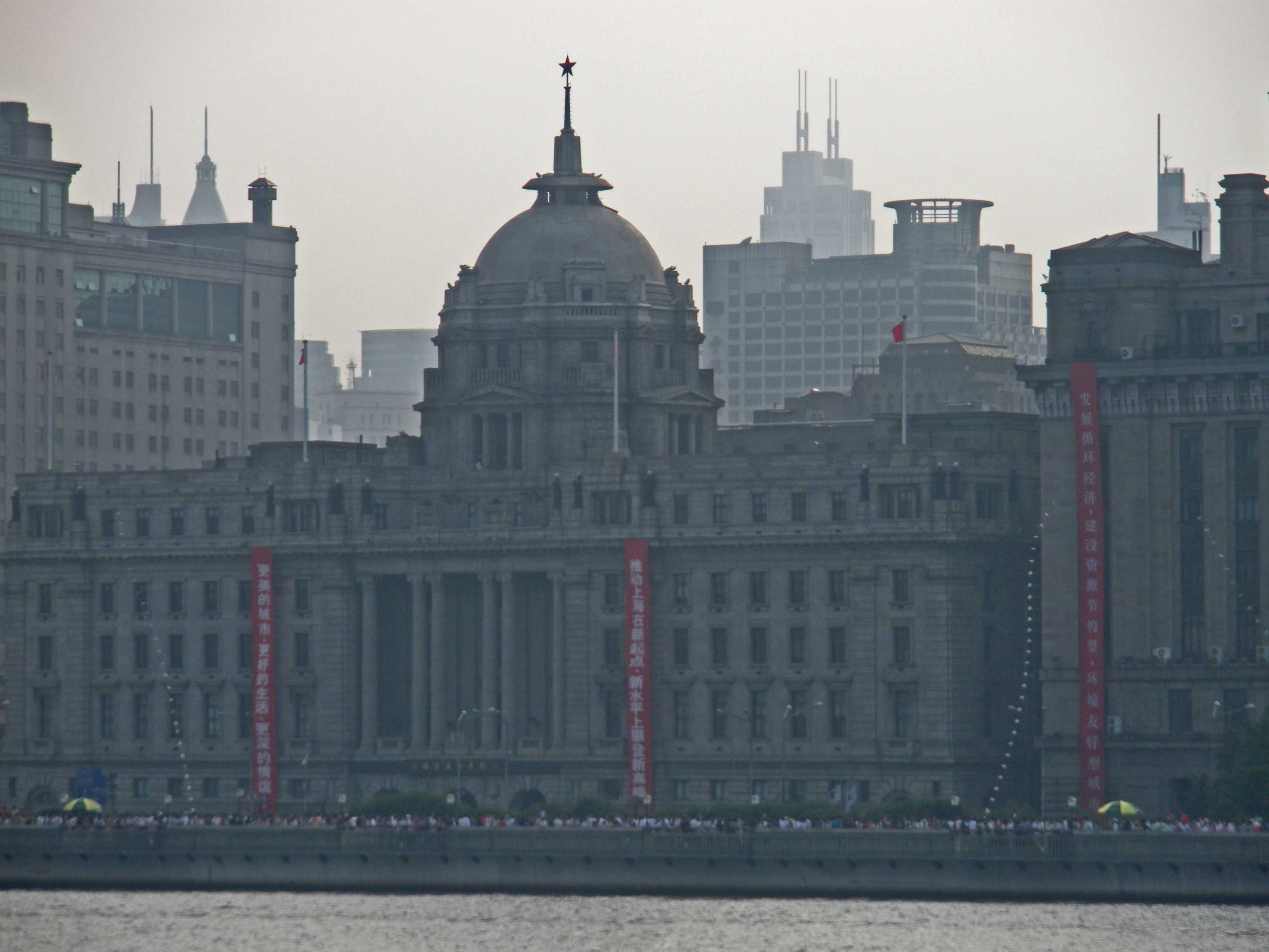
Shanghai side of Huangpu River – the croweded Bund

West of the Huangpu River is Shanghai. On the east bank is Pudong–fifty years ago, this land was farm land.

A close up of the crowded Bund on the Shanghai side of the river

Check out the number of Chinese tourists visiting the Bund in this photograph.  I’ve waded through these crowds.  These people are laughing, smiling, eating, taking pictures of each other, clowning around.  They are having more fun than I see from most American tourists when I travel in America.

Look at the signs-Nikon, LG, Nestle

China has almost five hundred million people living in its cities. Another eight hundred million live in rural areas.  There are now more Chinese surfing and Blogging on the Internet (513 million) than the entire population of the United States and there are ways to get around the censors. The average time spent on the Internet is almost three hours a day or more than 19 hours a week.

Fifteen to seventeen million people live in Shanghai.

To discover more of Shanghai visit: Shanghai Shanghai Huxinting Teahouse Eating Gourmet in Shanghai Shanghai’s History & Culture Chinese Pavilion, Shanghai World Expo

______________

Lloyd Lofthouse is the award-winning author of The Concubine Saga. When you love a Chinese woman, you marry her family and culture too. This is the love story Sir Robert Hart did not want the world to discover.

Subscribe to “iLook China”!
Sign up for an E-mail Subscription at the top of this page, or click on the “Following” tab in the WordPress toolbar at the top of the screen.

About iLook China