Another way to learn about China is through Chinese literature and film. Jiang Rong is the pen name for Lu Jiamin, a Chinese citizen and author. Set during the Cultural Revolution,Wolf Totem describes the education of an intellectual living with nomadic herders in the grasslands of Inner Mongolia.
The publisher of Wolf Totem says this novel is an epic Chinese tale and that’s true. Wolf Totem taught me a lot about this almost extinct culture. I learned about the fascinating connection between wolves and Mongols and why this connection may have been the reason why Genghis Khan was so successful in his conquests.
I recommend this novel to anyone who wants to learn more about the life of the Mongols and another perspective of Mao’s Cultural Revolution.
However, the theme that runs through the novel of maintaining a balance with nature is a bit overdone. I got the message the first time the characters talked about it but then the topic comes up repeatedly—a bit too much but an insignificant criticism of a book worth reading
I won’t give away the ending, but don’t expect it to be happy. Most Chinese novels don’t end with happy endings.
_______________
Lloyd Lofthouse is the award-winning author of My Splendid Concubine [3rd edition]. When you love a Chinese woman, you marry her family and culture too. This is the love story Sir Robert Hart did not want the world to discover.
Subscribe to “iLook China”!
Sign up for an E-mail Subscription at the top of this page, or click on the “Following” tab in the WordPress toolbar at the top of the screen.
Angela Wilde’s new pocket-guide to Feng Shui, Heal Your Home, Fix Your Life! The Easy Guide to Love and Moneyoffers easy tips of Feng Shui.
I am personally dubious of any self-help book with the word “easy” in the title.
However, as I have lived in Asia for almost a decade, I figured I should at least explore the Feng Shui genre before outright dismissing it.
While I have yet to report any results (positive or negative) because of following Feng Shui, I stand by my original premise that it can’t hurt and can only help.
As Wilde writes in the book’s introduction, “Lots of people can’t afford to have a complete Feng Shui consultation. They just want something that works, and fast.”
With this, she offers an efficiently minimalist A-Z guide outlined in handy alphabetical layout.
Curious about dried flowers (“Potpourri is definitely spiritually bad!”)? Just flip to the D or F sections. Wondering what herbs are auspicious? Turn to H (page 54) for a complete list of herbs and their respective powers.
book’s cover
Coming in at a mere 90 pages, the book is small and convenient enough to flip through for reference during house-cleaning day, yet the information therein goes a long way.
Did you know, for example, that by just boiling some cinnamon and basil together then adding that to a floor wash of nothing but salty water you will have instantly improved your wealth AND personal protection? Now that’s profitable multi-tasking!
Wilde also offers advice on speaking normal words in everyday life: “affirmations and even ordinary words should contain no negatives such as “no” or “not”. Overlooking the fact that this sentence itself uses the word “no,” it nonetheless is profoundly good advice and one I will attempt to incorporate in my day-to-day dealings.
For anyone interested in giving Feng Shui a precursory attempt before investing major time and money into revamping your lifestyle, Heal Your Home, Fix Your Life! The easy guide to Love and Money is a good starting point. Beginners will appreciate Wilde’s quick, A-Z reference layout and efficiently brief prescriptions.
Night in Shanghai by Nicole Mones kept me reading late into the night until I finished the book in record time. It’s all there: love, intrigue, suspense, drama, music and history masterly woven through the story.
Thomas Greene is an African American classical pianist who is recruited by Lin Ming—the illegitimate son of the powerful leader of Shanghai’s Green Gang, Du Yue-Sheng—to leave the United States and lead a jazz band of fellow African-Americans in Shanghai. It’s in Shanghai where Thomas discovers a life that isn’t plagued by the poverty and the racial discrimination he knew in America, and he falls in love with the city and people with no intention of going home.
Thomas has a lusty affair with a beautiful Russian refugee and makes friends with Jews fleeing the madness of Hitler’s Germany. Then Thomas meets the woman who will fill his life with passion and love. Her name is Song Yuhua, but she is the property of Du Yeu-Sheng. Song’s father gave her to the gangster to pay off a gambling debt.
In addition, you’ll discover the story of the Chinese Schindler, who risked his life while working in Europe as a Chinese diplomat to save more Jews than the real Schindler did—there should be a film about his courage but at least we now have this novel.
You’ll also discover the efforts by both some Chinese and China’s Japanese invaders to protect the Jews who escaped to China. Hitler pressured both Chiang Kai-shek and Japan’s leaders to kill all the Jews in China, but they refused. Instead, they did something no other country on the earth—even the United States—did. Chinese leaders and Japan’s military leaders in China protected the Jews and offered them a safe haven during the horrors of World War II.
And I learned something new—that Chiang Kai-shek admired Adolf Hitler. This kicked my curiosity into high gear and I did some Google research to discover that Chiang Kai-shek and Hitler were friends who admired each other. The two first met in 1912. In 1913, they even rented a room together in Munich. After Japan invaded China, Chiang asked Hitler’s for help with the Japanese but he didn’t know that Hitler was already forming a military alliance with Japan. In fact, The Nationalist Chinese led by Chiang Kai-shek cooperated with the Nazis from the late 1920s until the late 1930s.
“Night in Shanghai” also makes it clear that the Chinese Communists under Mao were nationalists first and communists second. In my Google research I discovered that the communists proclaimed: “There is the ‘patriotism’ of the Japanese aggressors and of Hitler, and there is our patriotism. Communists must resolutely oppose the ‘patriotism’ of the Japanese aggressors and of Hitler.”
The first character we meet in the novel is Song Yuhua. Near the end of the story, as the Japanese attack on Pearl Harbor is imminent, she must choose between her loyalty to the Chinese Communists and her love for Thomas Greene. You’ll have to read the book to discover her choice.
I received an advanced reading copy of this novel through Amazon Vine and this review is my own opinion of the novel.
_______________
Lloyd Lofthouse is the award-winning author of My Splendid Concubine [3rd edition]. When you love a Chinese woman, you marry her family and culture too. This is the love story Sir Robert Hart did not want the world to discover.
Subscribe to “iLook China”!
Sign up for an E-mail Subscription at the top of this page, or click on the “Following” tab in the WordPress toolbar at the top of the screen.
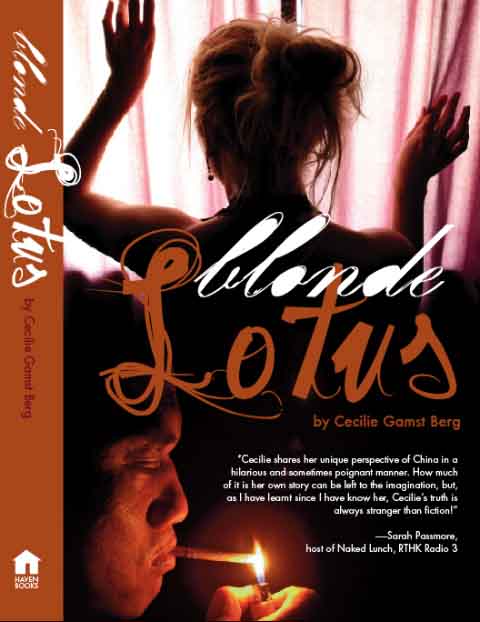
If there ever was an expat author in the Middle Kingdom whose enthusiasm and love of life was as contagious as Cecilie Gamst Berg’s, then that person has yet to be published.
Part travelogue of a directionless backpacker, part bedtime stories of a frisky European babe who enjoys seducing young Chinese guys “out of the festering prison of virginity,”
Blonde Lotus is in fact one in the same person. Gamst Berg, via her alter-ego protagonist Kat Glasø, accidentally arrives in late-1980’s China (“all I wanted was to be on the train; I had no interest in the journey’s destination, Beijing”), back when the mighty bicycle was still king of Peking and foreign tourists were a rare sighting.
Expecting a people with “long, billowing sleeves, reciting poetry and plucking at stringed instruments,” what Kat finds in New China instead are street corners populated with shady money changers and young hipsters whose knowledge of English is limited to the words ‘Okay-la’ and ‘Sex!’ Lulled by their charming incessancy, Kat shrugs her shoulders and good-naturedly gives it to them – the money AND the sex. “How could so many men find the women of a race attractive, and so few women find the men the same,” she ponders postcoitally over a shared Zhongnanhai cigarette.
Queen gweipo (devil woman in Cantonese) Gamst Berg is an unpretentious, fun-loving writer with nothing to prove. She’s not out to save China as so many a self-righteous foreigner here are (“I hope this country never modernizes” Kat admits in one of her many blunt moments of sincerity), she’s not trying to force feed them Faulkner (“I loved books and he never read one”), nor is she out to land a career in journalism like the rest of us.
No, the author is clearly just looking to have a good time (“We were young, stoned and in China”), and maybe learn some Putonghua while doing it, and therefore spares us the sappy, sympathetic observations and “deep understanding” of life in China that makes most Laowai Literature such a torture to read.
Conversely, nor is Gamst Berg out to tear Communism apart, vilify Chinese people or point and laugh at the “strangeness” of their culture, a common last-resort for some western travel writers (whom I refrain from naming as a professional courtesy) who don’t want to admit that they have learned nothing about the Chinese during their stay here.
Indeed, while her fellow expats spend their time in China sitting around at bars “shouting out orders in English, and when they weren’t understood, complained loudly to each other about how stupid the Chinese were,” rather than join in, Kat moves tables, literally and figuratively, to the Chinese side of the bar.
Instead of whining about China’s infamously filthy public toilets, Kat hangs out in them (smoking dope), then laughs when there’s a line of squeaming girls waiting to use the stall.
Rather than bitch about the People’s Republic’s chaotic queues at its railway stations, she jumps right in, elbows swinging, with the rest of the seething proletariat.
Our Blonde Lotus ain’t no saint, and she would laugh in your face if you dared suggest it. “I wanted to experience everything and sleep with everybody…” confesses, nay, asserts the Norwegian-born Kat Glasø – and then proceeds to actually do so, from coal-and-petrol-scented industrial North China all the way down to the steamy islands of Hong Kong, her final destination.
Throughout her candid memoir, the author employs an uproarious combination of reluctant intellectualism (“learning Chinese was better than being in love because there was no danger of waking next to the Chinese language wanting to kick the f*cker out of bed”) and ribald hedonism (“I felt something push into me, shudder and expire. Was it an asparagus?”) that is sure to win Gamst Berg as many fans as frighten them away.
If Blonde Lotus is a window into China, then that window has been fogged with the sultry breathe of its occupants. If it is a work of reportage; then the author was too distracted by eating, drinking, smoking and playing cards with the peasantry to be concerned about making the front page. And that nonchalance, that self-depreciating humor, is exactly this novel’s charm.
Blonde Lotus is a refreshingly unserious memoir of an infectiously upbeat young woman (this reviewer’s favorite line in the whole book: “Ha ha, life was perfect and made for me!”) who, lost in China and unsure of what she wants to do with said life – as many of our kind are – inadvertently ends up making a new, better one for herself.
Subscribe to “iLook China”!
Sign up for an E-mail Subscription at the top of this page, or click on the “Following” tab in the WordPress toolbar at the top of the screen.
Unsavory Elements edited by Tom Carter, the author of China: Portrait of a People, has twenty-eight short memoirs that offer a balanced view of China from expatriates who have lived and/or traveled there.
But the title almost misleads because not all of the authors come off as unsavory elements—most are there to learn and not to judge. Only a few of the stories in this collection were written by expatiates suffering from some form of sinophobia.
I also value books that teach and I think that many of the stories in Unsavory Elements did that refreshingly well.
For a few examples, first there was Paying Tuition by Matthew Polly who wrote: “One of the first things I had learned during my stay was that the Chinese love to negotiate. They love it so much that even after an agreement is reached, they’ll often reopen negotiations just so they can do it all over again.”
I have visited China many times and—unlike most Westerners—I enjoy negotiating, but I didn’t know about the reopening gambit. Next time, I may want to give that a try and extend the fun.
In Communal Parenting by Aminta Arrington, I learned that the “Chinese have a fundamentally different relationship with their history than we Westerners. History is a subject we study in schools,” and that history is not connected to who we are.
“Not so for the Chinese,” Arrington writes. “History here [in China] is not book knowledge. Rather, their history is carried along with them as they walk along the way, an unseen burden, an invisible shadow; unconscious, and therefore, powerful.”
Kaitlin Solimine in Water, For Li-Ming writes about the five-months she stayed in China as a teenager in a high school, home-stay program, and it was her first time outside of the United States. For those few months, Li-Ming was her Chinese mother.
Here is the gem that Solimine shares with us: “That’s the thing about Chinese mothers: hidden behind their maternal expectations and critical diatribes are women who will fight to the death for you. As soon as I called her Mama, Li-Ming would be my strongest ally for the only months I knew her.”
From Graham Earnshaw in Playing in the Gray we discover: “There were no rules. Or rather, there was only one rule: that nothing is allowed. But the corollary, which reveals the true genius of China’s love of the grey—in contrast to the black and white of the West—is that everything is possible. Nothing is allowed but everything is possible. It’s just a matter of finding the right way to explain what you’re doing.”
Reading Empty from the Outside by Susie Gordon we see that the “New China isn’t shackled with the Judeo-Christian Morals of the West.”
Some in the West may see this lack of Judeo-Christian morals in China as a bad thing but that depends on how deeply entrenched a Westerner is in fundamentalist Christian morality. China—believe it or not—does have a moral foundation that many in the West turn a blind eye to. If you are married to a woman who was born in China and grew up there during Mao’s puritanical repressive twenty-seven years as its leader, you might understand what I mean.
In conclusion, there is Tom Carter’s signature-title piece. In his short Unsavory Elements, Carter says in one passage, “Claude admittedly couldn’t care less about Chinese culture; he was simply, like so many other foreigners in China—myself included—aimless and desperate for an income.”
There is so much more to this book called Unsavory Elements than these few examples. If you are have an open mind that isn’t infected by sinophobia and you want a better understanding of the Chinese, I highly recommend this collection.
_______________
Lloyd Lofthouse is the award-winning author of My Splendid Concubine [3rd edition]. When you love a Chinese woman, you marry her family and culture too. This is the love story Sir Robert Hart did not want the world to discover.
Subscribe to “iLook China”!
Sign up for an E-mail Subscription at the top of this page, or click on the “Following” tab in the WordPress toolbar at the top of the screen.


 Posted by Lloyd Lofthouse
  A guest post by Tom Carter

 iLook China