Competition vs Harmony

October 3, 2018

China is a collective culture vs. Europe and North America with cultures based on individualism, and understanding Confucianism helps explain how China’s collective culture works.

Religion

China has never been dominated by one religion like Christianity dominates Europe and all of the Americas or Islam dominates the Middle East and most of North Africa.

Philosophy

In China, Confucianism developed during the Spring and Autumn period from the teachings of the Chinese philosopher Confucius (551–479 BCE). His philosophy concerns the fields of ethics and politics, emphasizing personal and governmental morality, correctness of social relationships, justice, traditionalism, and sincerity. Over time, Confucianism replaced Chinese Legalism.

Chinese Buddhism entered China from India during the Late Han Dynasties. By the time of the Tang dynasty five-hundred years after Buddhism’s arrival into China, it had transformed into a thoroughly Chinese religious philosophy dominated by the school of Zen Buddhism. Neo-Confucianism became highly popular during the Song dynasty and Ming Dynasty due in large part to the eventual combination of Confucian and Zen Philosophy.

In Europe and the Americas, there is Socrates, Plato, Aristotle, Thomas Aquinas, Rene Descartes, John Lock, et al.  In the West, instead of one major philosopher, there are many. Western Philosophy refers to philosophical thinking beginning with Ancient Greece and Rome, extending through central and Western Europe and, since Columbus, the Americas.

The Basics of Philosophy says, “Very broadly speaking, according to some commentators, Western society strives to find and prove ‘the truth’, while Eastern society accepts the truth as given and is more interested in finding the balance.”

Westerners put more emphasis on individual rights while Easterners focus on social responsibility.

Individualism vs. Collectivism

China is a collective culture vs the west that is based on individualism, and this difference might explain why China was the wealthiest, most technologically advanced civilization on the planet for about 1,500 years up until the 16th century.

Objectivism 101 explains, “Collectivism … sees the group as the important element, and individuals are just members of the group. The group has its own values somehow different from those of the individual members. The group thinks its own thoughts. Instead of judging the group as a bunch of individuals interacting, it judges the group as a whole, and views the individuals as just members of the group.”

In individualism each individual is acting on his or her own, making their own choices and are not guided by the collective, and to the extent they interact with the rest of the group, it’s as individuals.

Collectivism views the group as the primary entity and most if not all individuals are expected to conform. Harmony is considered the foundation of a collective culture while divisiveness is the foundation of individuality.

But first, China Mike says, “To understand the Chinese mind, you need to start with Confucius (552-479BC). Arguably the most influential person in Chinese history, Confucius and his teachings continue to exert a deep influence on society even in modern China today. … Confucianism is a complex system of social and political ethics based on filial piety, kinship, loyalty and righteousness. His teachings cover a wide range—from how a ‘true gentleman’ should behave in his daily life (down to how he eats with proper decorum) to how a ruler should govern (with a benevolent concern for the well-being of his subjects).”

Note: When I started iLookChina in January 2010, I set a goal to write and publish three blog posts a day until I reached 1,000 posts, and then I slowed down. More than seven years later, iLookChina has now published 2,355 posts with more than one-million words. That’s why I have decided to slow down some more. Starting today, I will be posting once a week on Wednesdays. To the more than twenty-thousand amazing people that follow iLookChina, thank you.

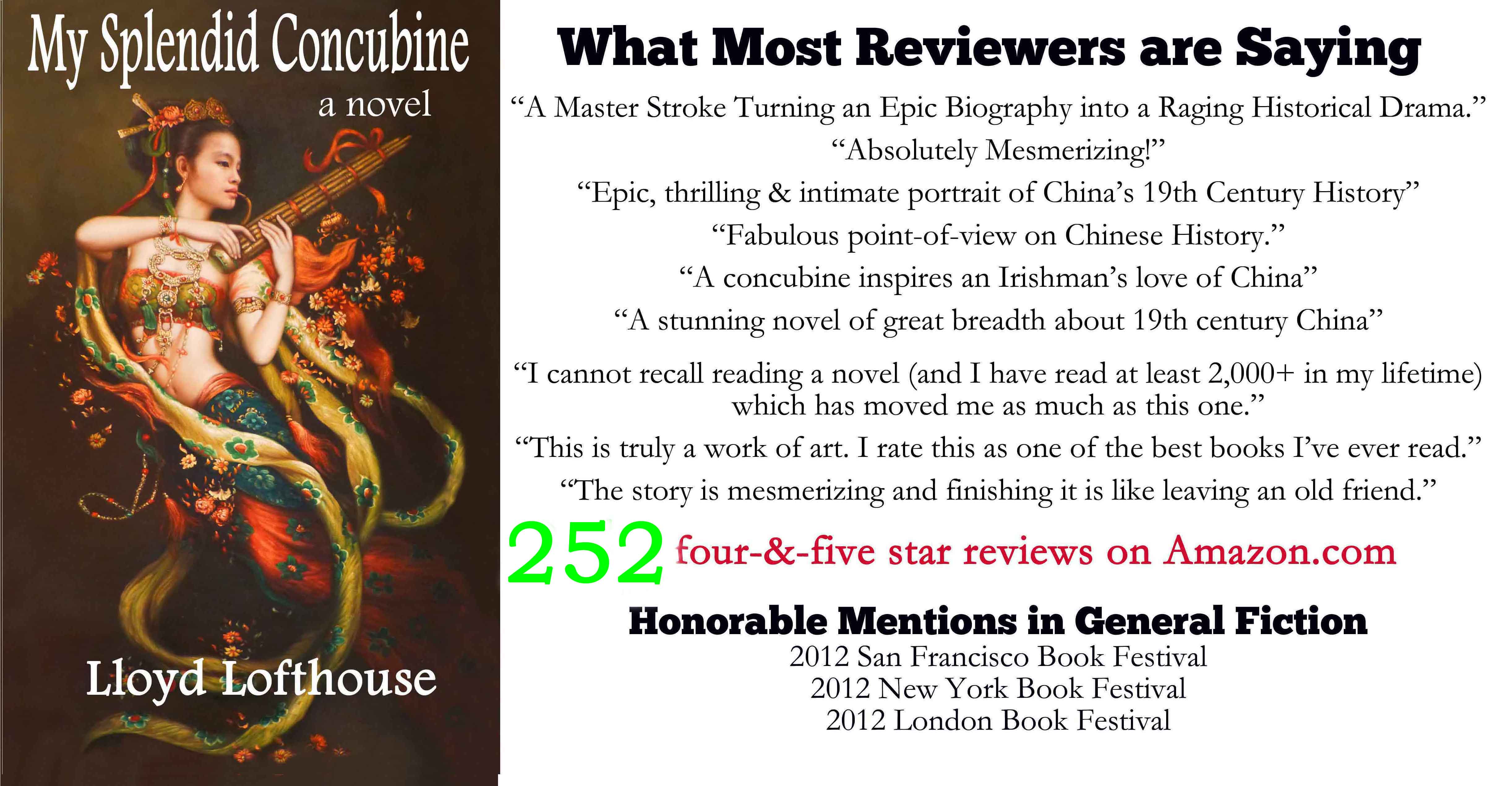
Lloyd Lofthouse is the award-winning author of My Splendid Concubine, Crazy is Normal, Running with the Enemy, and The Redemption of Don Juan Casanova.
Where to Buy

Subscribe to my newsletter to hear about new releases and get a free copy of my award-winning, historical fiction short story “A Night at the Well of Purity”.

About iLook China


Seeking Harmony versus the Search for Happiness

November 15, 2017

The Search for Happiness in bold white print was splashed across the cover of my November 2017 issue of National Geographic Magazine.  In the United States, it has been my perception that the search for happiness sends many people to places like Disneyland or out to eat something that is horrible for their long term health. Maybe buying that type of happiness explains why more than 70-percent of Americans are fat or obese. In other words, when feeling depressed, spend money and while out shopping, walk around texting your friends nonstop until you run into a tree or bounce off other pedestrians because you weren’t paying attention to what was going on around you.

I think this type of thinking is one reason why the U.S. child prodigy Grace VanderWaal wrote and sang “So Much More Than This”.

Like Grace VanderWaal says in her song, “Close your phone and breathe in the air. You’ll soon realize that there’s something that is so much more than this …”

Money will buy fleeting happiness but unless you have an endless supply of money to keep buying that happiness, it will not last long. That’s why I think buying happiness is the same as being addicted to cocaine and heroin. The withdrawal symptoms when the money dries up are agonizing.

What does harmony mean to many in China and can harmony lead to a more stable form of happiness?


In China, harmony plays an important role in everyday life. Cultural etiquette among Chinese revolves around harmony as Confucius taught. Confucianism still plays an important role in Chinese society. It is a system of ethics and conduct, the obligations of people toward each other based on their relationships.

Even the way the government in China does business is governed by the same principals. As much as most Americans and Europeans seem incapable of understanding China, the Chinese often see foreigners as barbaric when they do not behave properly according to Chinese standards.

Understanding cultural differences is a two-way street.

For instance, several years ago, after dinner with guests one night, I got up to wash dishes at the sink while Anchee and our daughter were still eating. Anchee later explained that when we have Chinese guests it is impolite to do that since it signals to the guests that it is time to leave. Her advice, “Soak the dishes and leave them until the guests go.”

Discover The Return of Confucious

Lloyd Lofthouse is the award-winning author of My Splendid Concubine, Crazy is Normal, Running with the Enemy, and The Redemption of Don Juan Casanova.

Where to Buy

Subscribe to my newsletter to hear about new releases and get a free copy of my award-winning, historical fiction short story “A Night at the Well of Purity”.

About iLook China

China’s Holistic Historical Timeline


The Law versus what is Morality

November 14, 2017

The Chinese legal system may have been shattered during Mao’s Cultural Revolution but that didn’t last forever. After Mao died, China rose from the ashes like a phoenix and a lot has changed since then.

For instance, China became a member of the World Trade Organization (WTO) on December 11, 2001. The admission of China to the WTO was preceded by a lengthy process of negotiations and required significant changes to China itself.

Many elements in China’s WTO accession agreement required improving the rule of law. When China joined the WTO, China agreed to ensure that its legal measures would be consistent with its WTO obligations and that led to China’s Rule of Law Reform.

In addition, China made a substantial number of other WTO commitments related to the rule of law in areas of transparency, judicial review, uniform enforcement of laws, and nondiscriminatory treatment.

China then reformed its judicial processes to ensure that they were compatible with its WTO commitments.

This transition from Chinese to western legalism hasn’t been as smooth as some critics wanted it to be, but it is taking place, and it’s clear that in the last few decades China has made an effort to fit into the community of nations while retaining its own identity.

That might be explained by the differences between Chinese legalism and Western legalism primarily related to morality. Western legalism defends the rule-of-law but argues against the morality of law. In contrast, Chinese legalism, especially in the early Pre-Qin era, did not separate morality from the law.

The fidelity to law in Chinese legalism was interpreted as the fidelity to the monarch in moral terms often as defined by Confucianism. In other words, morality in the United States and Europe is mostly based on the teachings of Christianity and many western philosophers while the morality of China is mostly based on Confucianism.

Understanding China’s history and the morality that’s part of its legal system is often ignored by many in the west, especially many Americans that judge China based on Western values and laws.

For instance, a conservative, born-again Christian, former friend of mine, once said to me that China needed a proper legal system. Since China already had a legal system, what did he mean by that?

I knew this individual for almost sixty-years, and I’m sure he meant that China should have a legal system like the one in the U.S. or the U.K. After all, he claimed scripture guided his life and the Christian Bible has been around for centuries proving it comes from God. To him, that meant there was no other choice. For his approval, China had to bend toward Christian scripture.

The problem with that logic is Confucius was around spreading his teaching for centuries before Jesus Christ was born, and the fact that the New Testament didn’t exist for centuries until after Christ died meant that what Confucius taught has been around longer. Was God behind that too?

The Chinese learned from Confucius while in the West we learned from the likes of Plato, Aristotle, and Socrates. There were many other voices that influenced western thought, and Eternity in an Hour provides a list of famous western philosophers.  Do you think that too many voices often leads to confusion, and that might explain why Chinese civilization has been more stable over the millennia than the west has?

If China becomes the world’s super power in the next fifty to one-hundred years, will the Chinese judge the United States and Europe based on Confucian morality?

Discover The Return of Confucious To China

Lloyd Lofthouse is the award-winning author of My Splendid Concubine, Crazy is Normal, Running with the Enemy, and The Redemption of Don Juan Casanova.

Where to Buy

Subscribe to my newsletter to hear about new releases and get a free copy of my award-winning, historical fiction short story “A Night at the Well of Purity”.

About iLook China

China’s Holistic Historical Timeline


How are women doing in China compared to the United States?

October 10, 2017

In 1949, Mao announced that women hold up half the sky. In one day they went from being the property of men to being equal. Sixty-eight years later, how are women doing in China?

China’s women make up 48.1 percent of the population, but Catalyst.org reports, “In 2016, only 17.5 percent of firms in China have women as top managers. … Less than one-quarter (24.2%) of all positions in China’s single-house parliament are held by women.”

When we isolate China and report these facts, China looks bad, doesn’t it?

But how does China compare to the United States when it comes to women reaching the top?

In the United Staets women make up 50.8 of the population.  American Progress.org says, “They are only 14.6 percent of executive officers, 8.1 percent of top earners, and 4.6 percent of Fortune 500 CEOs.” In addition, Rutgers.edu reports, “21 women (21%) serve in the United States Senate, and 84 women (19.3%) serve in the United States House of Representatives.”

The Harvard Business Review says, “In the decades since Deng Xiaoping instituted market reform, millions of women have profitably followed Deng’s dictate that “to get rich is glorious.”

Quartz.com tells us “No country comes even close to China in self-made female billionaires.” China has 56 self-made female billionaires; The United States only has 15. China has almost four times as many self-make female billionaires.

Discover Wu Zetian, China’s only female emperor

Lloyd Lofthouse is the award-winning author of My Splendid Concubine, Crazy is Normal, Running with the Enemy, and The Redemption of Don Juan Casanova.

Where to Buy

Subscribe to my newsletter to hear about new releases and get a free copy of my award-winning, historical fiction short story “A Night at the Well of Purity”.

About iLook China

China’s Holistic Historical Timeline


Will Mickey Mouse and Donald Duck Save America’s Global Image?

May 23, 2017

The Independent reports, “Donald Trump has ‘dangerous mental illnesses, say psychiatry experts at Yale conference.” … Mental health experts say President is ‘paranoid and delusional’

With a dangerous nutcase as president of the United States appointing diplomats that think like him, who will become the diplomates of good will in countries like China to influence future generations to love America and see it as a peaceful fun nation to be friends with?

The Financial Times says that Disney Publishing Worldwide has been opening English language schools in China.

The curriculum features Donald Duck, Mickey Mouse, the Little Mermaid and other Disney characters.

Enrolling children in this privately funded Disney language school is not cheap. It costs between $1,800 and $2,200 annually depending on which publication you read.

I’ve written before about how important an education is to Chinese parents so it shouldn’t be a surprise to learn that Disney isn’t having problems finding students.  The challenge is to find enough qualified teachers.  Each classroom has “a local and a Western instructor.”


A Lesson for Disney – How to Teach English Correctly

Disney English continues to operate less than 30 schools in China nationwide. Since opening in 2009, many English language schools have opened their doors or copied the Disney English teaching method across mainland China. Disney English Centers continue to operate strongly in Shanghai, Beijing, Nanjing, Guangzhou, Shenzen, and Chengdu.

On the other hand, we learn from Vice.com that the ESL teachers hired to work for Disney English have discovered that Mikey Mouse and Donald Duck might not be that friendly.

***Discover Anna May Wong, the American actress who died a thousand times just because she was Chinese.

Lloyd Lofthouse is the award-winning author of My Splendid Concubine, Crazy is Normal, Running with the Enemy, and The Redemption of Don Juan Casanova.

Where to Buy

Subscribe to my newsletter to hear about new releases and get a free copy of my award-winning, historical fiction short story “A Night at the Well of Purity”.

About iLook China