On Education – Learning to Love and Hate while teaching ESL in the Middle Kingdom

April 2, 2012

In 1949, China’s peasantry, more than 85% of the population, was still largely individualistic, illiterate, superstitious and lived in extreme poverty. Fast forward to the early 21st century and we may understand how much China has changed in the sixty-three years since then.  Today, more than 90% are literate and learning English is mandatory in China’s public schools.

“Yes China” by Clark Nielsen is an honest memoir written by a young American going to China to teach English in an alien and foreign culture. Nielsen pulls no punches in describing himself and his experiences teaching ESL in China, and is not shy when it comes to scorching himself and his former religion in the process.

In fact, his vivid descriptions of teaching in China reminded me of my three decades as an English and Journalism teacher in US public schools.

In the late 1970s, I worked as a substitute teacher and the descriptions of the first classes Nielsen taught reminded me too much of the American grade school, then middle school and eventually high school students I taught 1975 – 2005.


Songs that help teach English as a second language.

For example, in 1977, I was a substitute teacher in Southern California and as the fifth-grade students I taught one day—and never to see again—flooded into the classroom at the beginning of school, one boy saw me, squealed “Sub!” and then started to chase and pummel other students while knocking over desks as if having a substitute teacher was a ticket to mayhem.

I suspect that the young Chinese students Nielsen first taught may have had similar thoughts when they saw his foreign face.

Like Nielsen, I had classes I loved to teach and others I hated to face each day, and this went on for the thirty years I was a classroom teacher.

I hate to say this but the old phrase, “kids will be kids” has a ring of truth to it even though I hate hearing it since many parents seem to use it as an excuse to do nothing to correct unacceptable behavior.

From Nielsen’s vivid descriptions of the behavior of Chinese grade-school students, I discovered that there is little difference between America’s children and China’s — it seems that “kids will be kids” in any country/culture  if the parents allow them to behave as if they were wild animals and/or barbarians.

However, similar to my experience as a teacher, Nielsen also found gold in some of his students. In fact, the last semester he taught in China, he fought back tears as he said goodbye to one of his good classes.

There are also vivid scenes, from his foreign perspective, of what it must be like to live and work in a developing country where more than a billion people still live in poverty.  Before 1949, the average life span in China was age thirty-five. When Nielsen arrived to teach ESL, that number had changed drastically. Today, the average lifespan is 73, and less than 3% live in severe poverty.

China is a developing country on steroids and Nielsen’s experiences in China reflect that. For this reason, when wanting to discover what it is like to move from a Western culture such as America’s to an alien and foreign land, it is best to read more than one memoir on that subject for a better perspective.

For example, I found “Yes China” an interesting contrast to Janet Elaine Smith’s memoir, “Rebel With a Cause”. While Nielson rejected and abandons his Mormon religion, Smith went abroad to spend nine years as an evangelical missionary in Venezuela. She was not a Mormon and her motives were almost the exact opposite of Nielsen’s.

Before becoming an expatriate, Smith worked with Native Americans and Latinos in the US, so the culture shock was not as great, and Nielsen did not work with people living in extreme poverty as Smith did.

However, Smith was not prepared for the extreme poverty of most of the people the mission she was with were serving, and, unlike Nielsen, she used teaching English to become more of a part of the culture.

Smith was “warned” by her superiors not to minister to the wealthy class, as they would never accept the gospel. Nielsen probably worked mostly with children of middle class and wealth parents in urban China.

When Smith was approached by a bank president, a physician, a teacher and a government officer to teach them English, she took the open door as a “sign” from God and defied the orders and held free English classes out of her home.

For a richer experience and to understand the culture she was living in, she exchanged the English lessons for Spanish classes to help her learn the local vernacular of Spanish and the customs of the Venezuelan people—something Nielsen and most Western/American ESL teachers in China do not do. Instead, they arrive in China ready to criticize anything different that does not fit the Western lifestyle they are used to.

For Smith, this different attitude paid off. Later, when Smith needed help for paper work, cashing checks, medical care, etc. Venezuelans were available to help her, while her American Evangelical overseers struggled trying to find such help.

Although Nielsen meets his future wife in China—a Chinese citizen—and they both live in Utah today, I doubt that he truly understood or embraced the Chinese culture as Smith did in Venezuela due to the differences in how they approached their experiences as expatriates teaching English in a foreign land—a developing and/or third world country, which is very different from being a citizen in North America.  In Smith’s memoir, I do not sense the love-hate relationship that Nielsen had with China. He seems to have no purpose for going there to teach English other than some need to rebel and escape Mormon Utah where he grew up.

In fact, Nielsen’s passages that paint an unflattering picture of Mormonism reveal his true motive for going to China. I felt as if Nielsen fled to China to escape the reaction of his Mormon friends and peers after he let them know he wasn’t going to go out as a missionary, which is expected of all Mormons, and in spite of himself, once he arrived in China, he found more acceptance from the Chinese than he did in Utah. After all, he came home with a Chinese wife and that was not the reason he went to China.

I enjoyed reading Nielsen’s memoir and found myself laughing at his misadventures while teaching ESL in China.  In addition, on his days off from teaching, he traveled about the country as more than a tourist but less than someone like Janet Elaine Smith who found a way to reach across the culture gap and accept and understand the differences that exist.

Another book I recommend is Tom Carter’s “China: Portrait of a People”, which shows his experiences in China in mostly pictures with some text.  Carter, like Nielsen, taught ESL in China and then married a Chinese citizen, but Carter is still working in China. In addition, he visited, often on foot, every province of China and took thousands of photos of his two year epic journey.

“Eating Smoke” by Chris Thrall is another recommended expatriate memoir taking place in China.

Four books/memoirs of expatriates in developing countries with four very different stories, motives and perspectives.

Discover Tom Carter and Chris Thrall through book reviews of their work.

______________

Lloyd Lofthouse is the award-winning author of The Concubine Saga. When you love a Chinese woman, you marry her family and culture too. This is the love story Sir Robert Hart did not want the world to discover.

Subscribe to “iLook China”!
Sign up for an E-mail Subscription at the top of this page, or click on the “Following” tab in the WordPress toolbar at the top of the screen.

About iLook China


A Coup in China? A Jasmine Spring?

March 26, 2012

Do a Google search on “News of a coup in China” and you may end up with as many hits as I had, which was more than 110,000,000 when I was researching the topic of this post.  Amazing!

I suspect this viral Internet topic has to do with dreams of democracy sweeping the world leading to global peace and prosperity for eternity, but that ain’t going to happen anytime soon.

The last time there was this much Internet excitement over revolutions was in December 2010 when the Arab Spring swept across the Middle East and North Africa toppling governments, but at what price.

In November 2011, US News and World Report said that 3,500 had died in Syria (and the fighting isn’t over yet), 250 in Yemen, a 100 in Bahrain, 30,000 in Libya, 900 in Egypt, and 300 in Tunisia.  In addition many more were injured/wounded.

Al Jazeera reported almost 11 months after the Arab uprising that “freedom is not free, and there are now some clear financial costs emerging,” and the cost has reached a grand total of $55.84 billion. (Source: International Monetary Fund)

However, as the Arab Spring blossomed and spread, in America and the West there was a sense of euphoria that democracy was sweeping the globe and would arrive in China, which did not materialize as life went on as usual in the Middle Kingdom.

Then, as if prayers had been answered, on March 19, 2012, there were rumors of a coup in China and the Blogosphere and the media exploded with speculation.

If anything happened in China on March 19, it was probably a political protest by supporters of Bo Xilai, who was yanked from his position of power that week, and Bo Xilai is and was not a democracy advocate.

In fact, what he advocated was closer to a return to the era of Mao’s Cultural Revolution. Bo Xilai was also a populist figure and the last time China had a populist figure that was equal parts showman and strongman, his name was Mao Zedong, and he ruled China for twenty-six years and is infamously known in the West for his political purges, the failure of The Great Leap Forward and his closing act, The Cultural Revolution.

Hannah Beech of Global Spin, a blog about the world, its people and its politics, says, “Last May, I said on my blog that Bo Xilai wanted to become Mao Zedong,” Yang told me after Bo’s dismissal. “But he failed because in today’s China there is no need for a Mao.”


In the video, China analyst Jennifer Richmond dispels rumors of a recent coup attempt in Beijing and explores the intensifying political and economic reform debate happening in China ahead of its 2012 leadership transition.

Then the BBC reported, “Damaging coup rumours ricochet across China. Have you heard? There’s been a coup in China! Tanks have been spotted on the streets of Beijing and other cities! Shots were fired near the Communist Party’s leadership compound!

“OK,” the BBC says, “before you get too agitated, there is no coup. To be more exact, as far as we know there has been no attempted coup.

“To be completely correct we should say we do not know what’s going on. The fact is there is no evidence of a coup. But it is a subject that has obsessed many in China (and outside of China) this week.

“Photographs of tanks and armoured cars on city streets were flying around Twitter and elsewhere,” the BBC report continued. “On closer inspection though, some of the pictures seemed to be old ones from rehearsals for military parades, others did not even seem to be of Beijing, as they claimed, but different Chinese cities.”

Then in another report covering this rumor, Shanghaiist.com said, “In other countries, you might see reporters offhandedly refer to their unnamed contacts inside the Prime Minister’s Office, or the White House, or whatever institution they’re covering. Even when I worked in famously enigmatic Russia, I had a few ‘Kremlin sources’ I could occasionally turn to.”

“Not in China,” Shanghaiist continued. “I know many of the foreign journalists based here, and more than a few of the Chinese ones. None have ever claimed to me, or their readers, that they have a contact inside, or even close to, the decision-making Standing Committee of the Politburo of the Communist Party of China.”

Meanwhile, what about an update on the Arab Spring, the so-called democracy movement in North Africa and the Middle East that this post started with?

According to the “2012 Index of Economic Freedom”, Heritage.org said, “Corruption and Terrorism: Will They Undermine the Arab Spring?

Heritage.org says, “Any kind of political instability has important policy implications for development in general, and for sustainable economic growth in particular. The recent turmoil in the Middle East is no exception…”

The Heritage.org study by Nahid Kalbasi Anaraki, Ph.D. asked three questions:

  • Is terrorism more likely to appear under more corrupt regimes?
  • Is there a long-run relationship between a country’s level of economic freedom and terrorism?
  • What is the impact of terrorism on foreign direct investment (FDI) and gross domestic product (GDP) per capita?

Anaraki says, “The results point to a high risk that the hopes of the revolutionary movements will founder on the rocks of terrorism and corruption.”

For more on this, Professor Timur Kuran of the Cline Center for Democracy said, “A striking feature of these uprisings is the lack of an existing opposition or charismatic revolutionary leaders. These have been truly popular revolutions. While the popular character adds legitimacy to the ideals and aspirations of these uprisings, it may also prove a weakness on the path to actual democracy. Due to decades of severe oppression, the opposition forces in almost every transforming country in the region lack recognized leadership, partisan organization, and coherent political ideology. In fact, the only organized political force in this region comes from conservative Islamist groups. Meanwhile, the emergent transitional governments are being formed under the tutelage of defecting, formerly authoritarian elites and their militaries.”

In conclusion, an Arab Spring leading to democracy, a Jasmine Revolution in China, or any revolution by any other name does not guarantee an American and/or Western style democracy will emerge in time.  The only guarantee is that people in Western democracies will get excited and then soon forget they were excited as the next sensation appears, since attention spans and memories in the West are often short and opinionated.

In fact, to many in the West, the Arab Spring and rumors of a coup in China were entertainment, and the same people will soon switch to American Idol or another show such as America’s Next Top Model or maybe Survivor.

Note: Other posts and comments that focus on the 2012 transition of political power in China may be found at Breaking News – a Warning for the CCP from Premier Wen Jaibao and China’s Translation Sensation.

______________

Lloyd Lofthouse is the award-winning author of The Concubine Saga. When you love a Chinese woman, you marry her family and culture too. This is the love story Sir Robert Hart did not want the world to discover.

Subscribe to “iLook China”!
Sign up for an E-mail Subscription at the top of this page, or click on the “Following” tab in the WordPress toolbar at the top of the screen.

About iLook China


Americans doing Business in China – Part 10/16

March 1, 2012

Note from Blog host — another example of East meets West through business and trade: The Wall Street Journal reported, “Beijing Brews Up Its Own Craft Beers… With the recent opening of Slow Boat Brewery in Beijing, the city’s number of American-style microbreweries officially doubled — to two. Mr. Jurinka and Slow Boat co-founder Daniel Hebert are looking to open a tap room and sell their beer directly to local bars and restaurants… The other brewpub in town is Great Leap Brewing, set in a classic hutong in Beijing’s Gulou neighborhood… Great Leap’s owner, Carl Setzer, has been living in China and Taiwan for eight years… U.S. microbrew beer exports to China hit a record in 2010, with sales reaching $546,000, five times the level just five years ago…”

_____________________

Guest Post by Bob Grant — publisher/editor for Speak Without Interruption, an international online magazine.

As I write about my personal experiences in China, I again want to note that they are strictly that—my “personal” experiences. I am certain there are people, who have visited China who could contradict everything that I have, or will write. The products I imported perhaps did not lend themselves to the typical “Sweat Shop” stereotype in terms of the factories that produced them.

However, I never saw or visited any factory that, in my mind, would fit that definition.

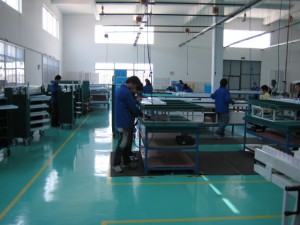
If the factories were not what I would call “modern”—they were certainly clean. The employees (factory workers) wore uniforms at most places I visited. They seemed proficient in their work and the products produced, and for the most part, were without quality problems—certainly no different from products produced in other countries.

Most of the factories tended to be in Industrial Parks that were quite large. Usually, the factories were a “small city” into themselves. There was housing provided for the employees on the factory grounds along with areas for recreation. I don’t suppose there was another way of doing it, but I saw a lot of laundry hanging from outside the housing units plus commercial apartments buildings I saw throughout China.

Most factories had certifications that were either the same or similar to those held by US factories. I saw elaborate R&D sections in most of the factories I visited. The office space was usually as modern and pleasant as any I had visited in the US.

A ritual that I truly enjoyed was at every meeting when hot tea was served. Sometimes the owner or general manager had tea to make in their office and other times it was brought in. However, I can’t recall a meeting where tea was not offered.

Being a non-smoker, another ritual I did not enjoy was in almost every meeting I attending most of the parties present smoked. I heard a figure once that 85% of Chinese men smoked. I can attest that this is probably a good estimate. Once inside the office or meeting room, the smoke became quite thick and uncomfortable for me; however, I was their guest and felt I could put up with the discomfort in the course of conducting my business affairs.

I have fond memories of my factory visits and discussions. I think the fact that I came to China, and met with the factory personnel aided my business immensely versus doing business in name only.

Note from Blog host – If you plan to do business in China, I recommend visiting the China Law Blog first.

Continued March 2, 2012 in Americans doing Business in China – Part 11 (a guest post) or return to Part 9

______________

Lloyd Lofthouse is the award-winning author of The Concubine Saga. When you love a Chinese woman, you marry her family and culture too. This is the love story Sir Robert Hart did not want the world to discover.

Subscribe to “iLook China”
Sign up for an E-mail Subscription at the top of this page.

About iLook China

Note:  This guest post first appeared on March 5, 2010


Americans doing Business in China – Part 9/16

February 29, 2012

Note from Blog host — another example of East meets West through business and trade: Higher education is a business, and the number of international students at U.S. colleges and universities reached 723,277 during the 2010-11 academic year.  China, the top country of origin for international students, sent 157,558 undergraduate and graduate students to America, up 23% from the previous year.

International students and their dependents contributed more than $20 billion to the U.S. economy that academic year. For Chinese students, that means about $4.4 billion came from China.

Ann Stock, assistant secretary of the US State Department says, “Young people who study abroad gain the global skills necessary to create solutions to 21st-century challenges. In turn, international students globalize our campuses and communities.” SOURCE: USA Today

_____________________

Guest Post by Bob Grant — publisher/editor for Speak Without Interruption, an international online magazine.

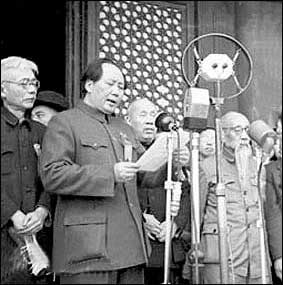
On October 1, 1949 the People’s Republic of China was formally established in a speech given by Mao Zedong from the Imperial Gate at Tiananmen Square. I stood at the very spot where Mao gave his speech and took a photo. From speaking with people – in China – who lived through his reign it was beyond believable. What he put his people through is an unforgivable act of power and brutality.

However, it is images from Mao’s era that some – outside of China – still have of the Chinese people. Nothing could be farther from the truth!

I never met a Chinese government official – did not even see one at least that I can recall. What I did meet were the people of China – the people with whom I had my business and personal interactions. I did not ask them questions about their government nor did they ask questions of mine.

The only political statement that I ever heard was a reference that China’s policy would probably change when the younger generation came into power, someday.

In meetings, over two years ago, I heard about the oil pipeline being built directly from Iran to China. None of the people in that meeting expressed an opinion one way or the other regarding this pipeline. It was a decision the Chinese government made.

Maybe my associates did not approve of dealing with Iran—maybe they did? The point being here is their government made this decision—not my associates.

Whether the officials in power in the US are republican or democrat, they have all made decisions of which I don’t agree. They did not consult me or ask my opinion—am I my government in these situations?

The point I am trying to make is that I found the Chinese people I met just like me in a lot of respects. I enjoyed doing business with them – learning their culture – and becoming their friend. No government – or its actions – is ever going to change that for me!

Note from Blog host – If you plan to do business in China, I recommend visiting the China Law Blog first.

Continued March 1, 2012 in  Americans doing Business in China – Part 10 (a guest post) or return to Part 8

______________

Lloyd Lofthouse is the award-winning author of The Concubine Saga. When you love a Chinese woman, you marry her family and culture too. This is the love story Sir Robert Hart did not want the world to discover.

Subscribe to “iLook China”
Sign up for an E-mail Subscription at the top of this page.

About iLook China

Note:  This guest post first appeared on March 9, 2010


Anna May Wong – the Woman that Died a Thousand Times

February 10, 2012

Almost half a century after her death, Anna May Wong (1905 to 1961) has not been forgotten.

As a child, Anna loved going to the movies and even cut school to go.

Between 1919 and 1961, she acted in 62 films. The Internet Movie Data Base says she was the “first Chinese-American movie star”.

To act, Anna had to play the roles she was given. The Western stereotype cast her as a sneaky, untrustworthy woman that always fell for a Caucasian man. The dark side of achieving her dream of acting in movies was that Anna had to die so the characters she played got what they deserved.

Anna often joked that her tombstone should read, “Here lies the woman who died a thousand times.”

Until Chinese started to emigrate to the U.S. in the mid-19th century, they had never encountered a people who considered them racially and culturally inferior.

However, the discrimination against the Chinese in America was only exceeded by the racism and hatred directed at African-Americans.

In fact, in the 1960s, many of the anti racist laws enacted during the Civil Rights era focused on protecting African-Americans, which created a protected class, and since the Chinese—due to cultural differences often did not complain—they were left behind.

In many respects, this racism toward the Chinese still exists in the US today and manifests itself through the media as China bashing, which supports the old stereotype.

When Anna May Wong visited China in 1936, she had to abandon the trip to her parent’s ancestral village when a mob accused her of disgracing China.

After her return to Hollywood, she was determined to play Chinese characters that were not stereotypes, but it was a losing battle. To escape the hateful racism, she lived in Europe for a few years.

Since U.S. law did not allow her to marry the Caucasian man she loved, and she was afraid that if she married a Chinese man he would force her to give up acting since Chinese culture judged actresses to be the same as prostitutes, she never married.

Anna May Wong smoked and drank too much. She died of a heart attack in Santa Monica, California at age 56.

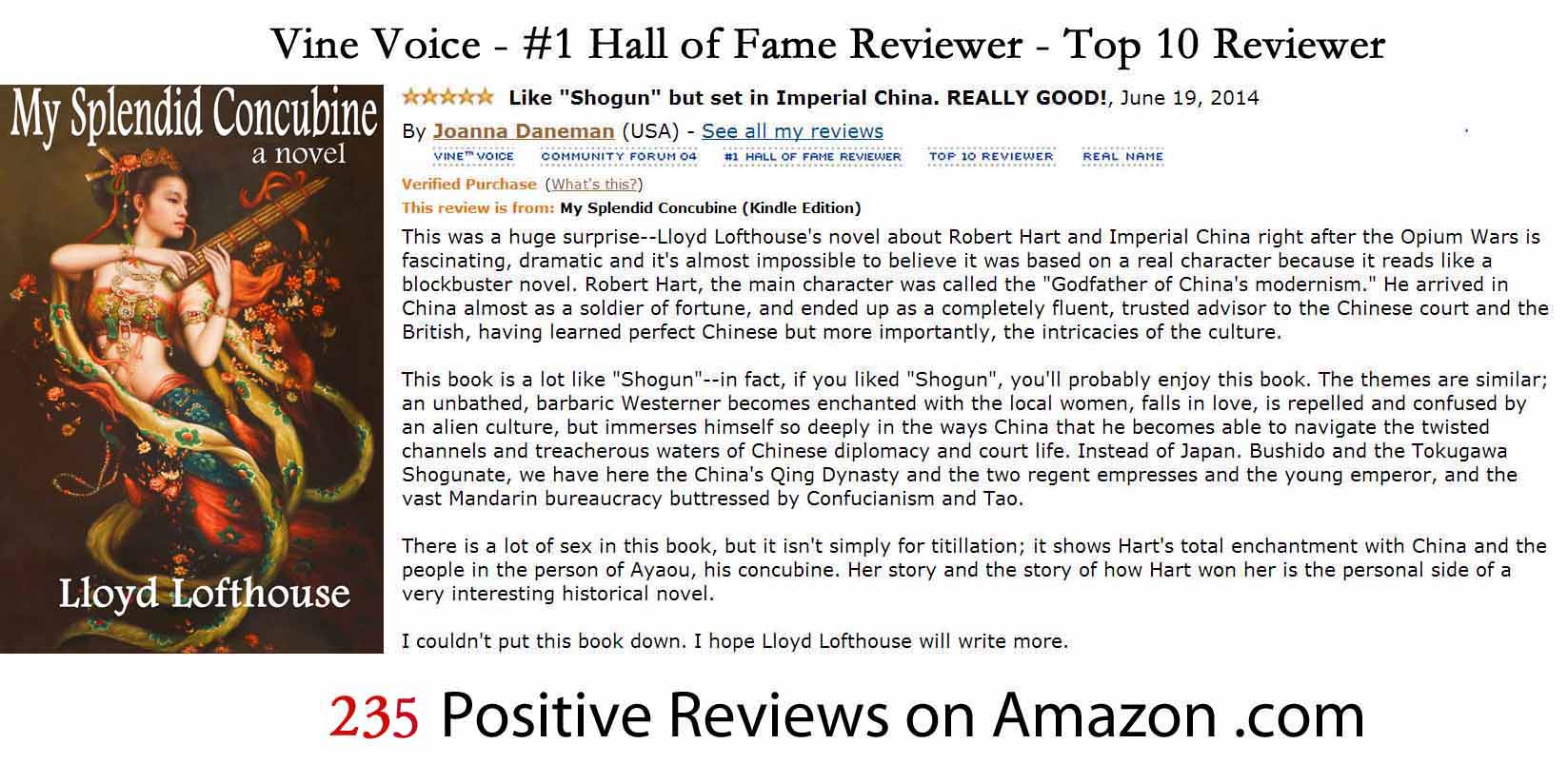
Lloyd Lofthouse is the award-winning author of My Splendid Concubine [3rd edition]. When you love a Chinese woman, you marry her family and culture too. This is the unique love story Sir Robert Hart did not want the world to discover.

1-joanna-daneman-review-updated-sept-21-2016_edited-3

Where to Buy

Subscribe to “iLook China”!
Sign up for an E-mail Subscription at the top of this page, or click on the “Following” tab in the WordPress toolbar at the top of the screen.

About iLook China

China’s Holistic Historical Timeline