There is a poem on the Statue of Liberty that ends with “Give me your tired, your poor, Your huddled masses yearning to breathe free, The wretched refuse of your teeming shore. Send these, the homeless, tempest-tossed to me, I lift my lamp beside the golden door!”
Angel Island in San Francisco Bay was America’s west coast Ellis Island, but those famous last lines on the Statue of Liberty Poem did not apply to the Chinese and other Asians.
From 1919 to 1940, mostly Asian immigrants entered the US through Angel Island.
After 1940, the immigration station on Angel Island was forgotten until California Park Ranger Alexander Weiss discovered the stories carved in the walls.
He thought these stories were ghosts waiting to be heard.
Over half of the Angel Island immigrants came from China and Japan and most of the carvings on the walls were poems written in Chinese.
A former detainee, Dale Ching, went through the station in 1937 when he was sixteen. Even though Dale’s father was born in the United States, he still had to go through the immigration station.
While the East Coast’s Ellis Island welcomed immigrants, Angel Island’s story was one of sadness and suffering.
Most European immigrants who went through Ellis Island stayed a few hours, but immigrants on Angel Island were kept locked up under armed guard with barbed-wire fences surrounding the buildings and some people stayed for days, weeks, months and even years.
The park service wanted to tear the Angel Island buildings down but Weiss found supporters, and they struggled to preserve this history. They succeeded and the restoration project was challenging.
Alexander Weiss sums up the video saying we should know both the right and the wrong from U.S. history.
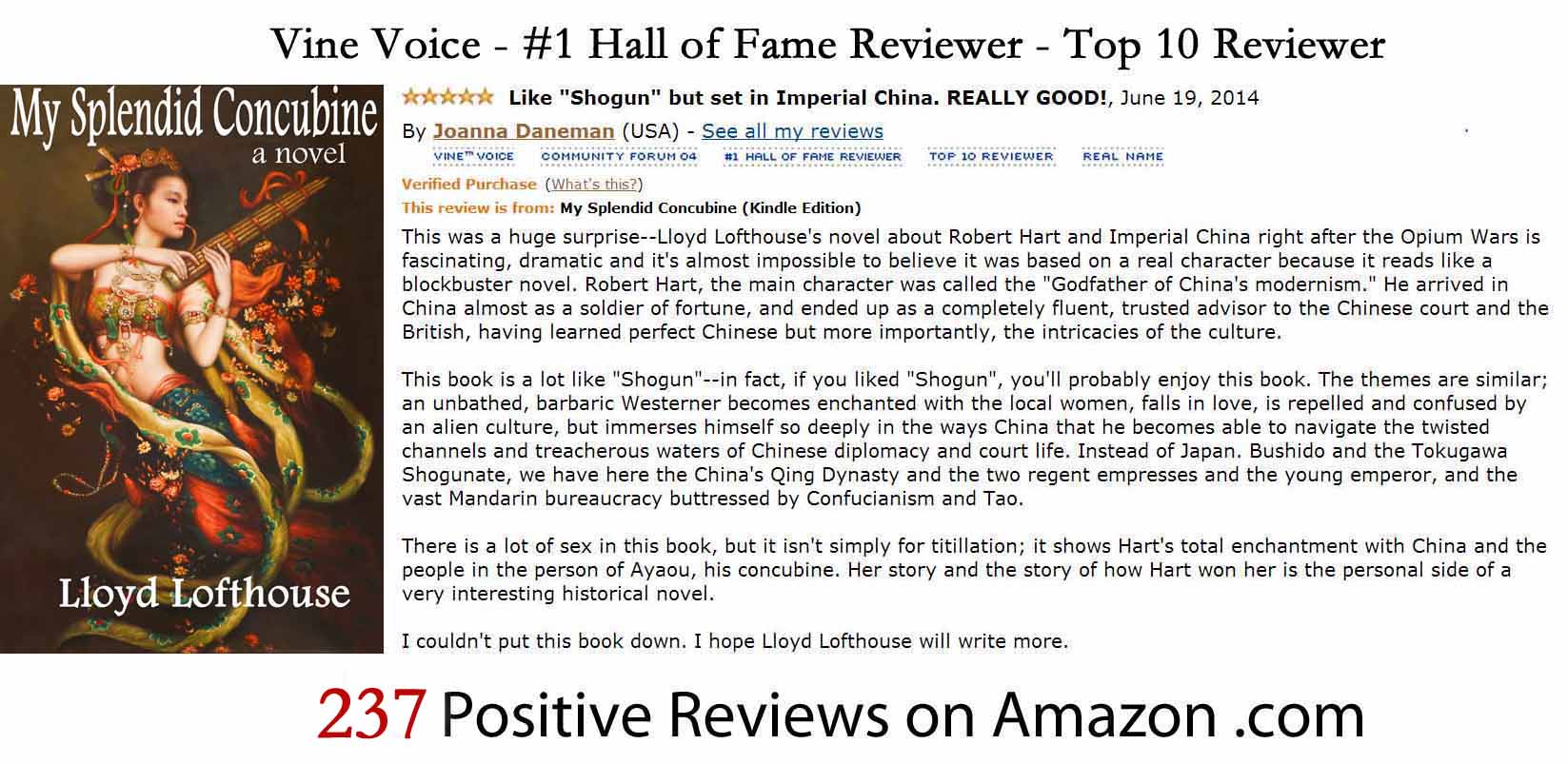
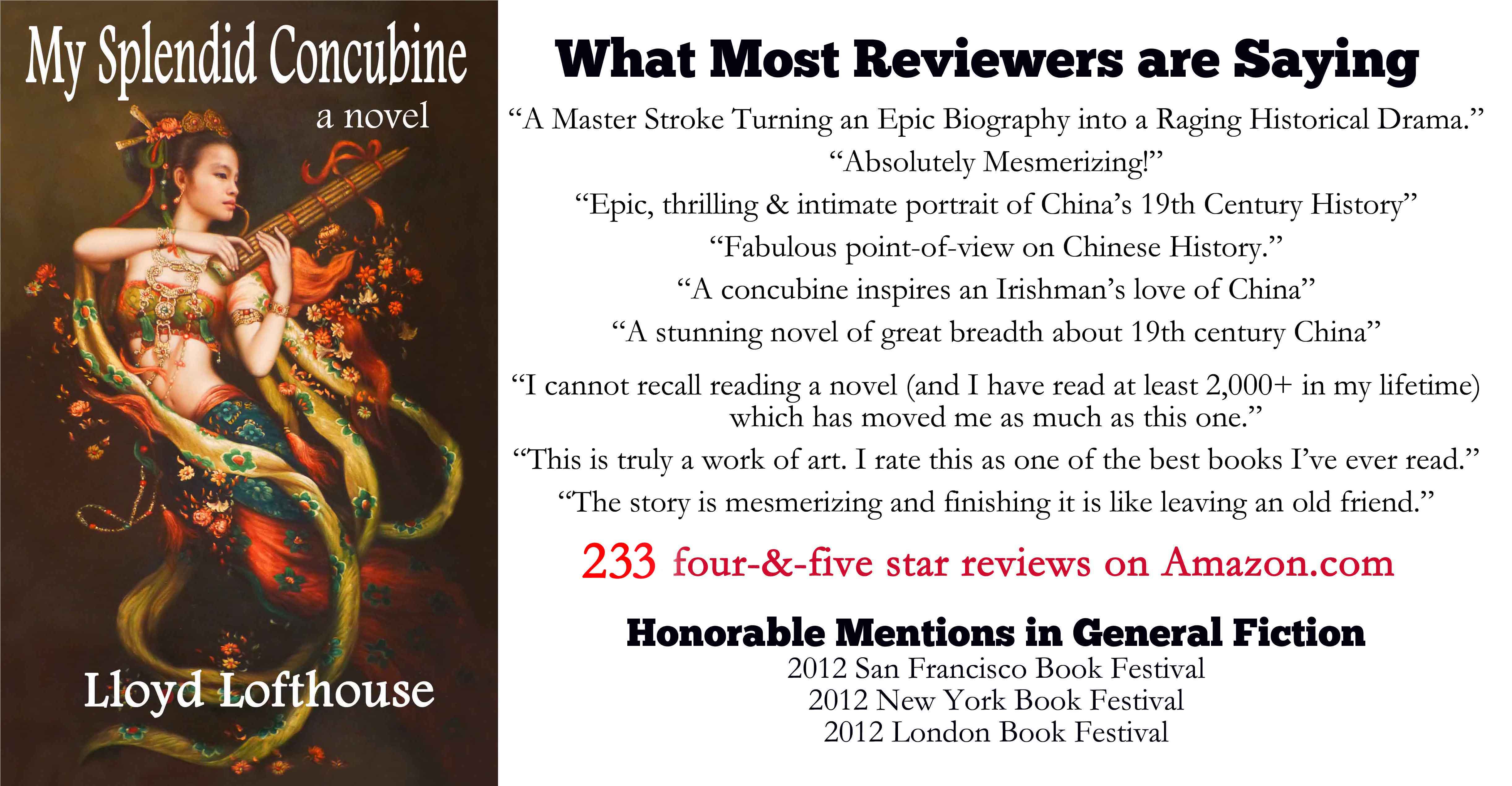
Lloyd Lofthouse is the award-winning author of My Splendid Concubine [3rd edition]. When you love a Chinese woman, you marry her family and culture too. This is the unique love story Sir Robert Hart did not want the world to discover.
Subscribe to “iLook China”!
Sign up for an E-mail Subscription at the top of this page, or click on the “Following” tab in the WordPress toolbar at the top of the screen.
Turkey is a fowl many Chinese seldom eat. However, eating duck and chicken is common. Duck is even considered a delicacy. In fact, the Unvegan says, “No trip to Beijing is complete without eating some Peking Duck.”
The Virtual Tourist says, “It is thought that Beijing roast duck, like the tradition of roast turkey in America and the UK, owes its origin to the roast goose that is still popular in Europe on festive occasions.”
Most Americans do not celebrate the Chinese New Year (the Spring Festival) and most Chinese do not celebrate Thanksgiving. After all, Thanksgiving is an American holiday that Canadians also celebrate, but on the second Monday in October.
Thanksgiving in Beijing with Peking Duck
CBS News.com reported, “America is the world’s biggest producer and exporter of turkeys. As a nation we’re also the largest consumers of turkey …” and “China is the second-largest market for U.S. turkey exports, reportedly buying more than $70.5 million in turkey meat in 2012.”
If you are visiting China during Thanksgiving, you have a choice between Peking Duck, which is easy to find, and turkey.
Go China says, “Just head to your local international grocery store (Jenny Lu’s in Beijing, Cityshop in Shanghai) and stock up on all the fixings: frozen Butterball turkeys, cranberry sauce and pumpkin pie makings. But you better do it fast, there tends to be a run on these items so if you’re shopping on the last Thursday in November, you’ll be out of luck.”
In fact, if you are visiting Shanghai, the Shanghai City Guide is there to help you find where to buy your favorite food. There are even three Walmarts in Shanghai, and Time Out Beijing provides a list for China’s capital city.
Lloyd Lofthouse is the award-winning author of My Splendid Concubine [3rd edition]. When you love a Chinese woman, you marry her family and culture too. This is the unique love story Sir Robert Hart did not want the world to discover.
Subscribe to “iLook China”!
Sign up for an E-mail Subscription at the top of this page, or click on the “Following” tab in the WordPress toolbar at the top of the screen.
The closest celebration in China to Halloween in the United States is The Hungry Ghost Festival celebrated the 14th or 15th night of the 7th lunar month in July or August. This year that day fell on August 17th.
The Ghost Festival, also known as The Hungry Ghost Festival, is a traditional Chinese festival and holiday celebrated by Chinese in many countries, in which ghosts and/or spirits of deceased ancestors come from the lower realm and/or hell to visit the living.
Buddhists and Taoists in China claim that the Ghost Festival originated with the canonical scriptures of Buddhism, but many of the visible aspects of the ceremonies originate from Chinese folk religion, and other local folk traditions (The Ghost Festival in Medieval China by Stephen Teiser).
In America, most children wear costumes and go door to door collecting free candy. In China, the opposite takes place; food is offered to dead ancestors, joss paper is burned, and scriptures are chanted.
Chinese Culture.net says the Hungry Ghost Festival is “Celebrated mostly in South China, Hong Kong, Taiwan and especially in Singapore and Malaysia.” It is believed by many Chinese that during this month, the gates of hell are opened to let out the hungry ghosts who want food.
By comparison, History.com says, “Halloween’s origins date back to the ancient Celtic festival of Samhain (pronounced sow-in). The Celts, who lived 2,000 years ago in the area that is now Ireland, the United Kingdom and northern France, celebrated their new year on November 1. This day marked the end of summer and the harvest and the beginning of the dark, cold winter, a time of year that was often associated with human death. Celts believed that on the night before the New Year, the boundary between the worlds of the living and the dead became blurred.”
I think it’s interesting that the dead linked both America’s Halloween and China’s Hungry Ghost Festival, at least historically.
As a child, I loved wearing a costume on Halloween and going out “trick-or-treating” at night to return home with a heavy bag (usually a pillowcase) filled with candy.
I still remember how much my stomach hurt and how terrible I felt after gorging myself on all that free processed sugar.
Today, due to the epidemic of diabetes and overweight or obese children in the United States (also in China mostly among its new middle class), I stopped celebrating Halloween years ago, and do not give candy to children. The last time I gave treats to children on Halloween, I handed out small boxes of raisins (sweet dried grapes) instead of candy, and one mother called me cheap.
But Science Daily.com comes to my defense with: “Teenagers who consume a lot of added sugars in soft drinks and foods may have poor cholesterol profiles—which may possibly lead to heart disease in adulthood, according to first-of-its-kind research reported in Circulation: Journal of the American Heart Association.”
In fact, the Centers for Disease Control and Prevention reports, “Teenagers and young adults consume more sugar drinks than other age groups and have been linked to poor diet quality, weight gain, obesity, and, in adults and children, type 2 diabetes.”
The American Diabetes Association says, “25.8 million children and adults in the US have diabetes while 79 million have prediabetes. Due to excessive sugar consumption, the risk of diabetes may lead to heart disease, stroke, high blood pressure, blindness, kidney disease, nervous system disease, and/or amputation of feet and legs.”
Maybe Americans should learn something from the Chinese Hungry Ghost Festival. Do not feed that sweet addictive candy to children. Instead, give the sugar to the dead and have your children eat apples, because there’s a lot of truth to the old saying that if you eat an apple a day, it will help keep the doctor away. If you doubt that, read this from Science Daily.
Lloyd Lofthouse is the award-winning author of My Splendid Concubine [3rd edition]. When you love a Chinese woman, you marry her family and culture too. This is the unique love story Sir Robert Hart did not want the world to discover.
Subscribe to “iLook China”!
Sign up for an E-mail Subscription at the top of this page, or click on the “Following” tab in the WordPress toolbar at the top of the screen.
In the Chinese film Not One Less (1999), a thirteen-year-old girl is asked to be the long-term substitute teacher in a small Chinese village. The teacher says to her that when he returns, if he finds all the students still there, he will pay her ten yuan, less than two American dollars at the time.
When one student, Zhang Huike, stops coming to school, Wei Minzhim, the thirteen-year-old substitute teacher, follows him to the city.
There are several themes in this film. The most powerful was the value of an education and not losing face. If Wei loses Zhang, she will fail the teacher who gave her the responsibility to teach the village children. To her, that means she must keep all the students.
This film reveals one of the greatest cultural differences between the United States and China. More than 2,000 years ago, Confucius taught that an education was the great equalizer and the key to leaving poverty behind. In the United States, for the last several decades, corporations in the private-sector education industry that profit off high-stakes tests claim high-test scores will lift children out of poverty, and low test scores are the fault of teachers, not children who don’t study for whatever reason.
Today many Chinese, not all, and most Asians outside of China still believe with a passion that education is the key, and this belief may explain why the on-time high school graduation for Asian-Americans in the United States is the highest when compared to all other racial groups.
U.S. News.com reports that Asian/Pacific Islander students comprised the only subgroup with a higher (on-time high school) graduation rate than white students (in the U.S.).
In the United States, teachers are often blamed for the lower graduation rates of Hispanics (more than 74 percent) and Blacks (71 percent), while in China parents take the blame when their children are not successful in school.
This is another significant difference between China and the United States. In China it would be unthinkable to wage war against the nation’s teachers for children who don’t learn. Instead, parents, who cared, and teachers work together to do what they can as partners to make sure children learn.
And for children that live in poverty and/or with parents that don’t care, a Stanford University Researcher discovered “There is an achievement gap between more and less disadvantaged students in every country, surprisingly, that gap is smaller in the United States.”
Zhang Yimou was the director of this film. He said, “Chinese culture is still rooted in the countryside. If you don’t know the peasant, you don’t know China.” Because of this, there is a strong message in this film about the urban–rural divide in China, which is being addressed as China sews the nation together with high-speed rail and electricity.
This a powerful movie about children, education, and poverty that shows the challenges China (and every country) faces in improving the lifestyles of almost 8-hundred million Chinese, who don’t live in the cities. The challenge is to do this without losing the cultural values that flow through Chinese history like a powerful river.
Lloyd Lofthouse is the award-winning author of My Splendid Concubine [3rd edition]. When you love a Chinese woman, you marry her family and culture too. This is the unique love story Sir Robert Hart did not want the world to discover.
Subscribe to “iLook China”!
Sign up for an E-mail Subscription at the top of this page, or click on the “Following” tab in the WordPress toolbar at the top of the screen.
If the population of the United States was the same size as China, America would be pumping out 22,722,840 kilotons of CO2 emissions – more than twice the carbon dioxide emissions of China. A kiloton is equal to 1,000 tons, and one ton is 2,000 pounds. Do the math. But because the U.S. has about 319 million people to China’s 1.36 billion, China looks worse than the U.S. when the total CO2 emissions are compared: 10,540,000 (kt) versus 5,335,000 (kt) for the U.S.
To me, this is mind boggling. The U.S. calls itself a democracy and many of its citizens never miss a chance to brag about their country’s power and the freedom offered to its citizens. Then why is China, an alleged totalitarian country without much freedom, as critics such as Liu Xiaobo’s claim, allowing Greenpeace to operate there without harassment from China’s central government?
Greenpeace is the leading non-governmental organization working in East Asia to fight climate change. Greenpeace has offices in Beijing, Hong Kong, Taipei and Seoul and is serving the People’s Republic of China, Hong Kong, Taiwan and South Korea.
And if democracies are so desirable, why did Japan send two Greenpeace activists to jail for one year after exposing widespread corruption in the Japanese government’s Southern Ocean whaling programme?
In fact, in China, efforts to combat climate change demonstrate that China’s government acknowledges the challenge as well as the responsibility of China to tackle them. In addition, if China’s Communist Party didn’t want Greenpeace, they wouldn’t be there.
Listen to Greenpeace China’s Tom Wang in Tianjin calmly being honest about China’s pollution challenges.
In 2006, Greenpeace China was the only NGO to be consulted on an early draft of renewable energy law by China’s National People’s Congress.
China has also allowed two Greenpeace expeditions to China’s Himalayan region in 2006 and 2007 where evidence was discovered of the dramatic retreat of glaciers, which was reported in National Geographic Magazine.
One Greenpeace China campaign focused on stopping Monsanto, a US-headquartered biotechnology giant, from patenting a Chinese indigenous soybean variety. Discover what Monsanto is doing to contaminate the world’s food supply?
How has China reacted to Monsanto GMO soybeans? Sustainable Pulse.com reports, “According to a statement last week by Beijing Food Safety Volunteers the Chinese Ministry of Agriculture has confirmed to them that Monsanto’s RR2 Xtend GMO soybeans have not been approved for import, despite the company’s claims earlier in 2016.”
Greenpeace campaigns in China have also focused on food, agriculture and electronic waste while highlighting the dangers of PVC in children’s toys.
I admit finding this information about Greenpeace China surprised me because all I’ve heard in the Western media of Greenpeace is that they are a gang of dangerous activists doing crazy things to get attention.
Until reading about Greenpeace in China, I didn’t know what a positive force it was for cleaning the environment.
Now I want to know why the US isn’t doing more. But I already know the answer: big oil and the Koch brothers, who fund ALEC, the climate change denial effort, and own many members of the U.S. Congress and state legislature are doing all they can to block ridding our environment of carbon emissions. Source Watch.org lists as many of these bought and paid for elected representatives as possible, because ALEC is cloaked in secrecy, and that is not how a democracy and/or a republic works.
Lloyd Lofthouse is the award-winning author of My Splendid Concubine [3rd edition]. When you love a Chinese woman, you marry her family and culture too. This is the unique love story Sir Robert Hart did not want the world to discover.
Subscribe to “iLook China”!
Sign up for an E-mail Subscription at the top of this page, or click on the “Following” tab in the WordPress toolbar at the top of the screen.


 Posted by Lloyd Lofthouse
 iLook China