The Power of Chinese Assimilation

July 9, 2010

Andrew Clark contributed a post to Politics Daily about China’s minorities and the autonomous regions they call home. As Andrew clearly pointed out, “Han Chinese make up 92 percent of the People’s Republic of China. The remaining 8 percent is made up of minority groups, mainly Tibetan, Zhuang, Uyghur, Mongolian, Miao, Manchu, and Hui (these are the major ethnic groups — China officially recognizes 55 minority populations).”

Clark concludes with, “It remains to be seen whether the Chinese government can successfully assimilate these groups, or if consistent suppression of uprisings can force social tranquility.”

The Chinese map has inflated and deflated for more than two-thousand years. Some of these minorities have been in China longer than others. The Mongolians Clark visited, like the Tibetans and the Uyghur, are three who haven’t been inside China as long since they were conquered by the Qing Dynasty (the Manchu minority), who ruled China from 1644 – 1911.

One other minority ruled China for a brief time and that was the Mongols as the Yuan Dynasty (1277 – 1367). Both the rulers of the Qing and the Yuan were assimilated into the Han culture while they ruled China. That’s was primarily because they were surrounded by Han Chinese in the capital.

Tibet broke from China in 1913 and stayed out until 1950 when Mao sent an army into Tibet, which has always been a difficult place for China to rule since sending armies there to enforce control was difficult. But today, a highway and a railroad make that journey easy. If those transportation routes are cut, there’s still air transportation. The travel distance between Tibet and  Beijing is shorter than it was a century ago.

Currently, China is adding about 40 thousand more kilometers of rail throughout China and building another grid of high-speed rail. This improved transportation system is also bringing about change and causing a Han migration that would have been unthinkable more than a century ago when most of China didn’t have electricity or roads.

For centuries, China ruled over these minorities without moving Han Chinese into their territories, but times have changed and the Han Chinese, like the Americans Europeans moving West, have been migrating into the autonomous regions for years, which may have more of an impact keeping these territories part of China than armies ever have. And if that doesn’t work, China still has the largest standing army in the world.

Clark also claimed, “the United States has seemingly countless ethnic and cultural minorities that are proud to call themselves American…”  While somewhat true, many of almost 2,500 American native tribes still  hold to their old ways and live on reservations proud to be Navaho or Sioux, Black Foot or Apache, maybe more so than being American.

If given a choice,  many of these North American tribes would jump at the chance to have their ancestral homes back. But the FBI keeps a tight watch over these American minorities, and the US Marines are always a phone call away. Then there is the fact that Alaska and Hawaii both have strong secessionist movements.

Discover more about Minorites in China

_________________________

Lloyd Lofthouse is the award-winning author of the concubine saga, My Splendid Concubine & Our Hart. When you love a Chinese woman, you marry her family and culture too. 

Sign up for an RSS Feed for iLook China


A Matter of Distance and Perspective

July 7, 2010

President Obama demonstrates that he does not understand the Chinese thought process in his response to President Hu Jintao of China over how to handle North Korea’s recent sinking of the Cheonan, a South Korean naval ship.

The New York Times Asia Pacific section reports that President Obama has accused Beijing of “willful blindness” toward what North Korea has done.  Some American officials say this was an act of war. Obama indicated the way China is handling this would not solve the problem.

There are two voices to pay attention to. Leon E. Panetta and China’s spokesman, Qin Gang. Mr. Qin said, “China is a neighbor of the Korean Peninsula, and on this issue our feelings differ from a country that lies 8.000 kilometers distant. We feel even more direct and serious concerns.”

Leon E. Panetta, the Director of the Central Intelligence Agency, said he believed that the sinking of the Cheonan was part of a succession struggle in North Korea.”

America tends to handle crises of this kind like a bull in a China shop, and what gets broken doesn’t hurt the US homeland. China, on the other hand, will handle this issue like delicate surgery.  One wrong move could end in disaster.  After all, who is closer to that nuclear bullring and how can Obama understand when China’s shoes won’t fit his feet?

See China and North Korea

_________________________

Lloyd Lofthouse is the award-winning author of the concubine saga, My Splendid Concubine & Our Hart. When you love a Chinese woman, you marry her family and culture too. 

Sign up for an RSS Feed for iLook China


The Challenge of Rural Health Care in America and China

July 7, 2010

This morning, I read in the AARP Bulletin about small town medicine in the US aptly titled Lonesome Doc.  I learned that 77 million Americans (more than 25% of the population) living in rural areas have 10% of the doctors and that a 2008 study found life expectancies are declining in rural America.  Many doctors will not work in rural America where primary care doctors make about $20,000 a year less than their big-city counterparts.

China has similar challenges with rural health care. In 2009, The Journal of International Relations reported that in China “low-end institutions, particularly the rural township hospitals and community hospitals in the cities are gradually shrinking. More than 87% of rural population was without any health insurance.…When rural low income people need to go to the hospital, 70 to 90% choose self care.”

Then near the end of 2009, China’s central government announced a new five-year plan to improve the quality of life for rural citizens. The New Health Care Bill Facts reported “The (Chinese) government decision to improve healthcare infrastructure in rural areas will result in increasing demand of medical devices and equipment.”

China also recently sent a team to Sweden to learn how chronic diseases are managed there since China, with its ageing population, has seen a dramatic increase in the number of chronic disease cases.”

I wondered what the US was doing to improve rural-health care.  I did read that primary-care doctors coming out of college would have student loans forgiven if they work in rural America. After all, this is America where we trust in the private sector to solve everything as long as the money is there.

See China’s Health Care During Mao’s Time

______________

Lloyd Lofthouse is the award-winning author of The Concubine Saga. When you love a Chinese woman, you marry her family and culture too. This is the love story Sir Robert Hart did not want the world to discover.

To subscribe to “iLook China”, look for the “Subscribe” button at the top of the screen in the menu bar, click on it then follow directions.


Adoptions in China Changing

July 3, 2010

In Earth to Earth, Dust to Dust, Ashes to Ashes, I wrote about the tragic death of Faith Dremmer, who was adopted in China.  Her American mother’s journey to adopt her was one that many Americans have taken.

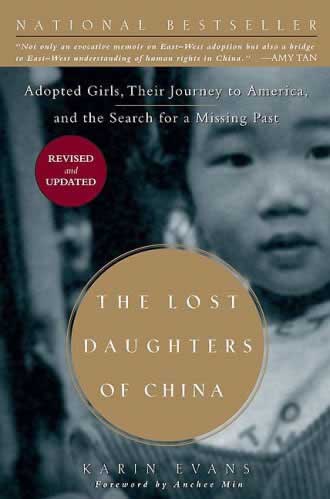
The Lost Daughters of China by Karin Evans is about those abandoned girls and their journey to America.

Now, McClathcy.com reports that China restricts foreign adoptions as demand grows at home.  One reason being that prosperous, middle-class Chinese families without children now want to adopt and can afford it.

Another reason is that there are not as many children being left at orphanages by poverty-stricken families, who cannot afford to feed another mouth. China’s prosperity allows families to earn enough money so they don’t have to make that difficult decision.

In fact, adoptions by American families are down 60% since 2005, according to the State Department.

______________

Lloyd Lofthouse is the award-winning author of the concubine saga, My Splendid Concubine & Our Hart. When you love a Chinese woman, you marry her family and culture too. 

If you want to subscribe to iLook China, there is a “Subscribe” button at the top of the screen in the menu bar.


Masters at Global Bartering, The Dragon’s Gift

July 2, 2010

US businessmen and politicians could learn from China, who learned from Japan.  Instead of debt-ridden countries giving money away as the US does, America could be earning profits.

I read a fascinating piece in the Global Post by Stephanie Hanson that shows us China has elevated the art of barter to Ferengi levels. If you don’t know what I’m talking about, that’s okay.  I’ve been watching Star Trek, Deep Space 9, and the Ferengi are an alien race who has turned the art of business into a science with a rule book.

While the US gives hundreds of billions of dollars to poor countries as aid, China trades or barters loans with African nations and in return China builds that country’s infrastructure. To understand, Hanson recommends reading “The Dragon’s Gift: The Real Story of China in Africa“.

Hanson writes, “In the 1970s, Japan extended aid to China that helped the country build transportation and energy infrastructure. This aid was repaid in barrels of Chinese oil. Now, across the African continent, China is extending concessional loans to African governments for roads, power plants, factories and hydro projects, in many cases using the same kind of financing arrangements it learned about from Japan.”

See Doing Business in China

_________________________

Lloyd Lofthouse is the award winning author of the concubine saga, My Splendid Concubine & Our Hart. When you love a Chinese woman, you marry her family and culture too. 

Sign up for an RSS Feed for iLook China