Looking at China through a Cultural Lens – Part 2 of 2

January 15, 2020

What do Confucianism, Taoism, and Zen Buddhism have in common?

Buddhism and Taoism are peaceful religions that use meditation for peace of mind and enlightenment. Taoism originated in China in the sixth century B.C. It is also believed that Buddhism originated in the sixth century B.C. but in India. Both Taoism and Buddhism believe in reincarnation, life after death, and both have similar end goals. The goal of Taoism is to have a balanced life while Confucianism focuses on creating and maintaining harmony in society and avoiding conflict.

For instance, if an individual or group threatens harmony for everyone else, China’s leaders throughout history have often imprisoned or executed those individuals or groups threatening the tranquility of the majority of people.

A Cup of Tea (Zen poem)
Nan-in, a Japanese master during the Meiji era (1868-1912), received a university professor who came to inquire about Zen.
Nan-in served tea. He poured his visitor’s cup full, and then kept on pouring.
The professor watched the overflow until he no longer could restrain himself. “It is overfull. No more will go in!”
“Like this cup,” Nan-in said, “you are full of your own opinions and speculations. How can I show you Zen unless you first empty your cup?”
101 Zen Stories

Zen-like Taoism focuses on staying in the present without judging anything or anyone.

However, it isn’t easy for Christians, Jews, or Muslims to do the same thing. Instead, the members of these religions often judge just about everything and everyone leading to many wars and lost lives.

Wars in China have seldom if ever been started by people that practice the philosophies of Zen Buddhism, Taoism, or Confucianism.

Return to or start with Part 1

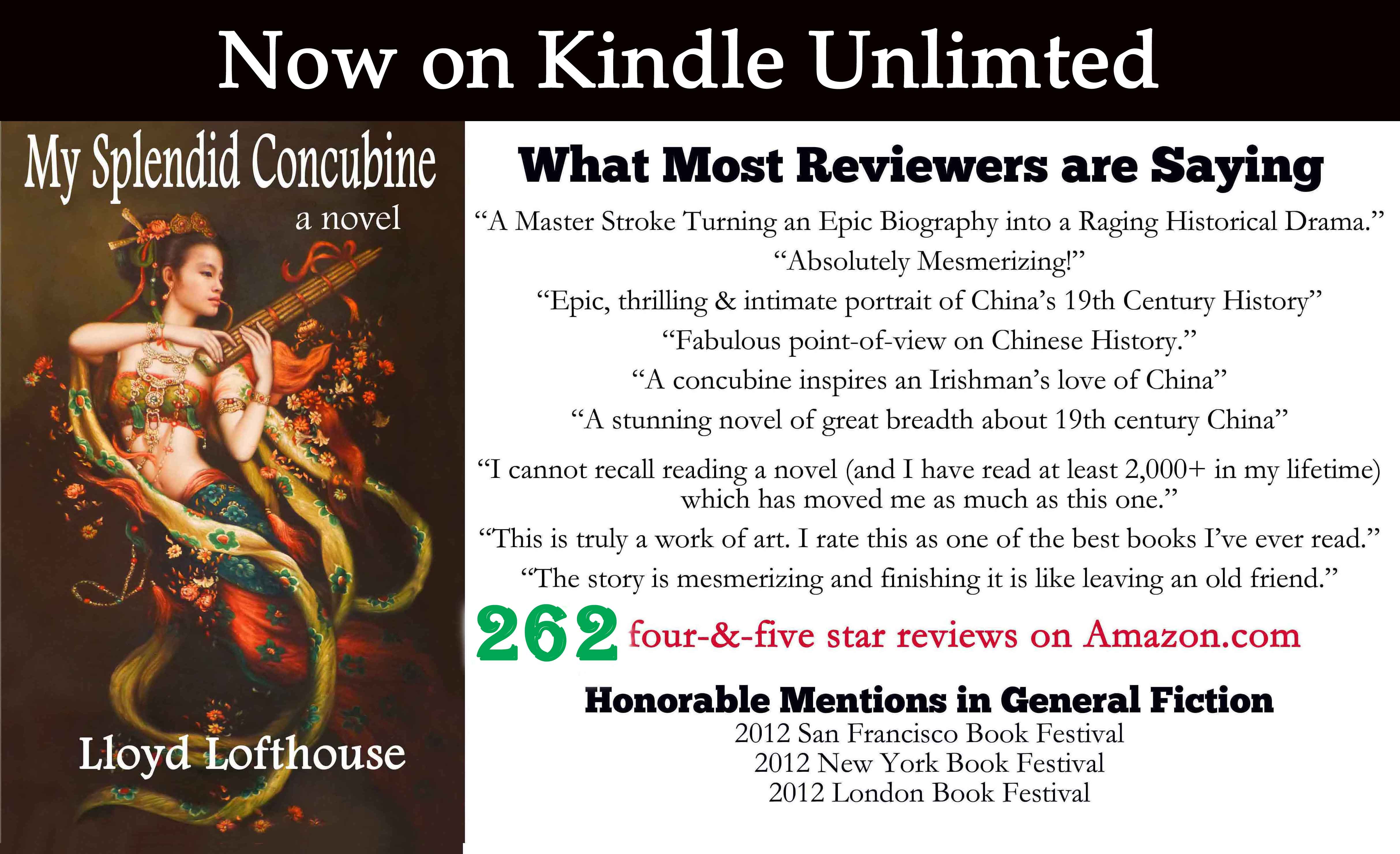
Lloyd Lofthouse is the award-winning author of My Splendid Concubine, Crazy is Normal, Running with the Enemy, and The Redemption of Don Juan Casanova.
Where to Buy

About iLook China


Looking at China through a Cultural Lens – Part 1 of 2

January 8, 2020

“Taoism (also known as Daoism) is a Chinese philosophy attributed to Lao Tzu (c. 500 BCE) that contributed to the folk religion of the people primarily in the rural areas of China and became the official religion of the country under the Tang Dynasty. Taoism is therefore both a philosophy and a religion.”  ꟷ Ancient History Encyclopedia

“Unlike Buddhism (that originated in India and reached China to become popular), Taoism arose from the observations and beliefs of the Chinese people. The principles of Taoism impacted Chinese culture greatly because it came from the people and was a natural expression of the way the Chinese (working class) understood the universe.”


Buddhist Parable on the True Nature of Human Existence

Buddha Weekly says, “The Daoist tradition was already present in China when Buddhism first entered the country over the border from neighboring India around the 3rd Century BCE. The two religions (Taoism and Buddhism) came to heavily influence each other in China, and this Daoist influence on Buddhism — after the two started to interact with one another — helped shape history and philosophical belief in the region for centuries.”

“Taoism has been one of the most influential philosophies and religions during the past 2,500 years in China, and it affects every aspect of Chinese life, including leisure.” ꟷ World Leisure Journal

The BBC reports, “Zen Buddhism is a mixture of Indian Mahayana Buddhism and Taoism. It began in China, spread to Korea and Japan, and became very popular in the West from the mid 20th century. The essence of Zen is attempting to understand the meaning of life directly, without being misled by logical thought or language. … If you’re a westerner you may find it hard to shake off the intellectual and dualist ways of thinking that dominate western culture: this can make it difficult for westerners to come to Zen.”

Part 2 will be posted on January 15, 2020

Lloyd Lofthouse is the award-winning author of My Splendid Concubine, Crazy is Normal, Running with the Enemy, and The Redemption of Don Juan Casanova.

Where to Buy

About iLook China


Frozen in China but the sky is Blue

January 1, 2020

Tourism is an important industry in China and if you prefer colder weather, like me, the place to go for winter fun is Harbin.

CNN Travel reports, “China has invested heavily in bringing commercial and tourist traffic to more remote regions of the country. ……… The city of Harbin hosts the annual Harbin International Ice and Snow Sculpture Festival, the biggest of its kind in the world. Every winter, visitors come from across China and the world to see the mammoth creations, which this year included a Buddha statue made from 4,500 square cubic meters of snow, and a 3-D light show reflected against the ice for dramatic effect.”

The festival originated in 1963. … In 2001, the Harbin Ice Festival was merged with Heilongjiang’s International Ski Festival and got a new formal name, the Harbin International Ice and Snow Sculpture Festival.


Sneak Preview of Harbin Snow and Ice World 2020

“More than 100 activities and events will be held in Harbin … The activities and events fall into several categories, namely ice and snow tourism, ice and snow culture, ice and snow fashion culture, ice and snow trade, and ice & snow sports.” ꟷ Ice Festival Harbin.com

The Atlantic reports that more than a million tourists visit Harbin to see the massive ice and snow sculptures.

China Daily.com reports, “The festival officially starts in January 5th every year, but the locals begin to celebrate the festival in the third week of December of the previous year because most of the ice lanterns, ice and snow sculptures are completed by this time. Depending on the weather conditions and activities, the festival usually last until the end of February.”

As of 2015, China is the fourth most visited country in the world, after France, the United States, and Spain, with almost 57 million international tourists per year. In 2017, tourism resulted in revenue of about USD 1.35 trillion, 11.04% of the GDP, and contributed to direct and indirect employment for more than 28-million Chinese.

The Chinese also like to travel outside of China. According to The Telegraph, in 2018, almost 150 million Chinese visited other countries. But domestic tourism adds up to almost 5.5 billion trips annually.

Lloyd Lofthouse is the award-winning author of My Splendid Concubine, Crazy is Normal, Running with the Enemy, and The Redemption of Don Juan Casanova.

Where to Buy

About iLook China


The Accident that led to Fireworks, Rockets, Cannons, Bullets, and Bombs

December 25, 2019

Do you know who is responsible for discovering what led to the fireworks we enjoy in the night sky on major holidays, like New Year’s Eve or the Lunar New Year?

Smithsonian says, “Around 200 BC, the Chinese unintentionally invented firecrackers by tossing bamboo into the fire, but it took another thousand years before true fireworks came alive. … Like many inventions, firecrackers fireworks were created by accident … and by the search for immortality.”

It would take more than a thousand years before this modern technology of war that was invented by accident ended up in the west.

Smithsonian also tells us in another piece, “The first known use of the military rocket occurred in 1232 when the Chinese used fei huo tsiang (flying fire lances) against Mongols besieging the city of Kai-fung-fu.”

If you Google ‘who invented the rocket,’ you will discover that Google gives credit to American Robert Hutchings Goddard, who did not invent the rocket. Goddard only improved on what the Chinese had already created almost seven hundred years earlier. The Chinese invented the first rocket that was powered with gunpowder. Goddard invented the world’s first liquid-fueled rocket in 1926, a different type of propellant that was easier to control.

After those ancient Chinese alchemists accidentally discovered gunpowder, “Centuries of trial and error refined the gunpowder formula, and alchemists likely stumbled upon the property of propulsion.”

When the fireworks soar into the sky around the world this New Year’s Eve, you will be witnessing “over 2000 years of danger, invention, and beauty wrapped into a simple package.”

When the sky lights up in splashes of color remember to give credit to “Emperor Wu Di of Ancient China’s Han Dynasty (156-87 B.C.).” Antiquitynow.org

Emperor Wu Di wanted to live and rule forever like many powerful men with a god complex, so he ordered his Taoist alchemists (the religious scientists of his empire) to research and discover a potion or elixir for eternal life. During that search for immortality, they discovered gunpowder.”

[yotube=https://www.youtube.com/watch?v=FkaxdGRgQgA]

A god complex is an unshakable belief characterized by consistently inflated feelings of personal ability, privilege, or infallibility.

Answer this question if you can: What modern-day world leader claims he is the “Chosen One”?

Often mentioned in science fiction and fantasy films and novels, the Chosen One is allegedly the sole person chosen by destiny to stop an impending disaster that threatens all life, save the world from a supervillain, and stop corruption.

If you have correctly answered the last question, you should know what the Bible says about God’s Chosen One: Timothy 2:5: “For there is one God, and there is one mediator between God and men, the man Christ Jesus …”

Modern-day mortal supervillains that have a god complex share characteristics of real-world dictators, gangsters, and terrorists, with aspirations of world domination or universal leadership.

Lloyd Lofthouse is the award-winning author of My Splendid Concubine, Crazy is Normal, Running with the Enemy, and The Redemption of Don Juan Casanova.

Where to Buy

About iLook China


China, the Enemy of your Enemy is NOT always your Friend

December 18, 2019

According to Global Research, “The ancient idea that ‘The Enemy of My Enemy Is My Friend’ originated in the 4th century B.C. in India.  Kautilya –  the ‘Indian Machiavelli’ – wrote about the idea in the Sanskrit military book, the ‘Arthashastra’.”

I have experienced and witnessed how “the enemy of my enemy is my friend” works.

Have you ever played or seen a game of four-way chess? When I was a faculty co-sponsor for a high school student chess club for several years, I often played four-way chess with three students, who thought I was the better player, formed an alliance to clear as many of my chess pieces off the board as possible until I was no longer a threat. Once that was achieved, two of the other three players would then form an alliance to take out the strongest remaining player. The smartest/sneakiest player was the one that used “the enemy of my enemy is my friend” to his/her best advantage and almost always won in the end.

I think Putin is that type of player, the sneakiest one that will manipulate the other players to help him win the game. To win, Putin will even turn countries against each other.

China must not forget that its history with Russia has not always been friendly.

Before 1600, China and Russia were on opposite ends of Siberia, which was populated by independent nomadic tribes.

But by 1640, Russian settlers reached the Amur River basin and settled in territory that belonged to China.

From 1652 to 1689, China’s armies drove the Russian settlers out, and after 1689 China and Russia made peace and established trade agreements. By the mid-1800s China’s economy and military power were no longer a match for Russia and Europe’s colonial powers. Taking advantage of the situation, Russia annexed the Amur basin and Vladivostok and stole that area from China.

During Russia’s 1917 Communist Revolution, there were two factions, the Reds vs the Whites. The Reds won. China-backed the Whites, and to punish China, in 1923, the USSR supported the Kuomintang (the Chinese Nationalists) and its leader Chiang Kai-shek instead of the Chinese Communist Party. It should be noted that Chiang Kai-shek also had the support of the United States.

China and Russia fought two border wars in the next ten years, and Joseph Stalin the leader of the USSR continued to give support to Chiang Kai-shek’s Kuomintang government. Stalin also told Mao Zedong to cooperate with Chiang Kai-shek. Instead, Mao attacked the Chiang’s Nationalist government.

After World War II, the Soviets no longer needed to be friends with the United States and switched sides and backed the Chinese Communist Party under Mao. With this help, Mao won the Civil War in 1949. The U.S. was still supporting Chiang Kai-shek and his Nationalist Party, the Kuomintang.

Political tension between China and Russia emerged after Stalin’s death in 1953. In 1961, the unstable alliance ended when Mao accused the Soviets of revisionism. Then the two countries started to compete for control over foreign communist states and political movements around the world.

In 1969, there was a brief border war between the two countries, and President Nixon’s intervention saved China from a Soviet nuclear attack.

In 1979 China invaded Vietnam, which was an ally of the USSR. China also sent aid to the anti-Soviet Mujahedeen in the USSR’s war in Afghanistan.

In two-way or four-way chess, the players cannot trust each other even when they are allies. Every player must keep their eyes on the board because some players cheat.

Russia’s leaders have a long history of Anti-Americanism, dating back to the early days of the Cold War. In some of the latest Russian population polls, the United States and its allies consistently top the list of Russia’s greatest enemies.

Because President Donald Trump started a trade war with China, he destroyed the goodwill that President Nixon created by stopping Russia from destroying China with nuclear weapons. Trump’s trade war turned China into an enemy of the U.S., and Russia’s Putin is using that to his advantage until the United States is no longer a global threat.

Can China trust Putin after Donald Trump is gone and hopefully in prison?

Did Trump start his trade war with China because Putin told him to do it?

The Moscow Project reveals “12 Ways Trump has Supported Putin’s Foreign Policy Agenda”.

The Washington Post reports, “Amid trade war, Trump drops the pretense of friendship with China’s Xi Jinping, calls him an ‘enemy’”

When the next U.S. president ends the Trump (Putin) trade war with China, what will Putin do next?

Will Putin turn against China?

Lloyd Lofthouse is the award-winning author of My Splendid Concubine, Crazy is Normal, Running with the Enemy, and The Redemption of Don Juan Casanova.

Where to Buy

About iLook China