Chris Bewley has taught English as a foreign language for the past 10 years all over the world, including Japan, Korea, Mexico and Brazil.
__________________________
When I first arrived in China as an English teacher, I had lofty scholastic goals: I wanted to try a creative variety of class activities and apply a broad spectrum of teaching methods that my students could benefit from to make them competitive in academia and, later, the international job market.
Almost 1 year later, my primary responsibility as a “Foreign Expert English Instructor” has been distilled down to little more than babysitting a bunch of spoiled, undisciplined children who for the most part want nothing to do with English.
At my crowded primary school in a small, semi-urban city in East China, there exists what I have coined the “20/20/20” split in each of my classes (60 kids per class): 20 eager/20 indifferent/20 bad. Basically, I’m teaching 20 while trying to control 40.
To make it fair for everyone, I have to dumb-it-down/ fun-it-up every class. Instead of actually teaching, I find myself playing games with them and jumping around for them like a monkey, which is the only way to retain their attention.
On the positive side, of the eager 20, there are several extremely smart students who I expect one day to be quite successful in what ever they do. Unfortunately, whenever those eager 20 are trying to learn, the other naughty 40 will try just as hard to spoil it for them.
In the past year, I’ve had only a handful of students ever raise their hand and ask ME a question about the English language. That’s 1,200 students/week x 30 weeks, which equals 36,000 (thirty-six thousand) chances for a student to raise a question, but only five ever have. On the rare occasion that my students do ask me questions, it’s usually regarding the price of my clothes or how much I get paid.
Criticism about my lessons that I have received from students, parents and Chinese teachers alike includes “it’s too difficult”, “it’s not fun enough”, “there’s not enough participation/activity,” but never have I ever heard that my classes are too easy, which in my opinion they most certainly are.
By now, I have figured out that English lessons in (urban) China are just a show; a clown show; a monkey show – starring myself as the foreign monkey.
For parents’ week last month, whilst dozens of “concerned” parents and school administrators observed my classes for 5 days in a row, rather than actually teach their children, I just played a bunch of silly games and sang some songs with them, and, guess what? That made all the parents really, really happy!
Most recently, I found myself having to literally, physically, throw out my Chinese teaching assistant (a recent college graduate with no classroom experience hired right off the street for a minimal salary) to avoid a mutiny from within.
You see, she absolutely refused to discipline the rowdiest students, and did nothing to help control their deafening volume when I was trying to teach.
A quarter of China’s rural youth overweight!
When I approached her about this, her response was: “you are not a real teacher!” I imagine that this assistant was once (11 years ago, to be precise) a spoiled, indifferent primary school student herself; how sadly ironic that at age 21 she still indentified with the students rather than with me, the teacher.
China’s universities are being touted with utilitarian promise, a promise that trickles down all the way to the elementary school level. The Chinese’s fear of poverty has undermined intellectual diversity; plagiarism and cheating are rampant and go unpunished, reading books is not encouraged, greater importance has been placed on math than any other subject starting in the earliest years of child development, and there are no other languages other than English offered until university.
The
English “industry” in China is what I call “C.O.O.C”: completely out of control! There is literally a new, privately run children’s English “school” popping up on every other corner every other week. Nor is it an industry that has grown in a healthy, steady way from its infantile beginning; it is a product for infants in hyper-drive.
A perfect parallel to this is the car situation in China, which is also out of control.
I hate to say it because it has become an international cliché, but, truly, nobody in China knows how to drive or even park properly. Automobile ownership in China has, along with its economy, bloomed at an alarming rate in the past 5 years, resulting in massive congestion everywhere from the smallest towns to the largest cities.
It’s obvious that the people who own these cars use them primarily as status symbols rather than for necessity; it rarely rains in my city and there are no hills, yet every single day, 6 times a day, hundreds of parents dropping off/picking up their children in new, black Audis will cause an hour-long gridlock directly
in front of my school rather than be seen walking or riding a bicycle.
Please don’t get me wrong, I am not a “China-hater.”
Colorful street life, extremely friendly people, great food, affordable massage parlors, a handful of good friends both Chinese and foreign, and a decent income have been sufficient to keep me reasonably comfortable.
But in the end, I have to ask myself: what am I here for? Because it’s obvious that China doesn’t want me to actually teach anybody anything.
_____________________
Chris Bewley has taught English as a foreign language for the past 10 years all over the world, including Japan, Korea, Mexico and Brazil.
To subscribe to “iLook China”, look for the “Subscribe” button at the top of the screen in the menu bar, click on it then follow directions.
To understand why China is often the focus of so much attention when it comes to pollution, such as carbon emissions from oil, coal, gasoline, diesel and burning wood, we should start where the industrial revolution began and that is in the West (more than two centuries ago). I will start with an “old” friend that believes environmentalists worship the environment instead of God. I do not agree.
Instead, I see environmentalism as humanity’s effort to save the world from a potential catastrophe. If anything, the Christian God would support environmentalism, since He entrusted the earth to humanity’s care. Nowhere in Genesis or the Bible does God tell man to destroy and/or pollute the earth.
In fact, He says in Genesis 1:28, “Be fruitful, and multiply, and replenish the earth, and subdue it: and have dominion over the fish of the sea, and over the fowl of the air, and over every living thing that moveth upon the earth.”
Then, in Numbers 35:33, the Christian Bible says, “So ye shall not pollute the land wherein ye are…” and 35:34, “Defile not therefore the land which ye shall inhabit…”
My “old” friend, that claims Global Warming is a hoax, has joined those that shout “no” loudest at the scientific theories that current trends in Global Warming are caused by carbon emissions, which “may” create what is known as greenhouse gasses that become trapped in the atmosphere.
If you want to learn more about the theory behind Global Warming, visit the Environmental Defense Fund and read the Basics of Global Warming, which my “old” friend believes is a hoax.
My “old” friend may also be described as an evangelical, born-again Christian, conservative libertarian that believes everything bad that happens is the fault of liberals. He also listens to neoconservative talk show host Dennis Prager and belongs to a chapter of the Dennis Prager fan club, which meets regularly.
If you decide to discover what Dennis Prager preaches to his fans, I suggest reading Why Liberals Fear Global Warming more Than Conservatives Do. You may quickly learn how an American radio talk-show host uses emotional language to manipulate the people that “worship” what he preaches daily.
Black Carbon causes an estimated 1.5 million deaths per year.
However, when we return to what the Christian Bible says about pollution, how guilty is the US (and American conservatives such as Dennis Prager and his fans) when it comes to what the Christian Bible says not to do?
To discover the answer, we will focus on Black Carbon and CO2 emissions as a source of pollution.
Between 1990 and 2008, according to the United Nations Statistics Division, the US produced 314.6 million metric tons of CO2, while China produced 57.23 million metric tons. One metric ton is 1,000 kg or 2,204.62 pounds, which means one million metric tons weighs one billion kg or more than two billion pounds.
Chinese Environmentalists Target Apple
In addition, in 2008, the Earth System Science Education Alliance reported, “Black soot is made up of microscopic carbon particles released during the incomplete combustion of fossil fuels (oil, gasoline, diesel fuel, coal and the burning of wood)…
“Soot, we now understand, is hazardous to our health and is suspected of contributing to global warming.”
In fact, soot has only recently been identified as a major player in the loss of ice and snow in the Polar Regions.
While the US has reduced CO2 emissions from 19.7 million metric tons in 1997 (the highest point on record) to 17.5 in 2008, China increased CO2 emissions from 2.8 million metric tons to 5.3.
In 2008, the US still produced more than three times the amount of CO2 China produced.
Facts and Details.com says, “The U.S. emits about 21% of the world’s CO2 and 6.1% of the world’s Black Soot. However, the majority of today’s black carbine emissions are from developing countries in Asia, Latin America, and Africa.
“China and India together account for 25-35% of global black carbon emissions.”
Using technology to confront polluters in China
What isn’t mentioned is that the US population is less than 5% of the global total while China and India together represent 36%. From these facts, it is clear that the US still pollutes more than its share of black soot and CO2 compared to China and India.
What is China doing to solve the pollution challenge before it equals the more than two hundred years of pollution from the US and Europe?
In China, the environmental movement started in recent years from the top down and the bottom up. Evidence of this fledgling movement appears in several Western media sources.
For a more detailed history, The China Daily’s Sun Xiaohua wrote A Legal Leap Forward, which starts with an accidental environmental disaster that took place the day before China passed its first ever draft of the Environmental Protection Law of the People’s Republic of China in 1979.
The man that caused the accidental environmental disaster was sentenced to two years in jail. As we all know, passing laws are easy compared to enforcing them, and it doesn’t matter if we are in the US or China. Some environmental disasters are accidents, as in this case, and some are intentional due to greed.
In The Atlantic, Christina Larson wrote China’s Nascent Environmentalism, and said, “Since 2007, I have been reporting in China (and elsewhere in Asia), looking at the efforts of China’s environmentalists, scientists, lawyers, and others to rein in their country’s enormous (I question the use of the word ‘enormous’ when we compare more than two hundred years of CO2 and Black Soot pollution in the US to China) pollution toll and related problems.
Larson says, “China may clean up its environmental mess eventually … but it almost certainly won’t do so in the same fashion as the West.”
Green Long March in China – 2009
Then Arrol Gellner, writing for SFGate of China’s environmentalist ways, says, “At China’s current rate of progress, and despite its posturing to the contrary, industrial polluters may well be brought up to Western standards within the next decade.
“What’s more,” Gellner writes, “when China decides that it’s ready to tackle its environmental problems full force, it’ll move quickly. Unlike us fiercely independent-minded Americans, the Chinese people, for the most part, are far more amenable to sweeping change being imposed from the top down – a deep-seated cultural trait that stems, not from China’s trifling time under communism, but rather from its nearly 3,500 years under dynastic rule.”
Another example by Philip P. Pan appeared in the Houston Chronicleof an environmental grass roots movement to do away with disposable wooden chopsticks. A quote by Kang Dahu, a truck driver in China says it best. “The disposable ones are such a waste! We’re destroying what little is left of our forests to make them,” said Kang, 22, who does volunteer work with several environmental groups. “Just imagine, years from now, when my grandchildren ask me what happened to all of China’s trees, I’ll have to say, `We made them into chopsticks.’ Isn’t that pitiful?”
In addition, Zhang Zhe, 24, who works for an environmental education group supported by British zoologist Jane Goodall, says, “Chopsticks are just an example. People are beginning to ponder even ordinary things.”
“Tashi, now 41,” Phil McKenna writes, “has crisscrossed the Tibetan plateau drawing 400 bird species. He is currently compiling a field guide that evokes the work of John James Audubon or Roger Tory Peterson. He wears prayer beads on one wrist and a digital watch with altimeter and compass on the other.”
However, in America, regardless of what is happening in Asia, China is often criticized in the media and by the public (after reading about it in the media) for air pollution blowing more than 6,000 miles across the Pacific to the United States.
The breathing earth
From Where Does Our Pollution Go, we learn that “Winds can carry pollution around the planet, therefore, all nations are connected by air currents,” and then from MSNBC, we discover that the U.S. exports its air pollution to Europe.
When I Googled “air pollution from China to America”, the results were more than 9.4 million hits, but when I searched “air pollution from America to Europe”, there were more than 17 million.
MSNBC’s Michael Schirber of Live Science reported in 2005, that “On Nov. 14, 2001, a low-pressure system caused a large mass of air huddled over the eastern half of the United States to rise up several miles, where it was then carried by the jet stream to Europe,” which resulted in a 33% increase in ozone levels in the Alps.
In addition, Schirber says, “European pollution has been tracked to Asia, as well as the Arctic…” He compares the wind to a conveyor belt.
In fact, the University Corporation for Atmospheric Research reported in October 2009 that when it comes to global air pollution, what goes around comes around. “Air pollution from factories, traffic, and power plants in Asia wafts over the Pacific Ocean to the United States, while pollutants produced in the United States wind up in Europe.”
Then there are those in America and Europe (and elsewhere in the world) that claim CO2 is not a pollutant and is not contributing to Global Warming.
Ocean Acidification — Changing Planet — As higher amounts of carbon dioxide become absorbed by the oceans, some marine organisms are finding it is a struggle to survive
For such naysayers, in January 2008, a Stanford Report written by Louis Bergeron reported on a study conducted by a Stanford scientist that linked carbon dioxide emissions to increased deaths.
“For the first time,” Bergeron wrote, there were direct links between increased levels of carbon dioxide in the atmosphere and increases in human mortality…
The study detailed how for each increase of 1 degree Celsius caused by carbon dioxide, the resulting air pollution would lead annually to about a thousand additional deaths and many more cases of respiratory illness and asthma in the United States.
So, next time you hear someone criticize China for air pollution crossing the Pacific Ocean to the US, consider the amount of CO2 and Black Soot China produced in the last thirty years of industrialization compared to the UK, Europe and America’s more than two centuries.
Once you know the facts and you were given a choice to live in Europe or America, where would the air probably be cleaner/healthier?
______________
Lloyd Lofthouse is the award-winning author of The Concubine Saga. When you love a Chinese woman, you marry her family and culture too. This is the love story Sir Robert Hart did not want the world to discover.
To subscribe to “iLook China”, sign up for an E-mail Subscription at the top right-hand side of this page.
We visited General Yue Fei’s tomb in Hangzhou, and hundreds of Chinese tourists were there. It was early October 2008. This was our third trip to the city in a decade, and I was watching people spitting on the kneeling, life sized metal statues of men dead for more than eight centuries. Those metal effigies with their hands tied behind their backs had been traitors.
It may be difficult to understand what honor means to most of the Chinese if one isn’t Chinese. One way to possibly understand the importance of this concept is to examine two of China’s historical heroes.
General Yue Fei died on January 27, 1142. He was a famous Chinese patriot and military general who fought for the Southern Song Dynasty against the Jurchen armies of the Jin Dynasty.
Several jealous Song ministers lied to the emperor saying that Yue Fei was planning to kill him and take over. The emperor believed these lies and had General Yue Fei executed. When the truth came out, Yue Fei became a model for loyalty in Chinese culture. By spitting on those statues of those ministers who lied, the Chinese honor Yue Fei’s memory.
Although the Communist Chinese government has made it illegal to spit on those statues for public health reasons, hundreds defy the law on a daily basis, and continue to insult those traitors while honoring Yue Fei.
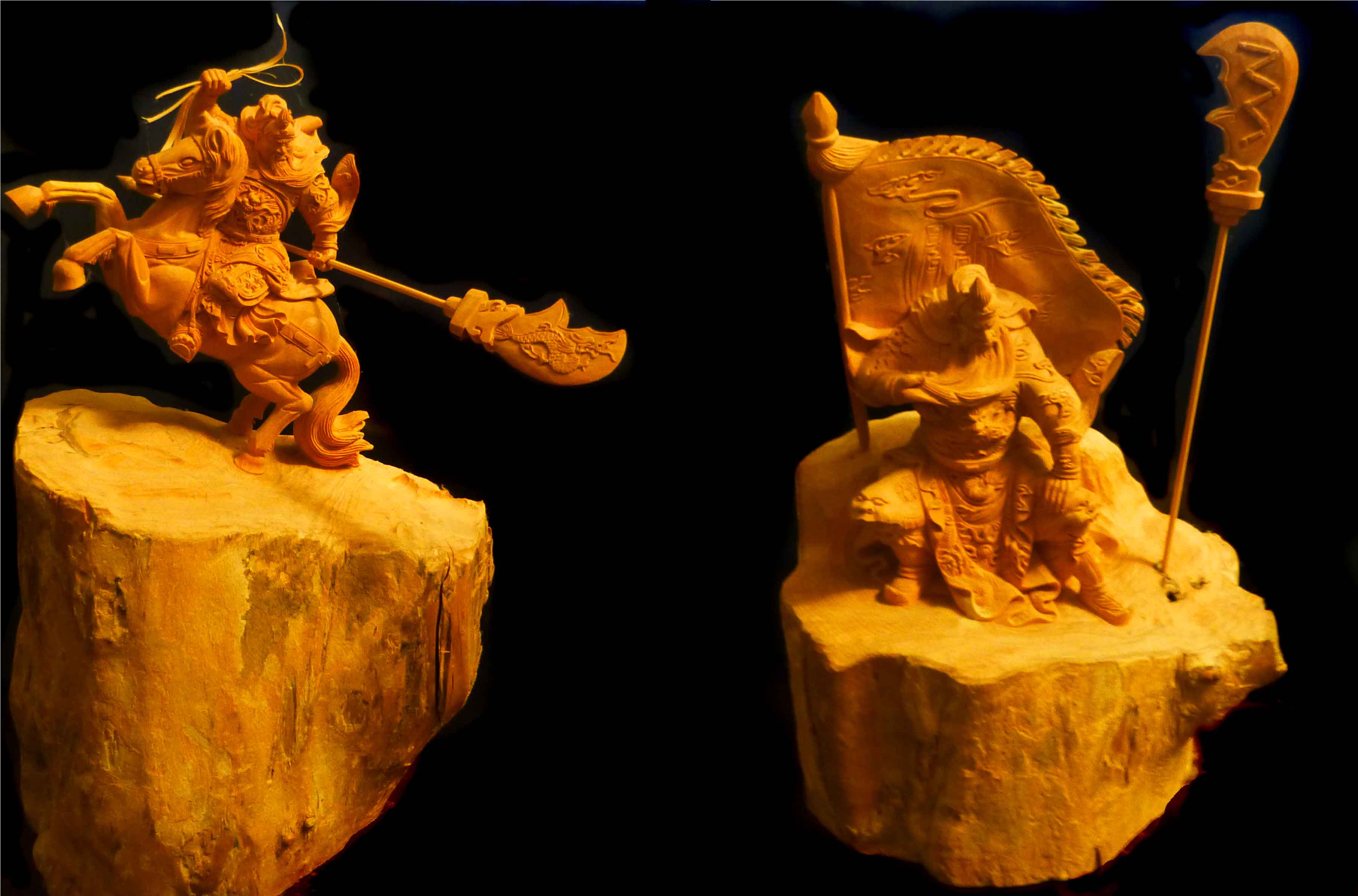
There is another moral hero from China’s history. During the Three Kingdoms era (220-265 A.D.) after the fall of the Han Dynasty, there was a period of civil war. Out of this era came the story of Guan Yu, who was another moral model of loyalty and righteousness.
Guan Yu lived almost eighteen hundred years ago, but it is easy to find carvings and statues of him in China. In fact, I have several hand carved in wood. Here are two of them.
It doesn’t matter if one is a member of the Communist Party, because role models like Yue Fei and Guan Yu still play an important part in how many Chinese behave and what they think. Anyone in China holding a position of power is measured against men like Yue Fei and Guan Yu.
To help gain a better understanding of what honor means to the Chinese, here’s a link to a piece published in theLos Angeles Times.
In 1935, Lin Yutang said, “Face cannot be translated or defined. It is like honor and is not honor. It cannot be purchased with money, and gives a man or a woman a material pride. It is hollow and is what men fight for and what many women die for.
“It is invisible and yet by definition exists by being shown to the public. It exists in the ether and yet can be heard, and sounds eminently respectable and solid. It is amenable, not to reason but to social convention.
“It protracts lawsuits, breaks up family fortunes, causes murders and suicides, and yet it often makes man out of a renegade who has been insulted by his fellow townsmen, and it is prized above all earthy possession.”
“It is more powerful than fate and favor,” Lin Yutang said, “and more respected than the constitution. It often decides a military victory or defeat, and can demolish a whole government ministry. It is that hollow thing which men in China live by.” (Lin Yutang, My Country and My People, Halcyon House, New York, NY, 1938, page 200)
Chinese like Yue Fei and Guan Yu were honorable men and gained much face/respect because of their beliefs and behavior.
When anyone in China reacts to anything, politically or personally, honor plays a large role. It doesn’t matter if one is a member of the Communist Party, a farmer or a factory worker or one of the wealthiest members of the new capitalist elite.
Most Chinese measure what is important in life by a different standard than the rest of the world.
_______________
Lloyd Lofthouse is the award-winning author of My Splendid Concubine [3rd edition]. When you love a Chinese woman, you marry her family and culture too. This is the lusty love story Sir Robert Hart did not want the world to discover.
Finalist in Fiction & Literature – Historical Fiction
The National “Best Books 2010” Awards
Honorable Mentions in General Fiction
2012 San Francisco Book Festival
2012 New York Book Festival
2012 London Book Festival
2009 Los Angeles Book Festival
2009 Hollywood Book Festival
Subscribe to “iLook China”!
Sign up for an E-mail Subscription at the top of this page, or click on the “Following” tab in the WordPress toolbar at the top of the screen.
Lloyd Lofthouse is the award-winning author of My Splendid Concubine [3rd edition]. When you love a Chinese woman, you marry her family and culture too. This is the love story Sir Robert Hart did not want the world to discover.
Subscribe to “iLook China”!
Sign up for an E-mail Subscription at the top of this page, or click on the “Following” tab in the WordPress toolbar at the top of the screen.
In America and the rest of the West, most people believe that Mao was a monster worse that Adolf Hitler or Stalin and is responsible for killing at least 30 to 60 million people during what is known as China’s Great Famine.
In fact, many Chinese also believe that millions died of starvation during The Great Famine (1958 – 1961) due to Mao’s demanding agricultural production goals during China’s Great Leap Forward.
Until recently, I also believed this without doubt since that is all I have ever heard.
The details that may have caused this famine are not common knowledge and it appears that no attempt by the Western media has been made to reveal them.
However, after discovering what happened in China and the world during Mao’s Great Leap Forward, what was once a certainty (at least to me) is now a mystery and possibly another hoax equal to the hoax that Tibet was never part of China before 1950 and there was a massacre in Tiananmen Square in 1989, which Wiki Leaks recently proved wrong.
No mention of drought, floods and severe weather that cut crop yields, and the number of deaths quoted in the video cannot be supported with evidence. In addition, evidence that does exist supports far fewer deaths.
Why Mao may have become scapegoat or victim of a hoax is worth examining.
The reason I say this is because in 1949 when Mao came to power, life expectancy in China was about 35, and then in 1960 life expectancy improved to about 60 or almost double what it had been in 1949, while the population of China increased by 19.5% with child mortality rates improving dramatically.
If Mao’s policies were responsible for these improvements in life expectancy and population growth, how could he also be the monster responsible for causing a famine that may have killed millions?
If a famine did occur, my research revealed that other factors may have contributed to the deaths and all but one of those factors did not deliberately cause people to die of starvation.
After learning of these other factors and completing the puzzle, it is obvious (at least to me) that Mao and the Communist Party did not order the deaths of 15 to 70 million people (the numbers quoted in the West vary widely because different people have made different claims without valid evidence to support those claims. There is evidence that supports the lower number.).
Before I started researching this post, I believed that Mao’s agricultural reform policies were mostly responsible for the famine, and then I learned that drought and severe weather also played a role in the famine.
The other factors that may have contributed to China’s so-called Great Famine will be listed in order of influence with the most damaging factor listed first and the least damaging last.
The first factors that may have contributed to the famine were droughts, floods and general bad weather.
In 1959 and 1960, the weather was less favorable, and the situation grew considerably worse, with many of China’s provinces experiencing severe famine.
Droughts, floods, and bad weather caught China completely by surprise, and in July 1959, the Yellow River flooded in East China and directly killed,either through starvation from crop failure or drowning, an estimated 2 million people.
In fact, droughts and famine are common in China. Between 108 BC and 1911 AD, there were no fewer than 1,828 major famines in China or one nearly every year in one or another province.
In the West, most if not all of what we hear about Mao is that he was a brutal monster responsible for the deaths of about 30 million people during the Great Leap Forward as if he pulled the trigger and ordered others to deliberately kill people by the millions as Hitler and Stalin did.
However, the facts do not support this claim.
The first time I heard that droughts and extremely bad weather also played a role in the so-called Great Famine was early July 2011 while I was researching another topic for this Blog and stumbled on that mostly unknown fact by accident.
Then I discovered another more insidious factor when I started working on this post, which may have contributed significantly to the early deaths of millions in China and no one in China was responsible for this one.
This factor was influenced by both American and Chinese paranoia generated by the Korean War (1950 – 1953), America’s involvement in Vietnam (1955 – 1975), McCarthyism‘s Red Scare (1947 – 1957) and the Cold Warwith Communist Russia (1945 – 1991).
The War in Korea (1950 – 1953), Vietnam (1955 – 1975), McCarthyism (1947 – 1957) and the Cold Warwith the USSR (1945 – 1991) set the stage for what may have contributed to mass deaths by starvation in China during the Great Leap Forward.
During the McCarthy era (1947 – 1957), thousands of Americans were accused of being Communists or communist sympathizers and became the subject of aggressive investigations and questioning before government or private-industry panels, committees and agencies.
In 1950, since China fought alongside North Korea against allied UN forces under the leadership of the US, the United States implemented a “complete embargo” that forbade all financial transaction with Communist China.
The US also convinced many of its allies to join this “complete embargo” to cut China off from the world.
After the Korean war, the United States did not lift this embargo for the next twenty years (1949-1969), with a goal to disrupt, destabilize, and weaken China’s communist government by causing the people to suffer and this “complete embargo” was one of the tools to achieve this.
The US embargo on China was a “complete embargo”, whch certainly must have contributed to the death toll of the Great Famine, a factor never mentioned before.
High American government sources have admitted that the objective of the economic warfare was aimed at causing a breakdown of Communist China. The idea was that problems in the Chinese economy would lead to loss of support from the people causing the collapse of the Communist Republic. Source: China for all.info and Asia for Educators – Columbia.edu
This embargo was lifted in 1969, when Richard Nixon was President. Source: Washington Post.com
However, while people were starving in China and US officials were waiting for Communist China to collapse, Washington D.C. had no idea how much suffering the Chinese people were capable of enduring and that even with the drought and famine, most Chinese were better off than they had been in centuries.
The evidence that the quality of life was improving was the fact that in 1949 when Mao came to power, life expectancy in China was 35, and by 1960 life expectancy had improved to age 60 or almost double what it had been in 1949, while the population of China increased by 19.5% with child mortality rates improving dramatically.
Field-studies in the 1930s revealed that in all parts of China, large numbers of landless laborers lived in tremendous poverty, and their situation had not changed since the sixteenth century. Source: China for all.info
If you want more evidence, I refer you to Pearl S. Buck’s “The Good Earth”.
We may never know how much of an impact America’s “economic warfare” against China crippled its ability to import food to feed its starving people in a time of drought and famine. In fact, this may have also influenced Mao’s decisions since he wanted the world to see China as strong and capable of feeding itself.
If anyone pulled a trigger on China’s people, it was not Mao. It was Washington D.C. fueled by fear of everything Communist caused by the Korean War, Vietnam, McCarthyism’s Red Scare and the Cold War with Communist Russia.
The last damaging factors that may have led to millions of deaths due to famine and starvation was the statistical lies of rural farmers and local party bosses reporting crop yields in rural China and Mao’s impossible goals to create a miracle in five years.
Mao’s five-year plan for the Great Leap Forward set quotas (goals) to develop agriculture and industry so China would catch up to America and the other Western nations that had invaded China during the 19th century (England, France, Japan, Germany, Russia, America, etc.)
Mao believed that both agriculture and industry had to grow to allow the other to thrive.
Industry could only prosper if the workers were well fed, while the agricultural workers needed industry to produce the modern tools needed for modernization.
For this to happen, rural China was reformed into a series of giant communes.
However, the droughts, floods and other severe weather arrived soon after this five-year plan was implemented and set the stage for a tragedy caused by nature and supported by American “economic warfare” in the form of a “complete embargo” of China.
Due to quotas set by Mao’s agricultural policies, no one wanted to be seen as a failure and/or unpatriotic so this generated boastful claims about output that were followed by more boastful claims of incredible crop yields.
Nobody – least of all the central government in Beijing – knew the real output figures and nobody was trying to find out. Instead, there was a sense of general euphoria in Beijing that China was succeeding.
While rural farmers and party posses lied about crop yields, China started exporting rice and wheat to other countries as a source of revenue, since Beijing believed there was a bumper crop. The result was that only urban areas suffered with reduced rations but with still enough food to survive.
However, the situation was different in the areas that lied the most and resulted in mass starvations largely confined to rural China, where, because of drastically inflated production statistics, very little grain was left for the peasants to eat.
Food shortages were bad throughout the country. However, the provinces, which had adopted Mao’s reforms with the most energy, zeal and the highest boasts, such as Anhui, Gansuand Henan, tended to suffer disproportionately.
Sichuan, one of China’s most populous provinces, known in China as “Heaven’s Granary” because of its fertility, is thought to have suffered the greatest absolute numbers of deaths from starvation due to the vigor with which provincial leader Li Jinquan undertook Mao’s reforms.
Once the central government in Beijing discovered the truth, the Chinese Communist Party acted quickly to correct the errors in national agricultural decision-making, to conserve food, and to save as many lives as possible implementing drastic measures to feed those in need and to restore agricultural productivity.
Grain exports were stopped, and imports from Canada and Australia (in spite of America’s complete embargo) helped to reduce the impact of the food shortages. Source: Library Index.com
The final question is: Would Mao’s Great Leap Forward have been more successful if there had been no drought, no floods and no “complete (U.S.) embargo” and the people had not lied about crop yields?
It is no secret that millions of rural people starved to death in China during the famine of 1959 – 1960, but it was a “great” tragedy caused by a complex series of circumstances and was not murder.
In addition, the actual number of deaths was significantly lower than what has been claimed in the West.
The CCP’s lofty goal was to prove to the world that the Party ruled China successfully by boosting crop yields and industrial output.
Another reason the CCP set such unrealistic goals for the five-year plan that contributed to the tragedy that was Great Leap Forward was because of Taiwan, which was recognized by the world as the official government of China and still held its seat in the United Nations.
It wouldn’t be until 1971 that the U.N. recognized the People’s Republic of China instead, and the United States wouldn’t switch diplomatic relations with China from Taipei to Beijing until 1979, finally recognizing the Communist Party as the legitimate ruler of China.
From Griffith University, Australia, Poverty, by David C. Schak, Associate Professor
______________
Lloyd Lofthouse is the award-winning author of The Concubine Saga. When you love a Chinese woman, you marry her family and culture too. This is the love story Sir Robert Hart did not want the world to discover.
To subscribe to “iLook China”, look for the “Subscribe” button at the top right of the screen.