China’s Privately Passionate Poetry

July 26, 2010

I’m sure that most Westerners do not think of love poems when they think of China. However, there has to be a reason for more than 1.3 billion people besides the Great Wall of China, the Pacific Ocean and the biggest mountain range on the planet, the Himalayas, which helped wall China from the violence that rocked the rest of the world for centuries—at least until the Opium Wars.

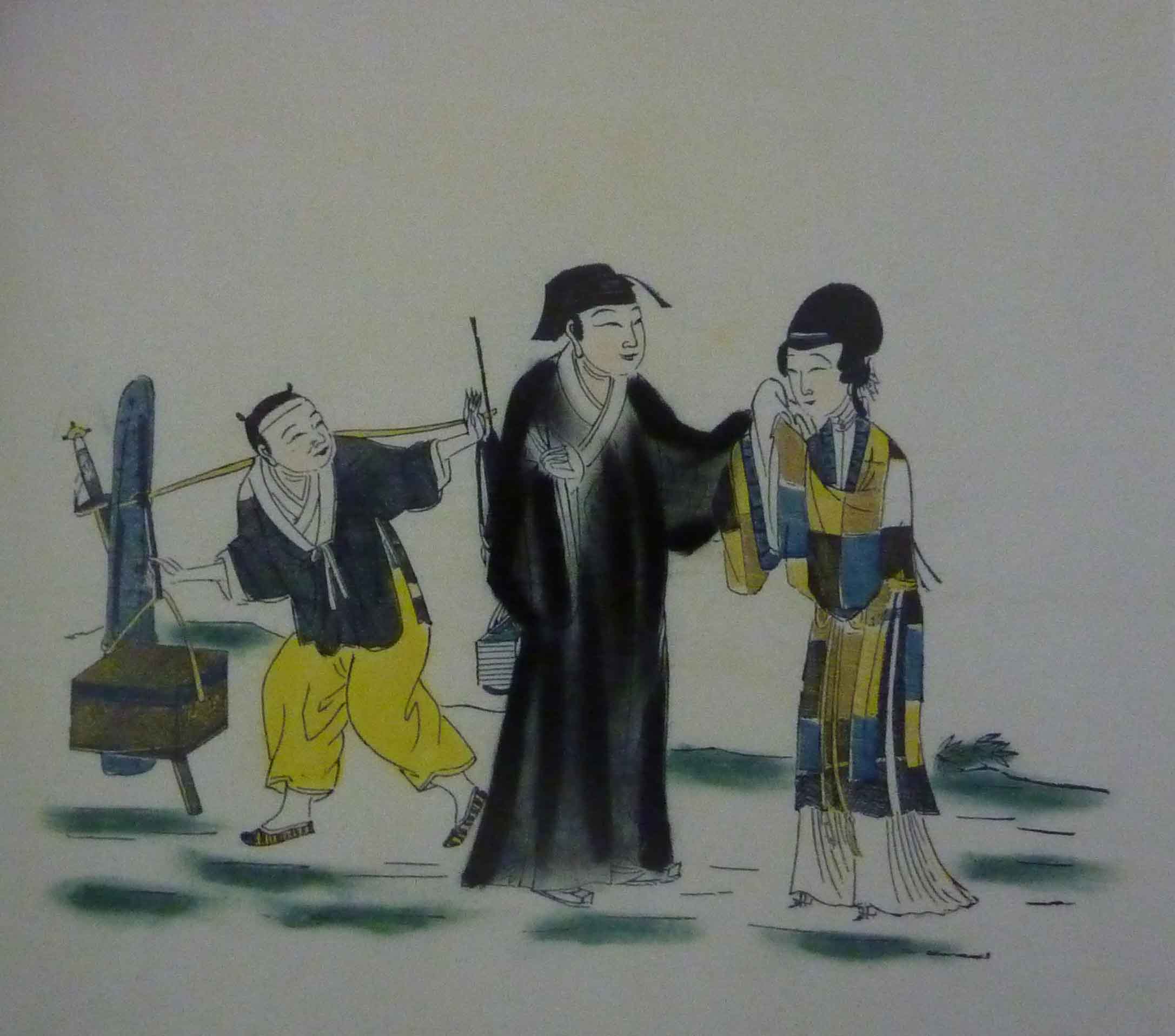
For poetry lovers, this book imparts a sense of the private passion that beats in the Chinese heart. The three arts of poetry, calligraphy and painting, the Triple Excellence, are represented on the pages.

The painting, lady weeping at parting from husband, 17th century, comes from the Qing Dynasty and the book says it is a color woodblock print on paper.

Chinese poetry is frequently personal and often linked to a particular occasion (page 9).

Deeply in love, but tonight
we seem to be passionless;
I just feel, before our last cup of wine
a smile will not come.
The wax candle has sympathy ­­–
weeps at our separation:
Its tears for us keep rolling down
till day breaks.

by Du Mu (803-852 AD)

As you can see, the Chinese are a passionate people—they just don’t dramatize these passions publicly as many in the West do—at least until the West invaded China to force—if possible—a different set of values on China’s collective culture.

The Golden Age of Poetry in China was in the Tang Dynasty (618-906 AD).  This book of Chinese Love Poetry was edited by Jane Portal (© 2004) and published by Barnes & Noble Books (ISBN 0-7607-4833-0).

discover China’s Sexual Revolution or Yu Opera with Mao Wei-tao

_______________

Lloyd Lofthouse is the award-winning author of My Splendid Concubine [3rd edition]. When you love a Chinese woman, you marry her family and culture too. This is the love story Sir Robert Hart did not want the world to discover.

His latest novel is the multiple-award winning Running with the Enemy.

Subscribe to “iLook China”!
Sign up for an E-mail Subscription at the top of this page, or click on the “Following” tab in the WordPress toolbar at the top of the screen.

About iLook China

China’s Holistic Historical Timeline


The Long March – Part 1 (3/6)

July 25, 2010

During the retreat, the Communists brought along the machinery for their government—printing presses, typewriters, etc.  The Communist’s leaders argued about what to do.  Mao wanted to break through the Nationalist lines and attack from the rear.  He was voted down.

Instead, the decision was for a full-scale retreat and to link up with another Red Army in its stronghold deeper in China. The Nationalists used hundreds of aircraft to bomb and strafe the Communist columns. As much as one-third of the Communist forces were killed by air attacks.  To avoid this, the Communists started to move at night and hide during the day.

A new obstacle, a rugged river, stood in their way. A brutal battle was fought to cross the river. A small force made it and the survivors were ferried across on bamboo rafts.  It took eight days for the entire army to cross.

The biggest problem was the heavy supply column with the machinery of government, so the Communists left the printing presses and coin minting machines behind along with the government’s records. After suffering horrible losses and not knowing what to do, Mao argued for a change of tactics. He said they didn’t have to win every battle.

Return to The Long March, Part 1/2 or go on to The Long March – Part 1/4

________________________

Lloyd Lofthouse is the award-winning author of the concubine saga, My Splendid Concubine & Our Hart. When you love a Chinese woman, you marry her family and culture too. 

Sign up for an RSS Feed for iLook China


Serious Spy Games

July 25, 2010

Am I wrong?  I read George Jahn’s Associated Press piece about spies on Yahoo.com, and got the idea that the author/editor was complaining. “Emerging giants such as China pose different threats as they use the most sophisticated cyber technology to snoop on established world powers.”

Does the CIA snoop? What kind of threats does China pose? In fact, what kind of threat does the US pose to China? Using the word SNOOP paints a picture of some pervert hiding in the bushes at night watching you undress through your window. I also question the use of the term “established world powers”.

Study history and you discover that power shifts all the time.  China was an established world power for more than two thousand years until the West got the upper hand during the 19th century. America didn’t become an established world power until after World War II and keeping that status has come at a steep price.

At one time, China was the established world power and nations like France, Germany, Russia, Japan, Great Britain and the United States were the emerging powers that posed threats to China and the price China paid for that assault was terrible. Now that China is on the way back, the nations that challenged China less than two centuries ago are complaining.

Interesting. I thought all was fair in love and war for both sides.

See The First Emperor: The Man Who Made China

______________________

Lloyd Lofthouse is the award-winning author of the concubine saga, My Splendid Concubine & Our Hart. When you love a Chinese woman, you marry her family and culture too. 

Sign up for an RSS Feed for iLook China


The Long March – Part 1 (2/6)

July 25, 2010

The US and Great Britain supplied bombers, fighters and reconnaissance aircraft to Chiang Kai-shek’s troops and wanted Chiang to attack the Japanese.  Instead, he went after the Communists and signed a truce recognizing a Japanese government in Northeast China.

Chiang wanted to fight army to army the old fashioned way. Mao had his forces avoid a direct assault and fought using hit and run tactics. Advisors from Soviet Russia pressured Mao to be bolder but he refused, while Chiang was getting advice from a Nazi General from Hitler’s Germany.

When the Red Army finally stood their ground as the Soviets urged, the Communists lost sixty-thousand troops. They could not hold the lightly fortified positions they had built, because Chiang’s KMT were better armed.

In October 1934, Mao’s forces streamed out of their territory after suffering horrible losses. The Long March had begun. Nearly 87,000 troops moved in two main columns to the West and to the South.

It would be several weeks before Chiang’s knew the Communists had fled. At this time, Mao came down with a severe case of malaria and had to be carried most of the time.

Start with or return to The Long March, Part 1/1 or go on to The Long March – Part 1/3

________________________

Lloyd Lofthouse is the award-winning author of the concubine saga, My Splendid Concubine & Our Hart. When you love a Chinese woman, you marry her family and culture too. 

Sign up for an RSS Feed for iLook China


Deadly Fat Profits

July 24, 2010

CNNMoney.com reports in China: The new fast food nation, that Yum Brand, the parent company of KFC, Pizza Hut and Taco Bell, has seen its profits in China jump 33% in the second quarter.… In fact, American fast food is very popular in China.  Yum opens one new KFC every day in China with nearly 3,000 and a long-term goal to have 20,000 fast-food outlets in Chinese cities.

Keeping pace with fast food consumption is the increase in obesity, diabetes and cancer rates in China.  Bullfax.com reports that the growing popularity of Western junk food is fueling a diabetes boom across Asia. In fact, China is facing a diabetes epidemic and 92 million Chinese men and women have diabetes and almost 150 million more are close to having it.

CBS News reports that China’s soaring cancer rates appear to be keeping pace with the increase in urban Chinese eating Western fast food. When Deng Xiaoping said, “Getting rich is glorious,” did he mean that business people should become parasites causing this to happen?

See The Challenge of Rural Health Care in America and China

________________________

Lloyd Lofthouse is the award-winning author of the concubine saga, My Splendid Concubine & Our Hart. When you love a Chinese woman, you marry her family and culture too. 

Sign up for an RSS Feed for iLook China