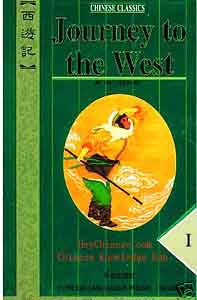
China’s Three “Journeys to the West”

July 31, 2010

No, this is not about immigrants or armies invading America. Besides, Chinese troops would have to swim the Pacific since China’s navy isn’t large enough to move a force that size, since China does not have America’s military capabilities.

This post is about China’s classic novel, “Journey to the West”.

There are four novels that are considered Chinese classics—Romance of the Three Kingdoms, Dream of Red Chamber, Journey to the West and The Outlaws of the Marsh (some of these classics have been released in other titles).

In fact, there are three Chinese books titled “Journey to the West”.

One Journey to the West is nonfiction about K’iu Ch’ang Ch’un, who visited Genghis Khan in Persia between 1221 and 1224.

The second Journey to the West is another nonfiction account about Hsuan Tsang, a Buddhist monk who travels to India to bring back Buddhist scriptures.

The third Journey to the West is a fictional romance that introduces the Monkey King and his friend the Pig on their journey to the West.

Also, see Dream of Red Chamber or Romance of the Three Kingdoms

______________

Lloyd Lofthouse is the award-winning author of The Concubine Saga. When you love a Chinese woman, you marry her family and culture too. This is the love story Sir Robert Hart did not want the world to discover.

Subscribe to “iLook China”!
Sign up for an E-mail Subscription at the top of this page, or click on the “Following” tab in the WordPress toolbar at the top of the screen.

About iLook China


The Dangers of the Korean Incident

July 30, 2010

Sunny Lee writing for the The Korea Times reports that the majority of Chinese policymakers and academics feel that the Cheonan incident, where a North Korean torpedo allegedly sank a South Korean navy ship, “may” not be true. However, that doubt is not the only factor playing a crucial role in Chinese decision-making.

The Chinese also feel that the US and South Korea are politically motivated and overreacting. China sees the incident as part of the 60-year-long hostility between the two Koreas. In fact, China wants the US, South Korea and North Korea to pull back from the incident.

China’s opinion may be the best advice. 

If you do not agree, consider World War I, the “Great War” if a war may be called great. World War I was not caused by dictators hungry for power as in the case of Mussolini and Hitler and the military oligarchy that ruled Japan during World War II.

World War I was caused by a strong sense of nationalism and emotions that were allowed to rule the day. Strong feelings of nationalism fed hatred in pre-war Europe. It turned Frenchman against German and Russian against Austrian.  Source: Causes of World War I

Regarding the Cheonan incident, China is the cool head while the hotheads are the US, South Korea and North Korea. If these hot heads prevail, how much suffering and death would add to the 45 deaths already caused by the sinking of the Cheonan?

The match that lit World War I was the assassination of one man, the Archduke Franz Ferdinand of Austria on June 28, 1914.  By the end of the war in late 1918, fifteen-million people had been killed, making the war one of the deadliest in history. 

Does the world want that in Asia?  America’s Military Industrial Media Empire might, but China clearly doesn’t—evidence that war is the last thing China wants.

Discover more about China and North Korea

_____________________

Lloyd Lofthouse is the award-winning author of the concubine saga, My Splendid Concubine & Our Hart. When you love a Chinese woman, you marry her family and culture too. 

Sign up for an RSS Feed for iLook China


The Long March Part 2 (4/4)

July 30, 2010

In 1949, Mao won China and Chiang Kai-shek, still supported by America, fled to Taiwan with the remnants of his KMT army.

Meanwhile, Mao’s six thousand survivors from the First Red Army ruled a country of a half-billion people. Most of the Communist government’s highest-ranking officials from the 1950s through the 70s were the survivors of the Long March.

In one year and one day, the First Red Army covered six-thousand miles, the distance between New York and San Francisco and back again.  They averaged about 24 miles a day, climbed 18 major mountain ranges and crossed 24 rivers.

The First Red Army wasn’t the only Communist army to make this march. Two other Red Armies followed and overcame the same obstacles to join Mao’s forces in Shaanxi Province.

Map of the Long March

Many outside China may think of Mao as a ruthless dictator, but there is no way anyone can deny what he achieved as the commander of the First Red Army during the Long March. He could not have done it without the loyalty of the people and his troops.

Return to The Long March – Part 2/3 or start with The Long March – Part 1/1

_________________________________

Lloyd Lofthouse is the award-winning author of the concubine saga, My Splendid Concubine & Our Hart. When you love a Chinese woman, you marry her family and culture too. 

Sign up for an RSS Feed for iLook China


A High Price for Chinese Porcelain

July 30, 2010

Jingdezhen in Jiangxi province is a well-known Chinese porcelain city and has been an important production center in China since the early Han Dynasty (206 BC – 220 AD). Chinese porcelain originated in the Shang Dynasty (16th century BC). Source: China Paper Online

Frances Miller writes about collecting antique Canton china at Suite 101.com. He says, “Since the 18th century, blue and white porcelain china originating from the port of Canton has been filling cabinets in America… and was a staple on the dining tables of such prominent Americans as George Washington and Thomas Jefferson.”  

“The demand for Chinese products—tea, porcelain, silk, and nankeen (a coarse, strong cotton cloth)—continued after the Revolution. Having seen the British make great profits from the trade when the colonies were prevented from direct trade with China, Americans were eager to secure these profits for themselves.” Source: Early American Trade With China

This hunger for Chinese products, while the Chinese found little in the West to buy, led to the Opium Wars, which Britain and France started and won to force China to even the trade imbalance. Then China sold the West silk, porcelain and tea while the West sold China opium.

Today, we still hear angry voices complain about the unfair trade imbalance between China and the US. Can anyone blame China for maintaining a powerful military?

See The Accidental Discovery of Gunpowder

_____________________________

Lloyd Lofthouse is the award-winning author of the concubine saga, My Splendid Concubine & Our Hart. When you love a Chinese woman, you marry her family and culture too. 

Sign up for an RSS Feed for iLook China


The Long March Part 2 (3/4)

July 29, 2010

Mao’s troops didn’t want to return through the grasslands and he issued orders to take the pass. The fighting was fierce and Mao’s Red Army took heavy losses.

Mao stopped the direct assaults and sent skilled climbers up one of the canyon’s walls.  From the high ground, they shot down at the Nationalist fortifications blocking the pass.

One volunteer wrapped his body in explosives, leaped from the cliff into the middle of the Nationalist fortifications, and blew himself up opening the pass.

Mao’s First Red Army finally reached desolate and rugged Shaanxi Province. The Long March was over, and Mao’s troops linked up with other Red Army elements that already had a base there.

Of the original 87,000 who started the Long March, fewer than 6,000 survived. These survivors would recruit and lead the new army.

The Long March turned Mao into a leader with a following from the common people throughout China.

Eventually, the Fourth Red army arrived, but two-thirds of this army had been killed in battles.

Chiang Kai-shek planned a new campaign to defeat Mao, but Chiang’s supporters and generals forced him to work with the Communists to fight the Japanese. This uneasy alliance would become a Civil War in 1945 when World War II ended.

Return to The Long March – Part 2/2 or go on to The Long March Part 2/4

_________________________________

Lloyd Lofthouse is the award-winning author of the concubine saga, My Splendid Concubine & Our Hart. When you love a Chinese woman, you marry her family and culture too. 

Sign up for an RSS Feed for iLook China