Fewer Workers and Rising Wages Equals More Spending

August 18, 2010

The Economist published an interesting piece about the changing economic landscape in China.   If you read between the lines, it appears that the Wall Street crash that shook the world in 2008 and is still generating pain may have been a catalyst for changes benefiting the Chinese worker.

In 2008, 670 thousand factories closed their doors in China putting 25 million migrant laborers out of work, but wages went up 17.3% by the end of 2009, which makes no sense.

When I was still teaching and California’s money was tight, schools saw funds cut, jobs lost and salaries frozen, which is still happening now because of the 2008 crash.

A shrinking workforce in China happened to coincide with the 2008 global economic meltdown.  The International Business Times reports that due to China’s longtime one-child, family planning policy, the population of 20 to 39 year-old workers, the backbone of China’s labor force, has dropped 22% in the last 10 years while older workers are staying in the villages.

These changes encouraged China’s central government to shift support from businesses to workers by encouraging the provinces to raise the minimum wage while keeping a low profile during labor unrest.

Some industries moved inland where wages are lower but ended up selling their products to local Chinese consumers, which caused other foreign companies to build factories inland—not for the cheap labor, but to get closer to those local consumers.

According to The Economist, “As pay goes up, the country’s domestic market will become more lucrative. Foreign firms that came for the workers will stay for the shoppers. China will become more of a workshop for itself and less of one for the world.” 

In today’s harsh global economy, China may have the only growing consumer market. In fact, this may generate jobs in America.  To understand, you’ll have to read both pieces yourself.

See Hitting Endless Home Runs

_______________

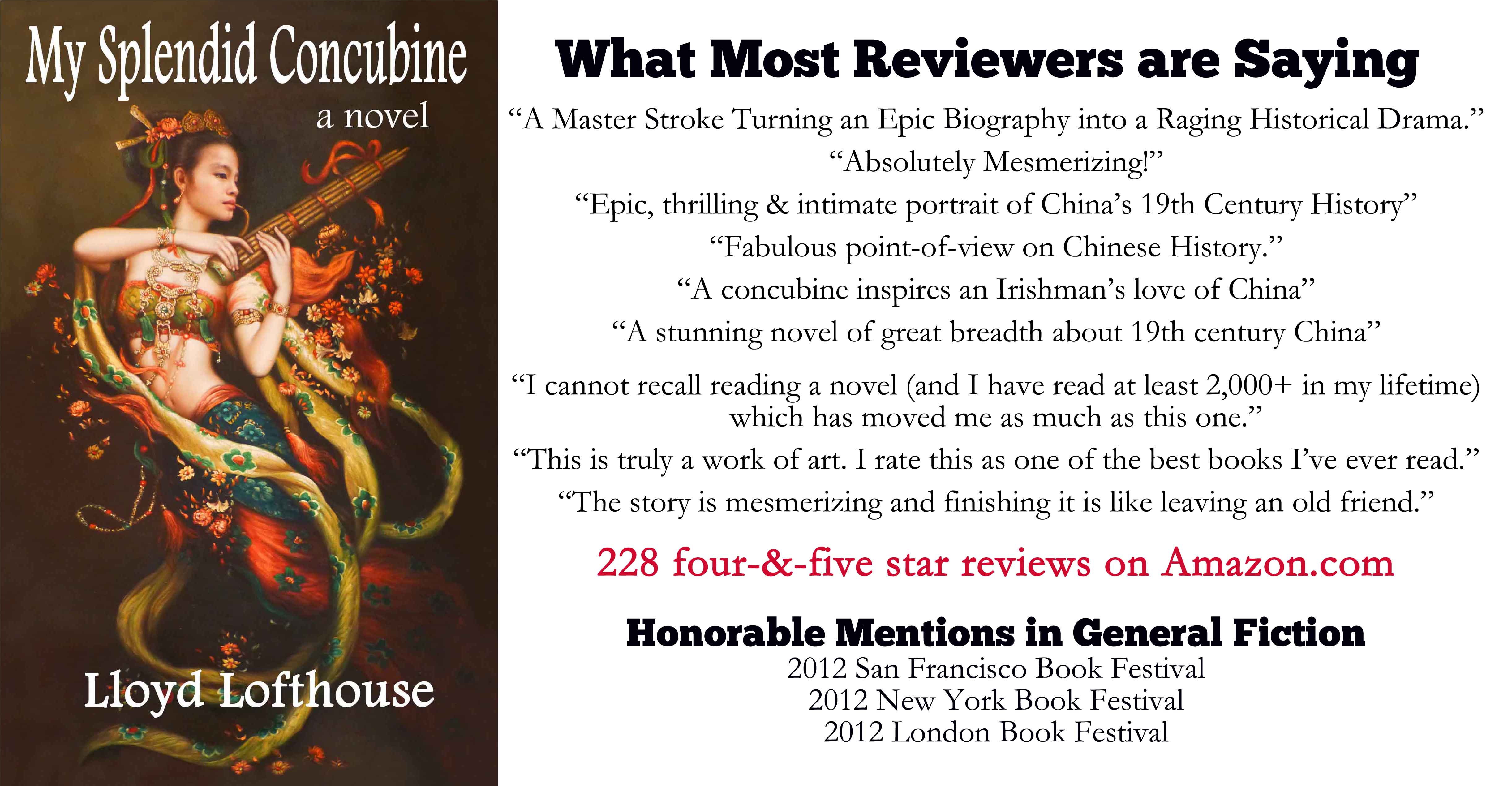
Lloyd Lofthouse is the award-winning author of the concubine saga, My Splendid Concubine & Our Hart. When you love a Chinese woman, you marry her family and culture too. 

Sign up for an RSS Feed for iLook China


The Danger of Arrogance (5/5)

August 18, 2010

In the 18th century, China had no competition, and the Qianlong Emperor was not alone in his belief that China was too civilized and powerful to worry.

However, in less than a century, China would face defeat during the Opium Wars caused by England and France. The century that followed would devastate China until Deng Xiaoping’s rise to power after Mao died.

Other factors that weakened China during the 19th century, were the rebellions caused by converted Chinese Christians and Muslims that would cause more than 30 million deaths.  

Now that China has recovered its power, it would be interesting to see if the Chinese have learned from the Qing Dynasty’s mistakes.  America could also learn something from the British Empire’s arrogance and why the sun stopped shinning twenty-four hours a day on that empire.

I’m not going to hold my breath.

Return to the Danger of Arrogance – Part 4

_______________

Lloyd Lofthouse is the award-winning author of the concubine saga, My Splendid Concubine & Our Hart. When you love a Chinese woman, you marry her family and culture too. 

Sign up for an RSS Feed for iLook China


In the National Interest

August 17, 2010

It seems America might be helping Vietnam become a nuclear power.

The Hindu reports that China is protesting what might be an American “double standard”.  A leading Chinese strategic expert on nuclear policy and disarmament told The Hindu that any move to allow Vietnam, which neighbors China, to enrich its own uranium would be “double standards” on the part of the U.S.…

This latest hot-button issue took off soon after the Wall Street Journal reported that the US was talking with Vietnam about sharing nuclear fuel and technologies that would include Vietnam enriching its own fuel, which is used in nuclear weapons.

Why would the U.S. play this dangerous game?  The answer may be found from Margi Mason of the Associated Press.  She writes that the U.S. has a “national interest” in seeing the claims resolved in the South China Sea.

So, what is in the national interest of the US to help Vietnam?  The answer is oil and to keep our military close to China while gaining allies. 

The US population needs the gasoline and diesel made from oil to drive to work and shop. The huge oil companies need to sell that oil, gasoline and diesel so they can pay wages to their employees while making profits. America’s national interest is everything to do with jobs and the economy.

However, China is not happy because what the US is doing in Vietnam is not in China’s national interest.

Discover The Real Police State

_______________

Lloyd Lofthouse is the award-winning author of the concubine saga, My Splendid Concubine & Our Hart. When you love a Chinese woman, you marry her family and culture too. 

Sign up for an RSS Feed for iLook China


The Danger of Arrogance (4/5)

August 17, 2010

China’s 18th century arrogance is evident in the letter the Qianlong Emperor wrote to King George III.

Emperor Qianlong’s letter to King George III says, “As your Ambassador can see for himself, we possess all things. I see no value on objects strange or ingenious, and have no use for your country’s manufactures.…

“Hitherto, all European nations, including your own country’s barbarian merchants, have carried on their trade with our Celestial Empire at Canton. Such has been the procedure for many years, although our Celestial Empire possesses all things in prolific abundance and lacks no product within its own borders.

“There was therefore no need to import the manufactures of outside barbarians in exchange for our own produce. But as the tea, silk and porcelain which the Celestial Empire produces, are absolute necessities to European nations and to yourselves, we have permitted, as a signal mark of favour, that foreign hongs should be established at Canton, so that your wants might be supplied and your country thus participate in our beneficence.”

At the end of the letter, Emperor Qianlong warns King George III what will happen to any merchants who try to circumvent his laws and says, “Do not say that you were not warned in due time! Tremblingly obey and show no negligence! A special mandate!”

This exchange took place in 1793.  At that time, the Chinese didn’t need anything from any country.  In fact, for more than a thousand years, the Chinese had been more technologically advanced in printing, paper production, weaponry, etc than any country on the planet.

See Foreign Devils and Barbarians or return to the Danger of Arrogance – Part 3

_______________

Lloyd Lofthouse is the award-winning author of the concubine saga, My Splendid Concubine & Our Hart. When you love a Chinese woman, you marry her family and culture too. 

Sign up for an RSS Feed for iLook China


The WHO’s War on Tobacco

August 17, 2010

Gillian Wong for the Associated Press wrote about a battle over tobacco heating up in China—pun intended. China also signed the global anti-tobacco treaty backed by the World Heath Organization to cut tobacco use.

However, in China, tobacco companies sponsor public schools.  Something similar happened in the US when Coke and Pepsi installed vending machines in the public schools where students could feed their sugar cravings and grow obese at the same time.

In fact, at Nogales High School in La Puente, California where I taught for years, I was told one morning by the truck driver filling the vending machines in the halls that more than two-thousand “cases” of Coke were selling a week there. 

The schools district made a nice profit from its share. Now, it seems selling sodas at schoolmay” be against the law.

Maybe the US was China’s role model, but the Chinese have gone one-step further by (according to Gillian Wong) taking elementary students on school sponsored tours of cigarette factories where the slogans say, “Talent stems from hard work, tobacco helps you become accomplished.”

Where’s Qin Shi Huangdi when China needs him most? After all, when the first emperor wanted to get something done, nothing stopped him. He unified China, finished building The Great Wall, mandated one written language and had the scholars who complained dig their own graves before setting them on fire and throwing dirt on the remains.

On the other hand, if China did nothing, the One-Child policy could be abolished pleasing Christians around the world.

Then China could encourage smoking to reduce the population. Estimates say that one in three young men will die early from tobacco use. Within fifty years, China’s population problems would be solved while making a profit.

_______________

Lloyd Lofthouse is the award-winning author of the concubine saga, My Splendid Concubine & Our Hart. When you love a Chinese woman, you marry her family and culture too. 

Sign up for an RSS Feed for iLook China