America’s Angel Island

September 8, 2010

Angel Island in San Francisco Bay was America’s west coast Ellis Island.

From 1919 to 1940, mostly Asian immigrants entered the US through Angel Island.

After 1940, the immigration station on Angel Island was forgotten until a California Park Ranger, Alexander Weiss, discovered the stories carved in the walls.

He thought that there were stories here as if there were ghosts waiting to be heard.

Over half of the Angel Island immigrants came from China and Japan and most of the carvings on the walls were poems written in Chinese.

A former detainee, Dale Ching, went through the station in 1937 when he was sixteen.  Even though Dale’s father was born in the United States, he still had to go through the immigration station.

While the East Coast’s Ellis Island welcomed immigrants, Angel Island’s story was one of sadness and suffering.

Most European immigrants who went through Ellis Island stayed a few hours, but immigrants on Angel Island were kept locked up under armed guard with barbed-wire fences surrounding the buildings and some people stayed for days, weeks, months and years.

The park service wanted to tear the Angel Island buildings down but Weiss found supporters and they struggled to preserve this history.  They succeeded and the restoration project was challenging.

Alexander Weiss sums up the video saying we should know both the right and the wrong from U.S. history.

Discover Discrimination Against the Chinese in America

_______________

Lloyd Lofthouse is the award-winning author of My Splendid Concubine [3rd edition]. When you love a Chinese woman, you marry her family and culture too. This is the love story Sir Robert Hart did not want the world to discover.

His latest novel is the multiple-award winning Running with the Enemy.

Subscribe to “iLook China”!
Sign up for an E-mail Subscription at the top of this page, or click on the “Following” tab in the WordPress toolbar at the top of the screen.

About iLook China

China’s Holistic Historical Timeline


Global Blood Suckers

September 8, 2010

It looks like Goldman Sachs & Co is under attack from the two most powerful countries on the earth.

Recently, the SEC in the United States penalized the Wall Street firm $550 million to settle civil fraud charges.

Meanwhile, in China, a book called the Goldman Sachs Conspiracy has been published and is selling well.

“The nearly 300-page, highly dramatized account covers much of the same ground as a widely cited piece by Matt Taibbi last year in the Rolling Stone magazine that portrayed the Wall Street institution as a ‘a great vampire squid wrapped around the face of humanity, relentlessly jamming its blood funnel into anything that smells like money.’ ” Source: The Huffington Post

The Young Turks reported that Golden Sachs conspired with John Paulson, who made $3.7 billion dollars in profits when the global economy collapsed and bought into Bank of America with some of that money becoming the bank’s fourth largest investor.

According to the Young Turks, Goldman Sachs set up clients, who lost billions while Sachs made billions from the clients’ losses. 

The Young Turks read one email from a Goldman Sachs’s employee, who calls himself the Fabulous Fab. “The whole building is about to collapse anytime now. Only potential survivor, the Fabulous Fab, standing in the middle of all these complex, highly leveraged, exotic trades he created without understanding all the implications of those monstrosities.”

The Young Turks say that there will be more court cases to follow the SEC case. Maybe China will also take a few Sachs employees to court using some of Sun Tzu’s strategies and put that well-known death penalty to use.

_______________

Lloyd Lofthouse is the award-winning author of the concubine saga, My Splendid Concubine & Our Hart. When you love a Chinese woman, you marry her family and culture too. 

Sign up for an RSS Feed for iLook China


Emperor Wu of Zhou Dynasty – Part 4/4

September 7, 2010

The Temple of Heaven in Beijing is a tribute to the Rituals from the Zhou Dynasty.

What the Zhou Dynasty established is still embedded in everyday aspects of Chinese social life. Showing respect for family ancestors originated with the Zhou Dynasty and is practiced today all over China.

The Book of Songs was the first poetry collection in Chinese history. Among the poems is the Eulogy for the Zhou Dynasty.


Video: Chinese with English subtitles.

The Book of Changes, which also discusses military thought, came from the Zhou Dynasty.

The civilization established by the Zhou Dynasty influenced the cultures of Korea, Japan and Southeast Asia.

Duke Zhou, Emperor Wu’s younger brother, was regent for seven years when King Cheng was mature enough to assume the power of king.  Duke Zhou stepped aside.

The Zhou Dynasty is also known for its bronze castings with history unscripted on them. Jade became important at this time too.

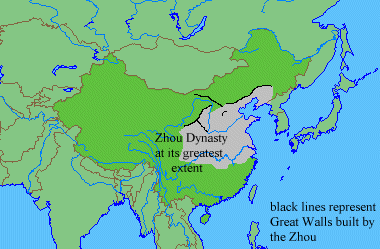
Zhou Dynasty at its greatest

The Zhou Dynasty attached great importance to agriculture and a large number of bronze farming tools were extensively used.

The Zhou Dynasty continued to expand as other states were slowly absorbed.  The Zhou also fought the nomads to the north and northwest.

Return to Emperor Wu of Zhou Dynasty – Part 3 or start with Part 1

______________

Lloyd Lofthouse is the award-winning author of The Concubine Saga. When you love a Chinese woman, you marry her family and culture too. This is the love story Sir Robert Hart did not want the world to discover.

To subscribe to “iLook China”, sign up for an E-mail Subscription at the top right-hand side of this page and then follow directions.


Emperor Wu of Zhou Dynasty – Part 3/4

September 7, 2010

Historical records shows that the Zhou people introduced what would become Chinese social codes—some followed to this day.

Duke Zhou, a younger brother to Emperor Wu, became an important figure after his older brother’s death.

According to tradition, the oldest son would succeed to his father’s position. Due to this, King Wu’s son, Jisong, became emperor after his father’s death.

Jisong became King Cheng but was too young to rule, so his uncle, the Duke of Zhou, became regent.

Some of the vassal states didn’t like this and revolted. Duke Zhou led a military expedition to suppress the revolt.


Video: Chinese with English subtitles

Duke Zhou then wrote China’s first laws known as the Ritual of Zhou—more than 3,000 rules that covered behavior and manners.

The rules also formulated wedding rituals and required ancestral temples in each vassal state, which encouraged loyalty to the king. The Zhou Dynasty attached great important to ritual and music.

The Kings of Zhou proclaimed that they were “the sons of Heaven.”  There were rituals for burials.

Worship for ancestors and Heaven were of prime importance and were practiced into the 20th century, which explains the Temple of Heaven in Beijing.

The Zhou tomb of the Marquis of Jin was discovered in 1992 in Shanxi province. Many jade articles were found.

Return to Emperor Wu of Zhou Dynasty – Part 2 or continue to Part 4

______________

Lloyd Lofthouse is the award-winning author of The Concubine Saga. When you love a Chinese woman, you marry her family and culture too. This is the love story Sir Robert Hart did not want the world to discover.

To subscribe to “iLook China”, sign up for an E-mail Subscription at the top right-hand side of this page and then follow directions.


Emperor Wu of Zhou Dynasty – Part 2/4

September 7, 2010

To defeat the Shang Dynasty, King Wu crossed the Yellow River and immediately marched his army toward the capital.

At the Battle of Muye, the Zhou army was outnumbered more than three to one with less than fifty thousand troops against one hundred and seventy thousand.

However, during the battle, many slaves and conscripted prisoners of war from other tribes in the Shang army changed sides to fight with the Zhou army.


Video: Chinese with English subtitles

The remaining Shang army offered little resistance after that.  The Shang king fled to his capital leaving what was left of his army behind. Once he arrived at his capital, he set himself on fire.

To honor his father, King Wu named him the founder of the Zhou Dynasty (1126 – 222 B.C.). Now an Emperor, Wu established a feudal kingdom built on a patriarchal clan system.

The agricultural system of the time required peasants to not only farm the land they owned but also a plot of state land—this was called the “jing-fields” system.

Return to Emperor Wu of Zhou Dynasty – Part 1 or continue with Part 3

______________

Lloyd Lofthouse is the award-winning author of The Concubine Saga. When you love a Chinese woman, you marry her family and culture too. This is the love story Sir Robert Hart did not want the world to discover.

To subscribe to “iLook China”, sign up for an E-mail Subscription at the top right-hand side of this page and then follow directions.