Learning English in China with help from a naughty monkey

September 13, 2016

The Oxford Royale Academy says, “It’s often said that English is one of the hardest languages to learn … and one of the reasons why English is known for being difficult is because it’s full of contradictions.”

That difficultly didn’t stop China from making learning English mandatory in its public schools, but speaking English like a native doesn’t always work well when you’re learning from a cartoon character called Mocky the naughty monkey.

Michael Meyer, the author of “The Last Days of Old Beijing” had this to say about Mocky: “Beijing students begin studying English in Grade One. Every child is enrolled in three forty-five-minute lessons each week until the end of elementary school, at Grade Six. Much of Mocky’s instruction is automated, reducing the teacher’s role to leading students through recitations of the dialogues, animated on a disc included with the text. Although Mocky speaks slowly, he sounds as if he’s inhaled some bad helium.”


This is a normal Chinese high school student who was not born in an English speaking country and learned English in class.

A friend shared the following e-mail and said it had gone viral among the Chinese. The friend said she knew someone else who went to Beijing and was given this brochure by the hotel he was staying at.  After you read this brochure that the hotel had translated into English, you might think it was written by that naughty monkey. Here goes:

Getting There:

Our representative will make you wait at the airport. The bus to the hotel runs along the lake shore. Soon you will feel pleasure in passing water. You will know that you are getting near the hotel, because you will go round the bend. The manager will await you in the entrance hall. He always tries to have intercourse with all new guests.

The Hotel:

This is a family hotel, so children are very welcome. We of course are always pleased to accept adultery. Highly skilled nurses are available in the evenings to put down your children. Guests are invited to conjugate in the bar and expose themselves to others. But please note that ladies are not allowed to have babies in the bar. We organize social games, so no guest is ever left alone to play with them self.

The Restaurant:

Our menus have been carefully chosen to be ordinary and unexciting. At dinner, our quartet will circulate from table to table, and fiddle with you.

Your Room:

Every room has excellent facilities for your private parts. In winter, every room is on heat. Each room has a balcony offering views of outstanding obscenity!

You will not be disturbed by traffic noise, since the road between the hotel and the lake is used only by pederasts.

Bed:

Your bed has been made in accordance with local tradition. If you have any other ideas please ring for the chambermaid. Please take advantage of her. She will be very pleased to squash your shirts, blouses and underwear. If asked, she will also squeeze your trousers.

Above All:

When you leave us at the end of your holiday, you will have no hope. You will struggle to forget it.

The punchline, as it turns out, is that the original e-mail was an April fool’s joke, but because someone who thought it was real forwarded it to everyone he knew who forwarded it again, it ended up going viral. Even the Chinese had fun with this one.

Lloyd Lofthouse is the award-winning author of My Splendid Concubine [3rd edition]. When you love a Chinese woman, you marry her family and culture too. This is the unique love story Sir Robert Hart did not want the world to discover.
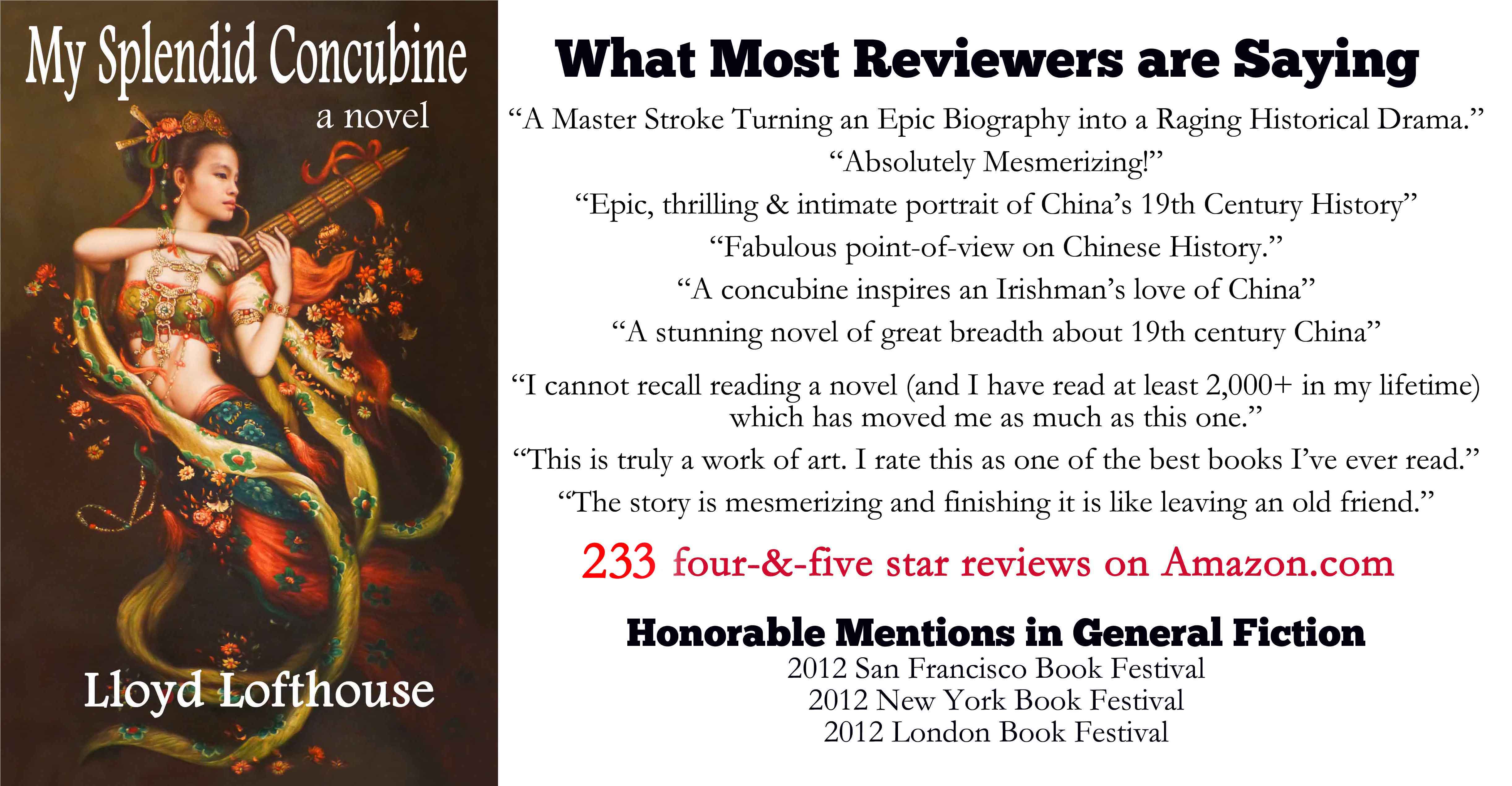
A1 on June 22 - 2016 Cover Image with BLurbs to promote novel

Where to Buy

Subscribe to “iLook China”!
Sign up for an E-mail Subscription at the top of this page, or click on the “Following” tab in the WordPress toolbar at the top of the screen.

About iLook China

China’s Holistic Historical Timeline


China’s challenge to preserve its arable land

September 7, 2016

Arable land is where countries grow the food people eat. According to Nation Master, the U.S. has 174.5 million hectares (one hectare is almost 2.5 acres) of arable land, India has almost 160 million hectares, Russia almost 122 million, but China has less than 105 million (almost 40 percent less than the U.S). The trouble with that is that China has more than 1.3 billion people to feed compared to America’s 320 million.

Then there’s the water. Live Science.com reports that after 3 days, you’ll need water or you’ll die, but you can survive for 3 weeks without food.

To make China’s challenge more daunting, it almost has the same amount of total renewable water that the U.S. has at 2,813 billion cubic meters vs. 2,818 for the U.S.

Don’t forget that China has more than four times the people to feed.

That’s why it is vital that China protects as much arable land as possible while conserving water. That challenge is tough because almost one third of China’s land is desert — a process that has accelerated due to development and human activities. The deserts of China have also become a tourist attraction and that doesn’t help.

In addition, another third of China is mountainous with an additional 10% covered with hills. Combine deserts, mountains and hills and that accounts for about 70% of the country’s land surface.

One strategy to slow the spread of the deserts has been to create a grid of plant growth that will hold the sand in place. The Economist reported that since 1978, 66-billion trees have been planted by Chinese citizens with the goal that by 2050, there will be a forest stretching 2,800 miles along the edges of China’s northern deserts that will increase the world’s forest cover by more than a tenth.

However, due to the natural resources needed to fuel China’s growth and a huge population, northern China has become a boomtown and is attracting millions of people because of the opportunities to earn better money. At the same time herders have also been restricted from allowing their animals to graze on the areas that are being reclaimed from the desert.

This has caused a reduction in the size of herds, for instance, sheep and goats.

Yet, even with these challenges, China still produces more food than any other country on the planet. Agriculture is a vital industry in China, employing over 300 million farmers. China ranks first in worldwide farm output, primarily producing rice, wheat, tomato, sorghum, peanuts, tea, millet, barley, cotton, oilseed and soybeans. Although accounting for only 10 percent of arable land worldwide, it produces food for 20 percent of the world’s population.

Lloyd Lofthouse is the award-winning author of My Splendid Concubine [3rd edition]. When you love a Chinese woman, you marry her family and culture too. This is the unique love story Sir Robert Hart did not want the world to discover.

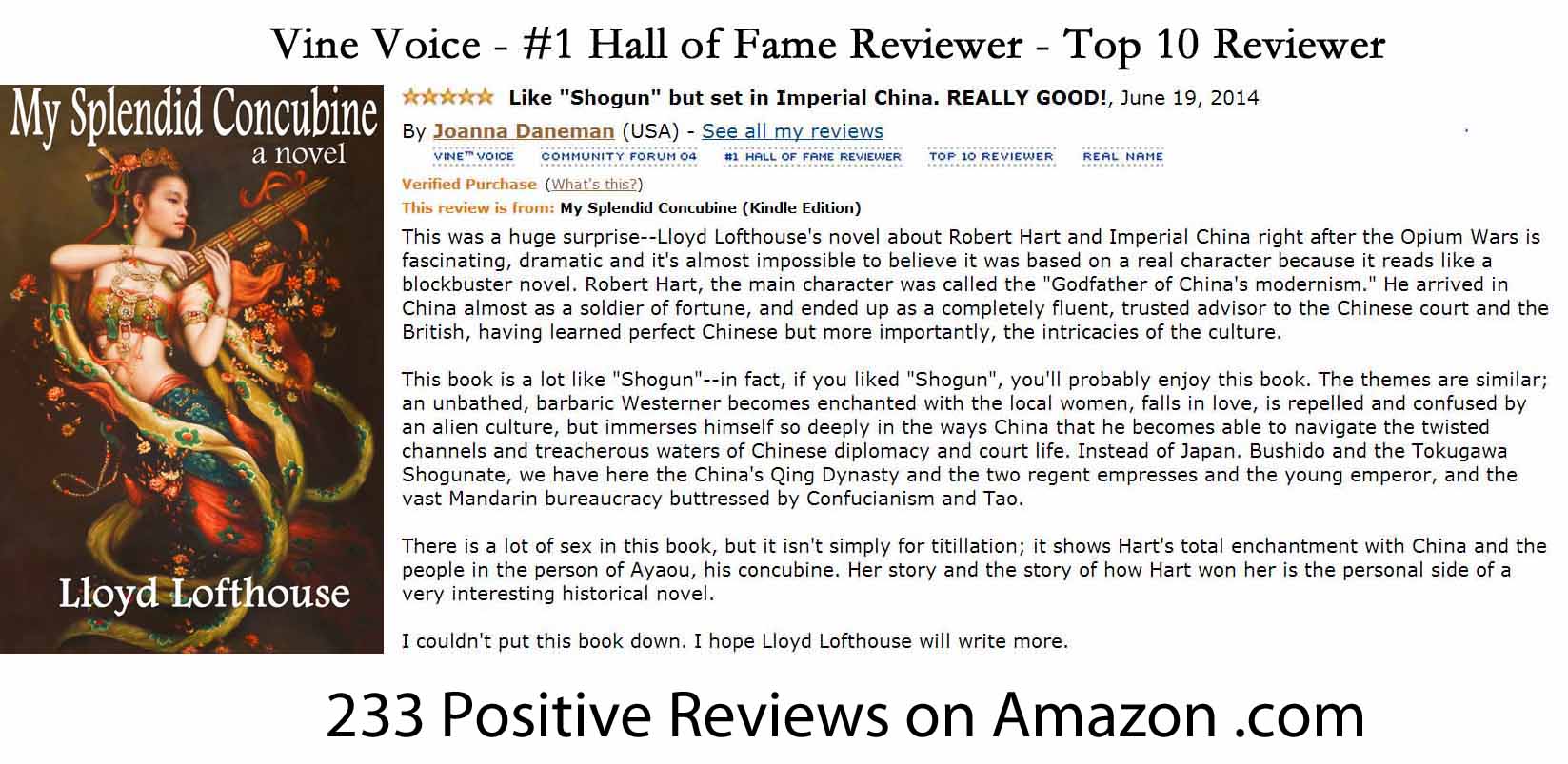
#1 - Joanna Daneman review posted June 19 2014

Where to Buy

Subscribe to “iLook China”!
Sign up for an E-mail Subscription at the top of this page, or click on the “Following” tab in the WordPress toolbar at the top of the screen.

About iLook China

China’s Holistic Historical Timeline


Jack London Accused of Racism after Visiting China in 1904

September 6, 2016

The experiences Jack London (1876 – 1916) had in Korea and China in 1904 led to an essay and a story that ignited a debate that he was a racist. At the time, London also took photographs during the Russo-Japanese War in Korea and Manchuria.

He wrote the The Unparalleled Invasion, which takes place in a fictional 1975, when the West decides to destroy China (for no good reason) by using biological warfare.

London’s 1904 essay, The Yellow Peril, contributed to the claim that he was a racist. Using Google, I found sites that support this theory.

The New World Encyclopedia says, “Many of Jack London’s short stories are notable for their empathetic portrayal of Mexicans (The Mexican), Asian (The Chinago), and Hawaiian (Koolau the Leper) characters. But, unlike Mark Twain, Jack London did not depart from the views that were the norm in American society in his time, and he shared common Californian concerns about Asian immigration and ‘the yellow peril’ (which he actually used as the title of an essay he wrote in 1904; on the other hand, his war correspondence from the Russo-Japanese War, as well as his unfinished novel “Cherry,” show that he greatly admired much about Japanese customs and capabilities.”

In addition, Jack London, Photographer (ISBN 978-0-8203-2967-3) by Jeanne Campbell Reesman, Sara S. Hodson and Philip Adam is a beautiful book showing that London had talent beyond writing stories such as White Fang or Call of the Wild.

On page 57, the caption says, “London had his camera confiscated in Japan and was often detained by Japanese officials when he got too close to the front lines, especially as the war spread to the Yalu River, the boundary between Korea and Manchuria.”

After seeing the pictures in Jack London, Photographer, it’s difficult to believe he was a racist. There have also been rumors that London committed suicide, but there’s no evidence to support that theory either.

If London were a racist, why did his Japanese servant Tokinosuke Sekine stay loyal to the end even after London was bankrupt and his ‘fair weather’ friends had abandoned him?

Lloyd Lofthouse is the award-winning author of My Splendid Concubine [3rd edition]. When you love a Chinese woman, you marry her family and culture too. This is the unique love story Sir Robert Hart did not want the world to discover.

A1 on June 22 - 2016 Cover Image with BLurbs to promote novel

Where to Buy

Subscribe to “iLook China”!
Sign up for an E-mail Subscription at the top of this page, or click on the “Following” tab in the WordPress toolbar at the top of the screen.

About iLook China

China’s Holistic Historical Timeline