Are You Your Government?

March 9, 2010

Originally Published at Speak Without Interruption on February 16, 2010 by Bob Grant — publisher/editor for Speak Without Interruption. Posted on iLook China, 3/9/10 at 08:00

On October 1, 1949 the People’s Republic of China was formally established in a speech given by Mao Zedong from the Imperial Gate at Tiananmen Square. I stood at the very spot where Mao gave his speech and took the photo at the right.  From speaking with people – in China – who lived through his reign it was beyond believable.  What he put his people through is an unforgivable act of power and brutality.  However, it is images from Mao’s era that some – outside of China – still have of the Chinese people.  Nothing could be farther from the truth!
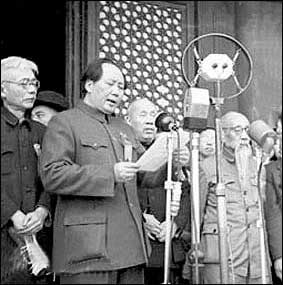
Mao Speech

I never met a Chinese government official – did not even see one at least that I can recall.  What I did meet were the people of China – the people with whom I had my business and personal interactions.  I did not ask them questions about their government nor did they ask questions of mine.  The only political statement that I ever heard was a reference that China’s policy would probably change when the younger generation came into power, someday. (for more on this topic read Changing the Guard at http://wp.me/pN4pY-e9 )

In meetings, over two years ago, I heard about the oil pipeline being built directly from Iran to China.  None of the people in that meeting expressed an opinion one way or the other regarding this pipeline.  It was a decision the Chinese government made.  Maybe my associates did not approve of dealing with Iran—maybe they did?  The point being here is their government made this decision—not my associates.

Whether the officials in power in the US are republican or democrat, they have all made decisions of which I don’t agree.  They did not consult me or ask my opinion—am I my government in these situations?

The point I am trying to make is that I found the Chinese people I met just like me in a lot of respects.  I enjoyed doing business with them – learning their culture – and becoming their friends.  No government – or its actions – is ever going to change that for me!


Every Kind of Beauty Under Heaven

March 7, 2010

When emperors ruled China, those men often wanted to be seen as benevolent—embracing every kind of beauty under heaven. To do this, the emperors encouraged minorities to stay where they had lived for centuries if not millennia. Even in Tibet, China has not driven out or slaughtered in mass (http://wp.me/pN4pY-6S) the minorities as Europeans did to North American natives, who lived off that land for more than ten thousand years.


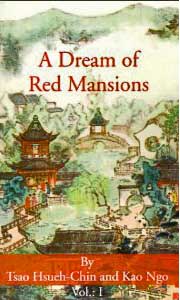
History shows that the Chinese emperors did not force minorities from their land with false promises followed by broken treaties. In China, if a minority king proposed a marriage alliance with the Emperor, the Emperor adopted a Chinese beauty as his daughter and sent her to the minority king. This is portrayed in The Dream of Red Mansions, a Chinese classic written in the 18th century.


One Child

March 7, 2010

China’s one-child policy is due to a population of 1.3 billion people in a country where food crops may be grown on only sixteen percent of the land. What isn’t well known is that the one-child policy applies only to the Han majority. That policy does not apply to the hundred million people that belong to the fifty-six minorities in China. That means Tibetans may not be able to worship and maintain the feudal, nomadic lifestyle like they had before Mao’s reoccupation of Tibet in 1951, but they can have as many children as they want.

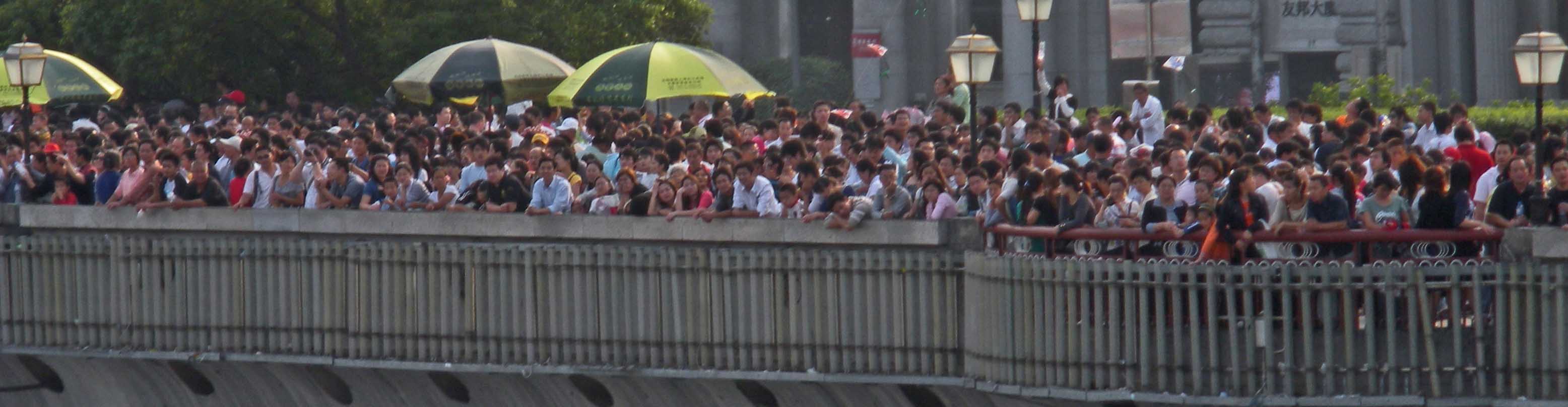
Crowded China

The biggest challenge is growing enough food to feed the bulging Chinese population of 1.3 billion people.  The Chinese government says if it weren’t for the one-child policy, there would be another four-hundred million mouths to feed and provide shelter for.

Meanwhile, Christians in the West (people who believe abortion is wrong) criticize China for this policy. If China did not have the one-child policy, I doubt if these antiabortion voices would have stepped up to feed four-hundred million people. How many would have starved if a famine struck?

There are other exceptions to the one child policy, and you may read about them at the Asian Correspondent .

You may also learn more about China from Tom Carter’s Book, China: Portrait of a People

_______________

Lloyd Lofthouse is the award-winning author of My Splendid Concubine [3rd edition]. When you love a Chinese woman, you marry her family and culture too. This is the love story Sir Robert Hart did not want the world to discover.

His latest novel is the multiple-award winning Running with the Enemy.

Subscribe to “iLook China”!
Sign up for an E-mail Subscription at the top of this page, or click on the “Following” tab in the WordPress toolbar at the top of the screen.

About iLook China

China’s Holistic Historical Timeline


China’s Modern Women

March 6, 2010

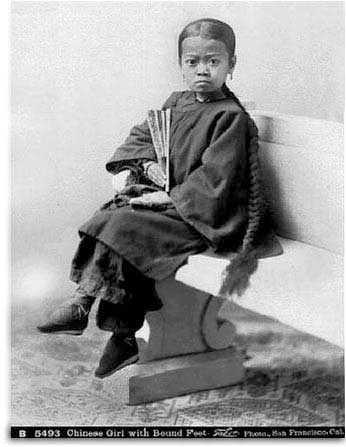
The changing role of Chinese women has been dramatic since Mao won China in 1949. Prior to that time, China was ruled by the Kuomintang—a dictatorship. There were never national elections held in China. There wasn’t much that changed under the Kuomintang leadership regarding the role of women. When my wife was born in the late 1950s, her grandmother had bound feet.

Chinese girl with bound feet

Before Mao, women were grass to be stepped on. Their role was to serve men.

The changes ushered in by Mao set the stage for his wife to become China’s leader after her husband’s death. The only reason she did not assume the leadership was because she was arrested as a member of the Gang of Four and sent to prison for crimes committed during the Cultural Revolution.

Modern Chinese woman

Since Mao, the changes have been even more dramatic.  Woman own businesses, hold political posts in the government, have jobs, and cannot be sold to become a wife or bought to serve as a concubine. They are not property. They are equals to men in many ways.

Learn about Marriage and Money in China.

______________

Lloyd Lofthouse is the award-winning author of The Concubine Saga. When you love a Chinese woman, you marry her family and culture too. This is the love story Sir Robert Hart did not want the world to discover.

To subscribe to “iLook China”, look for the “Subscribe” button at the top of the screen in the menu bar, click on it then follow directions.


Smoking Gun

March 5, 2010

The smoking gun I’m writing about in this post is complements of American tobacco companies earning huge profits in China. Isn’t the market-economy great?

Chinese child smoking

“Antismoking advocates often complain about smoking levels in Canada but our problems pale beside those of China, where it is estimated that 300 million people already smoke and more are being encouraged to do so by Western advertising. To its credit, the Chinese government is taking steps to discourage smoking as it prepares to host the 10th World Conference on Tobacco and Health in 1997. By 2025, smoking-related disease is expected to kill 2 million Chinese a year.” Source: CMAJ-JAMC

Big Tobacco in China

Yes, smoking is a problem in China. When we go out to eat, there will usually be people smoking in restaurants.  In cities, we use the subways, and I haven’t seen or smelled anyone smoking there.

When we travel in China, we often stay in a Jinjiang Inn, a chain of reasonably priced, modern, clean hotels that serve a complimentary breakfast. There are hundreds of Jinjiang inns in most if not all of China’s major cities. This chain caters primarily to the Chinese middle class or Asian business people.  Most foreign tourists stay in more expensive, upscale hotels.  We prefer the Jinjiang Inn.

However, even when we request a smoke-free room or floor, we often will smell drifting cigarette smoke coming from other rooms.

Bob Grant talks about the Chinese smoking in his guest post.

______________

Lloyd Lofthouse is the award-winning author of The Concubine SagaWhen you love a Chinese woman, you marry her family and culture too. This is the love story Sir Robert Hart did not want the world to discover.

Subscribe to “iLook China”
Sign up for an E-mail Subscription at the top of this page.

About iLook China