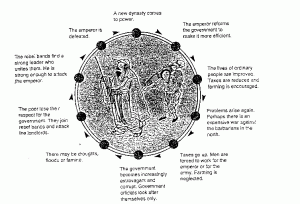
Due to the Mandate of Heaven, many of China’s people see rebellion as a birthright under the right circumstances. TheMandate of Heavenhas been traced back to 1753 B.C. or earlier.
Click on image to make larger.
With the Mandate of Heaven, the right to rule from divine legitimization to one based on ‘evenhanded’ rule was born. Whenever a dynasty fell, the reason offered by China’s wise men was the loss of the moral right to rule given by Heaven alone—on a good government, Heaven sends down all blessings; on the evildoer Heaven sends down all miseries.
However, humans in China were free to rule unjustly and could harm the people they ruled but their rule would come to a swift end as Heaven passed its mandate to another family or group. Heaven blessed the authority of a just ruler, but would be displeased with a despotic ruler and would withdraw its mandate. In addition, severe floods or famines might be considered evidence of divine repeal of the Mandate of Heaven.
The time an individual or family or a political group like the Communists rules China is based on a fair and just performance. As long as the ruling family or party rules fairly and justly, the majority will see no need for change.
______________________________
Lloyd Lofthouse is the award-winning author of My Splendid Concubine [3rd edition]. When you love a Chinese woman, you marry her family and culture too. This is the lusty love story Sir Robert Hart did not want the world to discover.
Subscribe to “iLook China”!
Sign up for an E-mail Subscription at the top of this page, or click on the “Following” tab in the WordPress toolbar at the top of the screen.
The Chinese Communist Party (CCP) has 83 million members, more than a quarter of the US population. For a comparison, there are about 63-million Democrats, 47-million Republicans and 32-million independents registered to vote in the United States.
How does a Chinese citizen become a member of the CCP?
One source for CCP members may come from the Communist Youth League of China that has 73-million members. China’s Youth League, although overseen by the CCP, is a separate organization. The two are not necessarily one and the same and not all Youth League members go on to join the CCP.
The China Daily says, “It (the Youth League) is a school where a large number of people learn about socialism with Chinese characteristics and about communism through practice. It is the Party’s assistant and reserve force.”
However, “Many of today’s party members are culled from the top ranks of high schools and colleges: top students are invited to join the party, and it is the sort of invitation that can’t be refused. Others can be nominated by friends who are party members, or apply on their own initiative if they have the support of other party members. During the past two decades, the ranks of the party have been expanded to include businessmen (who were previously not allowed to join) as well as more ethnic minorities, who currently account for 7 per cent of party members.” Source: Beyond Bricks
The conclusion of Leslie Hook’s Beyond Brick’s piece quoted Sidney Rittenberg, who says of the CCP, “Dictatorship gives you more dictatorship, not democracy.”
But, I do not agree with the term “dictatorship” to describe the CCP. China is ruled by an authoritarian, one party political system and decisions are made by the consensus of hundreds of Party members. A dictatorship is a form of government in which absolute power is concentrated in a dictator or a small clique. Source: Merriam-Webster.com
There are also factions within the CCP that have different political opinions and agendas that balance each other. Political theorists have identified two groups within the Communist Party, a structure which has been called “one party, two factions”. The first is the “elitist coalition” or Shanghai clique which is composed mainly of officials who have risen from the more prosperous provinces. The second is the populist coalition, the core of which are the tuanpai, or the Youth League faction which consists mainly of officials who have risen from the rural interior, through the Communist Youth League.
Within his “one party, two factions” model, Li Cheng has noted that one should avoid labeling these two groupings with simplistic ideological labels, and that these two groupings do not act in a zero-sum, winner take all fashion. Neither group has the ability or will to dominate the other completely.
Then there is this study from the China Quarterly that explains why we find so many of China’s wealthy as members/supporters of the CCP.
“This article presents original survey data from 1999 and 2005 to evaluate the Communist Party’s strategy towards the private sector. The CCP is increasingly integrating itself with the private sector both by co-opting entrepreneurs into the Party and encouraging current Party members to go into business. It has opened the political system to private entrepreneurs, but still screens which ones are allowed to play political roles. Because of their close personal and professional ties, and because of their shared interests in promoting economic growth, China’s capitalist and communist officials share similar viewpoints on a range of political, economic and social issues. Rather than promote democratic governance, China’s capitalists have a stake in preserving the political system that has allowed them to prosper, and they are among the Party’s most important bases of support.” Source: The China Quarterly, 192, December 2007, pp.827-854
Lloyd Lofthouse is the award-winning author of My Splendid Concubine [3rd edition]. When you love a Chinese woman, you marry her family and culture too. This is the love story Sir Robert Hart did not want the world to discover.
Subscribe to “iLook China”!
Sign up for an E-mail Subscription at the top of this page, or click on the “Following” tab in the WordPress toolbar at the top of the screen.
I read a misleading post at Global Voices that was titled China and Tibet: Democracy in Exile. My first thought was, “When was Tibet ever a Democracy?”
Let’s see, how did the United States become a Republic? The answer is simple: the American colonists rebelled against the British Empire and fought the American Revolution 1775 – 1783. There was the Declaration of Independence and then there was the US Constitution followed by twenty-seven ratified amendments. The 27th Amendment was enacted on May 7, 1992, but was proposed September 25, 1789. It only took two-hundred and three years for approval. Wow!
Tibet does not have a similar history. The only thing that is similar is that some Tibetans took part in an uprising against the CCP, and they lost. The same thing could have happened in America from 1775 to 1783. If the colonists had lost, a reluctant US might still be ruled by the UK.
In fact, it doesn’t matter what the Richard Geres of the world say or want us to believe—Tibet has never been a republic or a democracy.
Here’s what the Global Voices author said in the first sentence, “Being a Tibetan in exile is a loss that manifests in many forms: the loss of homeland and natural rights fall within that.”
What were the natural rights that were lost?
Most Tibetans in exile (represented by about 1% of the total Tibetan population) gave up land and thousands of serfs who were treated no better than slaves. What was lost were positions of power and wealth.
Before 1950, when Mao’s Red army reoccupied Tibet for China, there had been no democracy or republic in Tibet – ever.
The following quotes show us what Tibet was like before 1950.
“Lamaism is the state religion of Tibet and its power in the Hermit Country is tremendous. Religion dominated every phase of life. … For instance, in a family of four sons, at least two, generally three, of them must be Lamas. Property and family prestige also naturally go with the Lamas to the monastery in which they are inmates.
“Keeping the common people or laymen, in ignorance is another means of maintaining the power of the Lamas. Nearly all of the laymen (serfs) are illiterate. Lamas are the only people who are taught to read and write.” Source: October 1912 National Geographic Magazine, page 979.
I’m sure that under Lamaism, there was no freedom of religion, no freedom of speech, and the people did not vote. Need I saw more?
Between 1912—when those words appeared in National Geographic—and 1950, Tibet did not change, because it stayed the same as it had been for centuries. The only difference was that there was no Chinese governor in Tibet appointed by the Emperor and supported by Chinese troops.
What we have in Global Voices is clever manipulation to elicit support for the Tibetan separatist movement.
There’s nothing wrong with supporting a separatist movement. After all, there are at least eight known and active separatist movements in the United States: the Alaska Independence Party; Hawaiian sovereignty movement; Lakotah Oyate; Puerto Rico Independence Party; League of the South; Texas Secession Movement; Second Vermont Republic and the Cascadia Independence Movement.
In addition, Tibetans have the same odds to be free from China as Hawaiians and the Lakota Sioux have of being free of the United States.
It is a fact that a reluctant Tibet was ruled over by the Yuan (Mongol), Ming (Han) and Qing (Manchu) Dynasties from 1277 to 1913, when Great Britain convinced Tibet to break from China at the same time the Qing Dynasty was collapsing.
Lloyd Lofthouse is the award-winning author of My Splendid Concubine [3rd edition]. When you love a Chinese woman, you marry her family and culture too. This is the love story Sir Robert Hart did not want the world to discover.
Subscribe to “iLook China”!
Sign up for an E-mail Subscription at the top of this page, or click on the “Following” tab in the WordPress toolbar at the top of the screen.
Gillian Wong of the Associated Press reported on a lone, rural Chinese farmer that had resisted selling his house to the local government so a new road could be completed. The photo shows a house sitting in the middle of an almost finished road with pavement surrounding it.
If that had been in the US, the house would have been gone long before the road was build—something Wong fails to mention is that this sort of thing happens in the US all the time and it started during the decades that the roads and highways spread across the US like a spider web.
In fact, local US governments do not need to wait for the owner of a house to agree to sell. It can force the owner to sell and then use the police/marshals to move him or her out using force if necessary.
I still remember reading about one incident in The Los Angeles Times that happened in Southern California during the craze to build freeways there.
The home owner was a combat veteran from World War II, Korea or Vietnam (I do not remember which war). This vet refused to move out of his house even after the local government forced him to sell it. He claimed he wasn’t being paid what he had invested in the house in improvements.
This American vet filled sandbags and stacked them against the walls of his house; he stocked up on canned foods, bullets, rifles and a gas mask along with a bullet-proof vest. No one was going to take his house away from him.
A swat team had to be called in, tear gas was used and the swat team broke into his house and swarmed him before he could shoot anyone. Then off to jail and court he went to be judged by a jury of his peers. I never did find out what the outcome of that trial was.
In the US, as states, cities and towns expand and improve roadways, sewer and power lines, communications and other system, local governments often secure or acquire access to private land. Without the government’s power to do so, the size and capability or public infrastructure would become inadequate to serve the needs of society (the people) and often in the US the estimated value of a property does not match, because the government uses a different method to determine value not based on what the owner spent on the property but based on the value of other properties in the same community based on an average. To the government, the value of the property is an estimated value. To the owner, it may be every penny he or she invested in the property. Source: Find Law.com
In the US, this has been called legalized theft and it has been debated for decades. The following source is one example of that debate: Fee.org
The law is called Eminent Domain and it gives a government the power to buy private property for public use, usually with compensation to the owner.
Britannica Concise Encyclopedia says: “Government power to take private property for public use without the owner’s consent. Constitutional provisions in most countries, including the U.S. (in the 5th Amendment to the Constitution), require the payment of just compensation to the owner. As a power peculiar to sovereign authority and coupled with a duty to pay compensation, the concept was developed by such 17th-century natural-law jurists as Hugo Grotius and Samuel Pufendorf.”
Therefore, why is this incident in China worthy of media attention in the US, and I wonder if China’s media ever reported on similar incidents in America?
After all, they happen all the time and are often ignored by the American media because they are so common. If you doubt what I say, watch the three-part PBS program embedded in this post.
Lloyd Lofthouse is the award-winning author of The Concubine Saga. When you love a Chinese woman, you marry her family and culture too. This is the love story Sir Robert Hart did not want the world to discover.
Subscribe to “iLook China”!
Sign up for an E-mail Subscription at the top of this page, or click on the “Following” tab in the WordPress toolbar at the top of the screen.
It seems that students in China may be modeling themselves after a Jackie Chan movie and playing catch-me if you can. Harking back to a piece I wrote about Google being hacked, more evidence has been revealed that the real perpetrators may be high school students.
Even the New York Times says, “the attacks came from China but not necessarily from the Chinese government, or even from Chinese sources.”
The US National Security Agency (NSA) traced some of the attacks to servers in Taiwan. Then a United States military contractor that faced the same attacks as Google has also led investigators to suspect a link to a specific computer science class, taught by a Ukrainian professor at a vocational school in east China’s Shandong Province. Last week, in another hacking incident, the trail led through China to Germany where that attack originated.
What is most disturbing is the knee jerk reaction that took place when shortly after Google went public with its accusations against China without evidence, Secretary of State Hillary Rodham Clinton challenged the Chinese in a speech on Internet censors, suggesting China’s efforts to control open access to the Internet were in effect an information-age Berlin Wall.
This is not the way to build trust with other governments. The wise thing to do would have been to wait until all the evidence was in before deciding who was guilty. It’s also interesting to know that this vocational school is operated by a company with close ties to Baidu, the dominant search engine in China and Google’s competitor.
______________
Lloyd Lofthouse is the award-winning author of The Concubine Saga. When you love a Chinese woman, you marry her family and culture too. This is the love story Sir Robert Hart did not want the world to discover.
Subscribe to “iLook China”! Sign up for an E-mail Subscription at the top of this page, or click on the “Following” tab in the WordPress toolbar at the top of the screen.


 Posted by Lloyd Lofthouse
 iLook China