The Han Dynasty (3/3)

August 4, 2010

In one king’s tomb, there is a dining room and living room before reaching the inner-most chambers where the king’s casket was discovered. The casket is decorated on the outside with more than one-thousand jade pieces from Xianjiang, which is in the far northwest of China and was part of the Han Empire.

The king’s body was still intact and was dressed in a gold-threaded jade suit. Small pieces of jade were stitched together with solid gold threads/wires.  These suits were made for the highest-ranking Han nobles. The kings even took music with them into the afterlife along with terra-cotta dancers.

A tour of Xuzhou shows that the citizens are proud of their heritage.  It was during the Han Dynasty that the Silk Road and trade with the West was started.

Return to Part 2 of the Han Dynasty

_______________

Lloyd Lofthouse is the award-winning author of the concubine saga, My Splendid Concubine & Our Hart. When you love a Chinese woman, you marry her family and culture too. 

Sign up for an RSS Feed for iLook China


The Han Dynasty (2/3)

August 4, 2010

In Xuzhou, there is an underground tomb for a Han king and his wife.  An entire mountain was hollowed out to build this tomb, and it is open to tourists.   It is still unknown how the Han Dynasty constructed the tomb.  Experts say that it would take 300 workers ten years to build it but there wasn’t room for that many workers.

The tomb has two entrances.  One entrance faces Xian, the ancient capital of the Qin Dynasty one thousand miles from Xuzhou. How the architects managed that, no one knows.

In 1984, hundreds of Han Dynasty terra-cotta warriors were discovered at the foot of the Lion Mountains. These figurines were there to guard their lord in the afterlife.  These terra cotta troops are smaller than the ones build for the first emperor near Xian, but they are just as detailed.

In the museum for one Han king is a hand-carved jade cup with a cap that screws on to seal the liquid inside.  Even today, no one can carve a jade cup with such detail and craftsmanship

Return to Part 1 of the Han Dynasty

_______________

Lloyd Lofthouse is the award-winning author of the concubine saga, My Splendid Concubine & Our Hart. When you love a Chinese woman, you marry her family and culture too. 

Sign up for an RSS Feed for iLook China


The Han Dynasty (1/3)

August 3, 2010

In this three-part series you will take a tour of Xuzhou, which was the capital of the Han Dynasty (206 BC – 219 AD) and is situated between modern day Shanghai and Beijing. In the third century BC, The Roman Empire was at its peak. At the same time, China’s Han Dynasty was more powerful than Rome.

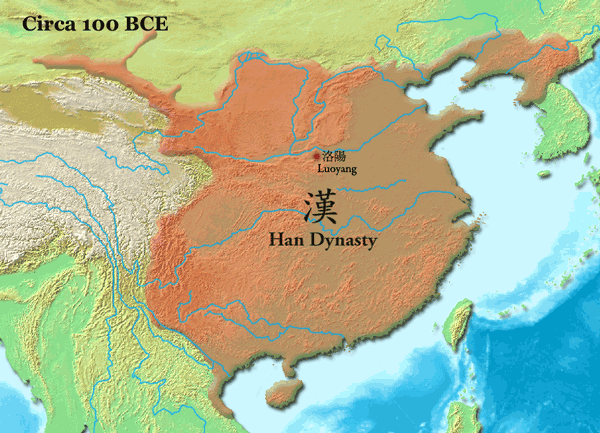
Xuzhou in northern Jiangsu province is one of China’s best showcases of the art and historical relics of the Han Dynasty. At its height, the Han Dynasty stretched from the Pacific Ocean to Central Asia and as far south as Vietnam. Its culture had a great influence on Central and Southeast Asia. 

In the center of Xuzhou on top of a mountain stands the famous horse-training terrace where the first Han emperor trained his troops. At age 23, Emperor Gaozu (202 – 195 BC), then known by his common name Liu Bang, fought the Qin and defeated China’s first dynasty.

To honor the first emperor of the Han dynasty, China rebuilt his palace in Xuzhou with many ancient Han stone sculptures displayed.

See The First Emperor: The Man Who Made China

______________

Lloyd Lofthouse is the award-winning author of the concubine saga, My Splendid Concubine & Our Hart. When you love a Chinese woman, you marry her family and culture too. 

If you want to subscribe to iLook China, there is a “Subscribe” button at the top of the screen in the menu bar.


Piety’s Flaw

August 3, 2010

I’ve heard that it was Confucianism that caused China to fall victim to Western Imperialism in the 19th century, and the reason Mao started the Cultural Revolution his last decade was to correct this imperfection.

However, I believe that the collective culture created in China by Emperor Han Wudi (156-87 BCE), considered one of the most influential emperors in Chinese history, is the reason that China’s civilization survived for thousands of years without suffering the fate of Europe after the Roman Empire collapsed.

Han Dynasty 100 BC

The problem is not from Confucianism but a flaw in the way an element of Confucianism has been interpreted over the centuries.  In fact, this flaw is buried so deep in the Chinese psyche that Mao’s disastrous Great Leap Forward and the tragic Cultural Revolution were not stopped because of it. 

There were powerful individuals in the Communist Party who did not agree with what Mao was doing but did not speak out when they could have. Some of those individuals even suffered during the Cultural Revolution but still kept silent due to the power of piety.

It wasn’t until after Mao’s death that those same people acted and Deng Xiaoping came to power stopping the madness of the Cultural Revolution.

To criticize an elder in China, even when that individual is power hungry, senile or maybe a bit crazy, is considered similar to Christian heresy during the Spanish Inquisition. Piety means elders must be treated with respect as if they can do no wrong. There must be a way to find a balance.

See China’s Capitalist Revolution

_______________

Lloyd Lofthouse is the award-winning author of the concubine saga, My Splendid Concubine & Our Hart. When you love a Chinese woman, you marry her family and culture too. 

Sign up for an RSS Feed for iLook China


Education and Cultures Collide in the US (5/5)

August 3, 2010

Another example may be found at Nogales High School, where I taught. When I was there, seventy percent of the student population was Hispanic/Latino and less than 5% of my students turned in the assigned homework or did the reading. However, most of my Asian students did the homework and the reading—they were among the 5%.

Percentage of Students Scoring at Proficient or Advanced for English-Language Arts at Nogales High School:

Hispanic or Latino 36%
African American 37%
White 52%
Filipino 60%
Asian 70%

California High School Exit Examination Results by Student (ethnic) Group

Hispanic or Latino 37.5%
African American 40%
White (no data)
Filipino 65.5%
Asian 85.7%

Some will say, as my foolish “old” friend will argue, that it is the teacher’s responsibility to teach the kids. My reply is that “few” teachers can teach a kid who won’t cooperate, refuses to read daily for thirty minutes to an hour and will not do homework. After all, you can lead a horse to water, but you can’t make it drink.

What kind of teacher was I? Click here to find out out about Lloyd Lofthouse as a teacher. Make sure to scroll and read everything on this page.

The success of China’s civilization and culture for several-thousand years is due to the value the Chinese put on an education, which appears much higher than other cultures. The home environment and the parents are the difference.

Return to Education and Cultures Collide in the US (4/5)

_______________

Lloyd Lofthouse is the award-winning author of the concubine saga, My Splendid Concubine & Our Hart. When you love a Chinese woman, you marry her family and culture too. 

Sign up for an RSS Feed for iLook China