Chinese American students from US Public Schools Score Big in China

August 25, 2010

The Mercury News reports that four California Chinese American high school students competed in the ninth annual China Girls Mathematical Olympiad and earned top prizes for the United States.  There are more details at Silicon Valley girls capture medals in China.

I congratulate these young women for their achievement.  Actually, the Mercury News did not tally the entire victory for America’s public schools.

If you click to MSRI Mathematical Sciences Research Institute, you will discover that girls from the IMO (USA International Mathematical Olympiad) team won eight medals —six gold, one silver, one bronze and one honorable mention.

What these results show is that students from America’s public schools can be competitive with other countries.

I wrote about this topic in more detail in a five-part series, Education and Cultures Collide in the US, about how the problems in America’s public school are due more to cultural/socio-economic differences than the perceived cancer of teachers unions protecting bad teachers.

If a student (no matter what his or her ethnicity is) does the work, pays attention and reads daily, most teachers will not be expected to do the impossible and face political and media criticism when they can’t.

_______________

Lloyd Lofthouse is the award-winning author of the concubine saga, My Splendid Concubine & Our Hart. When you love a Chinese woman, you marry her family and culture too. 

Sign up for an RSS Feed for iLook China


Sun Tzu’s “The Art of War” – Part 10/10

August 24, 2010

On the third day of Gettysburg during Picket’s charge up another hill, only 5,000 survived of 12,000 troops.  Sun Tzu would have been horrified.

Sun Tzu says, “When troops flee, are insubordinate, collapse or are routed in battle, it is the fault of the general.”

Sun Tzu sees a commanding general as someone intelligent and cunning and never rash or arrogant, which is the opposite of the commander of the Chu army more than two thousand years ago.

Sun Tzu won the war against Chu, which had an army ten times larger than his. He did this through preparation, deception and indirect attacks.

After winning the war against Chu, Sun Tzu retires and writes The Art of War.

The first line of Sun Tzu’s rules of war says, “War is a matter of vital importance to the State. It is a matter of life and death, survival or ruin.

Continued in Conclusion to Sun Tzu’s The Art of War, return to Sun Tzu’s The Art of War (HQ)- Part 9 or start with Part 1

Lloyd Lofthouse is the award-winning author of My Splendid Concubine [3rd edition]. When you love a Chinese woman, you marry her family and culture too. This is the unique love story Sir Robert Hart did not want the world to discover.

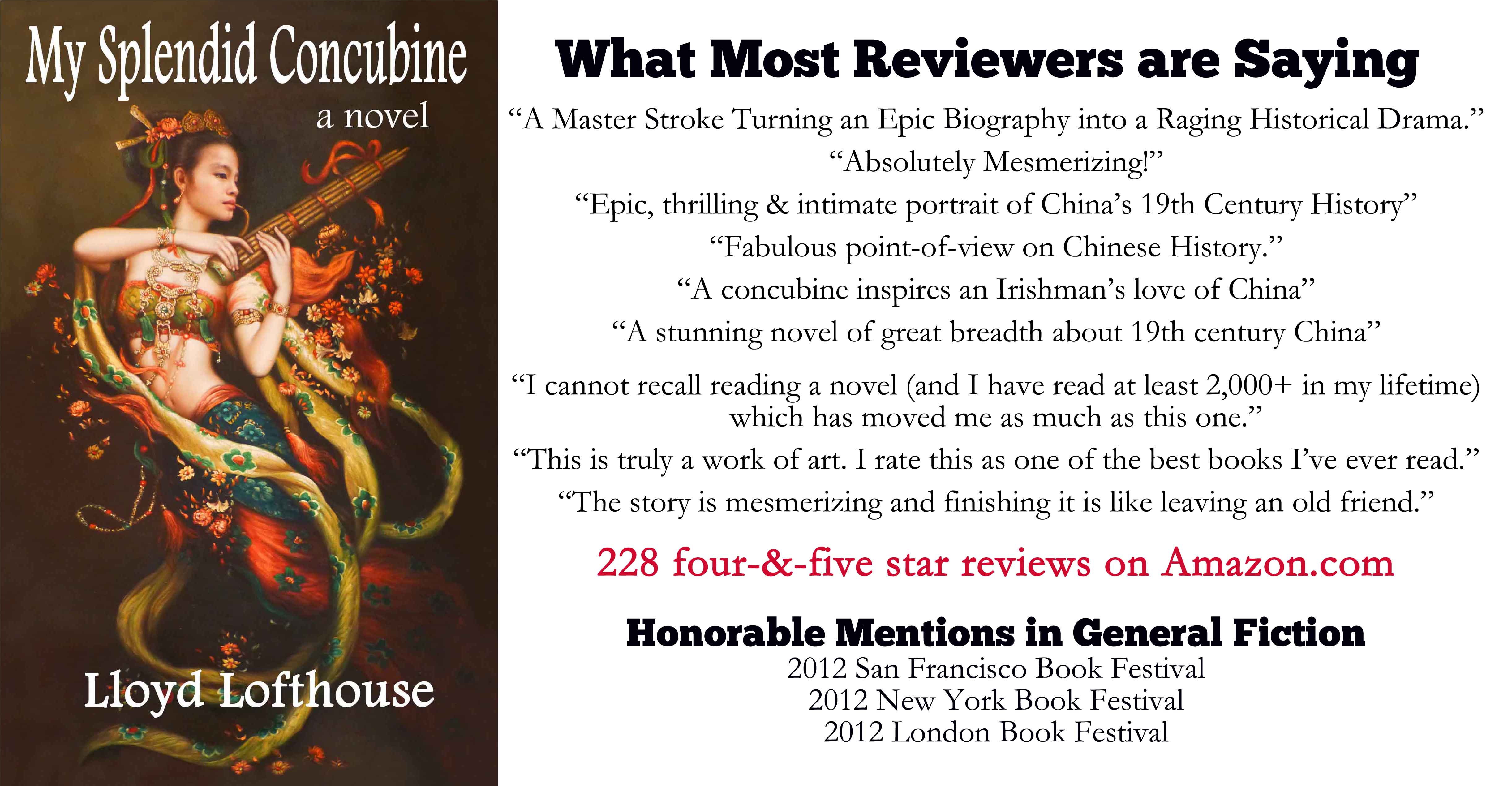
A1 on March 13 - 2016 Cover Image with BLurbs to promote novel

Where to Buy

Subscribe to “iLook China”!
Sign up for an E-mail Subscription at the top of this page, or click on the “Following” tab in the WordPress toolbar at the top of the screen.

About iLook China

China’s Holistic Historical Timeline


Sun Tzu’s “The Art of War” – Part 9/10

August 24, 2010

China’s Sun Tzu says if the orders are unclear, it is the fault of the commanding general.

General Lee told one of his generals to “Attack when you think it is practical.”  That general decides it isn’t practical and does nothing.

At the Battle Gettysburg, Lee did not give clear orders.

Robert E. Lee made a tactical mistake when he did not follow Sun Tzu’s rule to “Move only when you see an advantage and there is something to gain. Only fight if a position is critical.”

Sun Tzu says, “When the enemy occupies high ground, do not confront him.  If he attacks downhill. do not oppose him.”  Robert E. Lee didn’t listen and decides to attack the Union positions on the high ground.

General Longstreet disagrees.  He does not want to attack the high ground.  Instead, he wants to go around the Union Army toward the North’s capital, Washington D.C.

Sun Tzu says, “There are some armies that should not be fought and some ground that should not be contested.”

After two days of horrible losses, Robert E. Lee orders what’s left of his army to attack uphill a third time.  General Longstreet urges Lee not to do this. Lee ignores him.

Go to Sun Tzu’s “The Art of War” – Part 10 or return to Sun Tzu’s “The Art of War” – Part 8

Lloyd Lofthouse is the award-winning author of My Splendid Concubine [3rd edition]. When you love a Chinese woman, you marry her family and culture too. This is the unique love story Sir Robert Hart did not want the world to discover.

A1 on March 13 - 2016 Cover Image with BLurbs to promote novel

Where to Buy

Subscribe to “iLook China”!
Sign up for an E-mail Subscription at the top of this page, or click on the “Following” tab in the WordPress toolbar at the top of the screen.

About iLook China

China’s Holistic Historical Timeline


The Sheng, one of China’s Oldest Musical Instruments

August 23, 2010

According to one source, the Sheng dates back as far as 1200 BC. Many Westerners also call it a “Chinese mouth organ”.

An early Sheng was discovered in Hubei Province in a Zeng royal tomb dating back 2400 years to the Zhou Dynasty (1111-222 BC).

 The Sheng has also been found in Han tombs in Hunan province.

The Sheng is a wind instrument with a bundle of between 17 and 37 pipes. Music is made by blowing and/or sucking the air through a tube connected to the base.  The tubes are connected to shape like a gourd.

This instrument predates the organ, concertina, harmonica and accordion.

One source says that most modern shengs have 17 pipes that produce crisp, melodious tones using a chromatic scale.  Source: Sheng (instrument) – Wiki

If you want to learn more about Chinese music, see the Jing-Hu

_______________

Lloyd Lofthouse is the award-winning author of the concubine saga, My Splendid Concubine & Our Hart. When you love a Chinese woman, you marry her family and culture too. 

Sign up for an RSS Feed for iLook China


Covered by the China Daily

August 23, 2010

For a Western photo journalist to be featured in the China Daily says a lot when the topic he writes about is China.  For Tom Carter, who has written guest posts for iLook China, it is like a coming of age for a journalist to receive such recognition for his work.

The China Daily is the English language edition of the state-run media.  In China, it is comparable to the London Times, The New York Times, The Los Angeles Times or the San Francisco Chronicle.  When I say it is comparable, the key to that description is “in China”.

The China Daily says of Tom’s work, “There is no single image that can adequately represent the diversity that is China. This is partly why Tom Carter’s 638-page tome of photographs taken during his tour of the country between 2006 and 2008 works so well.”

Photo of Tom Carter in China

“The goal was to portray China as it portrayed itself to me,” Carter says of his travels with his trusty Olympus Camedia C4000, a no-frills four-megapixel camera.

It seems both foreigners and Chinese are hungry for what Carter has to say about “all” of  China.

Recently, Carter had an author event in Shanghai at a bar on the Bund where more than a hundred people came to hear him (paying a 65 yuan cover charge to boot) talk about his journey across China. There was standing room only with a line out the door.

Tom Carter’s book is China: Portrait of a People and is available in the United States through Amazon.

See more about The China Daily

_______________

Lloyd Lofthouse is the award-winning author of the concubine saga, My Splendid Concubine & Our Hart. When you love a Chinese woman, you marry her family and culture too. 

Sign up for an RSS Feed for iLook China