Poetry from the Golden Age of Chinese Art and Literature

April 20, 2016

The Tang Dynasty (618 to 907 AD) is regarded as one of the most prosperous times in China’s long history.

It was also the golden age of Chinese art and literature.

Crossing the Han River
Song Zhi-wen (656 – 712 AD)

No news, no letters – all winter, all spring —
     Beyond the mountains.
With every homeward step more timid still
I dare not even inquire of passerby
.

Song Zhi-wen, the poet, was found guilty of accepting bribes and executed. He had good reason to fear returning home from exile.


In this video is a famous Tang poem.

The classical form of Chinese poetry developed in the late Han Dynasty (206 BC – 220 AD) and reached its peak during the Tang Dynasty.

Most Tang poems have four or eight lines, with five and seven Chinese characters in each line following certain rules.

Another example of Tang Dynasty poetry is Spring Perspective by Du Fu (712 – 770 AD).

When the post of prime minister was awarded to a cousin of the imperial concubine, there was the military rebellion of An Lu–shan in 755 AD.

The nation has fallen, the land endures
Spring trees and grasses flourish in the town.
Troubled by the times — flowers bring tears;
Dreading parting — birds startle the soul.

With turmoil of battle three months on end,
A letter from home is worth a fortune in gold.
As it is, they can barely hold a pin.

This poem demonstrates what happens when the Chinese people get tired of nepotism and corruption, which should be heeded as a warning today to crack down on corruption in Communist China.

The next poem is one of many that Yuan Zhen (779 – 831 AD) wrote for his dead wife, who he married when he was poor. She did not live long enough to share his fame and fortune.

In former years, we chatted carelessly of death and what it means
     to die.
Since then, it’s passed before my very eyes.
I’ve given almost all your clothes away
But cannot bear to move your sewing things.
Remembering your past attachments, I’ve been kind to maids you
     loved.
I’ve met your soul in dreams and ordered sutras sung.
Certainly, I know this sorrow comes to all
But to poor and lowly couples, everything life brings is sad.

Lloyd Lofthouse is the award-winning author of My Splendid Concubine [3rd edition]. When you love a Chinese woman, you marry her family and culture too. This is the unique love story Sir Robert Hart did not want the world to discover.
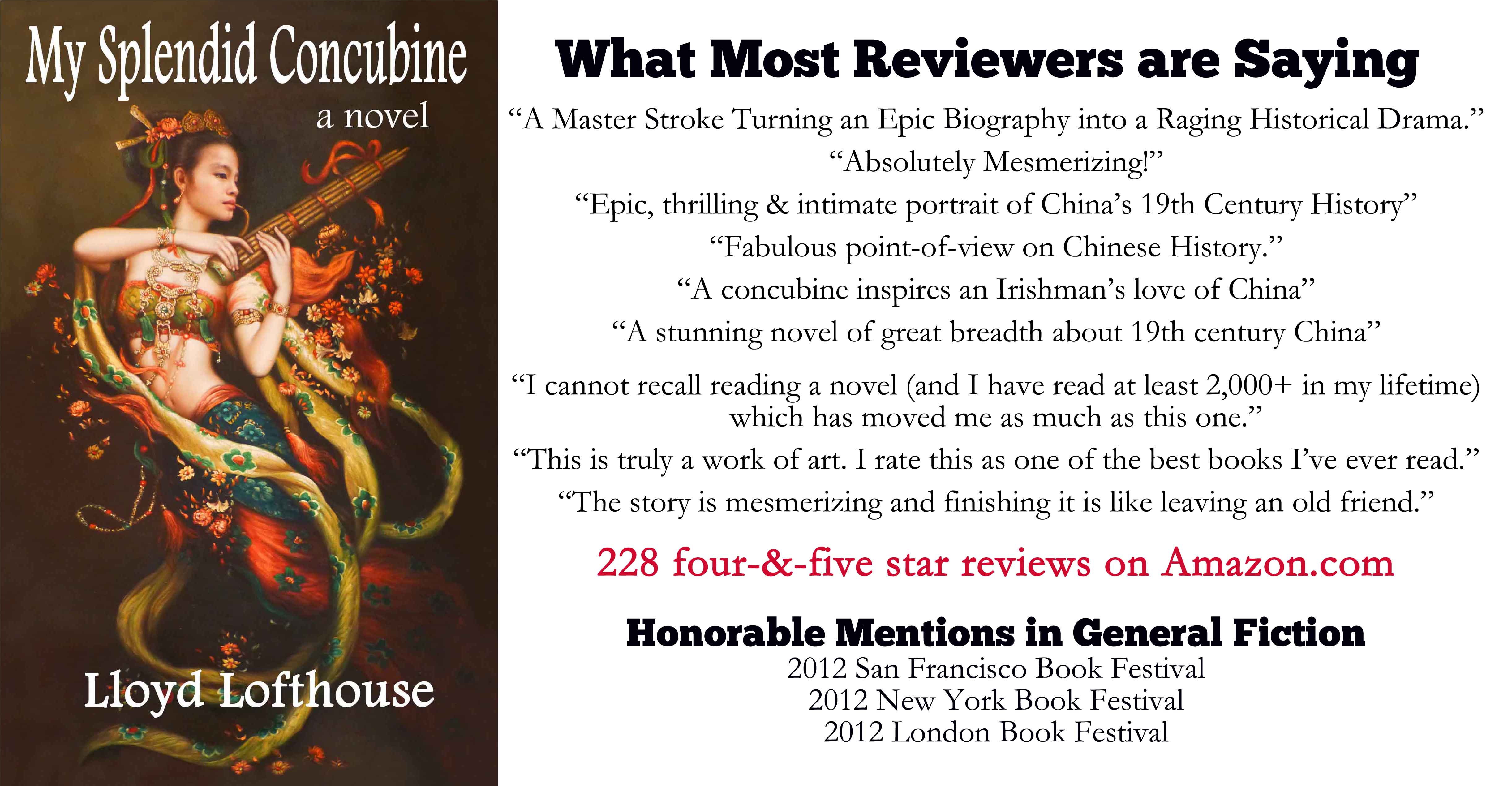
A1 on March 13 - 2016 Cover Image with BLurbs to promote novel

Where to Buy

Subscribe to “iLook China”!
Sign up for an E-mail Subscription at the top of this page, or click on the “Following” tab in the WordPress toolbar at the top of the screen.

About iLook China

China’s Holistic Historical Timeline


China’s Wu Guanzhoung is one of the world’s fathers of expressionism.

April 19, 2016

Wu Guanzhong (1919 – 2010) is known as the father of Chinese Expressionism. He was born in Yixing, Jiangsu Province, China. He was a graduate of the National Art College in 1942, and studied oil painting in Paris from 1947-1950.

When Wu returned to China from France in 1950, he taught Western art to his students at the Central Academy of Fine Art in Beijing until 1953. He then taught art at Tsinghua University in Beijing 1953 – 1964.

Due to criticism that Wu had been influenced by Western bourgeois ideas, in 1966, during the beginning of Mao’s Cultural Revolution, Wu was told he could not paint or write about art. To avoid persecution and possible execution by the rampaging teenage Red Guard, he burned many of his paintings.

In 1970, he was separated from his wife and spent three years working at hard labor in the countryside as part of Mao’s re-education program.

After Mao died in 1976 with China now led by Deng Xiaoping, Wu was allowed to paint again. He had his first professional solo exhibition in 1979, and succeed as a professional artist in the 1980s.

 Wu Guanzhoung’s painting of Shakespeare’s hometown was listed to sell for
RMB: 2 million ($US 318,878) – 2.5 million ($US 398,597).

During his life as an art teacher and a professional artist, his goal was to introduce French modernism to the Chinese world of art while preserving China’s cultural identity.

Wu combined his French training and Chinese background to develop a semiabstract style to depict scenes from the Chinese landscape. Before he died, Wu had solo exhibitions in major art galleries and museums around the world, including Hong Kong, Singapore, Tokyo, Taipei, Korea, England and the US.

In 1992, Wu was honored by the French Ministry of Culture. He died at age 90.

Lloyd Lofthouse is the award-winning author of My Splendid Concubine [3rd edition]. When you love a Chinese woman, you marry her family and culture too. This is the unique love story Sir Robert Hart did not want the world to discover.

#1 - Joanna Daneman review posted June 19 2014

Where to Buy

Subscribe to “iLook China”!
Sign up for an E-mail Subscription at the top of this page, or click on the “Following” tab in the WordPress toolbar at the top of the screen.

About iLook China

China’s Holistic Historical Timeline


Sun Yat-sen’s Republic in China: Part 4 of 4

April 15, 2016

Now that we know more about the United States and Hawaii, where Sun Yat-sen lived as a teenager, Sun’s concept of a republic would have been very different from what we think today.

In addition, members of the U.S. Senate were not elected to office by the popular vote until 1913 when the 17th Amendment to the U.S. Constitution provided for direct popular election of senators, ending the system of election by individual state legislatures.

If Sun were aware of the details of America’s political history and its limitation by the time he left Hawaii at the age of 17 in 1883, the republic he wanted for China probably would have excluded many from voting—including women. How many Chinese would have been allowed to vote in the early 20th century if only Han Chinese men that owned property were eligible?

In addition, by 1903, when Sun Yat-sen returned to Hawaii looking for support for his dream of a future republic and/or democracy in China, Hawaii was no longer a republic but was a territory of the United States, and its people were not considered American citizens.

The republic Sun Yat-sen might have wanted for China may possibly have included at least one House as a National Congress with its members appointed by the elected legislatures of each province, and women would have been excluded from voting and possibly considered the property of men as women were in the United States at the same time.

In fact, it is possible that Sun Yat-sen would not have considered organizing a republic where the citizens elected China’s leader with a popular vote of the people since Hawaii’s Constitution of 1864 charged the legislature, not the people, with the task of electing the next king, who was King Kalākaua—the one forced to sign the 1887 Constitution four years after the young Sun Yat-sen had returned to China.

Now that we know the differences between then and today, it is easier to accept that the Chinese Communist Party’s 1982 Constitution created a government in China closer—and maybe even better—than what Sun Yat-sen might have wanted for China.

In fact, in a Sun Yat-sen republic, children in China might still be considered the property of parents as they were in the United States until the 1938 Federal regulation of child labor in the Fair Labor Standards Act. Before 1938, parents in the U.S. had the legal right to sell their children into servitude and/or slavery depending on which state one lived in.

“Prior to the passage of the Fair Labor Standards Act, both adults and young children often worked brutally long hours only to earn starvation wages.” – Economic Policy Institute

Did you know that in 1900 forty percent of Americans lived in poverty and only 7% of children graduated from high school with 3% of adult Americans graduating from college?

In addition, writing of the merits of a republican or representative form of government, James Madison observed that one of the most important differences between a democracy and a republic is “the delegation of the government (in a republic) to a small number of citizens elected by the rest.

When James Madison wrote this, the number of US citizens allowed to vote in federal elections was limited to white property owners—not counting Jews—that represented about 10% of the population of the U.S. in 1776, which was similar to the voting rights in Hawaii during most of Sun Yat-sen’s life.

Return to Part 3 or start with Part 1

Lloyd Lofthouse is the award-winning author of My Splendid Concubine [3rd edition]. When you love a Chinese woman, you marry her family and culture too. This is the unique love story Sir Robert Hart did not want the world to discover.

A1 on March 13 - 2016 Cover Image with BLurbs to promote novel

Where to Buy

Subscribe to “iLook China”!
Sign up for an E-mail Subscription at the top of this page, or click on the “Following” tab in the WordPress toolbar at the top of the screen.

About iLook China

China’s Holistic Historical Timeline


Sun Yat-sen’s Republic in China: Part 3 of 4

April 14, 2016

Hawaii was not a democracy modeled after today’s United States when Sun Yat-sen lived there from age 13 to 17 [1879 – 1883].

In fact, when Sun Yat-sen lived in Hawaii, it was a kingdom ruled by a king and was a Constitutional Monarchy similar to but not the same as Great Britain.

It wouldn’t be until 1887, that the Hawaiian King Kalākaua was forced to sign the 1887 Constitution of the Kingdom of Hawaii—four years after Sun Yat-sen had returned to China—that stripped the king of any authority he had turning him into a figurehead.

In addition, there was a property qualification in 1887’s Hawaiian Constitution for voting rights similar to what the Founding Fathers wrote into the U.S. Constitution in 1776, and resident whites in Hawaii, who owned property, since Asians were not allowed to own property or could not afford to buy it, were the only ones allowed to vote.

Meanwhile, the American Chinese Exclusion Act of 1882 excluded skilled and unskilled Chinese from entering the United States for ten years under penalty of imprisonment and deportation. In the U.S. at this time, many Chinese were relentlessly beaten or murdered just because of their race.

Therefore, when Sun Yat-sen lived in Hawaii as a Chinese teenager, it was not a republic or a democracy and he was a second-class person barred from entering the United States.

The structure of the political system in the United States was also dramatically different from the one America has today.

In 1790, the Constitution explicitly says that only “free white” immigrants could become naturalized citizens.

In 1848, Mexican-Americans were granted U.S. Citizenship but not voting rights.

In 1856, voting rights were expanded to all white men and not just property owners.

In 1868, four years after the end of the American Civil War, former slaves were granted citizenship, however only African-American men were allowed to be citizens and the right to vote was left up to each state.

In 1870, the 15th Amendment was passed saying the right to vote could not be denied by the federal or state governments based on race (this still did not include women), but some states restricted the right to vote based on voting taxes and literacy tests.

In 1876, the US Supreme Court ruled that Native Americans were not citizens and could not vote.

In 1882, the Chinese Exclusion Act barred people of Chinese ancestry from naturalizing to become U.S. citizens.

In 1920, the right to vote was extended to women with the 19th Amendment. – U.S. Voting Rights Timeline

What do you think Sun Yat-sen learned from these facts about the U.S. republic and democracy?

Continued on April 15, 2016 with Part 4 or return to Part 2

Lloyd Lofthouse is the award-winning author of My Splendid Concubine [3rd edition]. When you love a Chinese woman, you marry her family and culture too. This is the unique love story Sir Robert Hart did not want the world to discover.

IMAGE with Blurbs and Awards to use on Twitter

Where to Buy

Subscribe to “iLook China”!
Sign up for an E-mail Subscription at the top of this page, or click on the “Following” tab in the WordPress toolbar at the top of the screen.

About iLook China

China’s Holistic Historical Timeline


Sun Yat-sen’s Republic in China: Part 2 of 4

April 13, 2016

The answer to the question I asked in Part 1 has nothing to do with the government of the United States as it exists today, but it does have everything to do with the politics of Hawaii when Sun Yat-sen lived there for four years of his young life, the structure of the United States government, and who could vote at that time.

Sun Yat-sen attended a Christian British Bishop’s school in Hawaii for four years. His model on a Chinese republic may have been based on the beliefs of America’s Founding Fathers, who despised democracy as mob rule. Since Sun attended a British school, we may assume safely that he also learned about the British parliamentary system where the prime minister is not elected to office but is the leader of the majority party and there is no term limit. In fact, there was no term limit for the president of the U.S. until 1947, long after Sun’s death.

According to Sun Yat-Sen Hawaii Foundation, he arrived in Hawaii in 1879 at the age of thirteen. He then spent four of his teenage years being educated in Hawaii. China’s first revolutionary society, the Xing Zhong Hui (Revive China Society) was organized in Hawaii in 1894 more than a decade after Sun left.

Sun Yat-sen would later be involved in the overthrow of the Qing Dynasty in 1911 and a failed attempt to establish a republic in China. He never achieved his goals during his lifetime.

Whatever Sun Yat-sen’s vision of a republic might look like had to be formed during the four years he lived in Hawaii as a teenager.  The Sun Yat-sen Timeline shows that he returned to China in 1883.

To learn what Sun Yat-sen may have believed means learning about the political structure of Hawaii and the United States between 1879 and 1883.

Continued on April 14, 2016 in Part 3 or start with Part 1

Lloyd Lofthouse is the award-winning author of My Splendid Concubine [3rd edition]. When you love a Chinese woman, you marry her family and culture too. This is the unique love story Sir Robert Hart did not want the world to discover.

#1 - Joanna Daneman review posted June 19 2014

Where to Buy

Subscribe to “iLook China”!
Sign up for an E-mail Subscription at the top of this page, or click on the “Following” tab in the WordPress toolbar at the top of the screen.

About iLook China

China’s Holistic Historical Timeline