What’s the Skinny on the Tiananmen Square Incident: Part 1 of 2

July 31, 2018

The Urban Dictionary says one of the definitions for “what’s the skinny” means “an inquiry for inside information”.

Twenty-nine year after the alleged 1989 Tiananmen Square Massacre, the U.S. media continues to annually remind the world of what happened but are they wrong with all their facts?

I’ve talked to several Chinese American friends, now US citizens, that lived in China in 1989. They all say the student leaders behind the Tiananmen Square protest/massacre, April 14 – June 4, 1989, were supported by the CIA.

I asked myself, “Was this another conspiracy theory?”

However, my curiosity was stirred, so I spent hours searching the internet for clues to validate what I had been told, and I discovered several interesting coincidences.

The new U.S. Ambassador in China was James Lilley, a former CIA operative who worked in Asia and helped insert CIA agents into China. Future President H. W. Bush served as Chief of the U.S. Liaison Office in Beijing (1974 – 1976), and he went from there to serve as Director of the CIA (1976 – 1977).

Why did President H. W. Bush replace Winston Lord as ambassador to China during the early days of the Tiananmen Square incident with former CIA agent James Lilley? After all, Lord spoke some Chinese and was a key figure in the restoration of relations between the U.S. and China in 1972.  Wasn’t he the best man for the job during a crisis like the Tiananmen Square Incident?

I returned to my friends and asked, “How do you know the CIA helped the student leaders of the protest?”

“It’s obvious,” was the answer. The reason, they explained was the fact that it was very difficult, almost impossible, for anyone in China to get a visa to visit the United States before the 21st century. Yet most of the young student leaders of the Tiananmen Square incident left China quickly after the event with U.S. Visas and prospered in the West without any obvious difficulty.

I returned to my investigation to verify these claims and found Let’s Welcome Chinese Tourists By J.W. Marriott Jr. This piece talked about how difficult it was for Chinese to get U.S. Visas at that time.

Another piece I found in The Washington Post also documented how difficult it was to get a visa to visit the United States from China. I read another piece in The Chicago Tribune on the same subject. And my wife, Anchee Min, told me her brother and two sisters were denied visas to the U.S.

Continued in Part 2 on August 1, 2018

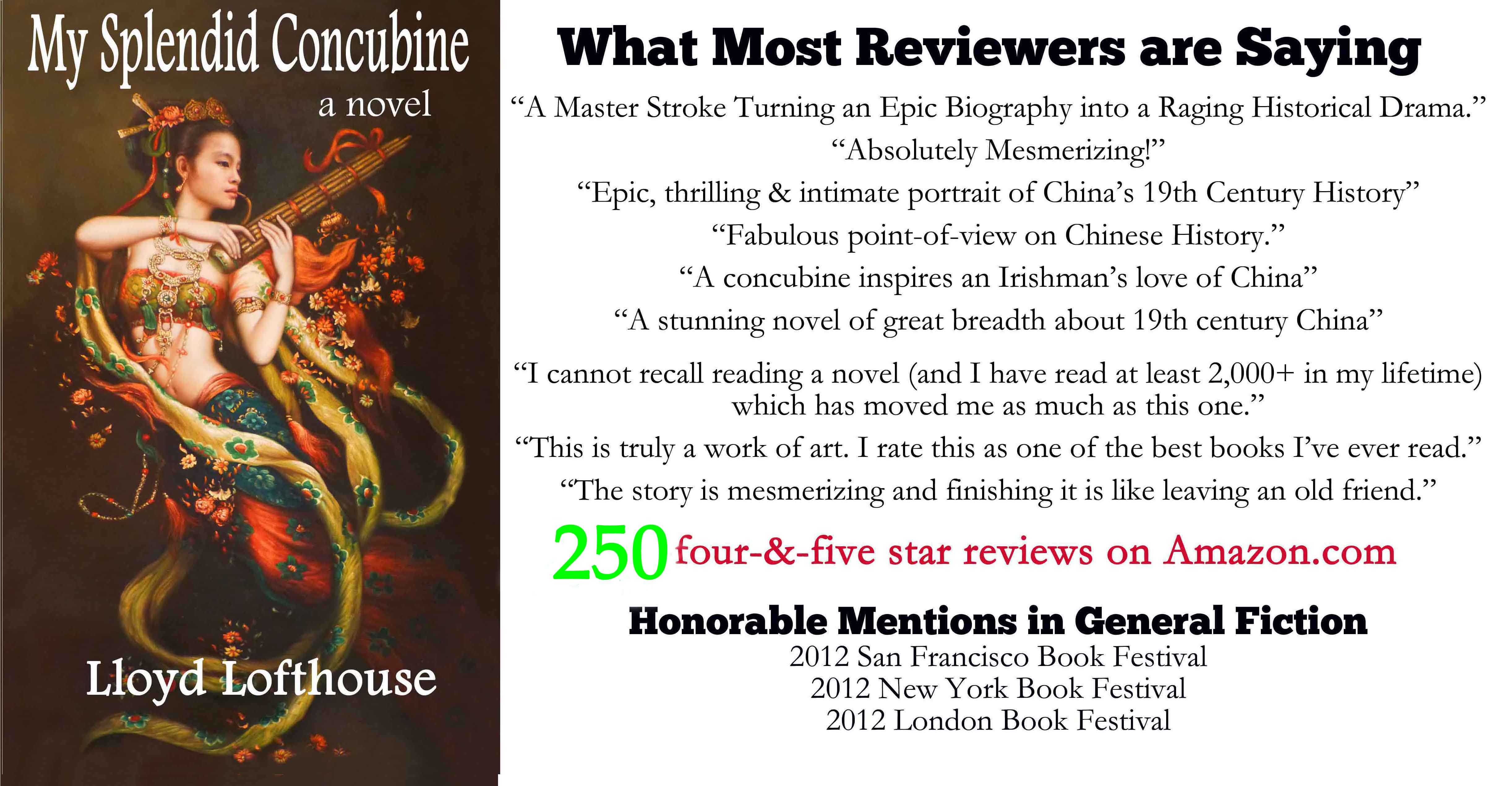
Lloyd Lofthouse is the award-winning author of My Splendid Concubine, Crazy is Normal, Running with the Enemy, and The Redemption of Don Juan Casanova.
Where to Buy

Subscribe to my newsletter to hear about new releases and get a free copy of my award-winning, historical fiction short story “A Night at the Well of Purity”.

About iLook China


What if China and America Stopped Trading

July 25, 2018

After establishing relations with the United States and imposing the One-Child Policy, China, in 1986, opened the country to foreign investments and encouraged the development of a market economy and private sector.

China also started the long process to join the World Trade Organization (WTO). It took China another 15 years of diplomatic struggle to became a full member of the WTO. To join, China had to significantly change its economy. These changes were difficult steps for China and conflicted with its prior economic strategy. Acceptance into the WTO meant China had to engage in global competition according to rules that it did not make

The BBC reported, “China’s formal membership comes exactly one month after the 142 members of the World Trade Organisation (WTO) ratified its application at the world trade talks in Doha in the Gulf state of Qatar, and the Chinese government formally approved the deal.”

What happened to China after joining the WTO?

WTO.org said, “in 2001, China’s trade in goods was valued at $0.51 trillion, ranking 6th in the world, but by 2014, it reached $4.3 trillion, growing over 8 times.”

By 2016, China was exporting $2.27 trillion in goods and importing $1.23 trillion,” and OEC report said.

China’s top five export destinations were the United States at $436 billion (19% of the total), $250-billion (11%) to Hong Kong, $148 billion (6.6%) to Japan, $99 billion (4.4%) to Germany, and $87.2 (3.8%) billion to South Korea.  If we subtract the United States, China exported $1.834 Trillion worth of goods to the rest of the world.

China also buys products from the United States and other countries. It’s top four import countries were the United States at $122 billion (9.9%) in goods, $121-billion (9.8%) from South Korea, $120 billion (9.8%) from Japan, and $83.7 billion (6.8%) from Germany.

If we subtract what China buys from the United States, China imports good worth $1.08 Trillion from the rest of the word, and did you notice that China has a trade deficit with some countries?  If we focus on just South Korea, China bought more goods than it sold by $33.8 billion.

What goods does China want from other countries? China’s highest value imported goods are electronic circuits and micro-assemblies, crude oil, iron, cars, mobile phones, and then soya beans.

In 2017, China exported $2.2 trillion of its production. The EU exported $1.9 trillion that year.

There is also a common misconception that the United States doesn’t make anything anymore, and it doesn’t help that Donald Trump, a malignant narcissist, and serial liar, reinforced that thinking during the presidential debates in 2016.

What do the facts say?

The Balance reports, “2017, total U.S. trade with foreign countries was $5.2 trillion. That was $2.3 trillion in exports and $2.9 trillion in imports of both goods and services.” China exported $2.2 trillion to the world that year, less than the United States exported from its manufacturing sector.

How many jobs in the U.S. does that $2.3 trillion in exports support and how many jobs are at risk in the United States due to Mr. Trump’s trade war?

CNN Money says, “analysts say that tens of thousands of American workers are likely to lose their jobs—and upwards of two million jobs are at risk—more or less as a direct consequence of the Trump administration’s trade policies, and the retaliatory tariffs that follow.”

Lloyd Lofthouse is the award-winning author of My Splendid Concubine, Crazy is Normal, Running with the Enemy, and The Redemption of Don Juan Casanova.

Where to Buy

Subscribe to my newsletter to hear about new releases and get a free copy of my award-winning, historical fiction short story “A Night at the Well of Purity”.

About iLook China


China’s Changing Misunderstood One-Child Policy

July 24, 2018

The BBC reported, The first day of 2016 was the end of China’s controversial (and often misunderstood), 40-year-old one-child policy. Although families will still require government-issued birth permits, or face the sanction of a forced abortion, couples in China can now request to have two children.

In 1979, the same year that China established diplomatic relations with the United States, China’s government imposed a one-child policy in an effort to curb population growth.

Why did China do that?

ONE, China has the largest population in the world, a population that has doubled since 1976 and is currently at 1.4 billion people and growing.

TWO, China has 119 million hectares of arable land compared to 156.4 million in India and 152.2 million in the United States. This helps explain why China was once known as the land of famines because China could not grow enough food to feed all of its people even when the population was 150 million in 1650.

For a comparison, even with all that crop land in India, 37.4 million hectares more than China, India Food Banking says, “Three thousand children in India die every day (EVERY DAY) from poor diet related illness.”

It’s obvious that China did not want that for their children or adults. Why allow children to be born so they can live in poverty and starve to death?

THREE, people cause pollution. The more people a developed country has, the more pollution they produce.

What happens when China becomes as developed as the United States? The answer: In 2015 the United States produced 4997.5 million metric tons of carbon dioxide emissions from fuel combustion. China produced 9040.74, but that country has 4.4 times the people. If the U.S. had that many people, America would be producing 19,990 million metric tons of carbon emissions.

In addition, there were and still are exceptions to China’s One-Child Policy. For instance, the one-child policy does not apply to the hundred million people in China that belong to one of the fifty-six recognized minorities or many of the Han Chinese living in rural China.

Since minorities in China are a small segment of the population, China’s government practices flexibility with the minority birth rate in order to keep minorities an important part of China’s culture.

A few examples: Tibetans may not have the freedom to live a feudal, nomadic, illiterate lifestyle of servitude that came with an average 35-year lifespan they once had under the Dalai Lama, but Tibetans may have as many children as they want.

This applies to all of China’s recognized minorities.

We often hear of the Uighur Muslims since this minority has an Islamic separatist movement in the northwest near Afghanistan where the US is still fighting a war against a similar insurgency, but the Uighurs are a minority in China, so the one-child policy also does not apply to them, and they are not the only Muslims.

The Hui are unique among the fifty-six officially recognized minorities of China in that Islam is their only unifying identity. They do not have a unique language as the other minorities do and often intermarry with Han Chinese.

In fact, many live outside the Hui autonomous region. Since the Hui are considered a minority, the one-child policy also does not apply to them.

The Chinese government said if it weren’t for the one-child policy, there would be about four-hundred million more mouths to feed and provide shelter for.

Lloyd Lofthouse is the award-winning author of My Splendid Concubine, Crazy is Normal, Running with the Enemy, and The Redemption of Don Juan Casanova.

Where to Buy

Subscribe to my newsletter to hear about new releases and get a free copy of my award-winning, historical fiction short story “A Night at the Well of Purity”.

About iLook China


Deng Xiaoping’s first Steps to Open China to the World

July 18, 2018

It’s time to leave Mao behind as part of China’s history. His era ended with his death and the arrest of the “Gang of Four”, including Mao’s widow, Jiang Qing. The “Gang of Four” was convicted of crimes against the state and Jiang said in court, “I was Chairman’s Mao’s dog. What he said to bite, I bit.”

Jiang was Mao’s third wife, and she was convicted in 1981 of “counter-revolutionary crimes” and imprisoned. In 1983, her death sentence was commuted to life imprisonment. On June 5, 1991, she hung herself while still in prison. She was seventy-seven.

In 1977, Deng Xiaoping emerged as the dominant figure among pragmatists in the leadership. Under him, China launched far-reaching economic reforms.

One of the most famous maxims of Deng, dating back to the years before the Cultural Revolution, states that “It doesn’t matter whether a cat is black or white, as long as it catches mice.” That quote caused trouble between Mao and Deng because it meant Deng did not worry about whether a person was a revolutionary or not, as long as he or she was efficient and capable of doing their job under the socialist economy.

Once you understand that quote, you will understand China’s amazing economic reforms in the decades since Mao’s death and why one of Deng’s first steps in 1979 was to establish diplomatic relations with the United States.

Deng Xiaoping paid an official goodwill visit from January 20 to February 4, 1979, to the United States at the invitation of President Carter. This was the first visit by a Chinese leader to the United States after the founding of the People’s Republic of China.

During his visit, Deng exchanged views with President Carter on the international situation.

About Taiwan, Deng said that China was willing to solve the Taiwan question in a peaceful way. The Joint Press Communiqué issued by both sides said that both sides are of the view that differences in social systems of the two countries should not impede the enhancement of mutual friendly relations and mutual cooperation.

During the visit, China and the United States signed an agreement on cooperation in science and technology and a cultural agreement. They also signed agreements on cooperation in education, commerce, and space, and on the mutual establishment of consular relations and the opening of Consulates-General in each other’s country.

Lloyd Lofthouse is the award-winning author of My Splendid Concubine, Crazy is Normal, Running with the Enemy, and The Redemption of Don Juan Casanova.

Where to Buy

Subscribe to my newsletter to hear about new releases and get a free copy of my award-winning, historical fiction short story “A Night at the Well of Purity”.

About iLook China


Climate Change and Development in Tibet Creates Lifestyle Challenges

July 17, 2018

In 1949, 99 percent of Tibetans were mostly illiterate serfs. Serfs have always been treated as an inferior element in society. As serfs, most Tibetans depended entirely upon the few landowners for survival. In this system of serfdom, peasants could be traded, punished without due process of law, and made to pay tribute to the lord with labor. When China occupied Tibet, all those serfs were freed just like they were throughout China.

Tibet is part of China. Rural Life in China reported, “A typical family of seven described by Business Week in 2000 lived in a four-room house, used 0.64 of an acre for growing rice, used 0.59 an acre for growing other crops and owned four pigs, one horse, and 20 ducks. Their expenditures were $546: $217 for food, $96 for transportation, $72 for fertilizer and pesticides, $48 for medicine, medical services, $36 for local taxes; $7 for road building and improvement; $4 for power station maintenance; $6 for education and culture and $60 for cloth and clothes.”

Did you notice there was no mention of rent or a mortgage payment? My mortgage payment in the United States is almost 38 percent of my income and a friend and his family of three pay more in rent for less space in the same area. But in urban China,, renting or owning a home is not free. Tibet is mostly a rural area of China.

“Since 2006, the Tibetan government has mandated that Tibetan farmers, herders, and nomads use government subsidies to build new homes closer to roads. New concrete homes with traditional Tibetan decorations dot the stark brown countryside. But the base government subsidy for building the new homes is usually $1,500 per household, far short of the total needed. Families have generally had to take out multiple times that amount in interest-free three-year loans from state banks as well as private loans from relatives or friends.” [Source: Edward Wong, New York Times, July 24, 2010]”

Even the lives of Tibetan Nomads that makeup about a quarter of the population is changing. “Tibetan nomads have a lot in common with Mongolian nomads. Tibetan nomad culture is quickly disappearing as more Tibetans each year are being relocated off of the grasslands.”  But that might have more to do with climate change.

Nature.com reports, “A comprehensive environmental assessment of the Plateau of Tibet has found that the region is getting hotter, wetter and more polluted, threatening its fragile ecosystems and those who rely on them.

The plateau and its surrounding mountains cover 5 million square kilometers and hold the largest stock of ice outside the Arctic and Antarctic; the region is thus often referred to as the Third Pole. And like the actual poles, it is increasingly feeling the effects of climate change, but rapid development is putting it doubly at risk and is also changing lifestyle choices.

Lloyd Lofthouse is the award-winning author of My Splendid Concubine, Crazy is Normal, Running with the Enemy, and The Redemption of Don Juan Casanova.

Where to Buy

Subscribe to my newsletter to hear about new releases and get a free copy of my award-winning, historical fiction short story “A Night at the Well of Purity”.

About iLook China