In the PBS documentary of foreign entrepreneurs in China we discover (when the US financial crises hit the world causing more than $64US trillion in global loses while those who caused the crises walked away with fortunes) China experienced a slowdown in economic growth in 2008.
One foreign entrepreneur, Ed Hung, talks of the clothing store he co-founded, NLGX Design, which opened in Beijing in 2008. He said rent was still increasing.
Ed Hung was born and raised in San Francisco. His business partner, Michel Sutyadi, was born and raised in Germany. They met in Beijing while studying Mandarin in 2005.
Ed Hung says modern Beijing is becoming a consumer culture.
Then Doug Ma, a co-founder of Go Tour-ING, talks of how the global financial crisis (which was started in America) has affected business.
In the spring of 2008, Dough Ma left his job at an investment bank to travel. He wrote a post for Jet Set Zero in July 2009, and said, “It has been quite a challenge starting up Tour-ING (looks like this business didn’t survive). For one thing, it has been a tough year for the tourism industry. Less people are traveling due to the global economy and the outbreak of swine flu has hindered a lot of travel plans.”
Brian Sloan, CEO of Robotic Blow Job (want to be shocked and/ or LOL, click on the link), says the toys he manufactures and sells seem more popular in hard economic times since people spend less money going out and stay home more so they need a method of self-entertainment.
Then in August 2014, The Diplomat.com said, “China has long been preparing the ground for entrepreneurial revolution. … Starting in the 1980s, the Chinese government actively encouraged entrepreneurship across the country, by introducing the first patent law, allowing state-owned enterprises (SOEs) to go bankrupt, and creating a more investor-friendly environment for private entrepreneurs.”
And in May 2014, TechNode.com offered The Top 3 Tips For Foreign Entrepreneurs Starting Up in China:
Lloyd Lofthouse is the award-winning author of My Splendid Concubine [3rd edition]. When you love a Chinese woman, you marry her family and culture too. This is the lusty love story Sir Robert Hart did not want the world to discover.
Subscribe to “iLook China”!
Sign up for an E-mail Subscription at the top of this page, or click on the “Following” tab in the WordPress toolbar at the top of the screen.
“Young and Restless in China” was filmed over a period of four years starting in 2004 for the Public Broadcasting Service (PBS).
Paris Franz, a student, blogger and writer with a passion for history, art and travel, wrote a post about “Young and Restless in China” for Suite 101.com.
This two-part segment is about foreign entrepreneurs in China. I plan to also feature other segments of this PBS Frontline documentary because it demonstrates how much China is changing. The more I learn, the more it appears that there is more freedom in China than most people outside China are aware of.
Franz wrote, “The film highlights what is unique about China at the beginning of the twenty-first century.
“The entrepreneurs – starting up tailoring, hotel and internet café businesses – are full of optimism, supremely confident that their hard work is going to make them rich. As one of them says, China today is “the land of opportunity.”
Part One starts with “there is this misconception of China that it is not modern, that it is still changing, but if you come and see with your own eyes you will discover that (urban) China (where about 600 million people live) is as modern as any city in the world.
One entrepreneur says, if you visit Beijing and see the architecture, you will see that it is leaps and bounds ahead of the US.
Another entrepreneur says, China is a melting pot for all types of entrepreneurs in Beijing … For young entrepreneur it is cheap to start something new in China compared to the US.
In fact, as the economic tide turns against the west, younger, foreign talents are taking their entrepreneurial ambitions to China because the market is right for starting a business.
One American entrepreneur says he graduated from law school at Penn State in 2005. He then talks about how he arrived in China to create, manufacture and sell his own brand of sex toys and fetish clothing.
Lloyd Lofthouse is the award-winning author of My Splendid Concubine [3rd edition]. When you love a Chinese woman, you marry her family and culture too. This is the lusty love story Sir Robert Hart did not want the world to discover.
Subscribe to “iLook China”!
Sign up for an E-mail Subscription at the top of this page, or click on the “Following” tab in the WordPress toolbar at the top of the screen.
Last year, a friend from China who works in China’s investment banking industry in Shanghai came for a visit. She earned her MBA in the UK, and speaks fluent English. While in California, she decided to see how efficient America’s Amazon.com was compared to China’s Alibaba, and when it took more than a week for the average order to arrive from Amazon, she declared Alibaba the winner, because when she ordered a product in Shanghai through Alibaba in the morning, it was delivered to her front door that same afternoon and without the use of drones.
The rest of this post is mostly about Zhongguancun, China’s Silicon Valley, which is located in Beijing’s Haidian District and was first developed in the late 1990s.
Recently I have read several times on Blogs and in Op-Ed pieces in the Western media that China doesn’t have a chance to match California’s Silicon Valley, because China lacks freedom.
This is simplistic and flawed thinking.
The Chinese have every economic freedom that many Americans have and the few that they don’t have are not economic in nature—for instance, freedom of religion and limited political expression. It isn’t as if these few limits to freedom are a secret since they are part of China’s Constitution, which is taught in the public schools. In China, the people are free to follow five officially sanctioned religions: Catholicism, Christianity, Buddhism, Taoism and Islam. In comparison the U.S. has about 313 religions and denominations to choose from.
Other than that, since money and freedom are linked, the growing Chinese middle class has as much freedom to live the same consumer lifestyle as many Americans do, but in the United States poverty is on the rise and with poverty comes less freedom unless you include hunger and being homeless as an example of freedom.
For instance, in 1985, the poverty rate in the U.S was 14% (33.3 million of 237.9 million people), and today (2015) Stanford.edu reports that the mean poverty rate in the U.S. is 15.13% (48.5 million of 321 million people). How does that compare to China? In 1985, the poverty headcount rate in China was 30.7% (317 million of 1 billion people). Today, the CIA reports it’s 6.1% (about 79.3 million of 1.3 billion people).
In addition, if democracy is so precious, why do so many Americans not vote? A 2010 survey by the California Voter Foundation found that 51 percent of nonvoters (in the U.S.) grew up in families that did not often discuss political issues and candidates. Does that mean in the U.S., we are also free to give our freedom away?
Where is the evidence that total freedom of religion and/or political expression is necessary for entrepreneurial innovation? Good luck, because you won’t find that evidence, but in the next few paragraphs you will find evidence that shows that total freedom of religious choice and political expression are not necessary to prosper and innovate.
“Shenzhen has never hidden its ambition to be China’s answer to Silicon Valley. Last year (2014), the city saw more than 64 billion yuan (HK$80.46 billion) invested in research and development, accounting for 4 per cent of GDP, only matched by South Korea and Israel.” – South China Morning Post
This 2008 video takes us to a lab in Tsinghua University in Beijing where students are discussing solar technology.
Ye Yuming, an award-winning student at Tsinghua University said, “China lags behind other countries in the solar power industry. The solar PV will help us improve and break the monopoly held by foreign businesses. The solar PV has great market potential, especially in China. The market size is huge.”
What Ye Yuming said in 2008 was true, but two years later, China became the world’s largest solar power manufacturer.
Bloomberg Business reports, “Along with the new companies, China is also experiencing a surge in technological innovation. The country had more than 660,000 effective invention patents last year, up 12 percent from a year earlier …”
And The Wall Street Journal says, “Increasingly, China’s own technology companies are challenging market leaders and setting trends in telecommunications, mobile devices and online services.”
In conclusion, British scientist, historian and sinologist Joseph Needham proved with his Science and Civilisation in China Series that China led the world in technological innovations for about 1,500 years until the 16th century. Then the West led the world in innovation. Is that about to change again?
______________________________
Lloyd Lofthouse is the award-winning author of My Splendid Concubine [3rd edition]. When you love a Chinese woman, you marry her family and culture too. This is the lusty love story Sir Robert Hart did not want the world to discover.
Subscribe to “iLook China”!
Sign up for an E-mail Subscription at the top of this page, or click on the “Following” tab in the WordPress toolbar at the top of the screen.
In 1965, China’s Mao Zedong launched a cultural war against the excesses of capitalism, and this was led by the people, the workers and their children, and the capitalists in China and anyone who was accused of supporting the lifestyle of the rich and famous was targeted leading to millions of suicides.
For the last few decades, millions of people in the United States have been victims of its own cultural war, but this one is the reverse of the one that was led by Mao in China. America’s cultural war is being led by a handful of billionaire oligarchs who are transforming American into a money making paradise for those who have the most wealth and power.
This morning I read a piece in the Huffington Post that reported Kansas welfare recipients will be unable to get more than $25 per day in benefits under a new law sent this week to Republican Gov. Sam Brownback’s desk by the state legislature. To make life worse for people who live in poverty, the state also issues that welfare in the form of a government-issued debit card and required that they take the money out of debit machines that charge 85 cents for each withdrawal after the first one in a month—a windfall for banks and whoever owns those ATM machines but less money to buy food. The number of Kansans receiving benefits has also declined from 38,000 in 2011 to 15,000 last year, state data show.
It is no secret that Republicans (GOP) have waged war on people who live in poverty for decades—and recently GOP representatives have blamed poverty on the poor. Many in the GOP hate Social Security, Medicare, Obamacare, unemployment insurance, food stamps, abortion, marijuana, women, and even sexual orientation.
In addition, the GOP and the Democrats also have no problem handing out money to private sector corporations. For instance, the U.S. auto industry, banks, and Wall Street firms. In fact, there are elements in both parties who are handing our children to corporate Charters supported by hedge fund billionaires, the Walton family and the Bill and Melinda Gates foundation so those few individuals grow wealthier off taxes that were originally intended to support the transparent, nonprofit, democratic public schools.
How much does the state and federal government give away to corporations? The answer is more than the country spends on food stamps for people living in poverty, who are far from being lazy, because Recent studies show that 49% of all food stamp participants are children (age 18 or younger), and about 50% of the adults have jobs that pay mostly poverty wages, and, in 2013, for instance, the average SNAP client received a monthly benefit of $133.07, and the average household received $274.98 monthly—compare that number with the money corporations are getting from their state and federal welfare programs.
The New York Times spent 10 months investigating business incentives awarded by hundreds of cities, counties and states. Since there is no nationwide accounting of these incentives, The Times put together a database and found that local governments give up $80.4 billion in incentives given away each year compared to about $75 billion in food stamps to people who live in poverty, so they have enough money to eat and not starve.
Don’t forget, when the GOP blames the poor for their poverty and cuts food stamps to families, as Arkansas is doing, the GOP is waging a war against almost 20 million children living in poverty who can’t work to feed themselves.
However, according to The Times, the number of corporate welfare programs is 1,874. Have you heard Republicans or Democrats call for cuts to corporate welfare?
You might want to click on this link from the New York Times that leads to an interactive map and discover how much corporations are earning off federal and state welfare programs that tax payers are financing.
The New York Times identified 48 companies that have received more than $100 million in state grants since 2007. Some 5,000 other companies have received more than $1 million in recent years.
In fact, Politifact.com reports that it’s mostly true that 9 of the 10 poorest states are ruled by the GOP. PolitiFact.com also reports that it is mostly true that 97 of the country’s 100 poorest counties are in GOP ruled states.
The Washington Post reports, “Republican states have pursued economic and fiscal strategies built around lower taxes, deeper spending cuts and less regulation. They have declined to set up state health-insurance exchanges to implement President Obama’s Affordable Care Act. They have clashed with labor unions. On social issues, they have moved to restrict abortion rights or to enact voter-identification laws, in the name of ballot integrity, that critics say hamper access to voting for the poor and minorities.”
The cultural revolution in China that took place between 1965–1976, and the one being waged in the United States today have one thing in common: the public schools and the teachers who taught in them were attacked in China back then (but not today—after Mao died in 1976, China, under new leadership, started rebuilding its public schools and supporting its teachers) as they are being attacked in the United States today, because a transparent, non-profit, public education system where teachers have the freedom to express without fear what they think about current issues to the children they teach, who then talk to their parents, is a threat to the few who want to control the destructive cultural changes taking place, and it doesn’t matter if the cultural war is being led, for instance, by America’s Bill Gates, the Walton family, the Koch brothers or Mao Zedong in China. To drastically alter a culture, the few in power who are behind the changes must silence their critics and create an environment of punishment and fear, and this means silencing the teachers.
______________________________
Lloyd Lofthouse is the award-winning author of My Splendid Concubine [3rd edition]. When you love a Chinese woman, you marry her family and culture too. This is the love story Sir Robert Hart did not want the world to discover.
Subscribe to “iLook China”!
Sign up for an E-mail Subscription at the top of this page, or click on the “Following” tab in the WordPress toolbar at the top of the screen.
In China The Black Box, Barry Ritholtz demonstrates a better understanding of China than most U.S. talking heads I’ve read—at least in this piece. If you are willing to sit for a long read, I suggest clicking on the link. He does a good job explaining how China’s economy works and why it might survive for some time without an economic collapse like we saw during the 2007-08 global financial meltdown that started in the United States.
In summary, Ritholtz mentions how several prominent hedge fund managers in the United States have said China is making mistakes economically. Ritholtz says there is no way these hedge fund managers know what’s going on in the Middle Kingdom since China is half capitalist and half socialist and doesn’t fit any Western economic norms.
In addition to what Ritholtz says, I don’t know why anyone who is sane and intelligent would listen to the opinions of hedge fund managers about China. For instance, investopedia.com reports that “Hedge funds have always had a significant failure rate.”
Ritholtz continues: China is a unique civilization state, which gives it a tremendous advantage at this stage of its economic development, because China’s citizens have a singular desire to work hard and improve their material lot. It helps that the Chinese prefer to pay cash for things instead of using credit cards as many do in the United States.
Chinese civilization has periods of order followed by periods of disorder and since China recently emerged from two centuries of disorder, China’s Communist Party has a long way to go before it is their turn to leave the leadership stage.
______________________________
Lloyd Lofthouse is the award-winning author of My Splendid Concubine [3rd edition]. When you love a Chinese woman, you marry her family and culture too. This is the lusty love story Sir Robert Hart did not want the world to discover.
Finalist in Fiction & Literature – Historical Fiction
The National “Best Books 2010” Awards
Honorable Mentions in General Fiction
2012 San Francisco Book Festival
2012 New York Book Festival
2012 London Book Festival
2009 Los Angeles Book Festival
2009 Hollywood Book Festival
Subscribe to “iLook China”!
Sign up for an E-mail Subscription at the top of this page, or click on the “Following” tab in the WordPress toolbar at the top of the screen.


 Posted by Lloyd Lofthouse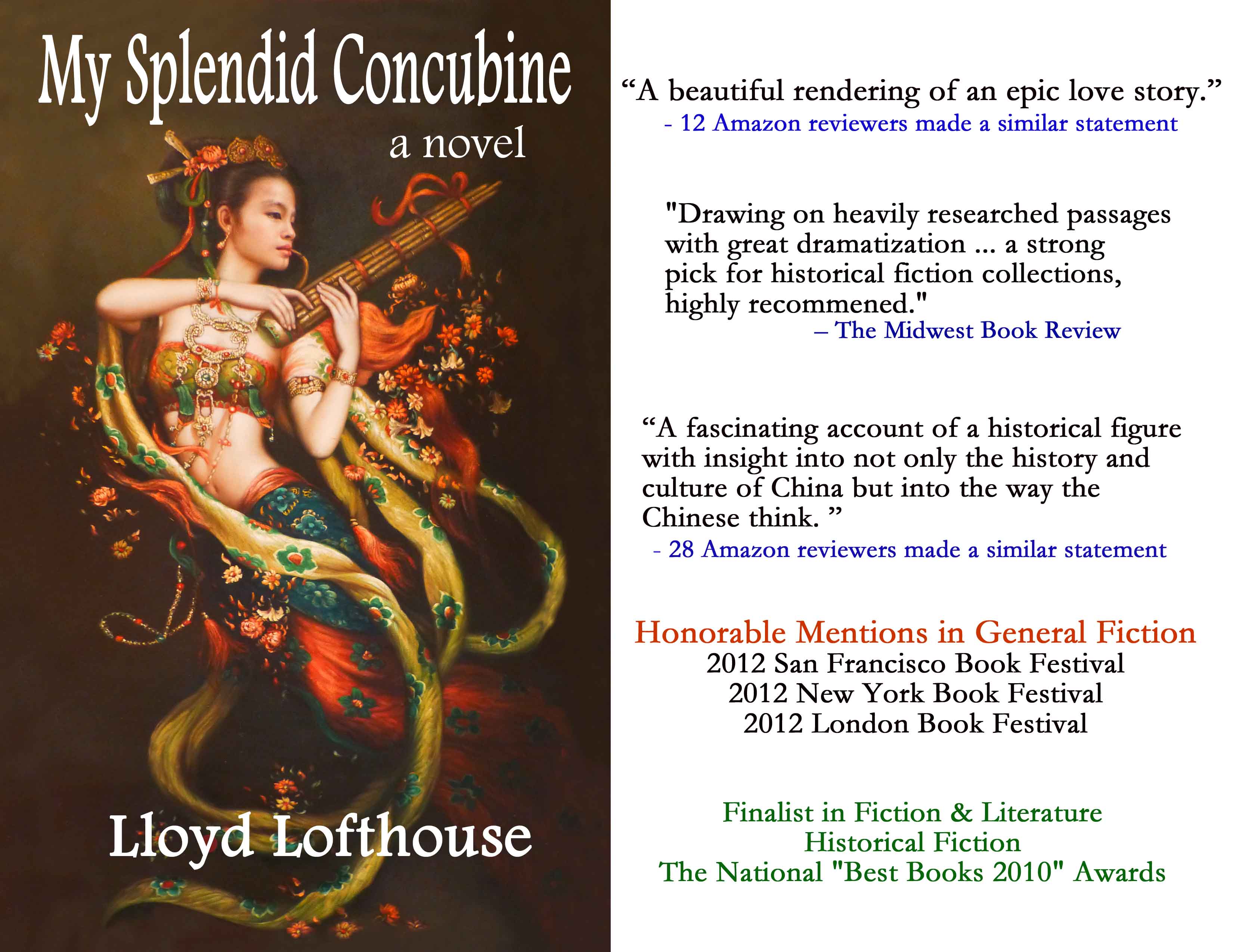

 iLook China