Vietnam versus China – 207 BC to Today

June 21, 2016

Compared to China, the few years the U.S. fought in Vietnam is insignificant, and based on history, the United States learned its lesson to get out in a much shorter time span than it took China. And the French learned this lesson in a much shorter time span between 1946 and 1954.

China’s most recent conflict with Vietnam started on February 15, 1979, when China invaded Vietnam to teach it a lesson.

Why did China do this? Well, after the death of Stalin, relations between the Soviet Union and China turned sour while the Russians and the Vietnamese developed a closer relationship.

To counter this perceived threat, China encouraged Cambodia to take aggressive action against Vietnam. Near the end of 1978, the Cambodians under the leadership of Pol Pot launched a series of attacks along the Vietnam border.

The Vietnamese retaliated with armored units and captured the capital of Cambodia on January 7, 1979.

Since ten-thousand Chinese military advisers in Cambodia became prisoners, China lost face, and invaded Vietnam to “teach it a lesson”.

The Vietnamese decided to hold back their regular army and defend the border with militia units using guerilla tactics in the hills and rainforest similar to how they fought America, the French and China in the past.

China took heavy casualties after attacking and soon pulled its troops out 3 weeks and 6 days after crossing the border.  Both sides declared victory. Border clashes between Vietnam and China would continue until 1990.

One would think that China would have learned its lesson long ago, because China has a long and bloody history with Vietnam. The first Chinese invasion and occupation of Vietnam took place in 207 BC to 39 AD. The second occupation was from 43 to 544 AD.  The third was from 602 to 905 AD.  The fourth event was between 1407 to 1427 AD. During this long history of invasions and occupations by China, the Vietnamese rebelled repeatedly to drive the Chinese out and regain their independence as a country.

France ruled over Vietnam from 1862 until the Japanese invaded during World War II. The French would return in 1946 and fight the Vietnamese until 1954.

The US and Vietnam, once enemies during the American-Vietnam War (1961 – 1975), are now allied to block China’s territorial claims in the South China Sea.  – Goldsea Asian American News

I seriously think many leaders do not study history to avoid repeating the same mistakes made by others before them.

Lloyd Lofthouse is the award-winning author of My Splendid Concubine [3rd edition]. When you love a Chinese woman, you marry her family and culture too. This is the unique love story Sir Robert Hart did not want the world to discover.
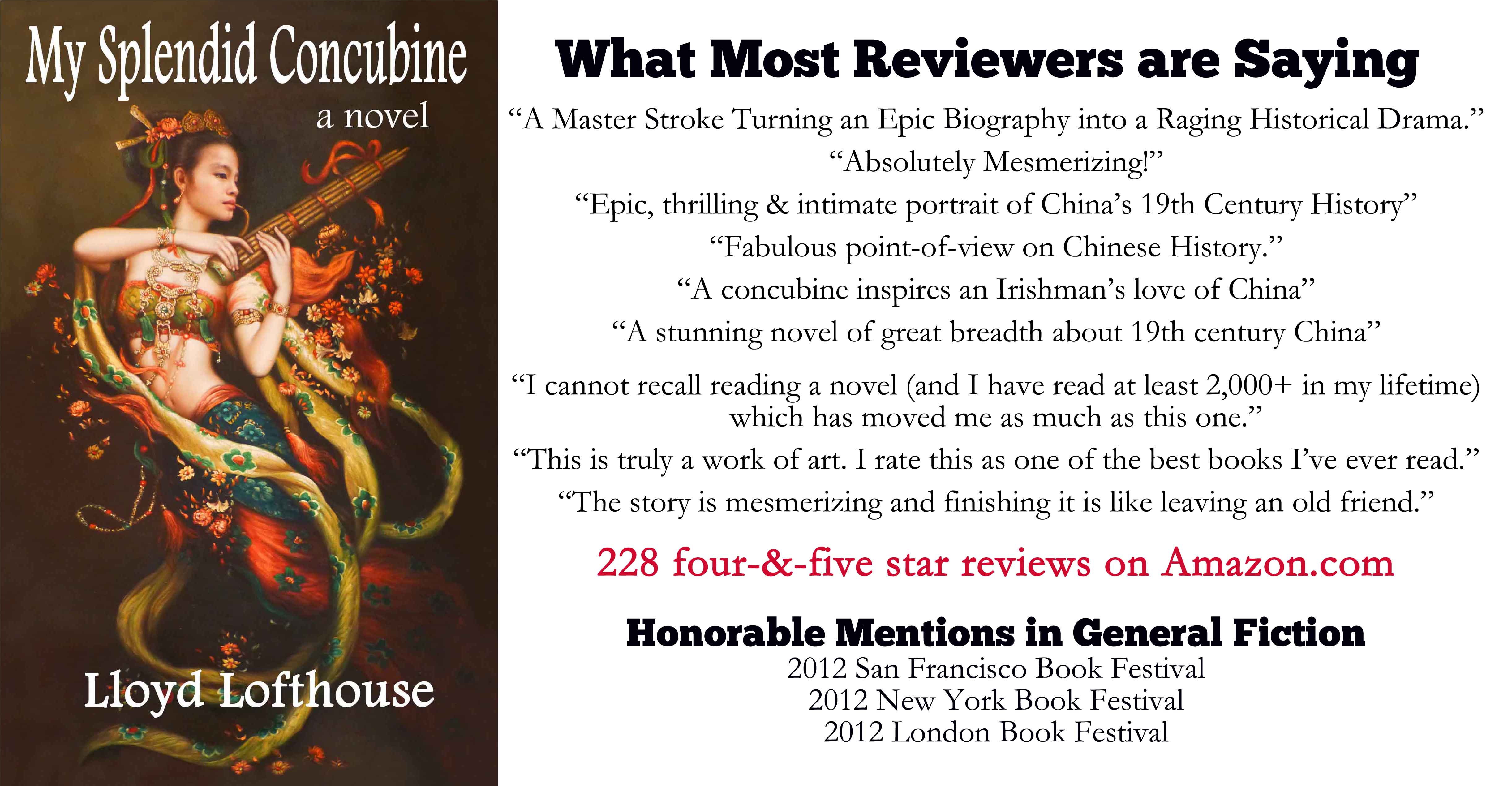
A1 on March 13 - 2016 Cover Image with BLurbs to promote novel

Where to Buy

Subscribe to “iLook China”!
Sign up for an E-mail Subscription at the top of this page, or click on the “Following” tab in the WordPress toolbar at the top of the screen.

About iLook China

China’s Holistic Historical Timeline


Shanghai Love – a book review

June 15, 2016

From the title, Shanghai Love, we already know that Layne Wong’s story is about love in Shanghai, and it doesn’t take long to discover who the two main characters are.

It is 1938, and in chapter one in China we are introduced to Peilin. In chapter two we meet Henri in Nazi Germany.

The love story isn’t what made this novel worth reading. It was the journey the two characters take to find each other. They are both doctors. Henri is Jewish and trained in western medicine. He has to leave his family behind in Germany and flee to China to avoid Hitler’s Nazis who are hunting for him because he dared to love a woman who was not Jewish.

Peilin was trained by her grandfather in Chinese herbal medicine, and by the time Henri meets her, she has already been married to a ghost.

As a young girl, a marriage was arranged to a boy almost twice Peilin’s age, but when he was a young man—before the marriage—he was killed in combat fighting the Japanese who invaded China in July of 1937. By the time Pearl Harbor is bombed by the Japanese in December 1941, China has already been fighting Japan for more than four years. To give you an idea of how horrible it was, by the end of World War II, China had lost ten to twenty million people (troops and civilians) to the war compared to 418,500 for the United States.

One would think with her fiancé dead, Peilin would be free to move on with her life, but no—because in China at the time it was expected that Peilin must still marry the man’s ghost, stay a virgin for life and live with her in-laws who bought a baby for her to raise as if she was its biological mother and the dead man its father.

In addition, the story is set in an era when both the Chinese and Europeans disapproved of interracial relationships. In Germany, there was racism against the Jews. But in China, there is prejudice from some Chinese because Henri is white. In addition, many of the Jewish refugees look down on the Chinese culture and disapprove of Henri spending time with Peilin. It seems that these two can’t win and are fated to be star-crossed lovers.

I recommend reading this story because it offers a reminder of the horrors of war and racism. During World War II, more than 20,000 European Jews fled to Shanghai, one of the few places in the world that put no limits on the number of Jews it accepted.

Another plot thread that runs through the novel is the focus on Chinese herbal medicine and how different it is from the western concept of medical care. The Chinese were studying advanced medical care long before the West. In fact, Chinese medical tradition is more than 5,000 years old including herbal medicine, acupuncture, massage, exercise and dietary therapy—concepts that the West didn’t pay serious attention to until near the end of the 20th century.

I’m not going to tell you how the love story turns out between Henri and Peilin. You’ll have to buy and read the novel to discover what happens.

Lloyd Lofthouse is the award-winning author of My Splendid Concubine [3rd edition]. When you love a Chinese woman, you marry her family and culture too. This is the unique love story Sir Robert Hart did not want the world to discover.

#1 - Joanna Daneman review posted June 19 2014

Where to Buy

Subscribe to “iLook China”!
Sign up for an E-mail Subscription at the top of this page, or click on the “Following” tab in the WordPress toolbar at the top of the screen.

About iLook China

China’s Holistic Historical Timeline


Was Hsi Wang Mu real?

June 14, 2016

To the Chinese, Hsi Wang Mu is the Queen Mother of the West (Western China), and she is an important figure in Chinese mythology.

It is believed that the myth of China’s Queen Mother goes back almost three thousand years, but the earliest recorded history was found from the Chou Dynasty (1122 – 222 BC) and was written in the second century BC. It appears that she may have been a real queen of a Western Chinese state and stories of her life become legend over the centuries turning into magical myths.

One of the older stories is about Hsi Wang Mu and the celestial archer, where she asks him to build her a palace of jade in the western sky. His reward was a pill made from the peaches of immortality, which ends in tragedy and heartbreak.

It is said that Hsi Wang Mu had nine sons and twenty-four daughters with her mate, Tung Wang Kung.

 Discover China’s First Emperor Qin Shi Huangdi

Lloyd Lofthouse is the award-winning author of My Splendid Concubine [3rd edition]. When you love a Chinese woman, you marry her family and culture too. This is the unique love story Sir Robert Hart did not want the world to discover.

A1 on March 13 - 2016 Cover Image with BLurbs to promote novel

Where to Buy

Subscribe to “iLook China”!
Sign up for an E-mail Subscription at the top of this page, or click on the “Following” tab in the WordPress toolbar at the top of the screen.

About iLook China

China’s Holistic Historical Timeline


A History Lesson from Mao on How to Win the War on Drugs in 24 Hours

June 8, 2016

From The Opium Monopoly by Ellen N. La Motte, we learn how opium addiction became an epidemic in China. Although The Chinese knew about opium for more than a thousand years, it wasn’t until the Portuguese arrived in the 18th century that the Chinese used it as a drug by smoking it. Merchants from Britain, France, Portugal, America and other nations became the drug cartels that plagued China into the 20th century.

In 1729, the emperor issued the first anti-opium edict, but the supply of opium flooding China went from 220 chests in 1729 to 70,000 in 1858.

It is estimated that before 1950, as many as 20 million Chinese were drug addicts. To solve this problem, Mao had the People’s Liberation Army execute the drug dealers and forced millions of addicts into compulsory treatment in a twenty-four hour period. — How Maoist Revolution Wiped Out Drug Addiction in China

Opium growers, who did not want to comply, fled into the Golden Triangle Region of Southeast Asia where many of Chiang Kai-shek’s nationalist troops had gone to escape defeat. Those generals also did business with the CIA, and American soldiers in Vietnam became the new customers. It is estimated that at least 20% of the almost nine million American troops that served in Vietnam became addicted.

China remained free of drugs until Deng Xiaoping declared, “Getting Rich is Glorious” and opened China to world trade. In 2003, it was estimated that China had four million regular drug users—even with China’s strict laws concerning illegal drug use.

And in America, where human rights are king and fear of Communism by Capitalists is supreme, drug users and sellers often end up in prison costing taxpayers an average of $47,000 annually explaining why America has more people serving time in prisons than any other country on the planet; that price tag is more than $90-billion a year. Where are the protests and the accusations? Instead, the U.S. has a presidential candidate, a billionaire called Donald who wants to build the Great Wall of Trump between the United States and Mexico.

Lloyd Lofthouse is the award-winning author of My Splendid Concubine [3rd edition]. When you love a Chinese woman, you marry her family and culture too. This is the unique love story Sir Robert Hart did not want the world to discover.

#1 - Joanna Daneman review posted June 19 2014

Where to Buy

Subscribe to “iLook China”!
Sign up for an E-mail Subscription at the top of this page, or click on the “Following” tab in the WordPress toolbar at the top of the screen.

About iLook China

China’s Holistic Historical Timeline


Predictions about China 50 Years ago that are True Today

June 7, 2016

Pearl S. Buck appeared on the Merv Griffin Show in 1966 and made a few predictions. That’s when Buck said China will be what we make it to be. She meant that the United States will either make China its enemy or its friend. Buck said the Chinese are marvelous friends and frightful enemies. If this is true, why are so many Americans and the US media demonizing China instead of cultivating friendship?

The Chinese have a marvelous sense of humor, Buck said. The Asian people are very human.

Buck said China will moderate and modernize in time. She saw Communism arrive in China in 1921, and said it was an impractical, impossible scheme of life. She was right. China has changed and is now a hybrid, socialist-capitalist country with a market economy and an authoritarian, one-party government, a political party with more than 80-million members compared to 46.6 million registered Democrats and 33.5 million registered Republicans in the United States.

In fact, there isn’t much difference between China and the United States when it comes to politics. “If one studies the Chinese leadership long enough and carefully enough, one will come to recognize that China’s decision-makers are by no means a monolithic group of elites who share the same views, values and visions. But instead, I believe that two factions coexist in the Chinese leadership. Members of these two factions often contrast sharply in terms of their personal backgrounds, professional expertise, and political careers. These two factions compete against each other for power, influence and policy initiatives.” – One Party, Two Factions: Chinese Bipartisanship in the Making

During her career as an author, Buck was awarded the Pulitzer Prize for the novel The Good Earth in 1932 and the Nobel Prize for literature in 1938.

Only seven American authors have been awarded both the Pulitzer and the Nobel: Sinclair Lewis; Eugene O’Neill; Pearl S. Buck; William Faulkner; Ernest Hemingway; John Steinbeck; Saul Bellow, and Toni Morrison—five men and two women.

Pearl S. Buck was born in America (1892 – 1973), and at the age of three months went to China. Except for attending college in the United States 1911 – 1914, she lived in China until she was forty

Meet Pearl S. Buck in the following mini-documentary that runs 2:14 minutes.

“She was a builder of bridges between China and the rest of the world,” says Edgar Walsh of his mother, Pearl S. Buck.

In this mini-documentary, Walsh describes how his mother was “ideally positioned to write about China.” Buck was the daughter of missionaries and spent much of the first half of her life in China, where many of her books are set.

Pearl S. Buck’s page on Amazon

Lloyd Lofthouse is the award-winning author of My Splendid Concubine [3rd edition]. When you love a Chinese woman, you marry her family and culture too. This is the unique love story Sir Robert Hart did not want the world to discover.

A1 on March 13 - 2016 Cover Image with BLurbs to promote novel

Where to Buy

Subscribe to “iLook China”!
Sign up for an E-mail Subscription at the top of this page, or click on the “Following” tab in the WordPress toolbar at the top of the screen.

About iLook China

China’s Holistic Historical Timeline